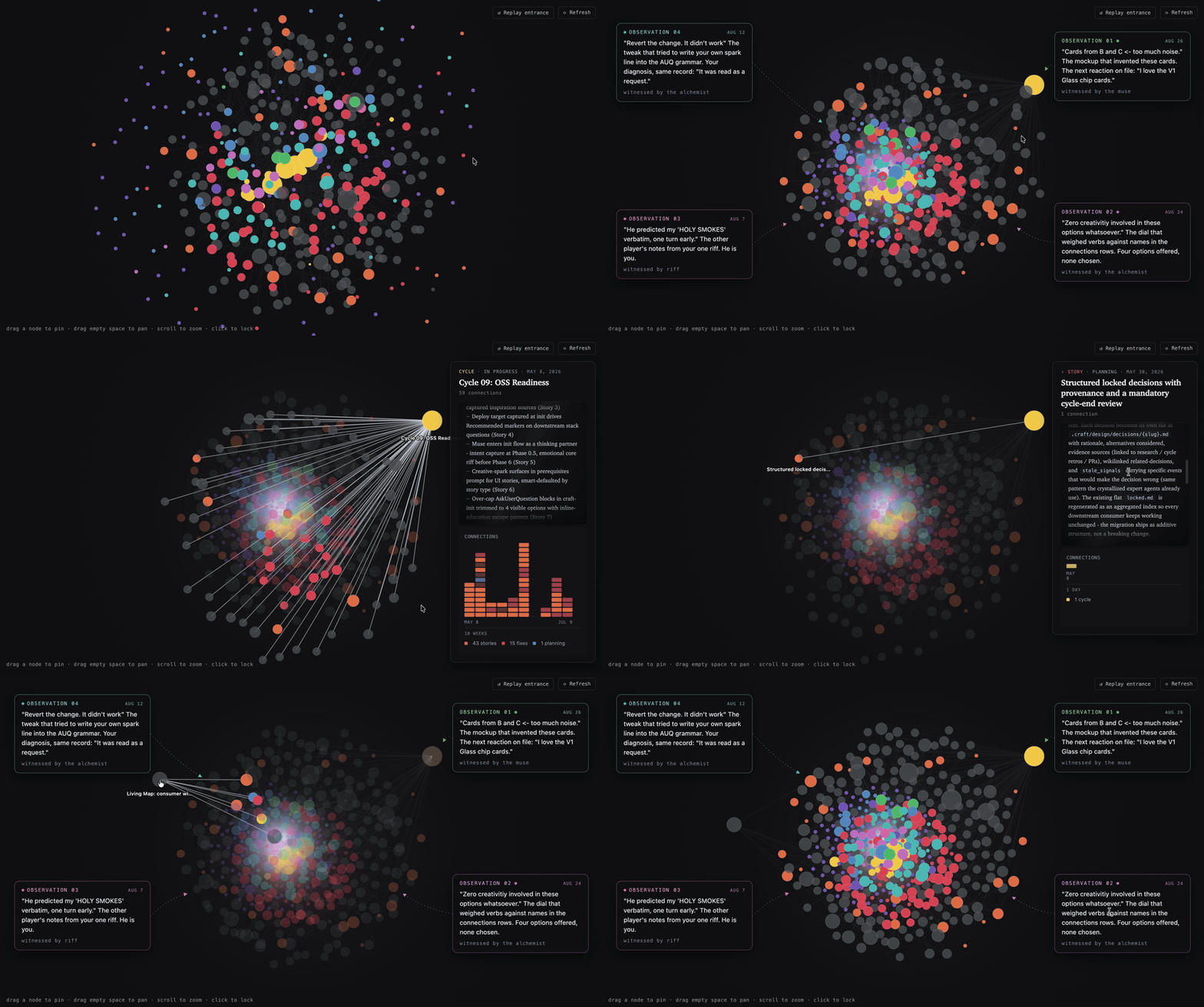
Stop Vibing. Start Crafting. Claude Code plugin: guided + controlled development orchestration harness with built-in workflow + state management, for designing + building durable, production-ready software through the entire product lifecycle - new projects
FAQ
craft is a Claude Code plugin with 11 hand-picked skills for development work, indexed on Flowy. Install it with the command on its page. It includes adhoc, approve, browser. Its skills do not fire on their own yet. Request auto-invocation to have Flowy route them as you prompt. Free and open source.
> /plugin marketplace add drobins25/craft> /plugin install craft@craft
Repo: drobins25/craft
Stop Vibing. Start Crafting.
Claude Code plugin: guided + controlled development orchestration harness with built-in workflow + state management, for designing + building durable, production-ready software through the entire product lifecycle - new projects or existing codebases.
Your codebase is read-only by default. Changes never land as a side effect of asking a question - every write goes through a channel you opened: a planned story, an investigated fix, a live tweak, or an approved one-off.
Install ยท Getting Started ยท Commands ยท How it works ยท What's New
Install in about a minute:
claude plugin marketplace add drobins25/craft
claude plugin install craft@craft
Then start Claude Code and run /craft - full install notes.
It steals your best ideas back. You say "that's it!" after working through a tweak, and craft remembers. It waits, then brings that same taste back on a completely different feature - elevated. Keep going, and you'll catch yourself asking, "how did I do this?"
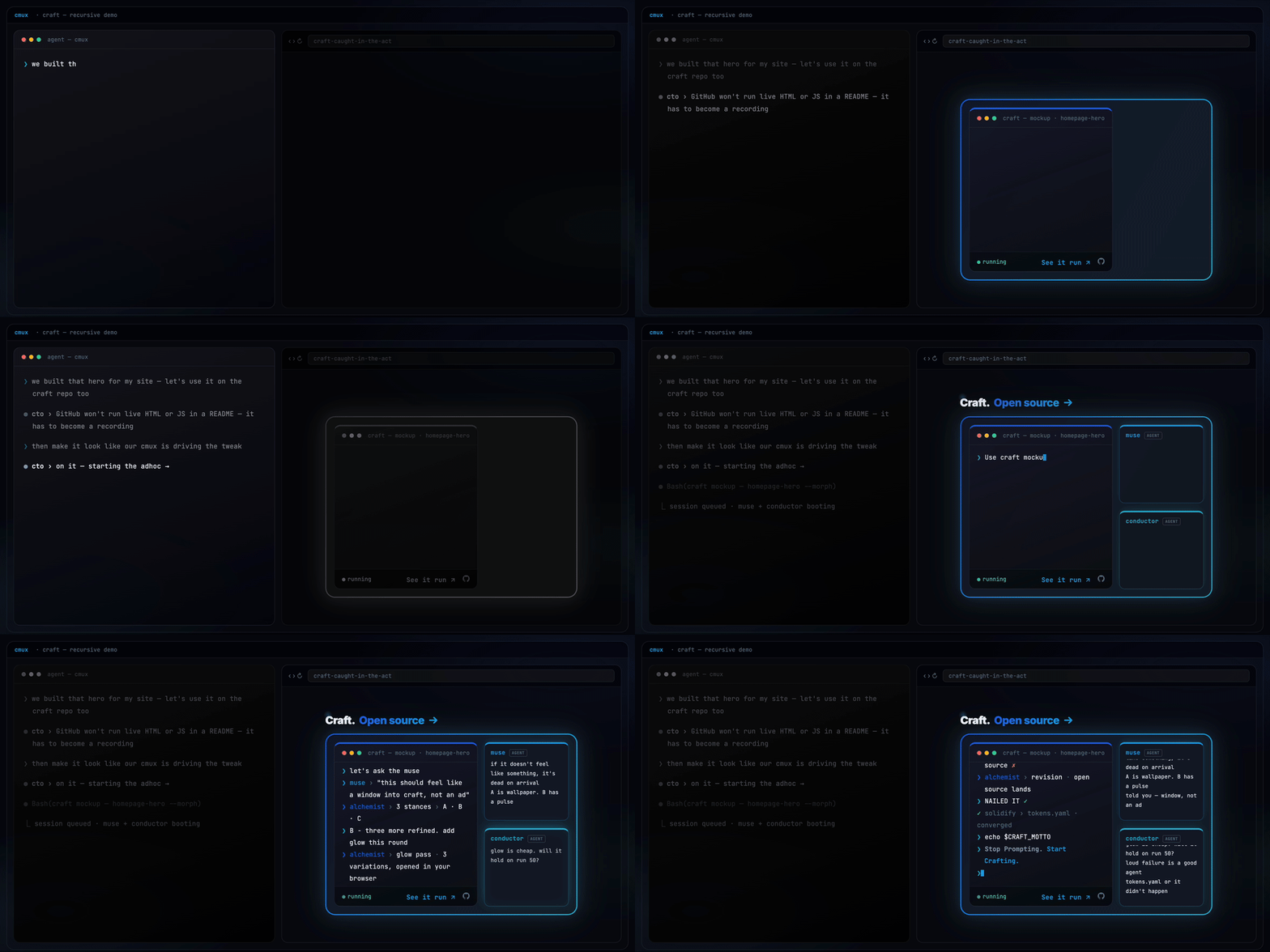
Craft building its own repo page, live.
[!TIP] Don't want to read any of this? You don't have to.
Just say it to craft, in your own words:
"How can the craft guide agent help me solve this?"
The read-only
guideagent auto-triggers on questions like that and answers from craft's actual source, not vibes. No command to memorize - though/craft:guideis there if you want to reach it on purpose.
Craft has shipped real, public products across different domains - click through and see working software:
Two of these are fitness apps, and they're genuinely different products - an instant generator versus a structured coaching tool. One is paid client work, shipped for someone else's business. That's the point: the same harness shipped range, not one idea four times.
Most Claude Code plugins ship a fixed set of helpers. Craft ships a workshop where you build your own - agents that argue from conviction, not a system prompt.
Craft's conductor is the AI-harness eagle eye craft itself is built under - every skill, agent, and hook in this repo was designed under its scrutiny. Ask it whether telling Claude "don't touch prod" actually protects you:
"You can, and it'll work about 95% of the time - which means it's guaranteed to fail on the exact run you can least afford it to. Instructions are guidance, not enforcement; a rule in your CLAUDE.md is a request the model can starve out under context pressure. If breaking this would actually hurt you, that's not a prompt - that's a hook. Exit code 2 blocks. A sentence just hopes."
That's not a system prompt. It's a crystallized practitioner. /craft:become studies a tool, role, or person and turns it into a portable agent that argues from scar tissue earned at 2 AM on run 50 - not read from docs.
And not just for code. Here's craft's muse, on why technically impressive features die:
I've watched enough launches fail - Google Wave, Fire Phone, Juicero, Google+, Facebook Home - to recognize the pattern before the metrics arrive. The pattern is always the same: the demo room loved it, the press loved it, users used it once and left. The thing that was missing was never functionality. It was always feeling.
Same machinery, different domain. You point /craft:become at the expertise you wish were in the room, and it crystallizes a mind you can consult - one with beliefs, refusals, and the scar tissue that makes its judgment worth trusting.
/craft:mockup is the fastest way to feel what craft is. Name something visual - a card, a hero, a whole page - and craft's alchemist builds three genuinely different live HTML options. Stances, not variations: at most one option may stay inside your current design language, and at least one has to go further than you dared to ask. Three safe layouts in the current palette counts as a failed round.
You just ask:
"Can we create a craft mockup of the ecosystem cards?"
and craft opens the funnel - three live options, in your browser, at real scale.
From there you converge by reacting in plain words - no forms, no pickers:
And when a reaction is only a feeling - "B is close but something's off" - craft riffs the fuzzy reaction into a sharp direction with you before rebuilding, instead of burning a round on its own guess about what you meant.
Acceptance is explicit - "that's it, ship it" - and then the important part happens: the new design values solidify into tokens.yaml with provenance, before any downstream artifact exists. Every later story, validator, and analyzer now enforces the design you approved in your own browser. The converged mockup then graduates on your call: tweak it in now, grow it into a story (its CSS ports as-is, never reinterpreted), or park it as a notebook todo that remembers everything.
And the mockup isn't the only door into your project's DNA. A two-minute tweak takes the same one:
"Tweak the rim around the Start button - gradient glow, maybe?"
craft routes it to /craft:adhoc, makes the change in place, shows you, and records what you said. Accepted tweaks reconcile the same way a mockup does: when a tweak's final values drift from your tokens or outgrow a lock, craft asks once - at acceptance, never mid-flow - whether the new taste becomes the documented standard. Say yes and it can snowball, offering to sweep the settled rule across every surface it fits. Whether the change arrived through a mockup or a two-minute tweak, your design system ends the session already agreeing with what you approved.
Your reactions are recorded verbatim along the way - they're the convergence history, and they feed the taste record the notebook builds on.
The notebook is one-line capture for thoughts that aren't story-shaped yet - ideas that may mature into stories, todos that need doing, and durable project facts future-you will want recalled. Entries land with context attached: the story, cycle, or tweak that produced them rides along, so a thought here is work paused, not a promise you'll have to reconstruct from zero.
You never fill out a form. You just talk:
"Can you check our notebook todos?"
"Create a notebook entry for a
craft:reskincommand with optional token extraction."
That second one doesn't exist yet - it's an idea, and ideas in the book can graduate into anything: a tweak, a story, an entire cycle.
And soon, some entries won't be yours at all. When tweaks you loved stack up, craft's scout goes looking for the other places that taste belongs - and writes the todo itself:
Run
/craft:mockupon the pricing cards - your last three tweaks kept warming the palette, and these are still cold. Creative direction and origin tweak attached.
You didn't ask for that one. Craft was paying attention.
That's the real reason the notebook exists: your taste compounds. Every design you love is recorded, not spent - a vote for what "good" means in your project. And it climbs: the morphing glow you tweaked onto one flat card becomes the move craft proposes for the row of cards, then the page, then the DNA of a site-wide experience - every step still linked back to the card where it started. Most tools forget what you liked the moment the session ends. Craft keeps score and builds upward from it, until the work isn't just more you - it's you, refined.
Craft holds up its end, too. Drop a deferral mid-story and craft offers the notebook - one ignorable line, never a popup:
"later" ยท "don't let me forget" ยท "side note" ยท "unrelated but" ยท "before I forget" ยท "for next time" ยท "remember to"
The entry lands stamped with the story, cycle, or tweak that produced it. And when a build reaches a step only you can do - a deploy setting, a DNS record - Claude writes the full walkthrough into the book, tied to the work it belongs to, waiting for your hands.
And the book remembers. Every entry knows when it was written and what it became - the one-line thought from three weeks ago is stamped with the story it turned into, and the story knows the line it grew from. Nothing in it is locked into a shape - a line can become a tweak, a story, an entire cycle, a mockup session - and nothing in it forgets where it came from.
Capture syntax, lifecycle, and where files live: Notebook, below.
Most agent frameworks treat the model as fixed and harden the harness around it: prompt scaffolding, retry logic, validation chains, every guardrail imaginable. Craft makes the opposite bet. Claude keeps getting smarter; we build around the capability curve instead of fighting it. The harness checkpoints for safety, not for control.
Craft is built with craft. This plugin and the projects shipped with it went through the same cycles, the same locked decisions, the same checkpoints you'll use. Craft does docs the way craft does code.
The longer story - four months of craft building craft - is in "I built Craft for myself. Now it's running me".
Creativity as default. Smart execution follows.
Most tools in this space are a different shape than Craft. Here's the lay of the land:
| Tool | What it is | Reach for it when |
|---|---|---|
| CrewAI, LangGraph, claude-flow | SDKs - you write the code that assembles agents and wires up orchestration | You want to build an agent system from parts |
| OpenHands, Aider | Standalone agents that bring their own runtime to drive your repo | You want an agent that owns the terminal |
| Cursor | An AI-native editor | You want AI woven into where you type |
| Agent OS | A tool-agnostic spec layer you drop into any assistant | You want portable specs across tools |
| Craft | A plugin inside Claude Code that paves the workflow and gates the writes - changes land only through channels you open | You want agent speed without handing over custody of your codebase |
Craft doesn't compete with LangGraph at the SDK layer - it adds creative ideation, locked decisions, checkpointed execution, and crystallized expert agents on top of the Claude Code session you already have.
Closer to home: the comparison people actually ask about is other Claude Code workflow plugins - Superpowers, or spec-driven tools like Kiro. The honest answer: the planning discipline overlaps. Plan first, implement against the plan, review after - several tools deliver that loop, and it's good discipline wherever you get it.
What the others don't have is the part that compounds across sessions:
/craft:become) - minds that argue from scar tissue, not a system prompt.And a harness that doesn't just work with you, it pries at you - pulling the creativity out of your head and onto the page. Every time that works, it pries further: what you loved last session is where the next one starts. A bare Claude session can do any one of these things once, then forgets the moment it ends. Craft keeps the record and enforces it - which is why week four feels nothing like day one. None of it is frontend-only: the same loop ships legacy C# as comfortably as greenfield Next.js.
Craft is a Claude Code plugin - it runs inside claude CLI sessions and adds opinionated workflow on top. What that means in practice:
First session. Install, run /craft - it's the front door, and it knows what to do with a brand-new project. Then ship one small thing:
/craft:mockup introduces muse and alchemist, your first two crystallized agents: muse asks what it should feel like, alchemist builds three live directions to react to - even in an empty folder. Or tweak something already built - an icon, a wording change. Either way, what you love gets remembered. That's the taste engine starting./craft:adhoc names the root cause, checks its confidence with you, then fixes and validates. No ceremony./craft:story-new โ /craft:story-implement, and watch the implement โ validate โ refine loop run for the first time.You don't have to type these commands, by the way - say it in your own words ("mock up a landing page", "that icon's wrong", "fix the login redirect") and craft opens the right door. Whichever it is, you'll have real work shipped within the hour.
By week two. Plan a real cycle and run multiple stories through it. Watch the chunk-validator + refine-chunk loop catch failures and route them to fixes without you babysitting. Run the analyzer agents post-cycle via /craft:analyze. Consult one of the crystallized experts via /craft:ask when you're stuck on a design call.
After a month. You stop hand-rolling the prompts you used to write every time. No more ad-hoc planning, no improvised validation chains, no choreographing the steps of a pairing session yourself. The harness owns that loop. You spend your attention on what to build, not on the routine of building.
Requires Claude Code 2.1 or later. Tested on macOS and Linux; on Windows, WSL is recommended (native + Git Bash should work but is untested).
Two commands from your terminal, then launch Claude Code - about a minute, start to finish.
claude plugin marketplace add drobins25/craft
claude plugin install craft@craft
The first command registers the craft marketplace by cloning this repo to ~/.claude/plugins/marketplaces/craft/. The second installs the plugin from it.
Then start Claude Code - the plugin loads on launch. (Already in a session? Run /reload-plugins instead.)
Verify it worked:
/craft
You should see the Craft entry-point prompt. If you don't, run /plugin and check that the craft marketplace (drobins25/craft) is listed with the plugin installed.
One thing to expect once craft is enabled: Claude starts hinting when a craft feature fits the moment - most visibly at session start, when a story or cycle completes, and when you make small tweaks and fixes. Say "don't let me forget..." mid-session and the orchestrator offers to drop it in your notebook - one ignorable line, never a popup. You don't need to memorize the command table below; the harness surfaces the right door.
Craft updates ship frequently, and Claude Code does not auto-update third-party plugins - your install stays on its version until you tell it to move. To pick up the latest:
claude plugin marketplace update craft
Or turn on auto-update once and never think about it again:
/plugin.From then on, Claude Code checks for new versions shortly after each session starts and prompts /reload-plugins when one lands.
Both paths start with /craft:init - and it's much more than scaffolding. Where you're starting decides what it does:
Empty folder, brand-new project. This is by far the funnest route in craft. Full setup walks you through:
It ends with a real first move, not a blank prompt: mock up a screen, describe a feature, or take it from here. On a blank canvas craft recommends the mockup - three live options in your browser before a line of code, and the one that clicks becomes your first story.
Existing project. /craft:init scans your code instead of asking about it: project type, stack, conventions, and the visual patterns already in your files. A mature codebase gets its consistent patterns extracted and locked; an early one isn't guessed at - craft defers tokens and learns your visual language from what you build next. Then start small - ask Claude:
"Can we redesign this section of my page using a craft mockup?"
or ship one targeted fix through /craft:adhoc. You'll see the whole loop without restructuring anything.
Curious how /craft decides what to invoke? See the decision tree.
/craft:story-new
This captures a focused unit of work - we call it a story - and lands it in the backlog until you're ready to work on it. A story owns one outcome end-to-end: spark, design decisions, implementation plan, validation.
/craft:cycle-design # design a batch of work and its stories
/craft:cycle-start # activate the batch for implementation
A cycle is a batch of related stories you ship together. Design it first (which stories, in what order), then activate it.
Planning-sourced cycles: If you have planning docs in .craft/planning/ (files with concept: or initiative: frontmatter), cycle-design detects them. Mention a specific planning doc in conversation before invoking the command and the orchestrator confirms via a safety gate, captures the source on the cycle, and routes story creation through the From planning protocol so each story's spark draws from the planning content. Cycles created without planning sources work exactly as before.
Planning alignment (/craft:planning): Concepts in .craft/planning/ have their own alignment walkthrough โ a structured way to resolve a concept's strategic sub-decisions before it becomes stories. Sub-decisions are walked one at a time via conversation (the orchestrator's TaskTool queue keeps it atomic โ no bundled multi-decision questions). Each sub-decision resolves to one of three destinations: Locked (written to ## Locked decisions only when the orchestrator asks "Want me to lock this as X?" and you give an explicit affirmative), Deferred (pending_decisions[] frontmatter โ comes back next session), or Blocked (## Open questions with the owner annotated โ doesn't auto-nag you). A destination-coverage gate at story-creation time blocks the next step if any task closed without filing. Depth ceiling is built in: planning is for strategic decisions, not implementation detail.
/craft:story-implement
This runs the story end-to-end. Craft flows through four beats: a creative pass to flesh the idea out, chunk planning (each chunk is an implementable unit with a rollback boundary), execution with quality gates per chunk, and final validation. You're in the loop at each gate.
You rarely type these. Craft routes plain English to the right one - this table is for when you want to be explicit.
How /craft chooses what to invoke is mapped in reference/decision-tree.md.
| Command | Purpose |
|---|---|
/craft | Main entry point - start here |
/craft:status | Dashboard view of progress |
/craft:notebook | Low-ceremony capture for ideas, todos, and notes (durable project facts). Graduate / mark done conversationally - no subcommands needed for lifecycle. |
/craft:riff | Two-gear thinking partner. Senses the moment - runs a tight calibration loop in the main loop, or hands open exploration to the riff agent. Notebook-grade restraint: ignorable offers, silence by default. |
/craft:story-new | Create story (lands in backlog) |
/craft:story-implement | Implement a story (interactive) |
/craft:story-implement-auto | Implement a story (autonomous) |
/craft:story-continue | Resume interrupted story |
/craft:story-archive | Move story back to backlog |
/craft:story-delete | Delete a story |
/craft:cycle-design | Design a cycle (new or existing) |
/craft:cycle-start | Activate a cycle |
/craft:cycle-assign | Move story to cycle |
/craft:cycle-complete | Complete a cycle, trigger reflection |
/craft:analyze | Run QA, UX, Creative, Style, or Walkthrough analysis |
/craft:review | PR-style code review - branch, story, or project audit. --maze flag enables perpendicular review via maze-architect |
/craft:reflect | Improve the harness based on learnings |
/craft:update-docs | Re-scan project, update documentation |
/craft:docs | Generate or update docs using the crystallized doc-writer agent (two-pass: brief then generate) |
/craft:become | Crystallize a tool, role, or person into a portable 9-section agent with beliefs and scar tissue |
The notebook is the upstream of craft's compounding system. Catch thoughts that aren't story-shape yet, before they get lost or forced into premature stories.
User-typed shapes:
/craft:notebook idea "compounding kb for decisions"
/craft:notebook todo "rename verifier error wording"
/craft:notebook note "project deploys on Vercel"
/craft:notebook # bare โ list view
That's the whole user-typed surface. Capture is one-Enter past zero-ceremony: after you provide text, you get exactly one AskUserQuestion ("Anything to add for future-you, or skip?") and a single Enter to dismiss.
Drop #tag tokens anywhere in the capture text. They're extracted into frontmatter, scrubbed from the body, and shown inline in the bare list view:
/craft:notebook idea "compounding kb for decisions #architecture #knowledge"
writes the body as just "compounding kb for decisions" and the frontmatter tags: [architecture, knowledge].
You won't type /craft:notebook graduate 3. Just tell Claude what you want:
You: "Turn the compounding kb idea into a story."
Claude: "Graduate 'compounding kb idea' to a story? I'll run /craft:craft-story-new with it as the spark."
You: "Yes."
Claude: runs story-new, flags the source idea on success "Graduated 'compounding-kb-decisions' โ story 'compounding-kb-decisions'."
Todos graduate too - and graduating a todo also closes it, because the story owns the tracking from that point. The offer names both effects, and that one yes covers both; no second confirmation:
You: "Turn the ecosystem closing beat todo into a story."
Claude: "Graduate 'ecosystem closing beat' todo to a story? I'll create the story and mark the todo done."
You: "Yes."
Claude: "Done 'ecosystem-closing-beat' -> tracked by story 'ecosystem-closing-beat'."
The closed todo lands in todos/done/ with graduated_to pointing at its story - so "where did this story come from" stays answerable.
For done, Claude always confirms first - the file moves silently from active view to todos/done/, so the two-second confirmation prevents you from losing track of state:
You: "I took care of the verifier todo."
Claude: "Mark 'rename verifier error wording' as done? [Yes / No]"
You: "Yes."
Claude: "Marked done: 'rename-verifier-error-wording'."
Claude won't silently mark things done from passing mentions. If the trigger isn't clear, Claude does nothing.
When you use deferral language ("later," "don't let me forget," "side note") in conversation, Claude may offer an inline mention as an ignorable closing line:
"Worth dropping in /craft:notebook? I'd tag it #verifier #cycle-9. Otherwise I'll continue."
Ignore the line, the conversation flows on. Say "yes" or "do it" and Claude captures silently with the conversation as context - no follow-up AUQ.
Different lifecycles, different storage: ideas accumulate as history (graduated ones stay in place with a graduated_to: <story-slug> flag), todos clear as inbox (done ones move to todos/done/), and notes are permanent reference in notebook/notes/ with no lifecycle at all.
A note captures the distilled standing fact, never the event that revealed it. "Kevin ran the vercel CLI today" is the trigger; the note is "Project deploys on Vercel." Each note carries a facet (infrastructure | tooling | ownership | process | convention | gotcha) that tells Claude when to resurface it - an infrastructure note fires when you touch deploys, an ownership note fires when you touch that person's domain.
Recall is hybrid: every session loads a lightweight one-line index of your notes, and Claude reads the full note on demand when the current work matches. Recalled notes are framed as "as of {date}" - true when written, verify before acting - so a note that has gone stale gets corrected, not blindly trusted. There's no expiry machinery; the dated filename plus the always-loaded index is the staleness defense (the same model Claude's own file memory uses).
Claude offers a note proactively only for solidly durable facts with no built-in expiry - the same high-bar-for-Claude / low-bar-for-you discipline as the deferral-marker offer. Provisional or soft-timelined facts stay silent unless you capture them yourself.
TaskCreate is ephemeral (current conversation only); notebook todos persist across sessions and survive cycle completion. If the thought is "track this for the next 30 minutes," that's TaskCreate. If it's "don't lose this," that's the notebook.
A future story adds [[wikilink]] syntax and a craft-wide graph helper that resolves backlinks across .craft/. The notebook is the prove-it surface for that pattern. Until then, tags handle retrieval.
| Skill | Phase | Purpose |
|---|---|---|
content-spark | Creative | Surface content assumptions, capture content direction |
creative-spark | Creative | Generate creative options and ideas. Supports Creative Driver step (Step 1.5) with muse/alchemist interrogators |
design-vibe | Creative | Visual cohesion review across stories |
lock-decision | Creative | Formalize approved decisions |
plan-chunks | Creative | Transform stories into implementation plans. Supports parallel batch mode with file-based dependency verification |
validate-chunk | Implement | Quick validation after chunk implementation. Derives FILES_CHANGED from git diff, not spec file list |
refine-chunk | Implement | Targeted fixes for validation failures |
test-fix | Implement | Triage failing tests, fix the right thing |
adhoc | Any | Adhoc fix or tweak without story ceremony. Classifies bug vs tweak: fixes gate on root-cause confidence, tweaks on visual fit - your reaction closes them |
approve | Any | Request scoped write permission from the user. Opens the write gate only after explicit AskUserQuestion approval |
browser | Any | Launch a persistent playwright-cli browser session. ~4x cheaper than Chrome DevTools MCP in token cost |
27 agents across six categories. See docs/agent-catalog.md for full descriptions, model assignments, and when to use each.
Core Workflow - run inside the implementation pipeline
| Agent | Role |
|---|---|
implementer | Owns the implement โ validate โ refine loop per chunk |
tester | Integration tests, E2E, final validation |
chunk-validator | Runs quality checks, returns structured report (haiku model) |
plan-chunks-agent | Autonomous chunk planning per story - used in batch mode |
project-scanner | Full project analysis for documentation updates |
claims-auditor | Verifies completion claims against on-disk artifacts at story-final (haiku model) |
Analysis - inspect the live app post-cycle
| Agent | Role |
|---|---|
qa-analyzer | Finds bugs using browser inspection |
ux-analyzer | Nielsen heuristics, accessibility, mental models |
creative-analyzer | Delight moments, viral potential |
style-analyzer | Token compliance, pattern consistency |
walkthrough-analyzer | First-time user simulation - clicks everything, tests every state |
Review and Research - code review, research, verification
| Agent | Role |
|---|---|
pr-reviewer-expert | PR review crystallized from CodeRabbit - reads locked.md before any opinion |
maze-architect | Generates perpendicular review questions from a diff with zero intent context (haiku) |
researcher | Investigates one research sub-question, writes branch file to disk |
research-synthesizer | Reads all research branch files, writes the ranked synthesis (_plan.md) and citation index (_sources.md) |
verifier | Adversarial claim checker - tries to disprove findings using primary sources |
practitioner-reviewer | Challenges verified claims from practical experience |
Browser
| Agent | Role |
|---|---|
playwright-browser | Owns a live browser session via playwright-cli. Interactive, steerable via SendMessage |
Crystallized Experts - consult via /craft:ask
| Agent | Role |
|---|---|
muse | Emotional job translator - finds why anyone will care before exploring how to build |
riff | Creative riff partner - reads the room and throws, pulls, or builds on your idea; never lectures. The wide-gear destination of the /craft:riff skill (open exploration); the skill itself senses when to engage and runs the tight calibration gear in the main loop. |
alchemist | CSS interaction physicist - sees the browser as a physics engine |
conductor | AI orchestration architect - knows which patterns hold under real conditions |
doc-writer | Documentation diagnostician - crystallized from Stripe/Linear-quality practitioners |
product-anthropologist | Human-truth layer - diagnoses whether a product solves a real problem |
crystallizer | Psychological synthesizer that distills research into agent personas (opus model) |
become-researcher | Psychological material collector for /craft:become - gathers beliefs, not facts |
Guide - understand and use craft itself
| Agent | Role |
|---|---|
guide | Read-only help agent - explains how craft works and diagnoses your .craft/ setup; the craft analog of Claude Code's docs agent. Auto-triggers, or reach it via /craft:guide |
A kitchen has prep, line, and pass - three stations, same kitchen, different work as the dish comes together.
The prep station.
Story creation, design, planning, and locking decisions. Write access restricted to .craft/ (no source-code edits) - the harness is in creative mode. Active skills: content-spark, creative-spark, design-vibe, lock-decision, plan-chunks.
The line.
Autonomous execution against a ready story. The implementer builds each chunk; chunk-validator checks it; failures route to refine-chunk or test-fix. Full write access, gated by the active story.
Tasting after service.
Post-cycle review triggered by /craft:analyze. Four analyzer agents (QA, UX, Creative, Style) scan what shipped to surface bugs, friction, missed opportunities, and design drift.
/craft routes/craft is not a menu. It reads your project's state and picks the next action. The same command does different things depending on what's already in flight.
flowchart LR
S[".global-state"] --> C["/craft reads it"]
C -->|story in progress| R["Resume the story"]
C -->|cycle being planned| P["Continue planning"]
C -->|cycle ready, no story| I["Pick a story to implement"]
C -->|backlog only / nothing| N["Create story or cycle"]
For the complete routing map across every command - fast paths, state recovery, request gates, the works - see reference/decision-tree.md.
State is the input. There are no flags, no subcommand picker. Whatever is true on disk determines the route.
After initialization, your project will have:
.craft/
โโโ backlog/ # Stories waiting to be worked
โโโ cycles/ # Time-boxed work containers
โ โโโ 1-auth/
โ โโโ cycle.yaml
โ โโโ .state
โ โโโ stories/
โโโ checkpoints/ # Chunk rollback points
โโโ fixes/ # Adhoc fix records (created by /craft:adhoc, bug path)
โโโ tweaks/ # Tweak records (created by /craft:adhoc, open until accepted)
โโโ analysis/ # Persistent analysis findings
โ โโโ pending/ # Findings queues (survive sessions)
โโโ inspiration/ # Reference library
โโโ design/
โ โโโ tokens.yaml # Design tokens (enforced)
โ โโโ components.md # Component patterns
โ โโโ locked.md # Approved patterns (enforced)
โ โโโ .confidence-signals.yaml # Scan signals: token confidence + total_files (init's kickoff menu reads it)
โโโ workflows/ # Reusable multi-step workflows
โ โโโ {workflow-name}/
โ โโโ definition.md # Routing table for stages
โ โโโ stages/ # Per-stage briefs (stages-v1 format only)
โ โโโ sessions/ # Per-run instances with progress + artifacts
โโโ requests/ # External feature requests
โ โโโ processed/ # Requests routed to stories or cycles
โโโ docs/ # Documentation briefs (created by /craft:docs)
โโโ research/ # Ad-hoc research folders (created by /craft:research)
โโโ mockups/ # Mockup artifacts (created by /craft:mockup): [date]-[slug]/ with mockup.html + record.md
โโโ project.md # Project DNA
โโโ quality.yaml # Quality gates
โโโ settings.yaml # Craft settings
โโโ .global-state # Current state
โโโ .continuation # Breadcrumb for skill continuation (transient)
Craft uses 7 hook events to manage state, enforce permissions, and track progress:
Two kinds of gates run on every story - the ones a script can verify, and the ones an agent has to look at.
Run by the chunk-validator agent after every chunk:
strict: true.any annotations in production source (test files exempted).tokens.yaml get flagged.Failures route to refine-chunk (build/lint) or test-fix (tests). FAIL is FAIL - no override.
The six built-ins auto-detect npm-shaped projects. For everything else - .NET, Go, Python, Rust, Make, multi-stack monorepos - craft never guesses. It measures what it can see and tells you the truth about the rest:
Gates row. A fast filesystem probe (gate-signals.sh) fingerprints which toolchain manifests your repo actually has; when every signal is measured by some gate, the row reads full coverage, otherwise it names what's unmeasured (1 uncovered: *.csproj). Coverage is judged by what actually ran - a package.json whose checks all skipped counts as uncovered, not covered./craft:status as your choice - uncovered: *.csproj (declined 2026-07-08) - so "ungated by decision" is never confusable with "ungated by accident." Reopening costs one sentence ("wire up the csproj") any time. New toolchain = new question; more of a declined toolchain = still declined.blocking: false option so the gate catches new breakage only. The result lands in quality.yaml with a verified: date stamp.command: in quality.yaml with no verified: stamp is inert. You can also wire gates by hand: write the command, run it yourself, add your own verified: stamp - honored without ceremony.Two things worth knowing. Trust model: quality.yaml commands execute with your shell - treat a cloned .craft/ like you treat package.json scripts, because a hand-stamped verified: command in a cloned repo runs at first validation. Per-machine memory: declined signals are recorded in .craft/.gate-signals; on projects that gitignore .craft/, each teammate is asked once per machine - by design, since gate choices ride with the workspace that runs them.
These can't be unit-tested - they need an agent reading the UI like a person. Three analyzers run post-cycle via /craft:analyze:
ux-analyzer - loading states (skeletons, not spinners), error handling and recovery, empty states, keyboard navigation, and WCAG 2.1 AA accessibility. Evaluates against Nielsen's heuristics.style-analyzer - design token compliance (colors, spacing, type scale), responsive consistency, and animation styling. Catches drift from tokens.yaml and locked.md.walkthrough-analyzer - first-time-user simulation: clicks every element, checks console and network for errors, presses each keyboard binding, captures mobile/tablet/desktop screenshots, and verifies the live experience matches the design intent.The chunk-validator confirms code health. The analyzers confirm the experience. Both run; neither replaces the other.
We considered renaming chunk, spark, lock, and mode to more familiar words. We kept them because each term encodes meaning that generic words lose:
Generic words flatten the opinion. The Glossary at the bottom of this README makes the choice navigable.
./tests/run-all.sh
30+ bash tests covering hook scripts, state management, and lifecycle operations.
Craft uses chrome-devtools MCP for the Analysis Phase:
The browser skill (/craft:browser) uses playwright-cli as an alternative to Chrome DevTools MCP. Playwright saves accessibility snapshots to disk as YAML files (~27k tokens per task) rather than streaming them into context (~114k tokens per task) - approximately 4x cheaper in token cost. It also supports persistent named sessions steerable via SendMessage. Both tools coexist; playwright-cli is purely additive.
To use /craft:browser, install playwright-cli globally:
npm install -g @playwright/cli && playwright-cli install-browser
A reference view of craft's named terms. Each one encodes meaning a generic word loses.
A batch of related stories shipped together. Has its own state, learnings, and completion ritual.
A focused unit of work that owns one outcome. Has a spark, design decisions, an implementation plan, and a completion state.
An implementable unit inside a story with a rollback boundary. Each chunk is checkpointed before it starts; failures roll back to that checkpoint. The git commit happens once, at story completion.
The creative seed of a story before it's been researched or planned. Captured first; everything else expands outward from it.
A decision that's been approved and is now enforced (by the validator, by analyzers, or by hooks). Locked decisions can be referenced; they can't be silently reversed.
The harness's current operating context (permission/state model). Determines what writes are allowed, which agents run, and how transitions are gated. Distinct from phase below: mode is about what the system is configured to do right now, not which stage of a story you're in.
The macro stage of a story or cycle. Creative Phase flows into Implement Phase flows into Analysis Phase.
Low-ceremony capture below the backlog for ideas (half-formed thoughts that may mature into stories) and todos (concrete actions). Lifecycle is conversational: graduate to a story when ready, mark done when complete - no subcommands. Lives in .craft/notebook/.
A small targeted change to shipped work, without story ceremony - via /craft:adhoc. Two flavors: a fix (something is broken; gated on root-cause confidence, recorded in .craft/fixes/) and a tweak (works as built but you want it different; gated on visual fit, recorded in .craft/tweaks/ and open until you accept it).
Too many permission prompts?
Add {"permissions": {"allow": ["Bash(*)"]}} to .claude/settings.local.json, or run /fewer-permission-prompts.
See CONTRIBUTING.md for the contribution workflow.
.claude-plugin/
marketplace.json
plugin.json
.gitattributes
.gitignore
.mcp.json
agents/
alchemist.md
become-researcher.md
chunk-validator.md
claims-auditor.md
conductor.md
creative-analyzer.md
crystallizer.md
doc-writer.md
guide.md
implementer.md
maze-architect.md
muse.md
plan-chunks-agent.md
playwright-browser.md
pr-reviewer-expert.md
practitioner-reviewer.md
product-anthropologist.md
project-scanner.md
qa-analyzer.md
research-synthesizer.md
researcher.md
riff.md
style-analyzer.md
tester.md
ux-analyzer.md
verifier.md
walkthrough-analyzer.md
CHANGELOG.md
CLAUDE.md
commands/
craft-analyze.md
craft-ask.md
craft-become.md
craft-cycle-assign.md
craft-cycle-complete.md
craft-cycle-design.md
craft-cycle-start.md
craft-docs.md
craft-guide.md
craft-init.md
craft-mockup.md
craft-notebook.md
craft-planning.md
craft-project.md
craft-reflect.md
craft-research-verify.md
craft-research.md
craft-review.md
craft-riff.md
craft-status.md
craft-story-archive.md
craft-story-continue.md
craft-story-delete.md
craft-story-implement-auto.md
craft-story-implement.md
craft-story-new.md
craft-update-docs.md
craft-workflow-design.md
craft-workflow-run.md
craft-workflow.md
craft.md
references/
agent-finding-handoff.md
alignment-check.md
auq-grammar.md
content-spark-inline.md
creative-spark-inline.md
crystallize-expert.md
cycle-design/
default-mode.md
detailing-mode.md
roadmap-mode.md
doc-standards.md
gate-reconcile.md
learnings-schema.md
map-for-agents.md
map.md
mockup-inline.md
mockup-muse-path.md
muse-inline.md
observations-surfacing.md
research-branch-template.md
rule-pass.md
story-from-mockup.md
story-from-planning.md
taste-pass-disable.md
taste-pass.md
validate-fix-loop.md
workflow-formats.md
CONTRIBUTING.md
DESIGN.md
docs/
agent-catalog.md
creative-workshop.md
design-philosophy.md
media/
craft-caught-in-the-act.gif
hero.svg
plan-tdd-enforcement.md
research-agentic-research-patterns.md
workflow-reference.md
hooks/
hooks.json
scripts/
__tests__/
cold-start-index.test.sh
notebook-cold.test.sh
validate-chunk.test.sh
aggregate-failures.py
append-event.sh
append-recovery-log.sh
auto-approve-plugin-scripts.sh
check-polish.sh
check-write-permission.py
complete-chunk.sh
complete-cycle.sh
complete-story.sh
complete-workflow-session.sh
complete-workflow-stage.sh
count-loved-tweaks.sh
count-requests.sh
count-ungraduated-fixes.sh
create-checkpoint.sh
create-cycle.sh
create-story.sh
delete-story.sh
discover-projects.sh
export-progress.sh
find-workshop.sh
gate-signals.sh
generate-project-md.sh
get-latest-cycle.sh
handle-tool-failure.py
handle-tool-failure.sh.bak
inject-craft-context.sh
mark-observations-surfaced.sh
merge-tokens.py
move-story.sh
notebook-capture.sh
notebook-done.sh
notebook-graduate-mark.sh
notebook-list.sh
notebook-notes-index.sh
observations-append.sh
observations-cluster.sh
observations-count.sh
post-compact-reinject.sh
process-request.sh
push-gate.sh
read-events.sh
salvage-partial-work.sh
secret-deny-patterns.sh
self-critique.sh
session-start.sh
setup-craft.sh
start-cycle.sh
start-story.sh
start-workflow-session.sh
statusline.sh
stop-hook-guard.sh
taste-pass-state.sh
track-usage.sh
triage-ledger.sh
update-cycle-state.sh
update-global-state.sh
update-progress.py
update-progress.sh.bak
update-story-status.sh
LICENSE
README.md
reference/
calibration-loop.md
cold-start-index.min
decision-tree.md
hunch-settling.md
orchestration-index.min
scripts/
check-doc-drift.sh
map/
__fixtures__/
Sample.cs
Sample.java
sample.js
sample.py
sample.ts
__tests__/
assemble.test.js
extract.test.js
parse-csharp.test.js
ux-contract.test.js
.gitignore
esbuild.config.mjs
FORMAT.md
grammar-currency/
currency-check.js
golden.json
PrimaryCtor.cs
grammars/
tree-sitter-c_sharp.wasm
tree-sitter-java.wasm
tree-sitter-javascript.wasm
tree-sitter-python.wasm
tree-sitter-tsx.wasm
tree-sitter-typescript.wasm
tree-sitter.wasm
lang-detect.json
map-capability.sh
map-freshness.sh
map-run.sh
package.json
runner.js
src/
assemble-area.js
budget-trim.js
cli.js
extract-tier1.js
extract-tier2-floor.js
extract-tier3-md.js
extract.js
index.js
rank.js
tags/
c_sharp.scm
java.scm
javascript.scm
python.scm
tsx.scm
typescript.scm
vendor-queries.mjs
settings.json
skills/
adhoc/
references/
fix.md
tweak.md
SKILL.md
approve/
SKILL.md
browser/
SKILL.md
content-spark/
SKILL.md
creative-spark/
references/
animation-integration.md
cross-domain-patterns.md
output-formats.md
SKILL.md
design-vibe/
references/
cross-domain-aesthetics.md
vibe-framework.md
SKILL.md
lock-decision/
references/
lock-templates.md
SKILL.md
plan-chunks/
references/
acceptance-walkthrough.md
batch-triage.md
chunk-format-guide.md
research-integration.md
spark-extraction.md
team-planning.md
SKILL.md
refine-chunk/
references/
output-templates.md
refinement-patterns.md
SKILL.md
test-fix/
references/
scenario-catalog.md
SKILL.md
validate-chunk/
references/
output-templates.md
quick-fixes.md
SKILL.md
templates/
analysis/
pending/
creative.yaml
qa.yaml
style.yaml
ux.yaml
walkthrough.yaml
craft/
.global-state
design/
design-cli/
locked.md
schemas.md
tokens.yaml
animations.md
components.md
locked.md
tokens.yaml
inspiration/
patterns.md
sites.md
project.md
quality.yaml
cycle/
cycle-state
cycle.yaml
learnings.yaml
planning/
active.md
concept.md
initiative-readme.md
README.md
request.md
story-backlog.md
story-full.md
story-roadmap.md
tests/
eval-init-merge.sh
fixtures/
claims-audit-receipt-failed.md
minimal.sh
with-cycle.sh
with-events.sh
with-failures.sh
with-shadow.sh
with-story.sh
run-all.sh
test_helper.sh
test-acceptance-preflight.sh
test-adhoc-todo-close.sh
test-agent-delegation-compliance.sh
test-aggregate-failures.sh
test-alignment-gate-gets-seen.sh
test-append-event.sh
test-append-recovery-log.sh
test-check-write-permission.sh
test-claims-audit.sh
test-complete-chunk.sh
test-complete-cycle.sh
test-complete-story.sh
test-count-loved-tweaks.sh
test-create-checkpoint.sh
test-create-cycle.sh
test-create-story.sh
test-delete-story.sh
test-discover-projects.sh
test-event-log-integration.sh
test-export-progress.sh
test-find-workshop.sh
test-fix-commit.sh
test-gate-signals.sh
test-handle-tool-failure.sh
test-init-kickoff.sh
test-init-suggest-inspiration.sh
test-inject-craft-context.sh
test-lifecycle-integration.sh
test-low-priority-scripts.sh
test-mark-observations-surfaced.sh
test-merge-tokens.sh
test-mockup-hunch-settling.sh
test-mockup-preflight.sh
test-mockup-tool-requests.sh
test-move-story.sh
test-muse-gets-seen.sh
test-notebook-capture.sh
test-notebook-lifecycle.sh
test-notebook-list.sh
test-observations-append.sh
test-observations-cluster.sh
test-observations-count.sh
test-observations-wiring.sh
test-plan-chunks-triage-grammar.sh
test-plan-researcher-removed.sh
test-push-gate.sh
test-read-events.sh
test-reference-links-resolve.sh
test-risk-tag-mechanism.sh
test-salvage-partial-work.sh
test-secret-deny-patterns.sh
test-session-start.sh
test-start-cycle.sh
test-start-story.sh
test-statusline.sh
test-stop-hook-guard.sh
test-taste-pass-state.sh
test-taste-pass.sh
test-templates.sh
test-triage-ledger.sh
test-tweak-reconcile.sh
test-update-cycle-state.sh
test-update-global-state.sh
test-update-progress.sh
... 1 moreยฉ 2026 Flowy ยท Free and open source
Built for Claude Code ยท Not affiliated with Anthropic
/craft:ask | Consult a workshop agent - routes your question to the best available mind |
/craft:workflow | Workflow router - dashboard, status, and dispatch to workflow-run or workflow-design. Full format reference: docs/workflow-reference.md. |
/craft:workflow-run | Run a workflow session - start, continue, next, run-all, batch-create, mark ready |
/craft:workflow-design | Author workflow definitions - create new, edit existing, archive unused |
/craft:research | Ad-hoc research - discover, elaborate, synthesize with ranked branches |
/craft:research-verify | Verify existing research findings against independent primary sources |
/craft:adhoc | Adhoc fix or tweak without story ceremony. Bugs record to .craft/fixes/, tweaks to .craft/tweaks/ |
/craft:mockup | Live HTML mockup funnel - 3 options, converge by reacting, graduate to tweak/story/todo |
/craft:project | Switch projects or cross-project dashboard |
/craft:init | One-time project setup |