Repo structure for in-house marketers
The folder layout that gives Claude Code your company's context before it writes anything. Fork it, fill context/ with the five foundational skills inside, and every draft after that starts from your ICP, your positioning and your voice. You stop re-explaining your product every session.
Use this template →
Agency or consultant with several clients? Use repo-structure-agency instead.
Start in three steps
- Create your copy. Click Use this template above, or run:
gh repo create my-marketing --template matteotitta/repo-structure-in-house --private --clone
- Open it in Claude Code and read the example first:
example/pulse-analytics/ is a made-up B2B SaaS company with every context file filled in.
- Fill your context in this order. Each skill asks for what it needs and saves into the right folder:
/icp-research → /competitor-research → /tov-guidelines → /positioning → /messaging
Want win-loss from your sales calls, the founder's point of view, a brand kit, a funnel or goals? Those six skills are in my context plugin, $19.99 on Maven.
Web research works best with an Exa key in .env (copy env to .env). Without one, the skills fall back to plain web search.
What's inside
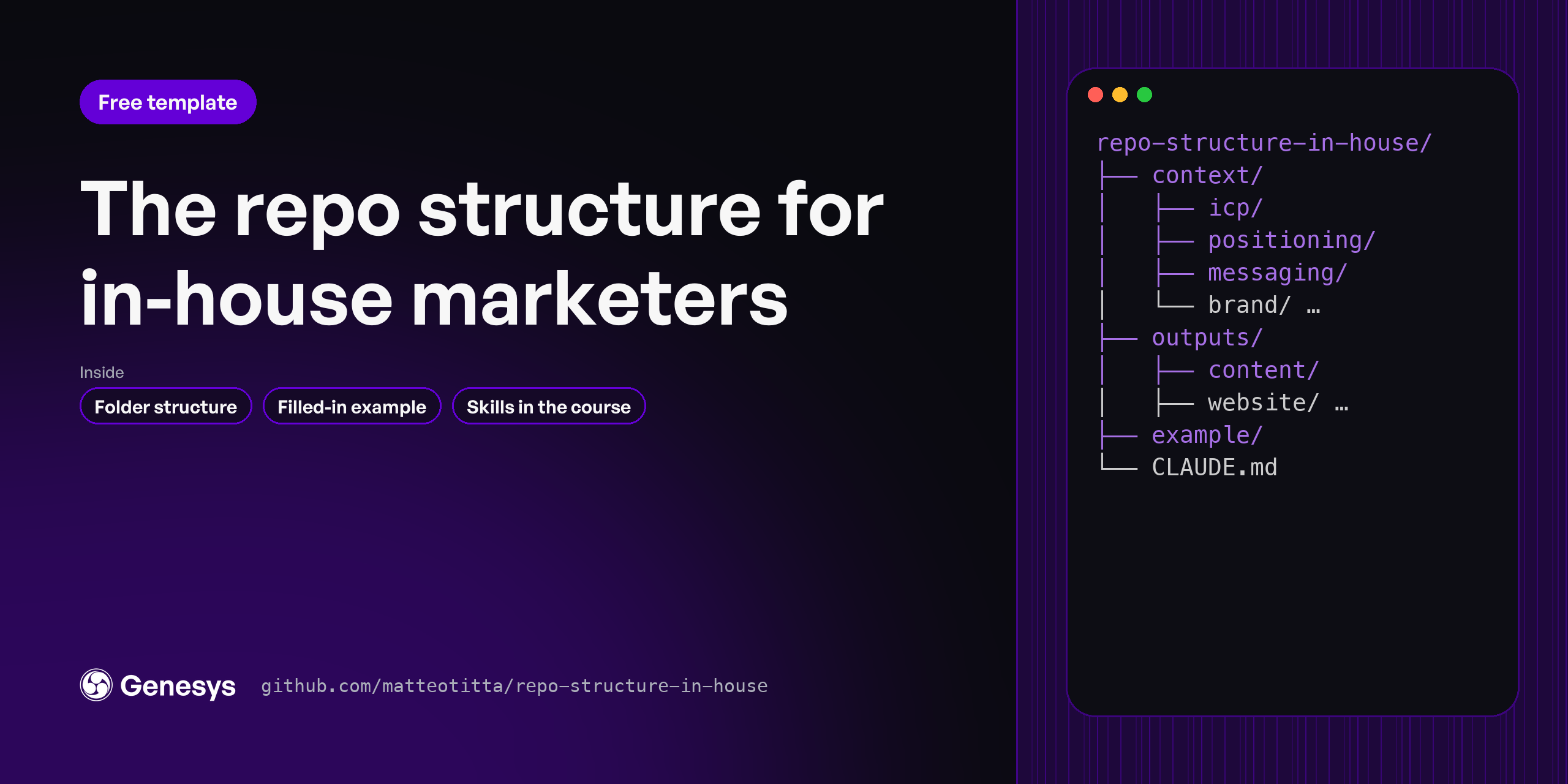
repo-structure-in-house/
├── context/          what Claude reads first: icp, competitors, positioning,
│                     messaging, brand (your voice), docs
├── outputs/          what you ship, one folder per lane: content, website, seo-aeo,
│                     social, product-marketing, sales, paid, lifecycle, outbound
├── example/          PulseAnalytics, filled in. Read it, then delete it
└── .claude/
    ├── skills/       the five foundational context skills, plus /level
    └── rules/        one house rule: quote the source, or lower the confidence
Every folder has a one-page CLAUDE.md that says what goes there and which skill fills it.
The idea: context/ is written once and kept current. outputs/ is where work happens. Because every skill reads context/ before it writes, a landing page, a launch plan and a LinkedIn post all come out sounding like the same company.
Add skills for each lane
The five skills here build your context. When you're ready to ship work, add the plugin for that lane. Each one reads the same context/ folder:
Want to build your own skills? Start from gtm-skill-template.
What the full version adds
This is the free starting point: the context layer, which is layer 1 of 4. Students in Marketing Engineering University build all four on their own company:
| Free (this repo) | Course |
|---|
| Context folders and the five foundational skills | ✓ | ✓ |
| Worked example company | ✓ | ✓ |
| The other six context skills (win-loss, founder POV, brand kit, funnel, goals, company context) | Context plugin, $19.99 | ✓ |
| Skills for every lane, with the reference material and templates | Lane plugins: launch free, the rest $19.99 to $29.99 | The full library |
| Lanes split into research, strategy and execution | | ✓ |
| Agents, commands and hooks that chain skills and check their own work | | ✓ |
| Session memory, so each session picks up where the last one stopped | | ✓ |
| Connectors set up for your stack (Slack, Notion, CRM, analytics) | Exa only | ✓ |
| House rules for transcripts, privacy and upkeep | One | Full set |
| Live sessions and feedback on your own company | | ✓ |
The free version is enough to get your context right. That's the step most teams skip.
Keep it alive
- Every file in
context/ has one owner.
- Re-run a context skill when something real changes: a new competitor, a pricing change, a new segment.
- Every 90 days, spend 30 minutes pruning anything nobody reads.
Built by Matteo Tittarelli at Genesys Growth. MIT licensed: fork it, change it, use it with clients.


 @coreyhaines31


