Hydraia

🇬🇧 English · 🇪🇸 Español
A personal agentic development harness for Claude Code. One command runs the
entire feature pipeline: it collaborates with you on the design (brainstorm,
approaches, spec), then builds autonomously — plan, execute, double-review, and
verify with no per-step babysitting and no telling it which model or skill to use.
/hydraia:feature add rate limiting to the public REST API
You stay on Opus 4.8; Hydraia decides everything else — when to brainstorm, when
to plan, when to drop to Sonnet for execution, which reviewers to run, which
security gates to enforce.
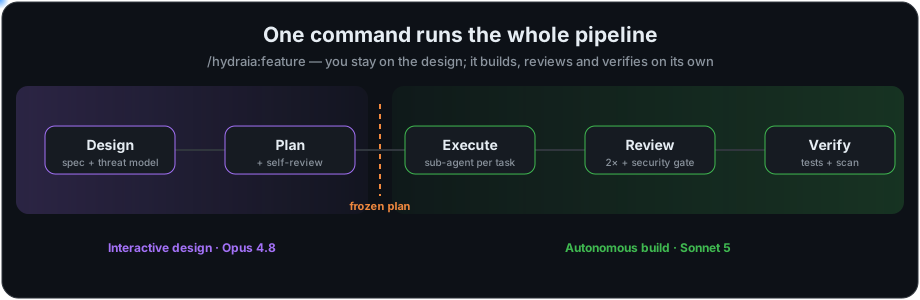
Visual overview
How one command drives the whole pipeline — the 7 phases (interactive design →
frozen plan → autonomous build), the Opus/Sonnet model split, and which phases
each main command runs.

Table of contents
- Why Hydraia
- What it does, automatically
- Standout capabilities
- Commands
- Worked examples
- Plan once, execute anywhere
- Use cases
- Getting the most out of Hydraia
- How it works under the hood
- Security (built in)
- Spec-drive, enforced
- The one setup step
- Prerequisites
- Install
- Repo layout
- Notes
Why Hydraia
Raw Claude Code is powerful, but hands-on. You decide when to plan, when to
threat-model, which reviewer to run, when to drop to a cheaper model — and you
carry all of it in one context window that bloats as the task grows. Skip a step
under time pressure and quality quietly drifts.
Hydraia removes the babysitting. One command runs a fixed, non-negotiable
pipeline — think → design + threat model → plan → execute → double review →
verify — with every model, skill, and reviewer decision already made. You stay on
Opus 4.8 and read one line per phase.
The point isn't "an agent that codes." It's the discipline you'd apply on your
best day, applied on every run — the threat model you'd skip when rushed, the
plan you'd hand-wave, the second reviewer you'd never bother to call, the tests
you meant to write. Hydraia doesn't let you skip them.
Without Hydraia: pick a model, remember to plan, remember to threat-model,
write it, remember to review, remember to run security, remember to test — every
step manual, every step skippable.
With Hydraia: /hydraia:feature add rate limiting to the public API — and
all of it runs, in order, unattended.
What it does, automatically
| Phase | What happens | Model |
|---|
| -1 · Triage | Intent detected and routed: feature · user story (PO) · bug · perf/DB · greenfield · review; ambiguous asks, never assumes | Opus 4.8 |
| 0 · Context | Code graph synced (session hook) + queried; any PDF converted to markdown | Opus 4.8 |
| 1 · Think | Forced think-before-coding gate (karpathy-guidelines) | Opus 4.8 |
| 2 · Design | Brainstorm → exhaustive spec + threat model | Opus 4.8 |
| 3 · Plan | Detailed plan + self-review loop (max 2 passes) | Opus 4.8 |
| 4 · Execute | Fresh sub-agent per task; heartbeat watchdog auto re-pushes hung agents; UI intelligence on frontend work | Sonnet 5 |
| 5 · Review | Depth chosen at plan freeze (Full/Lite/Custom, security floor always on) — Pass 1 whole-branch + Pass 2 diff-scoped reviewers + security gate, deduped | Opus (+ Sonnet/Haiku for mechanical) |
| 6 · Verify | Run tests, confirm against spec, secrets/deps scan, brief-or-detailed summary | Opus 4.8 |
Token discipline (compressed internal comms, caveman style) runs in the
background across all phases — it never touches code, plans, or your summary.
Standout capabilities
The pipeline table above is what runs. These are the things that make the
output different from asking Claude Code to "build a feature" yourself — most of
them are steps you'd never run by hand on a normal day.
| Capability | Why it matters |
|---|
| Code-graph context, not blind reads | Every run starts by querying a codegraph index — structure, call sites, blast radius — instead of dumping files into context. Cheaper, more accurate, and it knows what a change will break before touching it. Query it directly with /hydraia:graph. |
| Adversarial design loop | Before the spec freezes, Hydraia red-teams its own design: unstated assumptions, a simpler approach it ignored, failure modes, security holes the threat model missed. Catching a design flaw here is ~10× cheaper than at review time. |
| Security at three gates, not one | Threat model at design time (before code exists) → cross-stack scan + OWASP review at code time → secrets/deps/production audit at close. Any high-severity finding blocks the run. |
| Self-reviewing plans | The plan critiques itself (up to 2 passes) for gaps, hidden coupling, missing tests, and over-broad changes — before a single line is written. |
| Cost-aware model split | Opus 4.8 does the judgment work (design, plan, both reviews); mechanical execution is delegated to Sonnet 5 sub-agents. You pay for Opus only where thinking actually matters. |
| Fresh sub-agent per task | Each executor gets only its task + graph context — never your session history. No context poisoning, no drift across a long run. |
| Double code review | A whole-branch reviewer pass, then a panel: 8 stack-specific reviewers (Go, Angular, React, Vue, TS, Python, Java, C#) plus cross-cutting ones (security, silent-failure, performance, types, database). |
| Resumable runs | Every run writes a durable log with a phase checklist. If it's interrupted — crash, closed laptop, killed session — /hydraia:resume picks it up exactly where it stopped. |
| Persistent artifacts | Specs and plans are saved under docs/hydraia/ — reviewable, diff-able, reusable, and auditable after the fact. |
| You pick the depth | At plan freeze Hydraia asks how much review ceremony this change warrants (Full / Lite / Custom) and whether you want a brief or detailed closing summary — so a trivial fix need not pay for a full double review. The security floor is never skippable. |
Commands
| Command | Phases run | What it does |
|---|
/hydraia:feature <desc> | 0–6 | Full pipeline: context → think → design+threat-model → plan+self-review → execute (Sonnet 5) → double review + security gate (Opus 4.8) → verify + secrets/deps scan |
/hydraia:plan <desc> | 0–3 | Context + design + threat model + detailed plan (with self-review), then stop. Nothing executed. |
/hydraia:story <story> | -1–3 | Product-Owner analysis of a user story (INVEST, ambiguity questions, numbered acceptance criteria) → spec → QA cases + traceability matrix → frozen plan, then stop. Nothing executed. |
/hydraia:perf <symptom> | -1–6 | Measurement-first performance run: baseline → profile-driven diagnosis (perf-engineer) → spec with numeric target → implement → re-measure in verify. |
/hydraia:db <symptom> | -1–6 | DB bottleneck run: engine detection, read-only evidence (EXPLAIN, stats, locks), findings by taxonomy, expand-contract migrations — db-performance-tuner as primary. |
/hydraia:architect <idea> | -1–6 | Greenfield: guided elicitation → architecture proposals → confirmed stack → API contract → ADRs → full build pipeline. |
/hydraia:e2e [focus] | — | Generate + run a Playwright critical-flow E2E suite (auto-detected framework). |
/hydraia:devops <request> | — | Author CI/CD, Docker, or IaC — deploy and secrets flagged for human approval. |
/hydraia:observability <request> | — | Instrument logs/metrics/traces/alerts — OTel-first, never logs secrets/PII. |
/hydraia:docs [focus] | — | Sync README, API docs, CHANGELOG, ADR index with the code — reports drift. |
/hydraia:review [focus] | 5–6 | Double code review + security gate on the current branch. Code already exists. |
/hydraia:graph <query> | — | Query the code graph (call sites, blast radius) without running the pipeline. |
|
The hydraia skill also auto-triggers when you ask to build/add/implement a
feature in plain language — no slash command required. /hydraia:feature is the
explicit, unambiguous entry point.
Worked examples
1. Ship a full feature end to end
/hydraia:feature add rate limiting to the public REST API — 100 req/min
per API key, returning 429 with a Retry-After header
What you'll see, roughly one line per phase:
Running the Hydraia pipeline.
[0] Graph synced. Queried API middleware chain + route registration.
[1] Goal restated, assumptions listed, simplest approach chosen
(token bucket per key, shared store).
[2] Spec written. Threat model: bypass via missing/rotated keys,
memory exhaustion from unbounded key space, clock skew across nodes.
Mitigations folded into spec.
[3] Plan saved: docs/hydraia/plans/2026-07-02-api-rate-limiting.md
Self-review pass A found a missing test for the 429 header → revised.
[4] Executor #1: token-bucket store. Executor #2: middleware + headers.
Executor #3: tests. All committed.
[5] Pass 1 (branch review) + Pass 2 (typescript-reviewer, security-reviewer,
silent-failure-hunter) + security-scan/security-review. 1 material
finding fixed.
[6] Tests green. Spec + mitigations confirmed. repo-scan/production-audit
clean. Done.
2. Plan only — review the approach before any code is written
Use when you want to sanity-check the design and the file-by-file plan first.
/hydraia:plan migrate the session cache from in-memory to Redis with
a 30s TTL, keeping the current interface
Stops after Phase 3 with a frozen plan under docs/hydraia/plans/. Nothing is
executed. Run /hydraia:feature (or hand the plan to executors) when you're happy.
3. Review an existing branch you didn't build with Hydraia
/hydraia:review the auth module
Runs only Phases 5–6 on the current branch: both review passes, the cross-stack
security gate, and the pre-close secrets/deps scan. Findings ranked by severity;
high-severity security findings are treated as blockers. The optional focus
(the auth module) narrows attention.
4. Understand blast radius before touching anything
/hydraia:graph what calls parseConfig and what would break if I change
its return type
Pure code-graph query — call sites, dependents, blast radius. No pipeline, no
edits. Handy before deciding whether a change is surgical or sprawling.
5. No slash command at all
add a --dry-run flag to the CLI that prints planned changes without
writing them
The hydraia skill recognizes "add … feature" phrasing and runs the same full
pipeline. /hydraia:feature just removes the ambiguity.
Plan once, execute anywhere
The plan that Phase 3 writes is deliberately agent-agnostic: every file to
touch, the change per file, the tests, and how to verify — written for an
implementer with zero prior context. That makes it a portable hand-off
artifact, not just an internal note. Which unlocks a cost- and speed-optimized
way of working: spend the expensive model only on judgment, and push the
token-heavy bulk anywhere you like.
1 · Plan on Opus (judgment).
/hydraia:plan add rate limiting to the public REST API — 100 req/min per
API key, 429 with Retry-After
Stops after Phase 3 with a frozen plan at
docs/hydraia/plans/2026-07-02-api-rate-limiting.md — independent, numbered tasks,
each self-contained.
2 · Execute the tasks with whatever is cheapest / fastest. The plan's tasks
are independent by design, so fan them out. Each executor needs only its task
block plus the repo — never the planning context.
| Executor | How you run it | Good for |
|---|
| Hydraia's own Sonnet sub-agents | run /hydraia:feature <same request> — it plans and executes with Sonnet sub-agents automatically | fully hands-off, single session |
| Codex CLI | hand a task block from the plan file to codex in another terminal | parallel execution, a different model's strengths |
| Gemini | paste a task block into Gemini | a third model / free-tier capacity |
| A second Claude session (Sonnet) | open another session, give it task 2 while session 1 runs task 1 | true parallelism across independent tasks |
3 · Review on Opus (judgment again).
/hydraia:review
Runs Phases 5–6 on the branch — double review + cross-stack security gate + verify
— regardless of who wrote the code. Codex wrote task 3? A Gemini session wrote
task 5? Doesn't matter; the review and security bar are identical.
Why this wins:
- Token cost. Opus — the expensive model — only touches the two phases where
judgment actually pays off: planning and review. The token-heavy middle
(execution) runs on cheaper models, other tools, or free tiers.
- Parallelism. Independent plan tasks run at the same time across
agents/terminals instead of one-at-a-time inside a single context.
- No context bloat. Every executor starts clean with just its task, so none of
them degrade the way one long-running session does.
- Model diversity, one quality bar. Different executors catch different things;
the Opus review gate normalizes the result no matter the source.
You don't have to leave Claude to benefit — /hydraia:feature already does the
Opus-plan → Sonnet-execute → Opus-review split internally. Going multi-agent
simply extends that same principle across tools and terminals.
Use cases
| Situation | Reach for |
|---|
| New feature, want it planned, built, reviewed, and verified in one shot | /hydraia:feature |
| A user story or ticket that needs PO-grade analysis before building — INVEST, acceptance criteria, QA cases traced to each AC | /hydraia:story, then /hydraia:feature |
| An endpoint or job got slow and you want it fixed with proof, not guesses | /hydraia:perf — baseline first, numeric target, re-measured in verify |
| Slow queries, lock timeouts, connection exhaustion, or an index question | /hydraia:db — EXPLAIN-first evidence, expand-contract migrations |
| A brand-new app or service, designed before the first line of code | /hydraia:architect — elicitation, architecture options, stack, API contract, ADRs |
| An API surface that should be designed before implementing | api-design runs inside greenfield/feature runs — contract-first OpenAPI/GraphQL/gRPC |
| Test coverage you can trace: every acceptance criterion → case → test file | on by default (qaFunctional) — the plan cannot freeze with an uncovered AC |
| Risky change — want to lock the design + threat model before committing effort | /hydraia:plan, then /hydraia:feature |
| Inherited a branch (yours or a teammate's) and want a rigorous, security-aware review | /hydraia:review |
| Estimating scope / deciding if a refactor is safe | /hydraia:graph |
| Security-sensitive code (auth, user input, external calls) where a design-level miss is expensive | any pipeline run — the threat model + 3 security gates are always on |
| Frontend work | /hydraia:feature — ui-ux-pro-max runs at design time to set style, palette, type scale, and a11y in the spec; executors implement that visual direction exactly |
| Turn a Jira ticket exported as PDF into shipped code | /hydraia:feature path/to/ticket.pdf … — it's converted to markdown before planning |
| Greenfield service/module from scratch | /hydraia:architect — greenfield-architect drives elicitation → architecture (architect + , for splits) → stack → contract → ADRs before the spec |
Getting the most out of Hydraia
Small habits that meaningfully raise the quality of every run:
- Start the session on Opus 4.8. The only lever you touch. Opus does the
design and both reviews; it delegates execution to Sonnet on its own. On a
weaker model the pipeline still runs, just with lower ceiling.
- Run
/hydraia:doctor once. It installs codegraph and markitdown. The
graph context is where a large share of the value lives — without it, Phase 0
falls back to blind reads.
- Write the request like a ticket, not a wish. Goal + constraints +
acceptance criteria.
add rate limiting — 100 req/min per API key, 429 with Retry-After produces a far sharper spec and threat model than add rate limiting. The more concrete the input, the tighter every downstream phase.
- Use
/hydraia:plan first on anything risky or expensive. You approve the
design and the file-by-file plan before spending a single execution token. Then
run /hydraia:feature when you're happy.
- Point it at the PDF. A Jira export or design doc — pass the path instead of
copy-pasting. It gets converted and read in full.
- Check blast radius before you commit to a refactor.
/hydraia:graph what calls X and what breaks if I change it tells you surgical vs. sprawling in one
query.
- Let it finish. The pipeline is built to run unattended — the value is
concentrated in exactly the phases (threat model, adversarial design pass,
second review) you'd skip by hand.
How it works under the hood
Hydraia is a thin orchestration layer over bundled, battle-tested skills. It
holds no business logic of its own — it decides what runs, in what order, on
which model. Every skill and agent it uses ships inside the plugin (skills/,
agents/) — nothing external to install except two binaries (see Prerequisites).
The circuit, per command
Every run splits at the frozen plan: an interactive half where design happens
with you, and an autonomous half that builds without interruption.
/hydraia:feature <desc> full pipeline
Language gate · Model guard
-1 Triage intent → route: feature · story · bug · perf/DB ·
greenfield · review (ambiguous → asks, never assumes)
┌─ INTERACTIVE (pauses allowed — this is where design happens) ─┐
0 Context codegraph query + PDF→md
1 Think karpathy gate · clarifying questions
2 Design brainstorm (questions → 2-3 approaches → present →
YOUR approval) → write spec docs/hydraia/specs/…
+ threat model + adversarial pass
3 Plan writing-plans (exact Files, Interfaces, TDD steps,
literal content — the Haiku test) + qa-functional cases
→ self-review (rejects thin plans) → freeze plan
→ ARM gate (.active-plan) ← needs spec + plan
└─ AUTONOMOUS (never pause; only a real blocker stops it) ───────┐
4 Execute fresh hydraia-executor (Sonnet) per task · qa-automation
5 Review branch review (Opus) + reviewer panel + security gate
6 Verify run REAL build/tests · QA matrix · E2E gate · docs sync
· repo-scan/prod-audit → DISARM gate · print credits
/hydraia:plan <desc> Phases 0→3 only, then STOP
writes spec + frozen plan, does NOT arm the gate, writes no code.
The human review point before building. Then run /hydraia:feature.
/hydraia:story <story> Phases -1→3, PO-first, then STOP
story-analysis (INVEST, ACs) → spec → QA cases → frozen plan.
/hydraia:perf | :db <symptom> measurement-first tuning route
baseline → perf-engineer / db-performance-tuner → numeric target
→ build → Phase 6 re-measures against it.
/hydraia:architect <idea> greenfield route
greenfield-architect: elicit → architecture → stack → api-design
contract → ADRs → full build.
/hydraia:review [focus] Phases 5→6 on the current branch
double review + cross-stack security gate + verify — no matter who
(or what agent) wrote the code. Touches no earlier phase.
/hydraia:e2e | :devops | :observability | :docs opt-in specialists
e2e-runner · devops-engineer · sre-observability · docs-engineer.
/hydraia:graph <query> codegraph only — call sites, dependents, blast
radius. No pipeline, no edits.
/hydraia:doctor validate / install / update codegraph + markitdown
/hydraia:resume [run] read run log → continue from the last incomplete phase
The spec-drive gate (hooks/gate.sh, any repo with a docs/hydraia/) sits
across all of it — a source-code edit is blocked unless a plan is frozen
(.active-plan), a quick edit was human-approved (.quick-approved), or you set
HYDRAIA_ALLOW_DIRECT=1. Markdown and pipeline artifacts are exempt.
The skill is the contract. skills/hydraia/SKILL.md defines the phases and the
two modes: it forbids asking the user which model/skill/reviewer to use, requires a
real design dialogue in Phases 1–3, and forbids pausing once execution starts
(Phases 4–6). This is what makes one command drive the whole run.
Two subagents carry the load:
hydraia-executor (model: sonnet) — dispatched fresh per task in Phase 4.
Gets only the task + graph context, never session history. Surgical changes,
tests, commits. Consults ui-ux-pro-max for any UI. Cheaper model where the
work is mechanical.
hydraia-reviewer (model: opus) — Phase 5 pass 1. Reviews the whole branch
against spec, correctness, hidden coupling, test adequacy, over-engineering.
Model split, restated: the main session stays on Opus 4.8 for all the
judgment-heavy work (think, design, plan, both review passes). Execution is
delegated to Sonnet 5 — the main session never changes its own model, it spawns
executor subagents whose model is pinned in their frontmatter.
Bundled skills do the actual thinking (skills/, all MIT, licenses in LICENSES/):
| Phase | Bundled skill(s) used |
|---|
| -1 Triage | routing table in hydraia; story-analysis, performance-tuning, db-optimization, greenfield-architect, systematic-debugging per route |
| 1 Think | karpathy-guidelines |
| 2 Design | brainstorming; api-design, adr, microservices-architect on greenfield |
| 3 Plan | writing-plans + qa-functional (Given/When/Then cases + traceability matrix) |
| 4 Execute | subagent-driven-development, test-driven-development, ui-ux-pro-max, stack patterns (react/node/dotnet/python/go/springboot), qa-automation, e2e-testing |
| 5 Review | requesting-code-review, receiving-code-review, ECC reviewer agents, security-scan, security-review |
| 6 Verify | verification-before-completion, repo-scan, production-audit; QA matrix + E2E gate (e2e-runner) + docs sync (docs-engineer) |
| all | caveman — compresses internal/subagent comms only |
Context comes from the code graph, not blind reads. hooks/preflight.sh
runs codegraph sync (or index on first run) so Phase 0 can query structure,
call sites, and blast radius cheaply. PDFs (specs, tickets) are converted with
markitdown before entering context — never raw bytes.
Plan artifacts persist. Every plan is written to
docs/hydraia/plans/YYYY-MM-DD-<feature>.md and frozen only after the self-review
loop converges (max 2 iterations).
Security (built in)
Security is enforced at three points, not just at the end:
- Design (Phase 2): threat model over the code graph's blast radius — attack
surface, PII/financial data, authN/authZ, OWASP categories — folded into the
spec so mitigations become plan tasks, not afterthoughts.
- Review (Phase 5): cross-stack
security-scan + security-review (OWASP,
secrets, injection, vulnerable deps) covering Node, C#, React, and Angular; plus
springboot-security / django-security when the stack matches. High-severity
findings block the merge.
- Close (Phase 6):
repo-scan + production-audit for hardcoded secrets,
vulnerable dependencies, and production-readiness gaps.
Spec-drive, enforced
"Never skip a phase" is not just a prompt Hydraia hopes the model obeys — it's a
runtime gate. A PreToolUse hook (hooks/gate.sh) blocks any source-code edit
until Phase 3 freezes a plan. Design-before-code stops being aspirational: the model
literally cannot write code before the spec and plan exist.
-
Scope. Only enforced in repos that use Hydraia (those with a docs/hydraia/
directory). Markdown and the pipeline's own artifacts (specs, plans, run logs) are
exempt, so writing the plan is never blocked.
-
The decision to skip is yours, not the model's. Token cost or "this looks
trivial" is never a valid reason for the model to bypass the pipeline on its own.
There are exactly two sanctioned ways to skip:
-
Hard bypass (you, up front). Set an env var in your shell — un-forgeable by
the model, since it can't change the process environment the hook runs in:
export HYDRAIA_ALLOW_DIRECT=1 # allow direct edits; unset to re-arm the gate
-
Quick-mode (per change, human-approved). On a genuinely trivial change (no
new logic, no new file, no security surface), the model may ask you via a
prompt — "skip the ceremony? pro: fewer tokens; con: no spec-drive record, no
double review." Only if you approve does it proceed, and even then it still
runs the real build/tests. The model can never approve its own shortcut.
This closes the most common failure mode of prompt-only pipelines: a model that
rationalizes its way past the process on a change it judges "small."
The one setup step
Run the main session on Opus 4.8 (planning + both reviews). Execution drops
to Sonnet 5 by itself via the executor subagents. That's the only lever you touch.
If the session isn't on Opus, Hydraia tells you once and continues anyway — but
quality is best on Opus.
Prerequisites
Have these on your machine before installing. git, Node, and Python are not
auto-installed; /hydraia:doctor installs the last two tools for you.
| Requirement | Used for | Auto-installed by /hydraia:doctor |
|---|
| Claude Code | host | — |
| git | pipeline commits | No (prerequisite) |
| Node.js ≥18 + npm | installing codegraph | No (prerequisite) |
| Python 3.8+ + pip | installing markitdown | No (prerequisite) |
codegraph | code-graph context | Yes |
markitdown | PDF → markdown | Yes |
gh CLI | GitHub PRs from the pipeline | No (optional) |
| Playwright/Cypress browser binaries | E2E tests (e2e-runner) | Yes, opt-in (/hydraia:doctor → --install-e2e, only once the repo already picked a framework) |
Platform: macOS/Linux. On Windows, run inside WSL.
Install
Add the marketplace straight from GitHub, then install the plugin:
claude plugin marketplace add jdanigo/hydraia
claude plugin install hydraia
marketplace add clones the repo; plugin install reads
.claude-plugin/marketplace.json from that clone. Updates pull the latest
main (claude plugin marketplace update hydraia).
Both commands run inside the Claude Code CLI too — start claude in your
terminal first, then run them at its prompt.

That's it — every skill and agent Hydraia uses ships inside the plugin, so there
is nothing else to clone or wire up.
You don't need to install the external tools by hand. The first time you run
/hydraia:feature, Phase 0 detects whether codegraph and markitdown are present
and offers to install them inline — one click, no commands to memorize. You can
still run /hydraia:doctor yourself anytime to check or update them, and it prints
per-OS (brew / apt / dnf / winget) copy-paste commands for the system
runtimes (git, Node, Python) a plugin can't install for you.
/hydraia:doctor is a slash command, not a terminal command. It only runs
inside the Claude Code CLI session — after you type claude in your terminal
and land on its prompt. Running hydraia:doctor or claude /hydraia:doctor
directly in bash/zsh will not work.
$ claude # 1. start Claude Code first
> /hydraia:doctor # 2. then run this, at the Claude prompt

Repo layout
hydraia/
├── .claude-plugin/
│ ├── plugin.json plugin manifest
│ └── marketplace.json single-plugin marketplace (for `marketplace add`)
├── LICENSE MIT (Hydraia's own code)
├── NOTICE attribution for upstream skills/agents
├── LICENSES/ upstream licenses (all MIT)
├── CONTRIBUTING.md structure + how to add a skill
├── README.md this file
├── skills/ 46 skills, all self-contained
│ ├── hydraia/ the 7-phase pipeline contract (the brain)
│ ├── process (15) brainstorming, writing-plans, executing-plans,
│ │ subagent-driven-development, dispatching-parallel-agents,
│ │ requesting-code-review, receiving-code-review,
│ │ test-driven-development, systematic-debugging,
│ │ using-git-worktrees, finishing-a-development-branch,
│ │ verification-before-completion, using-superpowers,
│ │ writing-skills, story-analysis
│ ├── stack patterns (9) react-patterns, golang-patterns, springboot-patterns,
│ │ python-patterns, coding-standards, karpathy-guidelines,
│ │ microservices-architect, node-patterns, dotnet-patterns
│ ├── performance (2) performance-tuning, db-optimization
│ ├── architecture (3) greenfield-architect, api-design, adr
│ ├── security (7) security-scan, security-review, security-bounty-hunter,
│ │ repo-scan, production-audit, django-security,
│ │ springboot-security
│ ├── e2e (1) e2e-testing
│ ├── ui / ux (7) ui-ux-pro-max, ui-styling, design, design-system,
│ │ brand, banner-design, slides
│ └── token discipline (1) caveman
├── agents/ 26 agents, all self-contained
│ ├── hydraia-executor.md per-task executor (Sonnet 5)
│ ├── hydraia-reviewer.md whole-branch reviewer (Opus 4.8)
│ ├── architecture (2) architect, code-architect
│ ├── qa (2) qa-functional, qa-automation
│ ├── performance (2) perf-engineer, db-performance-tuner
│ ├── delivery (4) e2e-runner, docs-engineer, devops-engineer, sre-observability
│ ├── language reviewers (8) go-reviewer, angular-reviewer, react-reviewer,
│ │ vue-reviewer, typescript-reviewer, python-reviewer,
│ │ java-reviewer, csharp-reviewer
│ └── cross-cutting (6) code-reviewer, security-reviewer, silent-failure-hunter,
│ database-reviewer, performance-optimizer,
│ type-design-analyzer
├── commands/ feature, plan, story, perf, db, architect, e2e, devops, observability, docs, review, graph, doctor, resume, dashboard
├── hooks/
│ ├── hooks.json registers preflight (SessionStart) + gate/plancheck (PreToolUse)
│ ├── preflight.sh codegraph sync + daily dep nudge
│ ├── gate.sh spec-drive gate: blocks code edits before a plan is frozen
│ ├── plancheck.sh self-containment gate: blocks arming a plan that references the spec
│ └── doctor.sh validate / install / update deps
└── docs/hydraia/ specs/, plans/, and runs/ written by the pipeline
Skills reference
| Skill | What it does |
|---|
hydraia | The 7-phase pipeline contract — the brain that drives every run |
| Process | |
brainstorming | Explore intent, requirements, and design before any build |
writing-plans | Turn a spec into a step-by-step implementation plan |
executing-plans | Run a written plan in a fresh session with review checkpoints |
subagent-driven-development | Execute independent plan tasks via fresh subagents |
dispatching-parallel-agents | Fan out 2+ independent tasks with no shared state |
requesting-code-review | Request review when a feature is done or before a merge |
receiving-code-review | Triage review feedback with rigor, not blind agreement |
test-driven-development | Write tests before implementation code |
systematic-debugging | Structured root-cause analysis before proposing fixes |
using-git-worktrees | Set up an isolated workspace for feature work |
finishing-a-development-branch | Decide merge / PR / cleanup when work is done |
verification-before-completion | Run checks and confirm output before claiming done |
using-superpowers | How to find and invoke the right skill |
writing-skills | Create, edit, and verify skills |
story-analysis | Product-Owner pass — INVEST, ambiguity hunt, numbered acceptance criteria |
| Stack patterns | |
react-patterns | React 18/19 idioms — hooks, RSC boundaries, Suspense, a11y |
golang-patterns | Idiomatic Go patterns and conventions |
springboot-patterns | Spring Boot architecture, REST, data-access patterns |
|
Agents reference
| Agent | What it does |
|---|
hydraia-executor | Runs one plan task — writes code, tests, commits (Sonnet 5) |
hydraia-reviewer | Whole-branch reviewer, Phase 5 pass 1 (Opus) |
| Architecture | |
architect | System design, scalability, technical decision-making |
code-architect | Feature blueprint anchored to existing codebase patterns |
| QA | |
qa-functional | Derives Given/When/Then cases + traceability matrix from the spec (Sonnet) |
qa-automation | Implements QA cases in the repo's test framework; verifies matrix coverage (Sonnet) |
| Performance | |
perf-engineer | Profile-driven diagnosis: baseline, ranked bottlenecks, hypotheses (Opus) |
db-performance-tuner | Multi-engine DB tuning: EXPLAIN, indexes, N+1, locks, pooling (Opus) |
| Delivery | |
e2e-runner | Playwright critical-flow E2E; Phase 6 gate (Sonnet) |
docs-engineer | Syncs README/API/CHANGELOG/ADR with code; Phase 6, non-blocking (Sonnet) |
devops-engineer | CI/CD, Docker, IaC; deploy flagged for human approval (Sonnet) |
sre-observability | Logs/metrics/traces/alerts; OTel-first, redaction-strict (Sonnet) |
| Language reviewers | |
go-reviewer | Go — idioms, concurrency, error handling, performance |
angular-reviewer | Angular — change detection, RxJS, signals, templates |
react-reviewer | React — hook correctness, render perf, RSC boundaries |
vue-reviewer | Vue — Composition API, reactivity, template security |
typescript-reviewer | TS/JS — type safety, async correctness, security |
Forking
Fork on GitHub, then point marketplace add at your fork:
claude plugin marketplace add <your-user>/hydraia
claude plugin install hydraia
Everything Hydraia uses ships in the repo, so your fork is self-contained — nothing
else to wire up.
Notes
Every skill and agent lives under skills/ and agents/ — nothing is fetched at
runtime. Some are Hydraia's own and some come from MIT-licensed upstreams; the
per-project license text is in LICENSES/ and the attribution mapping in
NOTICE, as MIT requires. All of them are invoked internally by the pipeline —
you only ever call hydraia.