
Development
Plugin
whetstone
A Claude Code plugin that makes AI coding agents follow engineering discipline. Plan before coding. Verify before claiming done. Find root cause before patching. Review before merge. Skills activate based on file type and task signals, not manual toggling.

Plugin Signal83/100Strong
maintained99
capable94
documented75
adopted33
Install on Claude Code
> /plugin marketplace add iliaal/whetstone> /plugin install whetstone@iliaal-marketplace
Stats
34
Stars
3
Forks
Active
Maintenance
Python
Language
MIT
License
23h ago
Last commit
7mo ago
Created
Repo: iliaal/whetstone
In this plugin
- commands
- analyze-misfires
- announce
- audit-plugin
- diagnose-negatives
- eval-skills
- evolve-skill
- prune-sync-log
- release
- skillopt
- sync-from-repos
- triage-prs
- write-skill
- ia-adr
- ia-agent-native-audit
- ia-brainstorm
- ia-changelog
- ia-compound-refresh
- ia-compound
- ia-deepen-plan
- ia-document-release
- ia-feature-video
- ia-ideate
- ia-lfg
- ia-plan
- ia-report-bug
- ia-reproduce-bug
- ia-resolve-pr
- ia-resolve-todo-parallel
- ia-review
- ia-setup
- ia-test-browser
- ia-triage
- ia-verify
- ia-work
- adr-templates
- agent-browser-cli
- workflow-issue-formatting
- workflow-plan-templates
- skills
- skill-distiller
- ia-agent-native-architecture
- ia-brainstorming
- ia-c-systems
- ia-code-review
- ia-compound-docs
- ia-cpp-systems
- ia-debugging
- ia-document-review
- ia-file-todos
- ia-frontend-design
- ia-git-worktree
- ia-linux-bash-scripting
- ia-md-docs
- ia-meta-prompting
- ia-nodejs-backend
- ia-orchestrating-swarms
- ia-php-laravel
- ia-pinescript
- ia-planning
- ia-postgresql
- ia-python-services
- ia-react-frontend
- ia-receiving-code-review
- ia-refine-prompt
- ia-reflect
- ia-rust-systems
- ia-simplifying-code
- ia-tailwind-css
- ia-terraform
- ia-verification-before-completion
- ia-writing-tests
- ia-writing
- agents
- ia-accessibility-tester
- ia-architecture-strategist
- ia-best-practices-researcher
- ia-bug-reproduction-validator
- ia-cloud-architect
- ia-code-simplicity-reviewer
- ia-database-guardian
- ia-deployment-verification-agent
- ia-design-iterator
- ia-figma-design-sync
- ia-git-history-analyzer
- ia-infrastructure-engineer
- ia-kieran-reviewer
- ia-learnings-researcher
- ia-performance-oracle
- ia-pr-comment-resolver
- ia-repo-research-analyst
- ia-security-sentinel
- ia-spec-flow-analyzer
- MCP
What's inside
Skill(33 skills)
/skill-distillerFetches top-rated skills from skills.sh, analyzes them, and synthesizes one token-efficient skill combining the best elements. Use when the user asks to "distill skills for X", "find and combine skills for X", "synthesize skills", "merge skills", "make a skill for X from/ia-agent-native-architectureDesign agent-native applications where agents replace UI users as the primary actor. Use when designing MCP tools, agent-loop architectures, system prompt design, hooks policy, shared-workspace file patterns, or self-modifying agent systems./ia-brainstormingPre-implementation exploration: deep interview, approach comparison, design doc. Use when exploring a vague feature idea, clarifying ambiguous requirements, or comparing approaches before coding. For the full workflow, use the ia-brainstorm command (Claude Code).
- /ia-c-systems
- /ia-code-review
- /ia-compound-docs
- /ia-cpp-systems
- /ia-debugging
- /ia-document-review
- /ia-file-todos
- /ia-frontend-design
- /ia-git-worktree
- /ia-linux-bash-scripting
- /ia-md-docs
- /ia-meta-prompting
- /ia-nodejs-backend
- /ia-orchestrating-swarms
- /ia-php-laravel
- /ia-pinescript
- /ia-planning
- /ia-postgresql
- /ia-python-services
- /ia-react-frontend
- /ia-receiving-code-review
- /ia-refine-prompt
- /ia-reflect
- /ia-rust-systems
- /ia-simplifying-code
- /ia-tailwind-css
- /ia-terraform
- /ia-verification-before-completion
- /ia-writing-tests
- /ia-writing
Command(38 commands)
/analyze-misfiresIdentify skills injected where not needed, propose regex and description tightening/announceDraft X/Twitter announcement post (or thread) for the latest plugin release/audit-pluginDeep quality audit of all skills, agents, and commands for inconsistencies, gaps, duplication, and token waste
- /diagnose-negatives
- /eval-skills
- /evolve-skill
- /prune-sync-log
- /release
- /skillopt
- /sync-from-repos
- /triage-prs
- /write-skill
- /ia-adr
- /ia-agent-native-audit
- /ia-brainstorm
- /ia-changelog
- /ia-compound-refresh
- /ia-compound
- /ia-deepen-plan
- /ia-document-release
- /ia-feature-video
- /ia-ideate
- /ia-lfg
- /ia-plan
- /ia-report-bug
- /ia-reproduce-bug
- /ia-resolve-pr
- /ia-resolve-todo-parallel
- /ia-review
- /ia-setup
- /ia-test-browser
- /ia-triage
- /ia-verify
- /ia-work
- /adr-templates
- /agent-browser-cli
- /workflow-issue-formatting
- /workflow-plan-templates
Agent(19 agents)
ia-accessibility-testerWCAG 2.1/2.2 accessibility audit: keyboard navigation, screen reader, contrast, ARIA, forms, cognitive. Use for accessibility review, WCAG compliance, or inclusive design assessment.ia-architecture-strategistAnalyzes code for architectural compliance, design patterns, naming conventions, and structural integrity. Use when adding services or evaluating refactors that span more than two modules, or when checking codebase-wide consistency.ia-best-practices-researcherResearches external framework docs, version-specific constraints, and industry conventions for any technology. Use when you need authoritative external documentation.
- ia-bug-reproduction-validator
- ia-cloud-architect
- ia-code-simplicity-reviewer
- ia-database-guardian
- ia-deployment-verification-agent
- ia-design-iterator
- ia-figma-design-sync
- ia-git-history-analyzer
- ia-infrastructure-engineer
- ia-kieran-reviewer
- ia-learnings-researcher
- ia-performance-oracle
- ia-pr-comment-resolver
- ia-repo-research-analyst
- ia-security-sentinel
- ia-spec-flow-analyzer
Badges




README
Whetstone

A Claude Code plugin that makes AI coding agents follow engineering discipline. Plan before coding. Verify before claiming done. Find root cause before patching. Review before merge. Skills activate based on file type and task signals, not manual toggling.
Bundles agents, skills, workflow commands, and a skill distillery for PHP, Python, TypeScript, React, and infrastructure workflows.
Who this is for
Teams using Claude Code for real work. You're building with PHP, Python, TypeScript, or React. You want the agent to plan before building, verify before shipping, and debug by reasoning instead of guessing. This plugin provides that structure.
Solo developers who want consistency. Bash tasks receive guidance on strict mode and ShellCheck; Laravel tasks receive strict-type and thin-controller patterns. Skills guide the agent; only checks actually run can establish compliance.
Anyone building with AI agents. Includes skills for multi-agent orchestration, agent-native architecture design, and a distillery that generates new skills from top-rated community sources.
The Problem
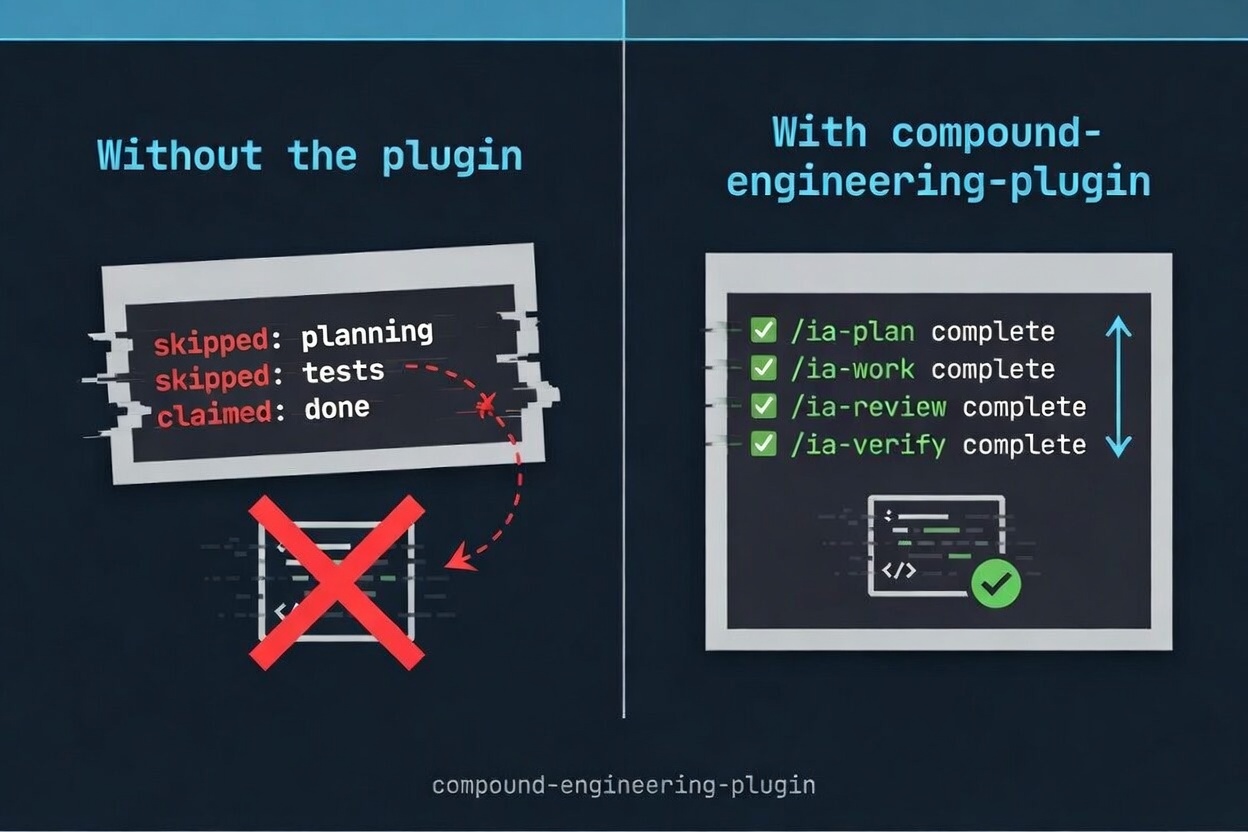
AI coding agents skip planning, claim "done" without verifying, patch symptoms over root causes, and forget what they learned when context resets. The output looks polished. The behavior underneath is undisciplined.
The long-form argument is at AI Agents Don't Lack Capability. They Lack Process.. This plugin supplies that process as instructions and supporting tools.
🚀 Install
Claude Code (recommended)
/plugin marketplace add https://github.com/iliaal/whetstone
/plugin install whetstone@iliaal-marketplace
/reload-plugins
Standalone skills (any AI coding agent)
Individual skills work with Claude Code, Cursor, Codex, Gemini CLI, Copilot CLI, OpenCode, and 35+ other agents via the ai-skills repo:
# All skills
npx skills add iliaal/ai-skills

# Single skill
npx skills add iliaal/ai-skills -s code-review

# Target a specific agent
npx skills add iliaal/ai-skills -a cursor
Codex
Install Whetstone's portable skills and Context7 integration through the repository's native Codex marketplace:
git clone https://github.com/iliaal/whetstone
cd whetstone
bash scripts/install-codex-plugin.sh
Start a new Codex thread after installation or update. The native package includes Whetstone's cross-harness skills and Context7 MCP server. Claude-specific agents, slash commands, and hooks remain available only through the Claude Code plugin.
No shipped skill carries Claude's disable-model-invocation flag or its Codex twin, allow_implicit_invocation: false in agents/openai.yaml. Commands reach skills through explicit Skill() tool calls, which the harness treats as model invocation, so either flag makes that call fail. Trigger control lives in each skill's description. scripts/test-codex-plugin.sh asserts the set of flagged skills stays empty.
Normal Whetstone releases refresh the local Codex plugin before publication when codex is on PATH. For source edits between releases, use the wrapper that applies a temporary cachebuster, reinstalls, and restores the tracked release version:
bash scripts/refresh-codex-plugin.sh
The legacy converter remains available for OpenCode and other non-plugin targets.
In this checkout, Codex also discovers the 12 repository commands and skill-distiller through .agents/skills/. Invoke them as $release, $audit-plugin, $write-skill, or $skill-distiller, with arguments after the name. Command wrappers read the maintained .claude/commands/ sources. If an existing session has not refreshed its skill list, start a new Codex session. These repository workflows are separate from the distributed plugin skills.
OpenCode
Same converter, different target. OpenCode reads skills from its per-project config. The converter translates the plugin's SKILL.md format into OpenCode's expected shape and writes output into the current project (override with --output <dir>).
Command-based PreToolUse and PostToolUse hooks use a bundled adapter; unsupported hook events and types cause conversion to fail. Whetstone's injection hook requires Bash and jq on PATH. The installed bundle includes its scripts and skill files, so it does not depend on the source checkout.
bun run src/index.ts install ./plugins/whetstone --to opencode
Cleanup for OpenCode (and other targets) uses the same command:
bun run src/index.ts cleanup --target opencode
bun run src/index.ts cleanup --target kilocode
bun run src/index.ts cleanup --target agents
Use cleanup --target opencode --output <dir> for a custom installation. Default OpenCode cleanup checks the current project and legacy global locations. Cleanup backs up individually identified Whetstone artifacts and preserves unrelated or customized files; files whose ownership cannot be established require manual review.
Additional targets (symlink-based)
For tools that read skills directly from ~/.agents/skills or ~/.kilocode/skills, scripts/sync-to-tools.sh symlinks the plugin's skill directory into each path so edits land immediately without re-conversion. It removes legacy Whetstone-owned links from ~/.codex/skills and adds managed Codex exclusions for the same skills discovered through ~/.agents/skills; the native plugin remains Codex's single source.
bash scripts/sync-to-tools.sh              # symlink into shared non-Codex tool dirs
bash scripts/sync-to-tools.sh --dry-run    # preview changes
🔗 Works well with
- codesage adds structural code intelligence (find symbols, references, dependencies, blast-radius analysis) as an MCP server. Whetstone supplies process guidance; CodeSage supplies codebase structure for applying it.
- ai-skills is the read-only mirror of this plugin's skills for agents without native Whetstone plugin support.
🛠️ The workflow
Five commands form a loop: explore the problem, plan the solution, build it, review it, document what you learned. Each pass makes the next one faster because solutions accumulate as searchable docs.
| Command | What it does |
|---|---|
/ia-brainstorm | Interviews you one question at a time to surface hidden requirements. Produces 2-3 named approaches with trade-offs. No code until a design doc is approved. |
/ia-plan | Turns a brainstorm or feature idea into a file-based plan with atomic tasks, specific file paths, and phased delivery in vertical slices. |
/ia-work | Executes a plan with task tracking, worktree isolation, and verification gates. Each task runs through build/test before marking complete. |
/ia-review | Multi-agent code review: scope-drift detection, spec compliance, code quality, security, performance. Auto-escalates to deep mode on complex diffs. |
/ia-compound | Captures what you just solved as searchable documentation in docs/solutions/ so the next person (or the agent) doesn't re-debug it. |
You don't have to use all five. /ia-review on its own is a solid pre-merge check. /ia-plan works standalone for scoping. Mix and match.
✨ Skills
Skills are instructions selected for the task. They guide procedures and identify anti-patterns; they are not runtime enforcement of the agent's decisions.
Architecture & design
| Skill | Description |
|---|---|
| ia-agent-native-architecture | 15-area architecture checklist for systems where AI agents are primary actors: tool design, execution patterns, context injection, approval gates, audit trails. For designing agent systems or MCP tools. |
| ia-frontend-design | Requires a design philosophy statement before code, detects existing design systems to match, and bans AI design cliches (purple-to-blue gradients, Space Grotesk, three-card hero layouts). Calibrates output via variance, motion, and density parameters. For work where visual identity matters. |
| ia-simplifying-code | Declutters code without changing behavior. Targets AI slop: redundant comments, unnecessary defensive checks, over-abstraction, verbose stdlib reimplementations. Applies changes in priority order and stops before touching public APIs. For cleanup after AI generation or accumulated complexity. |
Language & framework
| Skill | Description |
|---|---|
| ia-react-frontend | Decision tree routing most "should I use an effect?" questions to non-effect solutions. Separates state tools by purpose (Zustand for client, React Query for server, nuqs for URL). Enforces React 19 patterns, App Router server/client boundaries, and flags that Server Actions are public endpoints. For React, Next.js, and Vitest/RTL testing. |
| ia-nodejs-backend | Strict layered architecture (routes > services > repos) with no cross-layer HTTP imports. Contract-first API design using Zod schemas as the single source of truth. Production patterns like circuit breaker and load shedding as requirements, not suggestions. For Express, Fastify, Hono, or NestJS backends. |
| ia-python-services | Mandates modern tooling (uv, ruff, ty) over legacy equivalents. Structured concurrency via asyncio.TaskGroup, idempotent background jobs, and structured JSON logging with correlation IDs via contextvars. For Python CLI tools, FastAPI services, async workers, or new project setup. |
| ia-php-laravel | declare(strict_types=1) everywhere, PHPStan level 8+, fat models / thin controllers, Form Requests with toDto(), event-driven side effects. Prevents N+1 by disabling lazy loading in dev. Defaults to feature tests through the full HTTP stack. For Laravel codebases. |
| ia-rust-systems | Edition 2024, workspace layout with inward-only deps, thiserror in libraries / anyhow in binaries, no unwrap/expect outside main and tests, every unsafe block needs a // SAFETY: comment. Tokio patterns (JoinSet, CancellationToken, bounded mpsc) and axum service layout. For Rust CLIs, axum services, or cargo workspaces. |
| ia-c-systems | Repo conventions outrank the skill, so it defers on tabs, goto cleanup, and macros that return rather than fighting established C. Function altitudes (orchestrator / leaf / adapter) gated behind a name test that stops over-decomposition, status enums with one producer per error value, public-validates / internal-asserts boundaries. Separate references for memory safety (sanitizers, overflow-checked allocation, recursion to bounded worklists) and PHP extension C. For C11 and later, native extensions, and systems code. |
File tree
FAQ
whetstone is a Claude Code plugin with 33 hand-picked skills for development work, indexed on Flowy. Install it with the command on its page. It includes skill-distiller, ia-agent-native-architecture, ia-brainstorming. Its skills do not fire on their own yet. Request auto-invocation to have Flowy route them as you prompt. Free and open source.
- What is whetstone?
- A Claude Code plugin that makes AI coding agents follow engineering discipline. Plan before coding. Verify before claiming done. Find root cause before patching. Review before merge. Skills activate based on file type and task signals, not manual toggling.
- How do I install whetstone?
- Run these in Claude Code: /plugin marketplace add iliaal/whetstone then /plugin install whetstone@iliaal-marketplace. Then prompt normally.
- Does whetstone auto-invoke its skills?
- Not yet. It is indexed on Flowy as a plain plugin. Request auto-invocation on its page and Flowy will route its skills for you as you prompt.
- Is whetstone free?
- Yes. Flowy is free and open source, with nothing gated. You can read every skill in full before you install.
Is this plugin yours?
Claim it with GitHubSubmit a pluginPromote it