
prowler
MCPScans cloud accounts against security best practices and compliance benchmarks such as CIS.
 @prowler-cloudInstall MCP
Ships with outrider-recon: Claude-native, governed offensive-OSINT and external attack-surface platform for authorized security teams. Outrider is the governed front half of the offensive workflow.
Claude Code
> /plugin marketplace add Ap6pack/outrider-recon> /plugin install outrider-recon@outrider-recon
Codex
$ codex mcp add outrider-recon -- python3 mcp-server/server.py
Cursor
{
  "mcpServers": {
    "outrider-recon": {
      "command": "python3",
      "args": [
        "mcp-server/server.py"
      ]
    }
  }
}
Add it to mcp.json.
Gemini CLI
$ gemini mcp add outrider-recon python3 mcp-server/server.py
GitHub Copilot
$ copilot mcp add outrider-recon -- python3 mcp-server/server.py
OpenCode
{
  "mcp": {
    "outrider-recon": {
      "type": "local",
      "command": [
        "python3",
        "mcp-server/server.py"
      ]
    }
  }
}
Add it to opencode.json.
Windsurf
{
  "mcpServers": {
    "outrider-recon": {
      "command": "python3",
      "args": [
        "mcp-server/server.py"
      ]
    }
  }
}
Add it to mcp_config.json.
From the README
external asset discovery and surface mapping (subdomains, DNS, certificates, WHOIS);
web and API surface (OpenAPI/GraphQL, endpoints, security headers, JavaScript, email security, vendor/product…
identity fabric
SSO/IdP fingerprinting, Microsoft 365 deep enumeration, and employee enumeration;
cloud and infrastructure (cloud-native services, Kubernetes/containers, CI/CD, TLS);
secrets and dorking, with read-only credential validation;
people and breach intelligence (infostealer/breach correlation, package-registry leaks);
post-credential enumeration (gated, read-only) for validated keys;
analysis, scoring, attack-path hints, and bug-bounty / client reporting.
Security report
Not enough data
Known flaws
Not published
Signed build
Not published
Maintained
Sep 12, 2026
Last push
Licence
Not published
Runs as
Local process
On your machine
Deprecated
Not published
Signals from public registries, not an audit. Checked Nov 15, 2026.
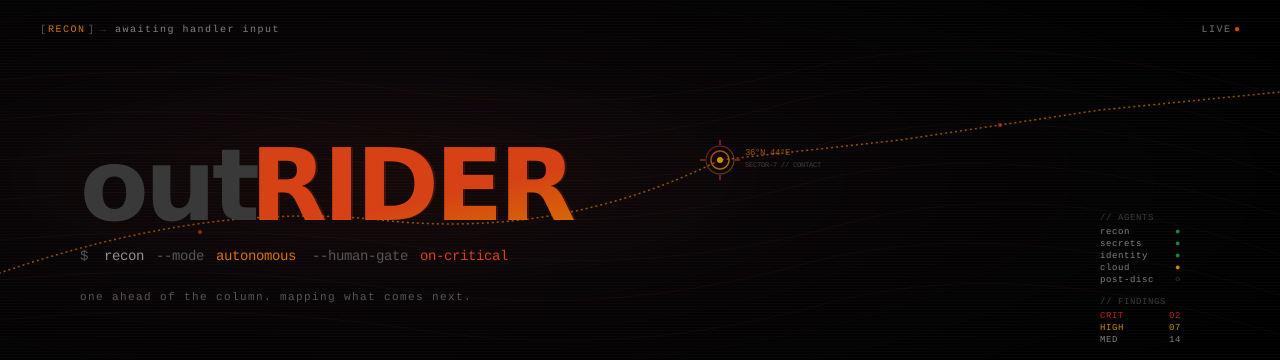



Claude-native, governed offensive-OSINT and external attack-surface platform for authorized security teams.
Outrider is the governed front half of the offensive workflow. It runs authorized, multi-agent OSINT and external attack-surface recon — across web and API, identity and SSO, cloud and infrastructure, secrets, and people/breach intelligence — under deterministic scope, evidence, and approval controls, then turns what it finds into prioritized, evidence-backed, human-reviewed findings to hand off to validation and pen-testing.
Outrider is intentionally not an exploitation framework. Active enumeration is approval-gated, intrusive validation is a human hand-off, and exploitation is out of scope by design.
Most recon tooling tells you what exists: subdomains, ports, URLs, technologies, leaked files, and scanner output. Outrider focuses on the next question:
What matters first, and why?
Use Outrider to:
Outrider fits between raw discovery tools and active testing:
Outrider Recon → ranked leads / technique cards → proxy-assisted testing, manual validation, ASM tickets, or remediation
Fastest path — one command. From a checkout, bootstrap.sh creates an
isolated virtualenv, installs the package, links the Claude skills, and runs a
deterministic self-check so you know it works before touching a target:
git clone https://github.com/Ap6pack/outrider-recon.git
cd outrider-recon
./bootstrap.sh            # add --no-web for a base install, --no-skills to skip skill linking
source .venv/bin/activate
outrider                 # start the local browser portal
A healthy self-check ends with promoted_findings_total: 0 and
schema_validity_rate: 1.0. That is the friction-free way to confirm the
install; no API keys, targets, or network needed.
Just want to see it in a browser (Docker, Linux). Outrider binds loopback
only by design, so share the host loopback with --network host:
docker build -t outrider-recon .
docker run --rm --network host outrider-recon
# then open http://127.0.0.1:8765
Manual path. Install the web extra and run outrider:
python -m pip install -e ".[web]"
outrider
The browser is the normal human interface. Use the guided wizard to create an authorized engagement, then choose Review Scope. CLI subcommands remain available for advanced automation and recovery. Discovery enrichment is disabled unless outrider --enable-mcp-enrichment is used.
This is the minimum successful path. For complete setup options, see Installation and Usage.
curl -fsSL https://raw.githubusercontent.com/Ap6pack/outrider-recon/main/install.sh | bash
This clones to ~/.local/share/outrider-recon and symlinks all skills into ~/.claude/skills/, so re-running it updates in place. For manual copies, Claude Desktop/API setups, and uninstall steps, see Installation.
Or install as a Claude Code plugin. The repo ships a marketplace manifest, so Claude Code can register it and install the plugin — all skills included, namespaced as outrider-recon:<skill> — with updates managed through /plugin:
/plugin marketplace add Ap6pack/outrider-recon
/plugin install outrider-recon@outrider-recon
The Python CLI and web portal below are installed separately from the skills.
From a source checkout:
git clone https://github.com/Ap6pack/outrider-recon.git
cd outrider-recon
python -m pip install -e .
For release artifacts and checksum verification, see Release documentation.
outrider init example.com \
  --actor authorized-operator \
  --authorization-reference EXAMPLE-ROE-001
outrider scope-check runs/example.com api.example.com
Use docs/usage.md for command workflows, Claude prompts, state transitions, evidence handling, approvals, contracts, finding promotion, reporting, and operational patterns.
Scope → Recon → Enrich → Score → Finding Cards → Handoff → Report
The design keeps reasoning and enrichment separate from durable authorization, scope, evidence, and finding records. See Architecture, Contracts, and the ADRs under docs/adr/ for details.
Recon & OSINT domains — Claude skills spanning the external attack surface:
Governance & orchestration — the controls that make the above safe to run:
Where this fits — Outrider is the governed recon half of the offensive life-cycle (recon → validation → reporting). Active enumeration is approval-gated and intrusive validation is a human hand-off today; extending the governed loop toward agent-to-agent validation is on the roadmap.
See Capabilities for the capability breakdown by domain and Coverage for coverage by engagement phase.
A useful recon workflow should not end with a flat list of hosts. Outrider aims to produce ranked, evidence-backed leads like this:
[HIGH] api.acme.example exposes OpenAPI schema
Confidence: Confirmed
Evidence: GET /openapi.json returned 200; schema includes user/account/order paths
Why it matters: API schema reveals object identifiers and hidden write endpoints
Public report intelligence: similar disclosed reports map to IDOR, mass assignment, and broken authorization patterns
Recommended handoff: hunt-api-misconfig, hunt-idor, Burp Repeater authorization testing
Safe next step: verify auth requirements and object-level authorization without modifying production data
See examples/05-sample-output.md for a fuller sanitized example.
Outrider has separate install paths for Claude skills, the Python CLI, optional web extras, and optional MCP server dependencies. The base Python package installs deterministic local controls and the CLI; web control-plane dependencies are installed with the web extra; MCP dependencies are installed from mcp-server/requirements.txt in a source checkout.
Use docs/installation.md for supported install patterns, including one-click install, manual Claude Code setup, editable Python installs, web extras, MCP setup, updates, and uninstall steps.
Outrider currently has four implementation domains:
The repository does not claim to execute full automated recon on its own. It is a controlled harness for authorized recon workflows and safe handoff. See Architecture, Web review plane, and Release readiness for the current product boundary.
Outrider ships as a single product under one version:
4.0.0 — the Python package and the Claude plugin/content bundle share this number.1
Stars on GitHub
Scans cloud accounts against security best practices and compliance benchmarks such as CIS.
@prowler-cloudInstall MCPGives coding agents semantic code search and editing through language server integration, IDE style codebase navigation.
 @trailofbitsInstall MCP
Ships with agent-governance-toolkit: AI Agent Governance Toolkit — Policy enforcement, zero-trust identity, execution sandboxing,…
 @microsoftInstall MCP
