
Content
Plugin
shotkit
The pre-production system we use to ship hundreds of videos a month. Open-sourced.

Plugin Signal57/100Fair
maintained75
capable37
documented75
adopted29
Install
$ npx -y skills add whystrohm/shotkit --agent claude-code
What's inside
Skill(5 skills)
/brand-lock-extractorExtract a production-ready brand-lock.md from a brand's existing assets. Point it at a website URL, a brand book PDF, screenshots, or a written description and it produces the nine-section brand-lock the rest of shotkit consumes, with a confidence and source noted for every/storyboard-architectTurn a creative brief into a production-grade storyboard with shot specs, timing, on-screen text, and per-shot rationale. Use when the user describes a video brief, plans a video, references shots or beats, scripts a social video, or hands over a creative concept to break into/storyboard-html-previewRender a structured storyboard (storyboard.md, shots.json, text-overlays.json, brand-lock.snapshot.md) into a single-file HTML preview that is shareable, printable, and offline. Use when the user wants to share a storyboard, export for review, hand off to an editor, or print a
README
shotkit
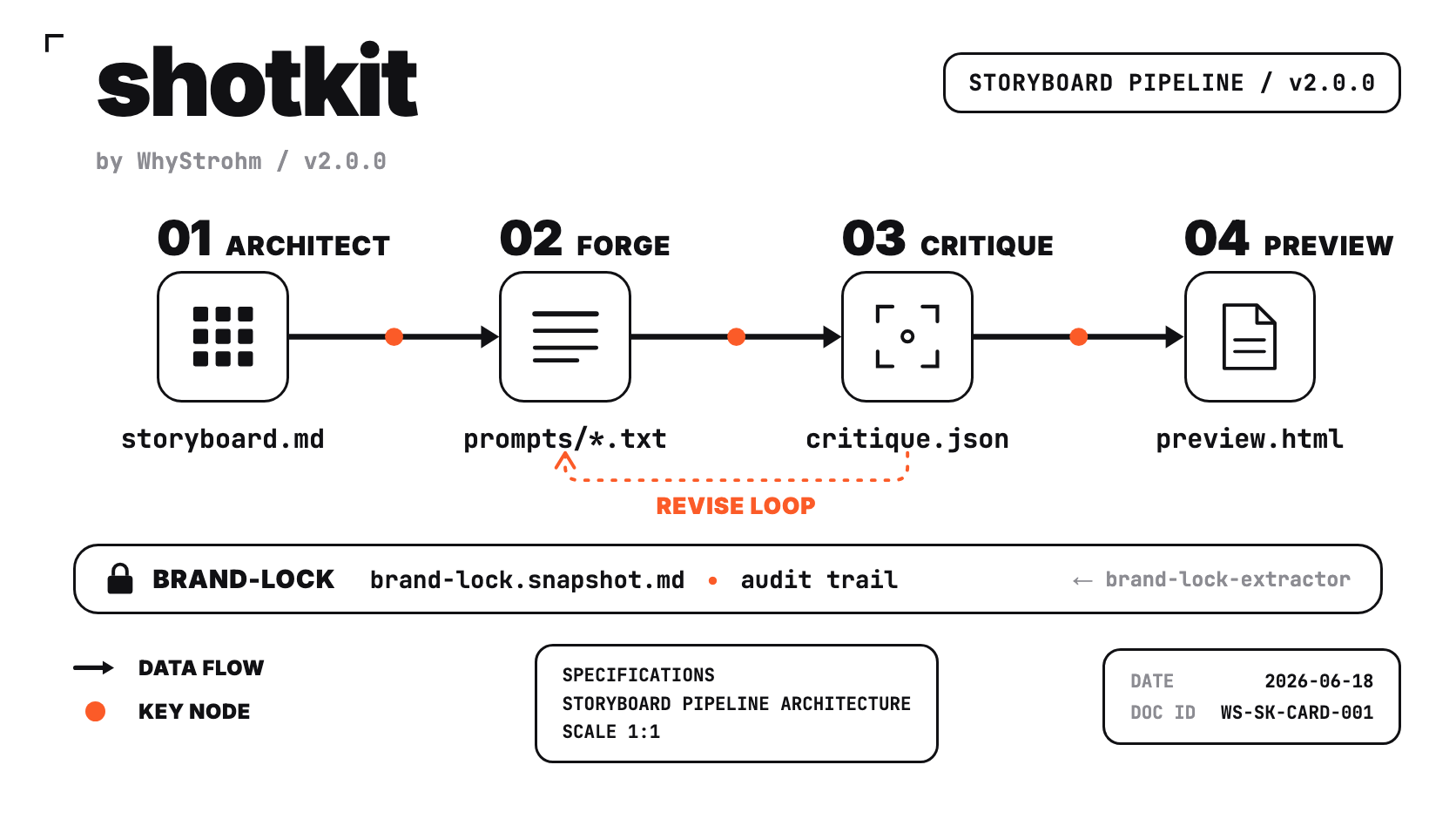
The pre-production system we use to ship hundreds of videos a month. Open-sourced.
Five Claude Skills that turn a creative brief into a production-grade storyboard with model-specific image prompts, on-screen text specs, an HTML preview, and a versioned audit trail, plus a brand-lock extractor that onboards a brand from its existing assets. Built by WhyStrohm. Apache 2.0.
git clone https://github.com/whystrohm/shotkit.git
cd shotkit && ./install.sh
That installs all five skills into ~/.claude/skills/. Restart your Claude Code session and they're live.
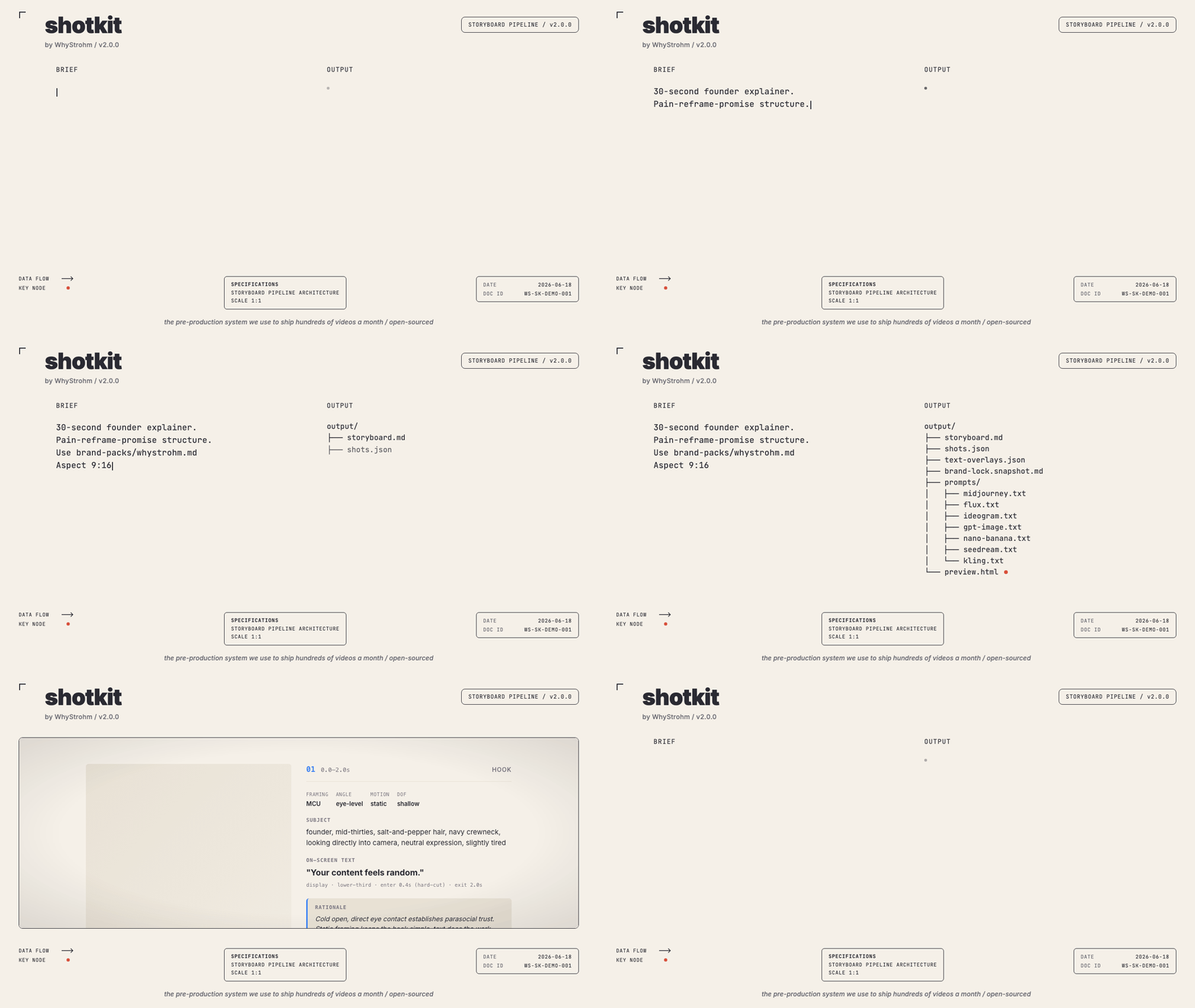
Watch shotkit explain itself. The 90-second explainer was made by shotkit. The storyboard, shots.json, brand-lock snapshot, per-generator prompts, and rendered preview live at skills/storyboard-architect/examples/shotkit-explainer/. Full breakdown at whystrohm.com/blog/you-dont-have-a-content-problem.
The rendered video and the demo GIF above are from v0.1.0 and have not been re-cut: they show seven adapters including Runway/Sora, which was discontinued and replaced by the fal.ai motion lineup. The storyboard files beside them are current.
What it does
You describe a video. The kit produces a complete pre-production package:
output/
├── run.json                   # Run id + every input pinned by content hash
├── storyboard.md              # Human-readable, shot-by-shot
├── shots.json                 # Schema-validated, machine-readable
├── text-overlays.json         # On-screen text + timing
├── brand-lock.snapshot.md     # Frozen brand state at generation time
├── prompts/round-1/           # Per-generator prompts, copy-paste ready
│   ├── midjourney.txt
│   ├── flux.txt
│   ├── ideogram.txt
│   ├── gpt-image.txt
│   ├── nano-banana.txt
│   ├── seedream.txt
│   ├── kling.txt              # Motion video (default)
│   ├── veo.txt                # Motion: dialogue/lipsync + native audio
│   ├── seedance.txt           # Motion: multi-shot sequences
│   └── hailuo.txt             # Motion: budget iteration
├── frames/round-1/            # Your generated frames
├── critiques/round-1/         # One verdict per shot, hashing what it reviewed
└── preview.html               # Single file. Shareable. Printable. Brand-aware.
Files. Not panels. Not a SaaS dashboard. Files an editor, agency, or developer can act on without asking follow-up questions.
Everything is addressed by round and shot, so no two writes land on the same path. Two people can work one project without overwriting each other's verdicts, and round 2 never destroys the prompt that produced round 1's frames.
The five skills
| Skill | What it does |
|---|---|
brand-lock-extractor | Brand assets (URL / PDF / screenshots) → validate-ready brand-lock.md |
storyboard-architect | Brief → structured storyboard (storyboard.md + shots.json) |
visual-prompt-forge | Shot data → model-specific prompts for 10 generators (6 stills, 4 motion) |
visual-asset-critic | Generated image + intent → markdown critique + machine-readable critique.json |
storyboard-html-preview | Storyboard files → single-file shareable HTML |
They work alone. They work better together, the critic writes a machine-readable verdict the prompt-forge can act on, so generate → critique → revise → re-critique runs as a closed loop. See docs/the-qa-loop.md. They work in Claude Code, Claude.ai, and the Claude API.
Why this exists
Every storyboard tool on the market is a SaaS app with a UI you log into. You upload a brief, you get illustrated panels, you export. The output never leaves the platform.
That's not how serious teams work. Serious teams want:
- Files, not cloud-locked panels
- Audit trail, not vibes. Every shot has rationale, every prompt is reproducible, every brand parameter is versioned.
- Brand lock, not "AI reads your URL". Explicit brand parameters that compose deterministically across every shot.
- Model agnosticism. Prompts adapt to whichever image generator you're using this month.
- No vendor lock-in. Markdown, JSON, HTML. Open formats only.
shotkit is what we use internally at WhyStrohm to ship hundreds of videos from code. We're publishing the methodology because the methodology isn't the moat. The operator is.
Read more in docs/why-this-exists.md.
Why this isn't another storyboard tool
The category isn't empty. It's full of tools that solve the wrong half.
- Provenance you can check, not just claim. Every run freezes brand state and records a content hash for every input, prompt, and reviewed frame. Six months later you can answer "what brand version was this built against" and prove the files have not moved since, because
validate_provenance.pyrecomputes the hashes. A frame regenerated after its review fails that check instead of passing quietly on a stale ACCEPT. - Ten generators, one spec. The same shot data adapts to six stills generators (Midjourney, Flux, Ideogram, GPT Image, Nano Banana, Seedream) and four motion-video models (Kling, Veo, Seedance, Hailuo). Every other storyboard skill on GitHub locks to one generator family.
- Files, not panels. The output is structured Markdown and JSON an editor, motion designer, or developer can act on. No dashboard, no export step, no platform.
- Methodology over pipeline. The pack stops at prompts and specs. Generator APIs churn monthly, the methodology stays stable. The pipeline lives where it belongs, in the operator's tooling.
60-second example
Drop this into a Claude Code session with the skills installed:
"30-second founder explainer for WhyStrohm. We help founder-led brands build content infrastructure instead of running content like a hobby. Pain-reframe-promise. Use
brand-packs/whystrohm.mdas the brand lock. Aspect 9:16."
Claude produces the full output/ set. Open output/preview.html in any browser. Print it. Share it. Hand it to an editor.
A complete worked example lives at skills/storyboard-architect/examples/30s-pain-proof-promise/. Clone the repo and open preview.html in that folder to see what the deliverable looks like.
Round-trip workflow
The complete loop, idea to revised image:
- Brief describes the video.
storyboard-architectproducesrun.json,storyboard.md,shots.json,text-overlays.json,brand-lock.snapshot.md.visual-prompt-forgewrites a prompt file per generator underoutput/prompts/round-1/.tools/copy-prompt.pypipes one shot's prompt to the clipboard. Paste into the generator UI.- The generator returns an image. It goes in
output/frames/round-1/shot_NN.png. visual-asset-criticscores the frame against the shot spec and brand-lock, writingcritiques/round-1/shot_NN.critique.jsonwith the hash of the frame, the prompt, and the brand-lock it judged.tools/validate_provenance.pyre-checks every hash and reports which shots are still open.- On REVISE,
visual-prompt-forgerevision mode re-emits prompts for only those shots intoround-2/. On REJECT, it stops and asks: a REJECT means no fix path exists. - Repeat from 5 until
--require-acceptexits 0.
python tools/validate_provenance.py output/ --require-accept || echo "work remains"
Files at every step. See docs/the-qa-loop.md for the full loop and
skills/visual-asset-critic/examples/worked-run/
for a real two-round output tree with hashes.
The methodology
Four ideas. None negotiable.
1. Five-layer prompt anatomy. Every image prompt is composed from locked layers: Brand Lock, Series Lock, Shot Spec, Text Layer, Generator Adapter. Change a brand color once. Every prompt updates. See docs/the-five-layer-prompt.md.
2. Versioned brand state, pinned by hash. Every run snapshots the brand-lock it was built against and records its SHA-256 in run.json. Brand changes later? The snapshot stays frozen, and if someone overwrites it, the hash mismatch says so. A filename alone never proved anything, which is the whole reason the hashes are there. See docs/audit-trail-pattern.md.
3. Text never gets baked into images. On-screen copy is a separate layer with its own timing, font, and animation spec. Always composited after generation. AI text rendering is not production-ready in 2026; treat text as a separate compositing pass.
4. Per-shot rationale. Every shot has a rationale field. Why this beat. Why this duration. Why this framing. Why this on-screen text. Decisions are logged so they can be challenged.
Brand packs
A brand pack is a single Markdown file that locks palette, typography, voice, and visual rules for a project. Three live in this repo:
brand-packs/_template.md. Empty starter.brand-packs/whystrohm.md. Flagship example, real WhyStrohm brand.brand-packs/examples/saas-clean.md. Neutral B2B SaaS reference.
Roll your own from the template. Or generate one from existing brand assets with media-tsunami, WhyStrohm's open-source brand voice extractor.
See brand-packs/README.md for the full pattern.
Where this stops, where the pipeline starts
shotkit produces specs and prompts, not rendered images or videos. The boundary is deliberate:
- In scope. The methodology, the structure, the prompts, the audit trail.
- Out of scope. API integrations to image generators or voice tools, the video render pipeline, automated publishing.
If you want the version where this is wired into a video render pipeline with automated publishing across multiple brands: whystrohm.com. The methodology is open. The operator is paid.
See docs/connecting-to-generators.md for how teams typically wire it up themselves, and docs/connecting-to-video-pipelines.md for how shots.json maps to programmatic video frameworks.
What comes after shotkit
shotkit is one stage in a longer content infrastructure pipeline:
- Brief captured from the founder
- shotkit turns the brief into structured pre-production files
- Image generators consume the per-generator prompt files
visual-asset-criticreviews each generated frame against its shot spec- Approved frames feed into a programmatic video framework
- The framework renders the final video
- Publishing tools post per-platform copy from
text-overlays.json
shotkit owns step 2. Steps 3 through 7 are file boundaries, not API integrations. Each downstream tool reads files. Nothing is coupled beyond the schema.
For wiring it up yourself, see docs/connecting-to-generators.md and docs/connecting-to-video-pipelines.md. For the operated version, whystrohm.com.
Companion tools
shotkit is part of a broader WhyStrohm open-source ecosystem of brand-infrastructure tools:
- media-tsunami brand voice extraction. Generates the brand-pack files shotkit consumes.
- whystrohm-audit content audit against a 5-layer framework.
File tree
FAQ
shotkit is a Claude Code plugin with 5 hand-picked skills for content work, indexed on Flowy. Install it with the command on its page. It includes brand-lock-extractor, storyboard-architect, storyboard-html-preview. Its skills do not fire on their own yet. Request auto-invocation to have Flowy route them as you prompt. Free and open source.
- What is shotkit?
- The pre-production system we use to ship hundreds of videos a month. Open-sourced.
- How do I install shotkit?
- Run these in Claude Code: npx -y skills add whystrohm/shotkit --agent claude-code. Then prompt normally.
- Does shotkit auto-invoke its skills?
- Not yet. It is indexed on Flowy as a plain plugin. Request auto-invocation on its page and Flowy will route its skills for you as you prompt.
- Is shotkit free?
- Yes. Flowy is free and open source, with nothing gated. You can read every skill in full before you install.
Is this plugin yours?
Claim it with GitHubSubmit a pluginPromote it