
Development
Plugin
modelharness
Make every model cheaper or better. Measured on four Claude models — none got worse. What it actually is: a zero-config Claude Code plugin.

Plugin Signal58/100Fair
maintained54
capable46
documented100
adopted33
Install on Claude Code
> /plugin marketplace add vitaliikapliuk/modelharness> /plugin install modelharness@modelharness
What's inside
Skill(3 skills)
/delegation-triggersUse when deciding whether to spawn subagents — explicit rules for when delegation pays off and when direct work is faster. Opus 4.8 under-delegates by default; these rules correct that./memory-disciplineUse when recording lessons learned in a project, or when a project contains lessons/ or MEMORY.md — file-based memory format and read/write rules that measurably improve long-horizon performance./verification-loopUse when a task spans more than a few steps or files — establishes a checkable definition of done, a verification cadence, and fresh-context verifier subagents before claiming completion.
Command(3 commands)
/goalExtract a full task specification up front (goal, constraints, definition of done), then execute — the primary documented lever for Opus 4.8 long-horizon quality./retroWrite this session's lessons into the project's lessons/ directory using the memory-discipline format./verifySpawn a fresh-context verifier subagent to check completed work against its specification before trusting it.
Hook(1 hook)
README
modelharness
Make every model cheaper or better. Measured on four Claude models — none got worse.



What it actually is: a zero-config Claude Code plugin. On every session start it injects a ≈910-token behavioral core — six working practices distilled from how Fable 5 was trained to operate — plus three on-demand skills and a fresh-context verifier agent. No commands to learn; the model just starts working differently:
| ✅ Grounded progress — only claims backed by a tool result; "tests fail" said plainly | ⚡ Act, don't overplan — enough information means act, not narrate options |
| 🎯 Autonomy calibration — decides minor things itself, asks only on scope or destructive actions | 🔍 Self-verification loops — a checkable definition of done, real checks on a cadence, a fresh-context verifier before "done" |
| 🔀 Delegation triggers — explicit rules for when to fan work out to subagents | 📝 Cross-session memory — writes lessons and plans to files, so the next session can pick up the work |
What the 17 tasks test
| 🐛 Bug hunts 4 tasks · 96 runsFind and fix planted defects: TTL cache, CSV quoting, rate limiter, date rollover | ✨ Features from spec 4 tasks · 96 runsBuild to a written spec: retry backoff, config merging, cursor pagination, slugify | ♻️ Refactors 2 tasks · 48 runsRestructure code with zero behavior change, verified structurally |
| 🧠 Long-horizon builds 2 tasks · 48 runsMulti-stage pipelines where later steps depend on earlier decisions | 🧩 Spec-dense traps 3 tasks · 72 runs18+ interacting rules (discount engine, mini-interpreter) that punish shallow reading | 🔁 Session handoffs 2 tasks · 48 runsA fresh session must finish another session's work — memory is the only bridge |
17 tasks × 3 attempts × 8 configurations = 408 runs. Grading is hidden and binary: test suites the agent never sees decide pass/fail. No LLM judge. Every task ships with a reference solution proving it solvable.
The results
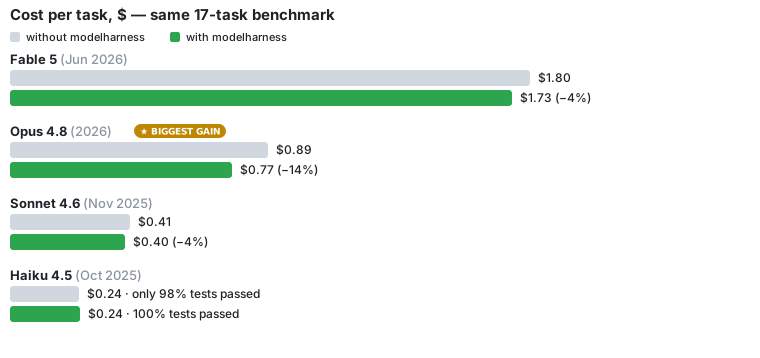
The numbers, exactly
Same 17 tasks, 3 runs per configuration. Higher pass rate and lower cost/time are better. 🟢 = better with modelharness, 🔴 = worse (explained in the last row).
The bottom line. modelharness packages the same working practices Fable 5 was trained on. The practices land hardest on Opus 4.8 — the flagship model available on every subscription — at −14% cost / −16% time, and that win is statistically significant (see below). Even Fable 5, competing against itself, runs significantly faster. On smaller models the average hides a trade: Haiku saves up to 19% on routine bugfixes but spends more on spec-dense tasks — extra verification work that is exactly what lifted its pass rate from 98% to 100%. Cheaper where it can be, more careful where it must be — and never significantly worse on any model.
How confident are we?
Averages can hide noise, so we ran the honest test: pair each model's plain vs +modelharness runs on the same task (3 reps averaged), take the per-task percentage delta, and put a 95% confidence interval around the mean across all 17 tasks. A CI that clears zero is a real effect; one that straddles zero is within run-to-run noise. Regenerate with python3 bench/stats.py.
| Model | Cost Δ (95% CI) | Time Δ (95% CI) | Tasks cheaper |
|---|---|---|---|
| Opus 4.8 | −12.0% [−17.3, −6.7] · significant | −16.5% [−25.3, −7.7] · significant | 15 / 17 |
| Fable 5 | −3.2% [−10.6, +4.2] · within noise | −11.4% [−20.1, −2.8] · significant | 8 / 17 |
| Sonnet 4.6 | −4.0% [−11.3, +3.3] · within noise | −7.8% [−15.7, +0.0] · within noise | 10 / 17 |
| Haiku 4.5 | +0.3% [−8.7, +9.3] · within noise | −4.5% [−17.6, +8.6] · within noise | 9 / 17 |
What this means, stated plainly: the harness delivers a statistically significant cost-and-time reduction on Opus 4.8 — the model most people run on a subscription — and a significant speed-up on Fable 5. For Sonnet 4.6 and Haiku 4.5 the cost and time changes are within noise: not a reliable saving, but never a reliable loss either. Quality is not a sampled average — it is an exact binary count: 407 of 408 runs passed, and the one failure (bare Haiku 4.5 on a session-handoff task) is fixed 3/3 by the harness. So the defensible claim is narrow and true: Opus gets meaningfully cheaper and faster, every model gets a memory-driven reliability floor, and none is significantly worse.
⚡ Install — 30 seconds, zero config
/plugin marketplace add vitaliikapliuk/modelharness
/plugin install modelharness@modelharness
Restart Claude Code — active in every session, on whatever model you run.
Why this exists
Claude Fable 5 left subscription plans on June 23, 2026 — the most capable model became API-only, and most subscribers went back to Opus, Sonnet, or Haiku. That raised a question worth measuring rather than debating: how much of a frontier model's edge is weights, and how much is working practices — the documented behaviors like grounded progress reporting, self-verification, and file-based memory that Anthropic describes in its own migration guides?
So we distilled those practices into a plugin and built a benchmark to find out. The answer surprised us in both directions: on self-contained coding tasks the practices made every model cheaper or better — including Fable 5 itself — while raw correctness at benchmark scale turned out not to separate the models at all. The harness, not the weights, was the measurable difference.
How it works
A SessionStart hook injects a behavioral core (≈910 tokens — your entire context tax, measured, not estimated) implementing six patterns from Anthropic's official Fable 5 migration guide:
| Pattern | Source |
|---|---|
| Grounded progress claims | Fable 5 migration guide → "Ground progress claims on long runs" |
| Act, don't overplan | Fable 5 migration guide → "Longer turns by default" |
| Autonomy calibration | Opus 4.8 notes → "More deliberate — asks more often" |
| Self-verification loops | Fable 5 guide → "Make self-verification explicit" |
| Delegation triggers | Opus 4.8 notes → "Under-utilization of subagents" |
| Memory surface | Fable 5 guide → "Give it a memory surface" |
File tree
FAQ
modelharness is a Claude Code plugin with 3 hand-picked skills for development work, indexed on Flowy. Install it with the command on its page. It includes delegation-triggers, memory-discipline, verification-loop. Its skills do not fire on their own yet. Request auto-invocation to have Flowy route them as you prompt. Free and open source.
- What is modelharness?
- Make every model cheaper or better. Measured on four Claude models — none got worse. What it actually is: a zero-config Claude Code plugin.
- How do I install modelharness?
- Run these in Claude Code: /plugin marketplace add vitaliikapliuk/modelharness then /plugin install modelharness@modelharness. Then prompt normally.
- Does modelharness auto-invoke its skills?
- Not yet. It is indexed on Flowy as a plain plugin. Request auto-invocation on its page and Flowy will route its skills for you as you prompt.
- Is modelharness free?
- Yes. Flowy is free and open source, with nothing gated. You can read every skill in full before you install.
Is this plugin yours?
Claim it with GitHubSubmit a pluginPromote it