
hush
Quieter sessions for Claude Code: less narration, shorter tool output and concise answers focused on the result.
8 hooks1 command+154
 @v-songbird
Audits a project's declared dependencies to find packages that no source file imports, and adds hooks that flag unnecessary code and file growth before more is added. For Claude Code users who want leaner codebases.
Claude Code
$ npx -y skills add V-Songbird/razor --agent claude-code
Codex
$ npx skills add V-Songbird/razor -a codex
Cursor
$ npx skills add V-Songbird/razor -a cursor
Gemini CLI
$ npx skills add V-Songbird/razor -a gemini-cli
GitHub Copilot
$ npx skills add V-Songbird/razor -a github-copilot
OpenCode
$ npx skills add V-Songbird/razor -a opencode
Windsurf
$ npx skills add V-Songbird/razor -a windsurf


You ask for a small query parser. The assistant reaches for a package, adds helper files, and leaves you more code to maintain. Razor asks whether the language or your project already has what the task needs.
It puts a short checklist before new code and uses targeted checks to prompt reconsideration of unnecessary additions. The aim is to finish the requested work with less to maintain. This example illustrates the workflow; the measurements below describe specific recorded runs.
A checklist asks whether the work is needed, already implemented or covered by the language. Targeted checks can request one reconsideration. A retry follows the host’s normal permissions. The unused-dependency audit reports findings without uninstalling anything.
| You want to | Outcome |
|---|---|
| Keep a small task small | Check reuse, dependencies and file growth |
| Pause or resume the checks | Change the session toggle |
| Find unused dependencies | Receive a report with confirmed, likely and unknown findings |
Send razor off or razor on to pause or resume the checks for the session; /razor off and /razor on also work in Claude Code. Send the toggle as a message of its own, with nothing else and no formatting; a final period or exclamation mark is fine.
Antigravity has no prompt event, so the toggle does not exist there. To keep razor out of an Antigravity session, set the environment variable RAZOR_DISABLE to 1 in the shell that launches Antigravity, before Antigravity starts (export RAZOR_DISABLE=1 in bash, $env:RAZOR_DISABLE = '1' in PowerShell). An Antigravity that is already running does not pick up the change.
Use /razor:unused in Claude Code, $razor:unused in Codex, or /unused in Antigravity. In Codex, mention the skill with its plugin prefix: Codex attaches the skill's instructions for $razor:unused, but not for a bare $unused.
Razor is one package for Claude Code, Codex and Antigravity. Install it in the one you use.
Requirements: Node.js 22 or later, Git and a Codex host with plugin support.
codex plugin marketplace add V-Songbird/foundry
codex plugin add razor@foundry
Review and enable its hooks, then start a new Codex session.
Requirements: Node.js 22 or later, Git and Claude Code 2.1.139 or later.
Inside Claude Code:
/plugin marketplace add V-Songbird/foundry
/plugin install razor@foundry
Start a new session to load the plugin.
Requirements: Node.js 22 or later, Git and the Antigravity CLI. Antigravity has no marketplace for third-party plugins, so install razor from a clone of Foundry, which checks razor out at the commit the Claude Code and Codex catalogs pin. Replace <path-to-clone> with the directory to clone into:
git clone --recurse-submodules https://github.com/V-Songbird/foundry.git <path-to-clone>
agy plugin install <path-to-clone>/razor
agy plugin list
The list should name razor. Start a new conversation to load it. The checklist and the drift note are added to every model call, because a message injected there reaches only the call it is attached to, and the build check speaks through the stop hook; the calls that answer it carry no drift note. Antigravity has no subagent event, so subagents there receive no checklist.
The install is a copy, so it stays at that commit. To take a new release, update the clone, install again and start a new conversation:
git -C <path-to-clone> pull
git -C <path-to-clone> submodule update --init
agy plugin install <path-to-clone>/razor
Input validation, security and error handling that protects your work remain necessary. Explicitly requested scope stays yours to choose. These checks are advisory, not a security boundary.
File checks see the edits made through the assistant's own editing tool: apply_patch in Codex, Write and Edit in Claude Code, write_to_file and replace_file_content in Antigravity. Files written by a shell command skip them, and so do unsupported or ambiguous patches in Codex. See setup and coverage and how razor works.
Each result belongs to the named model and recorded run. Missing measurements remain marked as unmeasured. The Codex run and the Claude Opus 5.5 run below measured the checklist's current one-lookup-per-rung sentence; the Claude Opus 5 run used its earlier "One check is enough, anywhere in this task" wording.
| Model | Setup | Correct and safe | Mean coding lines |
|---|---|---|---|
| GPT-5.6 Sol | No plugin | 19/26 | 18.7 |
| GPT-5.6 Sol | razor | 26/26 | 10.4 |
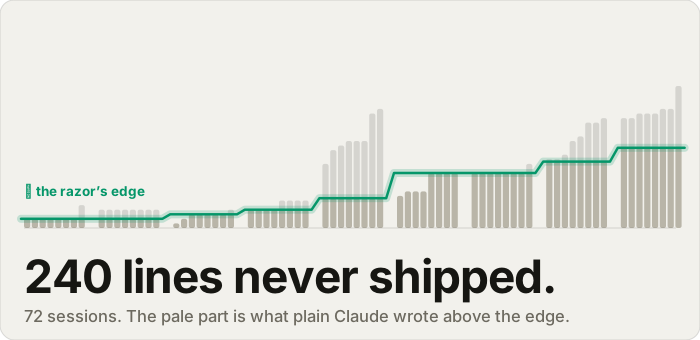
Controlled Codex run at high reasoning on Windows, on 2026-10-09 against razor 18d1d0a: the table covers the full task group. Across all groups, razor passed 38/38 cases versus 29/38 without it. On jointly passing pairs, the median ratio of razor's coding lines to the no-plugin answer's was 0.500. Elapsed time was 15.1% higher and input tokens 5.1% higher; output tokens were 6.2% lower. This exploratory result does not compare Sol against Claude.
| Model | Setup | Correct and safe | Mean coding lines |
|---|---|---|---|
| Claude Opus 5.5 | No plugin | 24/26 | 16.2 |
| Claude Opus 5.5 | razor | 26/26 | 8.7 |
Claude Code 2.1.296 on Windows, claude-opus-5-5 at the CLI's default effort, on 2026-10-13 against razor checked out at a6ecf5f, whose plugin code is identical to 1.8.1 (6174db6): the 13 jobs of the full suite, twice each per setup. Mean session cost was $0.086 with razor and $0.100 without a plugin; razor cost more on four jobs: the two with no code and two coding jobs. Two repetitions are exploratory, not a stable estimate. These workspaces sat outside the temp folder, so razor's new-file check was active; it did not speak. In a two-request drift test on the same setup and date, razor noted unrelated second requests in 3 of 3 conversations, against 0 of 3 without a plugin, and stayed quiet on 3 of 3 same-job corrections. In a run on 1.8.2 (9eb5215) with 3 three-request conversations per setup, razor noted the first unrelated request in 3 of 3 conversations and did not repeat the note on the third request in any.
| Model | Setup | Correct and safe | Mean coding lines |
|---|---|---|---|
| Claude Opus 5 | No plugin | 35/39 | 18.3 |
| Claude Opus 5 | ponytail | 39/39 | 12.2 |
| Claude Opus 5 | razor | 39/39 | 9.6 |
A clean session completed the job without adding a package. Lines are averaged across the coding jobs. Mean session cost was $0.121 with razor, $0.155 without a plugin and $0.151 with ponytail, another plugin that tells Claude to write less. The Claude Opus 5 run's CLI version and effort were not recorded. Blind comparisons did not establish better readability, and Sonnet cost savings did not reproduce reliably. These are recorded Claude results. The runner put this run and the earlier Claude Code runs in a temp folder by default, where razor's new-file check stays silent, so treat them as measuring its other checks only.
The Claude Opus 5 run in the second Claude Code table above (razor revision not recorded; published 2026-09-01 in cbc92f3; run date not recorded): its 27 no-plugin sessions on the nine dependency jobs. These measurements describe the recorded Claude sessions, not Codex performance.
Watch the recorded Claude Code demo: one real session each on Claude Opus 5, replayed on the recorded clock, published September 4, 2026

| Model | Setup | Correct and safe | Mean coding lines |
|---|---|---|---|
| Not measured | Not measured | Not measured | Not measured |
No Antigravity session has been measured yet.
Results can vary between runs.
How it works · Settings · Codex setup · Claude Code benchmark details · Codex benchmark details · Changelog
Foundry lists this plugin. The benchmark harnesses live in Foundry's benchmarks/ folder and are not distributed with the plugin.
MIT — see LICENSE.
Stars on GitHub
View @v-songbird’s profileQuieter sessions for Claude Code: less narration, shorter tool output and concise answers focused on the result.
@v-songbirdProject continuity for Claude Code and Codex: a roadmap beside your code, grounded handoffs, and clear task status.
@v-songbirdHelps you take a change from a rough idea or bug report through to a tested, reviewed result, with each step handled by a focused skill. Its skills cover pinning down domain terms, designing module interfaces, diagnosing hard bugs, and reviewing changes against your repo's coding standards.
 @mattpocock
A development methodology for coding agents that makes the agent brainstorm before building, follow plans, run parallel work and finish branches in a disciplined way. You get fewer skipped steps and more consistent results from your coding assistant.
 @obra
Gives your coding agent a planning, testing and review routine to follow on every task. It plans before building, checks changes with tests, has a fresh reviewer look for regressions, and saves repeated wins as reusable skills.
 @affaan-m
Developer tools for working on the React codebase itself. Provides skills for extracting error messages, managing and debugging feature flags across release channels, running Flow type checks, and fixing lint and formatting issues before committing.
 @facebook
Audits a project's declared dependencies to find packages that no source file imports, and adds hooks that flag unnecessary code and file growth before more is added. For Claude Code users who want leaner codebases. Install it with the command on its page. It includes unused. Its skills do not fire on their own yet. Free and open source.
Is this plugin yours?
Claim it with GitHubSubmit a pluginPromote it