
Code Review
MCP
code-review-graph
Ships with code-review-graph: Local-first code intelligence graph for MCP and CLI. Builds a persistent map of your codebase so AI coding tools read only what matters, with benchmarked context reductions on…
Claude Code
$ claude mcp add code-review-graph -- uvx code-review-graph serve
Codex
$ codex mcp add code-review-graph -- uvx code-review-graph serve
Cursor
{
  "mcpServers": {
    "code-review-graph": {
      "command": "uvx",
      "args": [
        "code-review-graph",
        "serve"
      ]
    }
  }
}
Add it to mcp.json.
Gemini CLI
$ gemini mcp add code-review-graph uvx code-review-graph serve
GitHub Copilot
$ copilot mcp add code-review-graph -- uvx code-review-graph serve
OpenCode
{
  "mcp": {
    "code-review-graph": {
      "type": "local",
      "command": [
        "uvx",
        "code-review-graph",
        "serve"
      ]
    }
  }
}
Add it to opencode.json.
Windsurf
{
  "mcpServers": {
    "code-review-graph": {
      "command": "uvx",
      "args": [
        "code-review-graph",
        "serve"
      ]
    }
  }
}
Add it to mcp_config.json.
Security report
Found
Low risk
Known flaws
None known
Signed build
No
No build provenance published
Maintained
Oct 29, 2026
Last push
Licence
MIT
Runs as
uvx
On your machine
Deprecated
No
Signals from public registries, not an audit. Checked Nov 12, 2026.
code-review-graph README
A local code knowledge graph that gives AI coding tools precise review context over MCP.
English | 简体中文 | 日本語 | 한국어 | हिन्दी






Usage · Commands · FAQ · Troubleshooting · GitHub Action · Reproducing the benchmarks · Roadmap
AI coding tools often re-read large parts of a codebase to review a change. code-review-graph builds a structural map of the code with Tree-sitter, keeps it updated incrementally, and serves compact context over MCP, so the assistant reads only the files a change touches.
Quick Start
pip install code-review-graph          # or: pipx install code-review-graph
code-review-graph install              # detect installed AI coding tools and configure each one
code-review-graph build                # parse the codebase
install detects which AI coding tools you have, writes an MCP server entry for each, installs hooks and skills where the platform supports them, and adds graph instructions to the platform's rules file. The MCP entry uses poetry run or uv run inside a Poetry or uv project environment, uvx code-review-graph serve when uvx is on PATH, and otherwise the current Python interpreter. Restart the editor or tool afterwards.
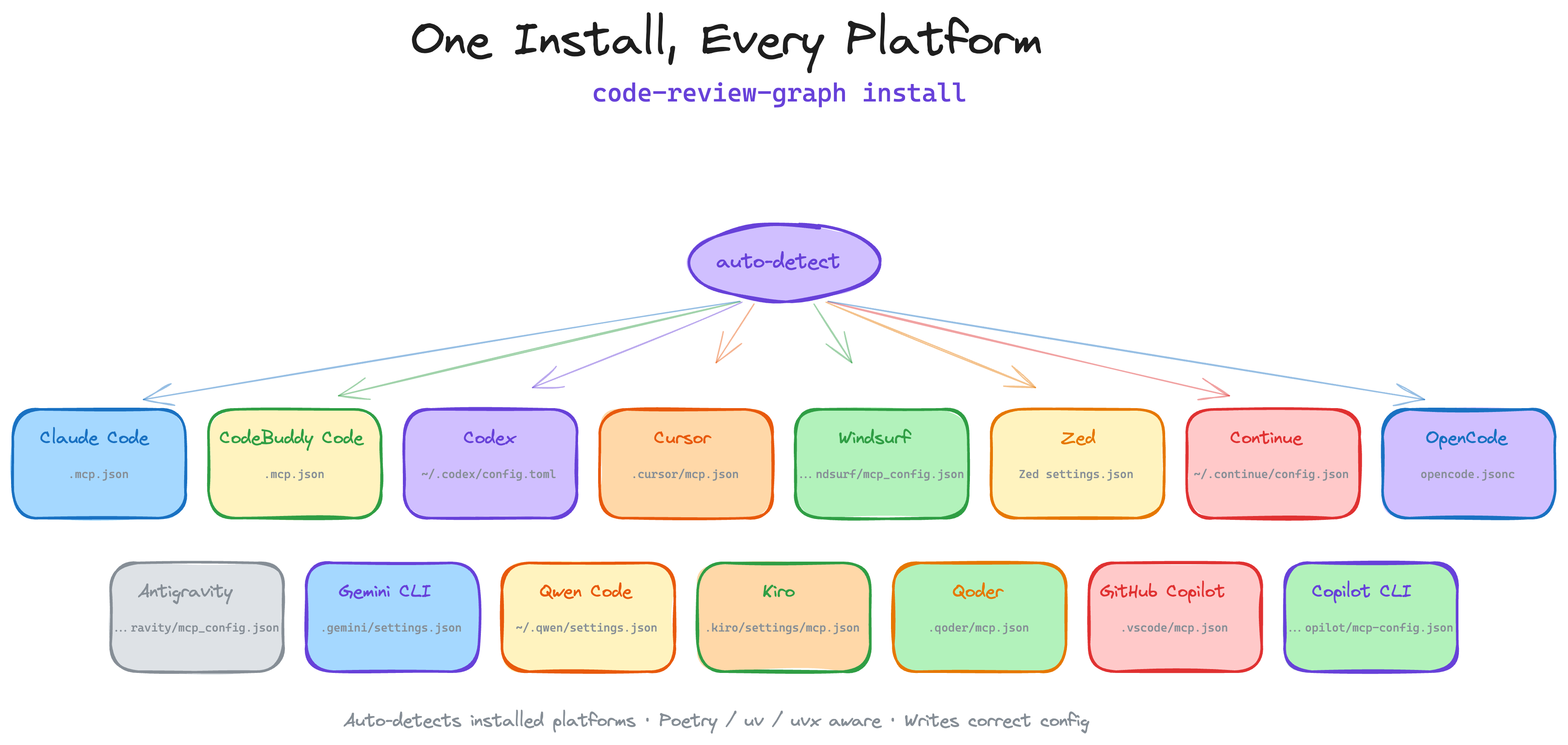
To configure one platform, pass --platform with one of codex, claude-code, cursor, windsurf, zed, continue, opencode, antigravity, gemini-cli, qwen, kiro, qoder, copilot, copilot-cli, codebuddy, or hermes:
code-review-graph install --platform cursor
code-review-graph install --platform codebuddy
Config file locations are listed in docs/USAGE.md. Requires Python 3.10+.
uninstall removes CRG-owned files and entries from a Git or SVN working tree and leaves other MCP servers, hooks, skills and JSONC comments alone. Run it from anywhere inside the tree. Shared config files are replaced atomically, so a failed write leaves the original intact.
code-review-graph uninstall --dry-run    # preview only
code-review-graph uninstall              # preview, confirm, apply
code-review-graph uninstall --yes        # apply without prompting
code-review-graph uninstall --all-repos  # also clean every registered repository
code-review-graph uninstall --keep-data  # remove integrations, keep graph databases
code-review-graph uninstall --keep-user-configs --repo .  # this project only
Then open the project and ask the assistant:
Build the code review graph for this project
Build time scales with repository size; a cold build of a ~3,000-file repository took about 40 seconds (measured). After that, hooks and watch mode keep the graph updated. If some files fail to parse, the result has status partial and names them in its summary; the CLI also prints a Warning: line on stderr, and those files keep their previous graph rows.
How It Works
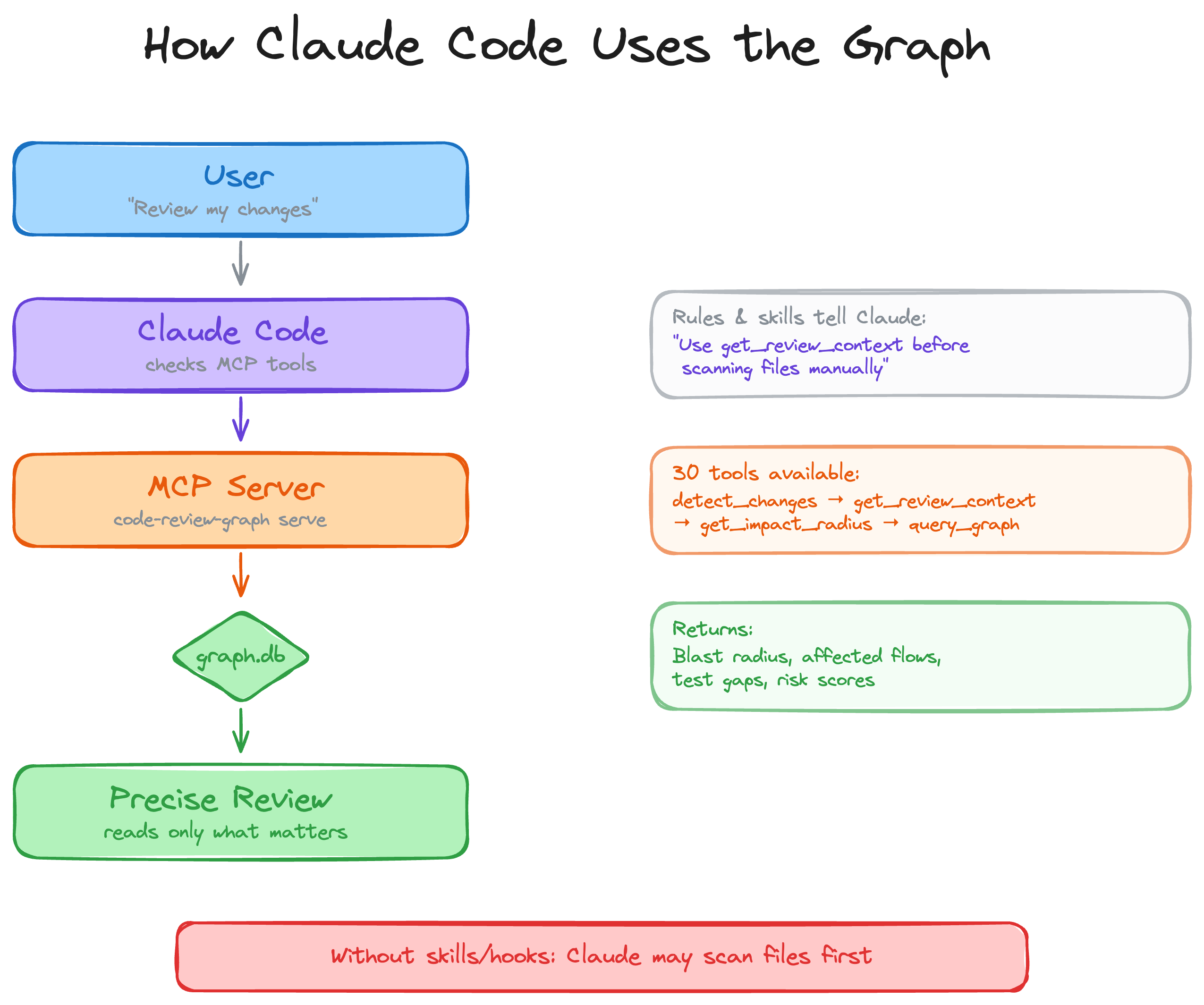
The repository is parsed into ASTs with Tree-sitter and stored as a graph of nodes (functions, classes, imports) and edges (calls, inheritance, test coverage). At review time the graph is queried for the smallest set of files the assistant needs to read.

Blast-radius analysis
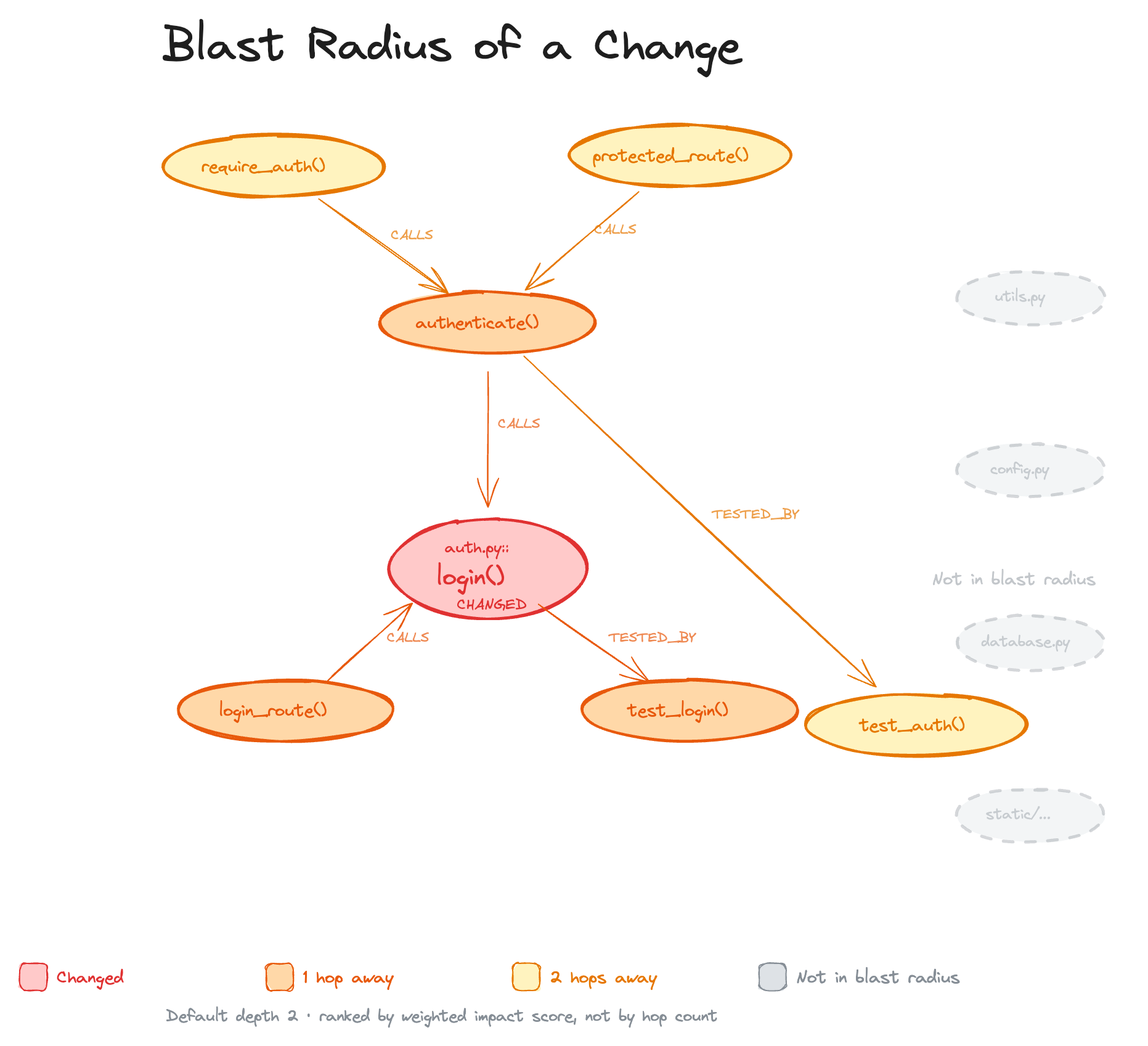
When a file changes, the graph traces every caller, dependent and test that could be affected. The assistant reads those files instead of scanning the whole project.
Incremental updates
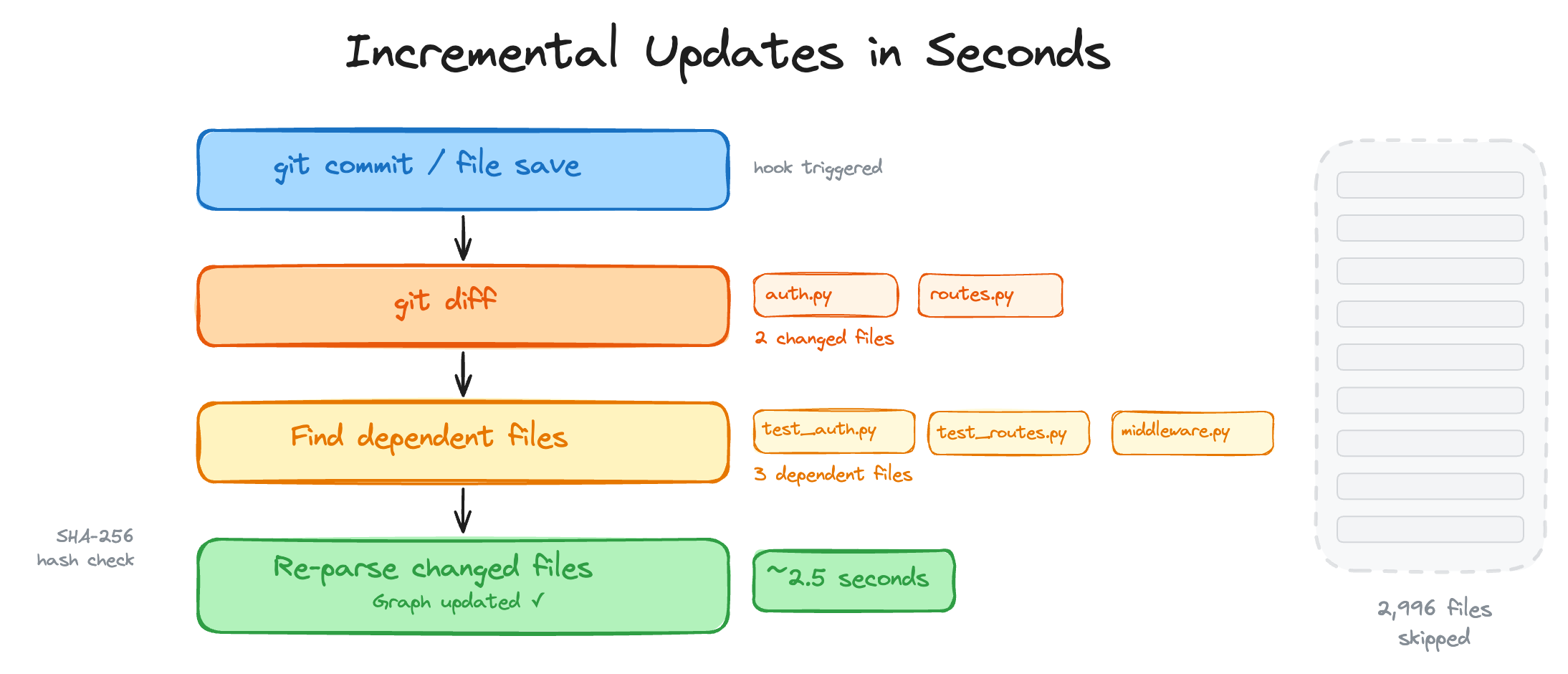
Hooks, the pre-commit hook and watch mode trigger incremental updates. The update diffs changed files, finds their dependents through the graph's import and call edges, and re-parses only the files whose SHA-256 hash changed. On a ~3,000-file project (django) a two-file edit re-indexes in about 2.5 seconds on the path the hooks use, of which ~1.4 s is process start-up; a no-op update costs only that start-up. See Incremental update latency.
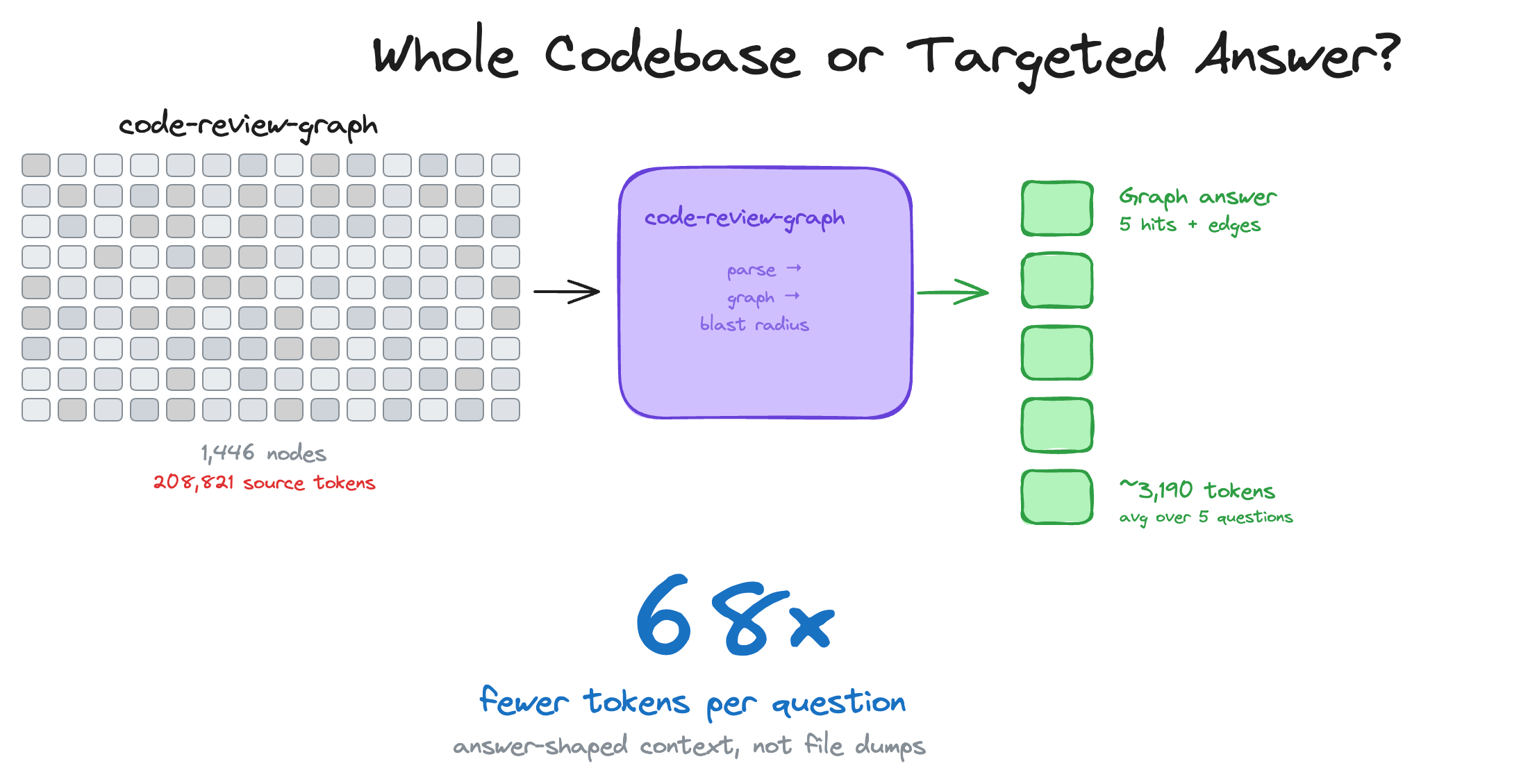
Whole codebase or targeted answer?
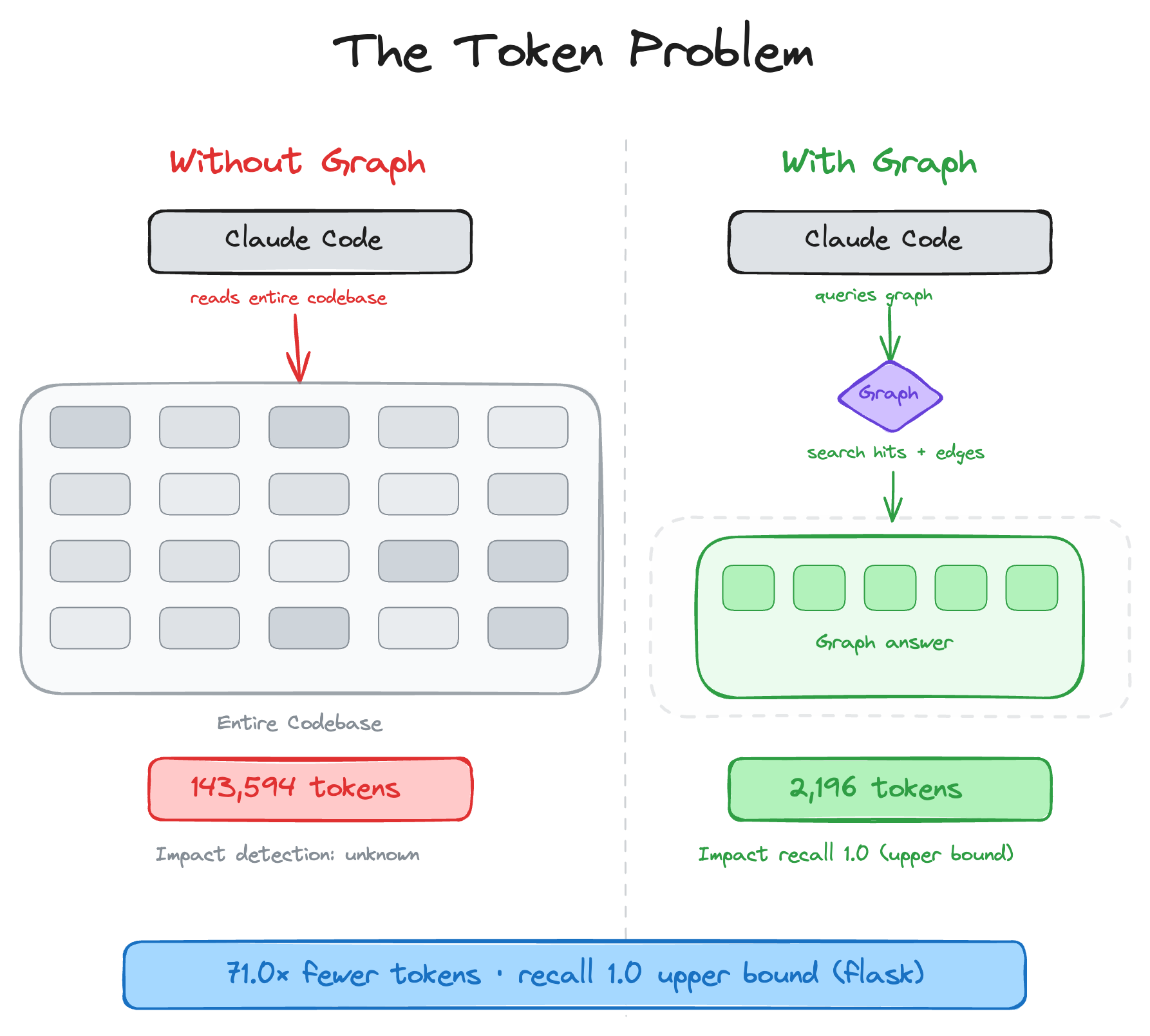
Instead of feeding a whole corpus to the model, the graph returns a slice shaped to the question. In the 2026-08-02 capture of this repository at 84bde354, 208,821 source tokens became ~3,190 tokens per question. The repository has grown a lot since that snapshot, so both numbers are larger today.
Language coverage and notebooks
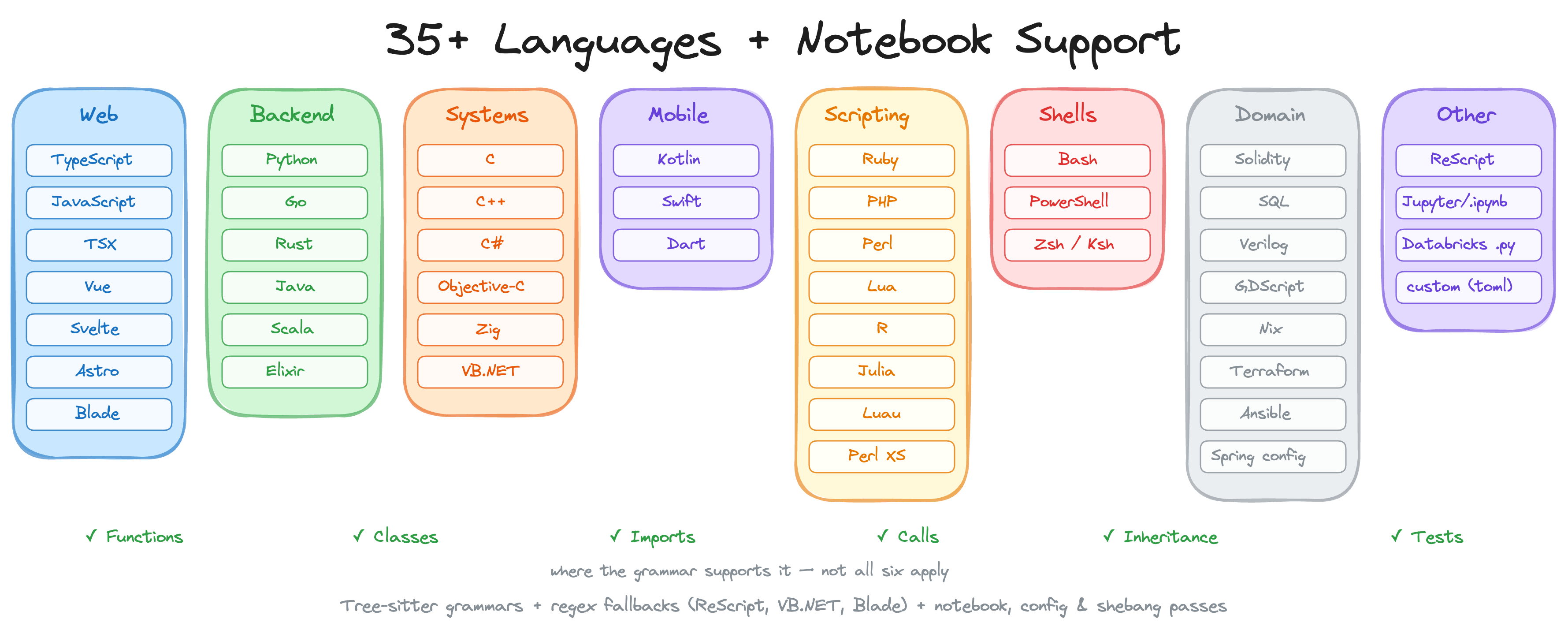
The parser extracts functions, classes, imports, call sites, inheritance and tests, using Tree-sitter where a grammar exists and targeted fallbacks elsewhere. Supported: Python, JavaScript/TypeScript/TSX, Go, Rust, Java, C/C++, C#, VB.NET, Ruby, Kotlin, Swift, PHP, Scala, Solidity, Dart, R, Perl, Lua/Luau, Objective-C, shell scripts, Elixir, Zig, PowerShell, Julia, ReScript, GDScript, Nix, Verilog/SystemVerilog, SQL, Terraform/OpenTofu (.tf; other .hcl files become file nodes only), Ansible YAML (playbooks, roles, tasks), Spring Boot application config (application.properties, application.yml, application.yaml and their application-<profile> variants; key names and value types only, never values), Vue/Svelte SFCs, Astro files (parsed with the TypeScript grammar), Jupyter and Databricks notebooks (.ipynb), and Perl XS files (.xs). Other YAML and other .properties files are not treated as source code.
PHP projects also get repository-bounded Composer PSR-4 resolution, Blade template references, and Laravel Route and Eloquent edges when the source shows explicit framework imports, model inheritance and receiver evidence.
Java projects get Spring dependency-injection call resolution, request endpoints and WebFlux routes, scheduled triggers, application-event publisher-to-listener edges, and Temporal workflow and activity edges. Each resolver runs after the parse and needs the injected field, published event or workflow stub to be visible in the repository.
Add your own language
If your repository uses a language the parser does not cover, add a languages.toml to .code-review-graph/ that maps file extensions to any grammar bundled in tree_sitter_language_pack, plus the node types for functions, classes, imports and calls:
[languages.erlang]
extensions = [".erl"]
grammar = "erlang"
function_node_types = ["function_clause"]
class_node_types = ["record_decl"]
import_node_types = ["import_attribute"]
call_node_types = ["call"]
The generic tree-sitter walker does the extraction. Built-in languages cannot be overridden. See docs/CUSTOM_LANGUAGES.md for the schema, validation rules and a worked example.
Risk-scored PR reviews in CI (GitHub Action)
The same analysis runs as a composite GitHub Action. The graph is built and queried on your CI runner; no source code is sent to an external service. On each pull request the action posts one sticky comment with risk-scored functions, affected execution flows and test gaps, updated in place on every push. The optional fail-on-risk input turns it into a merge gate.
# .github/workflows/code-review-graph.yml
on:
  pull_request:

permissions:
  contents: read
  pull-requests: write

jobs:
  review:
    runs-on: ubuntu-latest
    steps:
      - uses: actions/checkout@v7
      - uses: tirth8205/code-review-graph@v2.3.9
        with:
          github-token: ${{ secrets.GITHUB_TOKEN }}
See docs/GITHUB_ACTION.md for inputs, risk levels and caching, or the workflow this repository runs on itself in .github/workflows/pr-review.yml.
Benchmarks

Ships withcode-review-graph
33k7 skills1 MCP
Stars on GitHub
Momentum
- stars in total
- 32.5k
More MCP servers from other plugins.


Questions about code-review-graph.
- Which coding agents can use code-review-graph?
- code-review-graph works in any agent that reads an MCP config file: Claude Code, Codex, Cursor, Gemini CLI, GitHub Copilot, OpenCode and Windsurf. Each agent reads it from its own file; this page names the file for each one.
- How do I add code-review-graph to Claude Code?
- Run this in your terminal: claude mcp add code-review-graph -- uvx code-review-graph serve
- Is code-review-graph safe to install?
- Low risk. Signals from public registries, not an audit.