
Development
Plugin
bernstein
The open‑source AI Agents Governance & Orchestration framework: write the rules declaratively, Bernstein enforces them and produces the verifiable, replayable record. Free, Apache-2.0. https://bernstein.run

Plugin Signal87/100Strong
maintained100
capable73
documented100
adopted66
Install
$ npx -y skills add sipyourdrink-ltd/bernstein --agent claude-code
Stats
1,237
Stars
170
Forks
Active
Maintenance
Python
Language
Apache-2.0
License
55m ago
Last commit
6mo ago
Created
Repo: sipyourdrink-ltd/bernstein
What's inside
Skill(26 skills)
/bernstein-agentsManage Bernstein agents - list active agents, inspect their output, kill stalled agents, or stream live logs. Use when the user asks about agents, wants to see what an agent is doing, or needs to kill one./bernstein-alertsShow active alerts from Bernstein - failed tasks, stalled agents, budget warnings, blocked tasks needing human intervention. Use when the user asks about problems, errors, warnings, or what needs attention.
Command(3 commands)
Hook(1 hook)
MCP(1 mcp)
Badges

README
"To achieve great things, two things are needed: a plan and not quite enough time." - attributed to Leonard Bernstein
the open-source governance layer for AI agents








website · docs · install · first run · glossary · limitations · name policy · discord · sponsor
简体中文 · 繁體中文 · 日本語 · 한국어 · हिन्दी · বাংলা · Русский · Español · Português · Deutsch · Français · Italiano · Nederlands · Polski · Svenska · Suomi · Українська · Türkçe · العربية · עברית · Bahasa Indonesia · Tiếng Việt · ไทย
Status: beta. Solo-maintained, under active development. The version number counts releases, not maturity - minor versions may change interfaces. Pin the version for anything you depend on; regressions get fixed fast, file them.
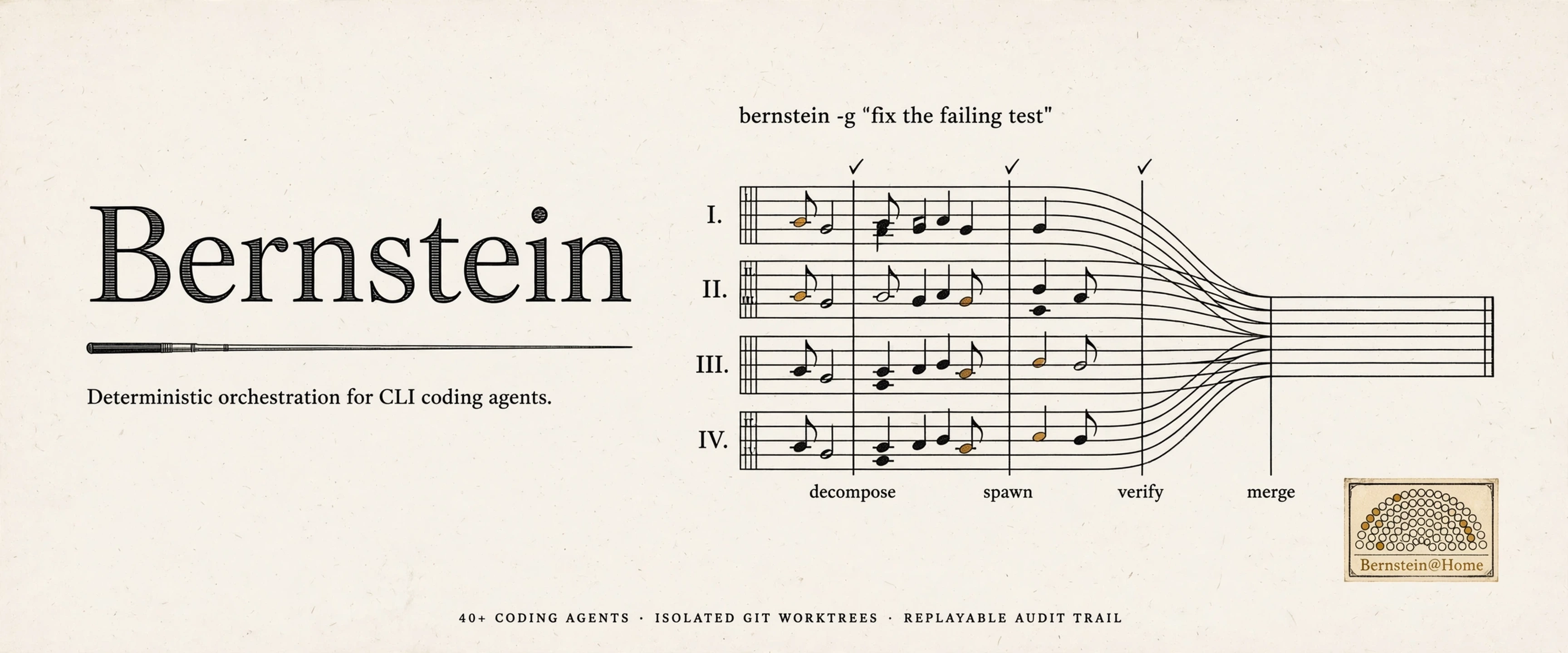
Bernstein is the open-source governance layer for AI agents. It runs on policy as code: you write the policy - who may do what, what needs approval, what must be recorded - and Bernstein enforces it and produces the verifiable record. A deterministic scheduler - no model in the coordination loop - runs agents in parallel, gates what they produce, and records every step, so a run can be verified after the fact, offline, from the artifacts alone. CLI coding agents work out of the box (Claude Code, Codex, Gemini CLI, and 40+ more), and the same layer governs any agent workload: the deliverable can be a diff, a research report, a dataset, or an audit evidence pack. Air-gap install profile included. Apache-2.0.
at a glance
Four things set it apart; everything after is detail.
- No LLM in the coordination loop. Scheduling is plain Python, so a run is reproducible end to end. Replay yesterday's plan and get yesterday's task graph.
- Checkable after the fact. The replay journal records every run, and the always-on lineage spine records every lineage-bearing step; the opt-in HMAC-chained audit log (
BERNSTEIN_AUDIT=1) adds receipts you verify offline. Non-determinism surfaces as a hash mismatch at the exact step, not a flaky re-run. Non-code deliverables get the same treatment: a task can declare an artifact contract (report, dataset, action log, ops result) and completes on a signed lineage receipt rather than a git commit. - Isolated by construction. Each coding task gets its own git worktree behind merge gates; artifact-mode tasks get a working directory under
.sdd/workspaces/. Agents share no mutable workspace by default; the only shared state is the task backlog, which is claimed atomically. Stricter filesystem enforcement is opt-in, from the sandbox backends. Disable worktrees and every task runs in the shared checkout. - Broad and local. 40+ CLI agent adapters plus a generic
--promptwrapper, file-based state, no SaaS hop, no third-party data plane.
The full list is on the capabilities page; the feature matrix is the exhaustive index.
what a run looks like
One YAML file declares the run: phases, roles, dependencies, and the conditions under which a node runs at all. The scheduler executes it as plain Python - nothing in the file is a prompt, and no model decides what happens next. This graph produces an audit evidence pack; the full file ships at .bernstein/workflows/audit-evidence-pack.yaml.
name: audit-evidence-pack
version: "1.0.0"

phases:
  - name: scope
    allowed_roles: [manager, architect]
  - name: collect
  - name: validate
    allowed_roles: [qa, security]
  - name: deliver
    allowed_roles: [security, manager]

nodes:
  define-control-inventory:
    phase: scope
    role: architect

  collect-audit-logs:
    phase: collect
    role: security
    depends_on: [define-control-inventory]

  # three more evidence streams collect in parallel:
  # collect-sboms-and-attestations, collect-runbooks-and-policies,
  # collect-eval-results

  assemble-pack:
    phase: validate
    role: docs
    depends_on:
      - collect-audit-logs
      - collect-sboms-and-attestations
      - collect-runbooks-and-policies
      - collect-eval-results

  mock-auditor-pass:
    phase: validate
    role: qa
    depends_on: [assemble-pack]

  remediate-findings:
    phase: collect
    role: docs
    depends_on:
      - source: mock-auditor-pass
        condition: "status == 'failed'"
    retry:
      max_attempts: 3
      until: "status == 'done'"

  sign-and-deliver:
    phase: deliver
    role: security
    depends_on:
      - source: mock-auditor-pass
        condition: "status == 'done'"
flowchart LR
    inv[define-control-inventory] --> logs[collect-audit-logs]
    inv --> sbom[collect-sboms-and-attestations]
    inv --> rb[collect-runbooks-and-policies]
    inv --> ev[collect-eval-results]
    logs --> pack[assemble-pack]
    sbom --> pack
    rb --> pack
    ev --> pack
    pack --> gate{mock-auditor-pass}
    gate -->|failed| fix["remediate-findings (retry x3)"]
    gate -->|done| sign[sign-and-deliver]
Each node is claimed by an agent whose role the phase allows; role fences and approval gates hold no matter what the agent does inside the task. A coding node completes behind merge gates in its own git worktree. The nodes above complete differently: an artifact contract names the deliverable (report, dataset, scan, action log), and the node finishes on a signed lineage receipt instead of a commit. Same scheduler, same journal, same offline verification - whether the graph ships code, research, an ops change, or a mix of all three. Ready-made graphs for software, research, docs, enterprise, and contributor workflows live in .bernstein/scenarios/.
install in 30 seconds
uv tool install bernstein    # or: pipx install bernstein
bernstein init
bernstein doctor             # checks a CLI agent is installed and authenticated
bernstein -g "fix the failing test in tests/test_foo.py"
pipx, pip, brew, dnf, npm, and Docker are covered in the install guide; the air-gapped wheelhouse has its own air-gap guide.
File tree
Showing a partial view of a very large repo.
FAQ
bernstein is a Claude Code plugin with 26 hand-picked skills for development work, indexed on Flowy. Install it with the command on its page. It includes bernstein-agents, bernstein-alerts, bernstein-approve. Its skills do not fire on their own yet. Request auto-invocation to have Flowy route them as you prompt. Free and open source.
- What is bernstein?
- The open‑source AI Agents Governance & Orchestration framework: write the rules declaratively, Bernstein enforces them and produces the verifiable, replayable record. Free, Apache-2.0. https://bernstein.run
- How do I install bernstein?
- Run these in Claude Code: npx -y skills add sipyourdrink-ltd/bernstein --agent claude-code. Then prompt normally.
- Does bernstein auto-invoke its skills?
- Not yet. It is indexed on Flowy as a plain plugin. Request auto-invocation on its page and Flowy will route its skills for you as you prompt.
- Is bernstein free?
- Yes. Flowy is free and open source, with nothing gated. You can read every skill in full before you install.
Is this plugin yours?
Claim it with GitHubSubmit a pluginPromote it