






Auto-invoked
Development
MCP
repowise
Ships with repowise: Codebase intelligence for AI and humans: code health scores, auto-generated docs, git analytics, dead code detection, and architectural decisions via MCP.
Claude Code
> /plugin marketplace add repowise-dev/repowise> /plugin install repowise@repowise
Codex
$ uv tool install repowise # or: pipx install repowise / pip install repowise
Cursor
$ uv tool install repowise # or: pipx install repowise / pip install repowise
Gemini CLI
$ uv tool install repowise # or: pipx install repowise / pip install repowise
GitHub Copilot
$ uv tool install repowise # or: pipx install repowise / pip install repowise
OpenCode
$ uv tool install repowise # or: pipx install repowise / pip install repowise
Windsurf
$ uv tool install repowise # or: pipx install repowise / pip install repowise
Security report
Info
Not enough data
Known flaws
Not published
Signed build
Not published
Maintained
Nov 9, 2026
Last push
Licence
AGPL-3.0
Runs as
Local process
On your machine
Deprecated
Not published
Signals from public registries, not an audit. Checked Nov 11, 2026.
repowise README

Quickstart · For your agent · What it does · Hosted · Benchmarks · Teams · Docs
Set it up in one line
Open Claude Code, Codex, Cursor or any MCP-capable agent in your repository and paste:
Read https://docs.repowise.dev/setup.md and set up Repowise in this repository.
The agent installs Repowise, indexes the repo with no API key, connects itself to the index, and asks you before anything costs money. To do it by hand:
uv tool install repowise          # or: pipx install repowise / pip install repowise
cd /path/to/your/repo
repowise init --yes --no-prose    # graph, git, health, dead code, docs. No key, no spend.
                                  # answers and docs: run repowise generate (one command, no re-index)
repowise serve                    # dashboard + MCP server (needs Node 20+; first run downloads the UI)
serve opens the dashboard in your browser. After a first index it starts with a short
guided tour, and Setup is where you connect agents, turn on sync and add coverage or a model.
Restart Claude Code or run /mcp, then ask "What breaks if I change
src/auth.py?" or "Use Repowise get_overview to summarize this repository."
init wires Claude Code for this repo and adds the global repowise MCP entry
when there is none; it never moves one that serves another repo. Full setup for every agent →
Your agent stops guessing
Without an index, an agent rediscovers your codebase on every task: grep, open a file, open three more, grep again. Repowise answers those questions ahead of time, so the agent asks once and gets on with the work.
In a measured run on django/django, an agent with Repowise made 3.8 tool calls
instead of 7.2, opened 3.0 files instead of 7.2 and wrote 31.6% less, with
answers just as good. That is the largest saving of the five context tools we
tested. On a small local model the output cut reaches 47.9%.
How it was measured →
- Your agent gets ten task-shaped MCP tools. Ask about several files at once and get callers, risk, tests, owners and the reasons behind the code in one answer. The tool list ↓
- Up to 99% less command noise.
repowise distilltrims test, install and git output before the agent reads it and keeps every error line. Distill → - Context before the agent asks. Optional hooks warn it
off fragile files and stale paths, and Repowise keeps your
CLAUDE.mdandAGENTS.mdcurrent from the index. - See your own savings.
repowise savedand the dashboard's Usage and savings page count the tokens your agent no longer has to read.
What it does
One index of your code, its history and its decisions, used three ways: to understand the code, to change it safely, and to keep improving it.
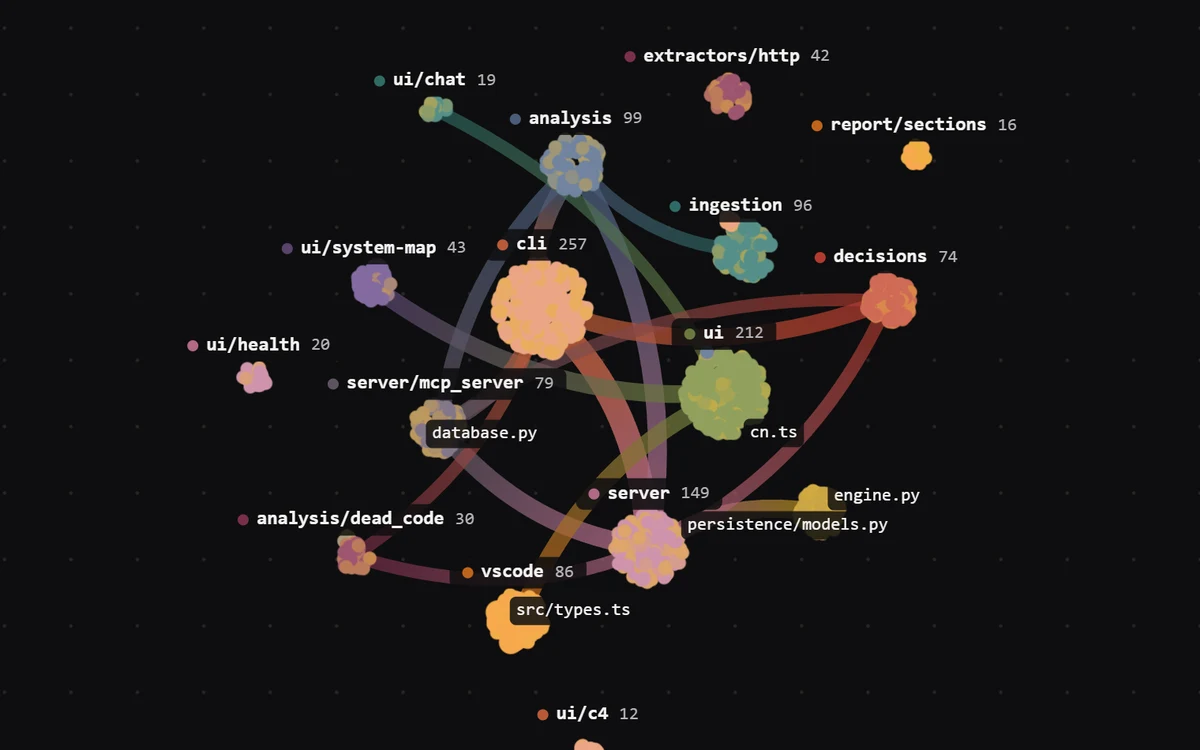
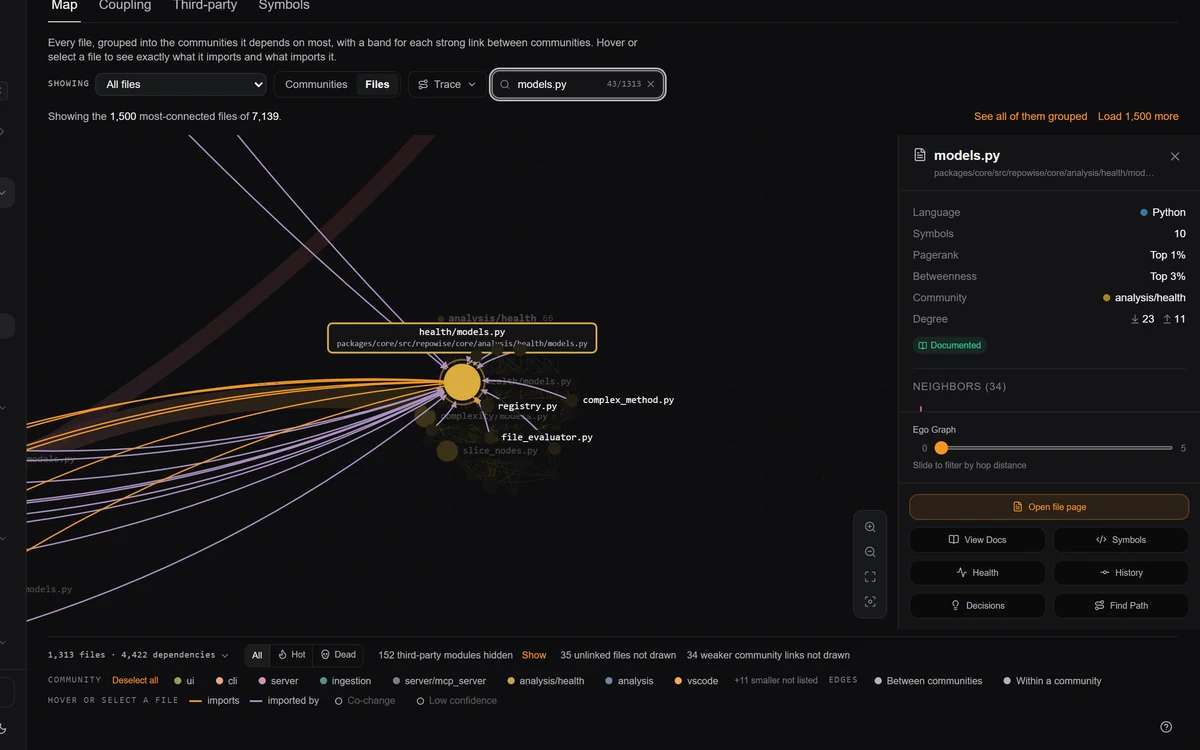
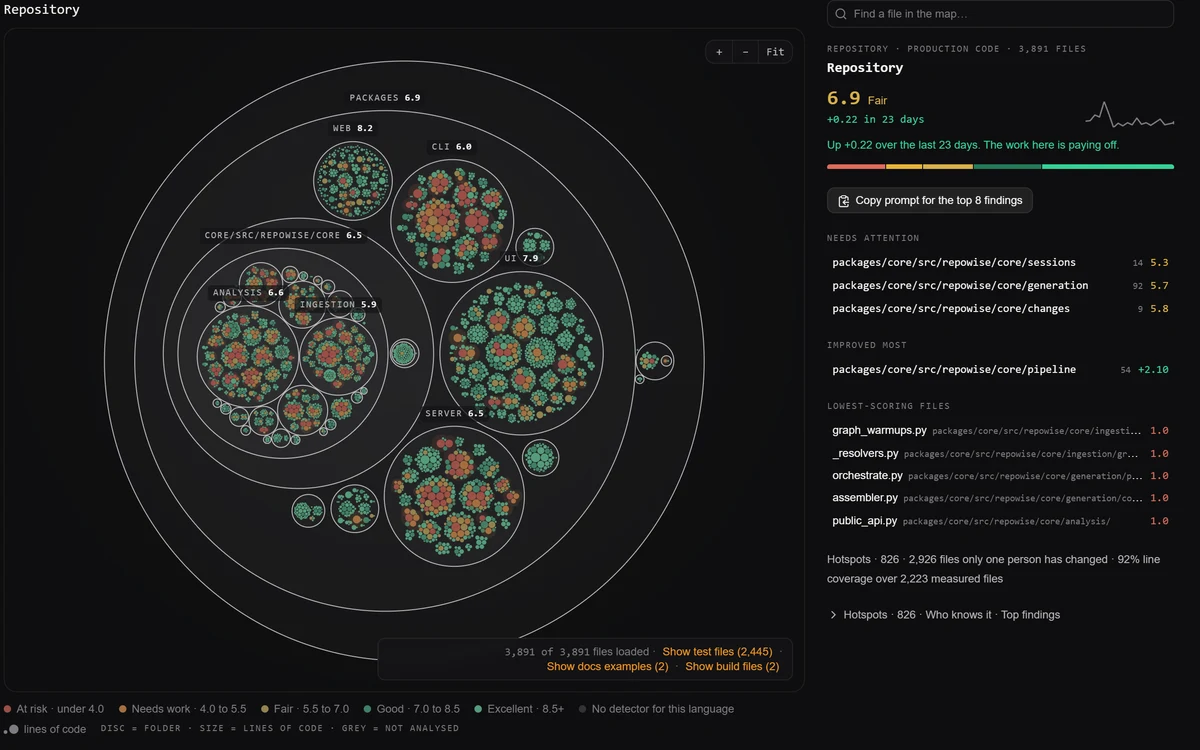
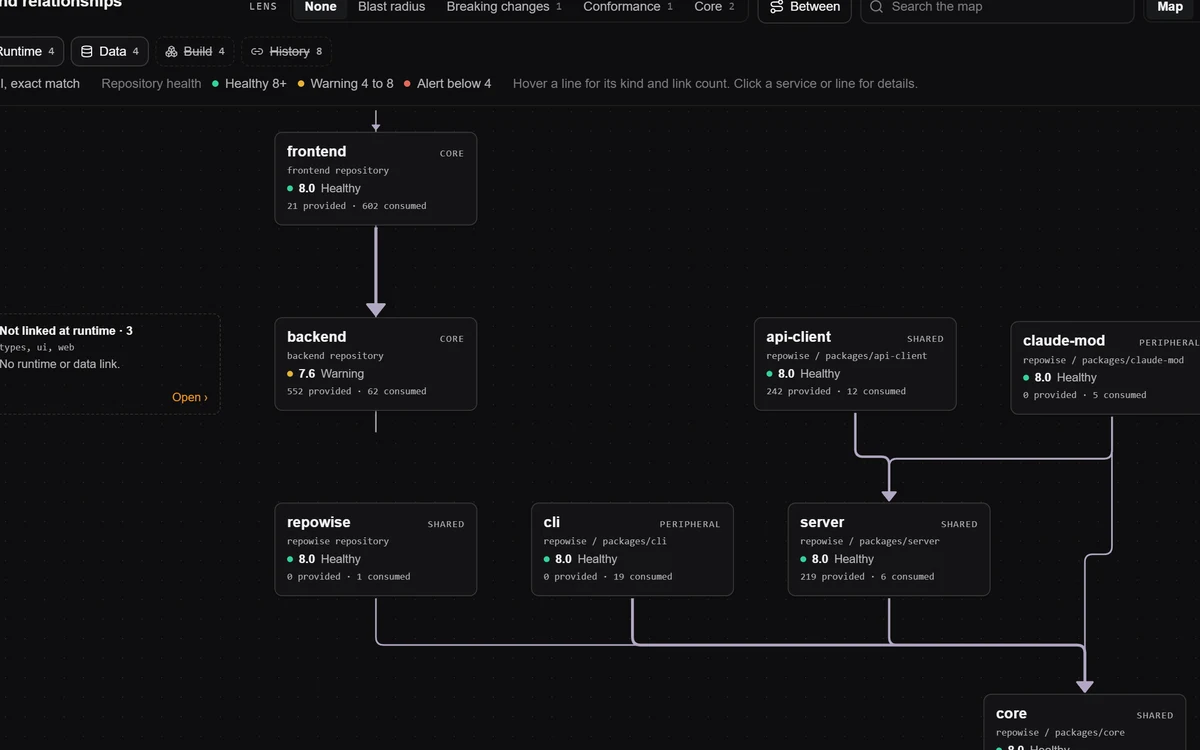
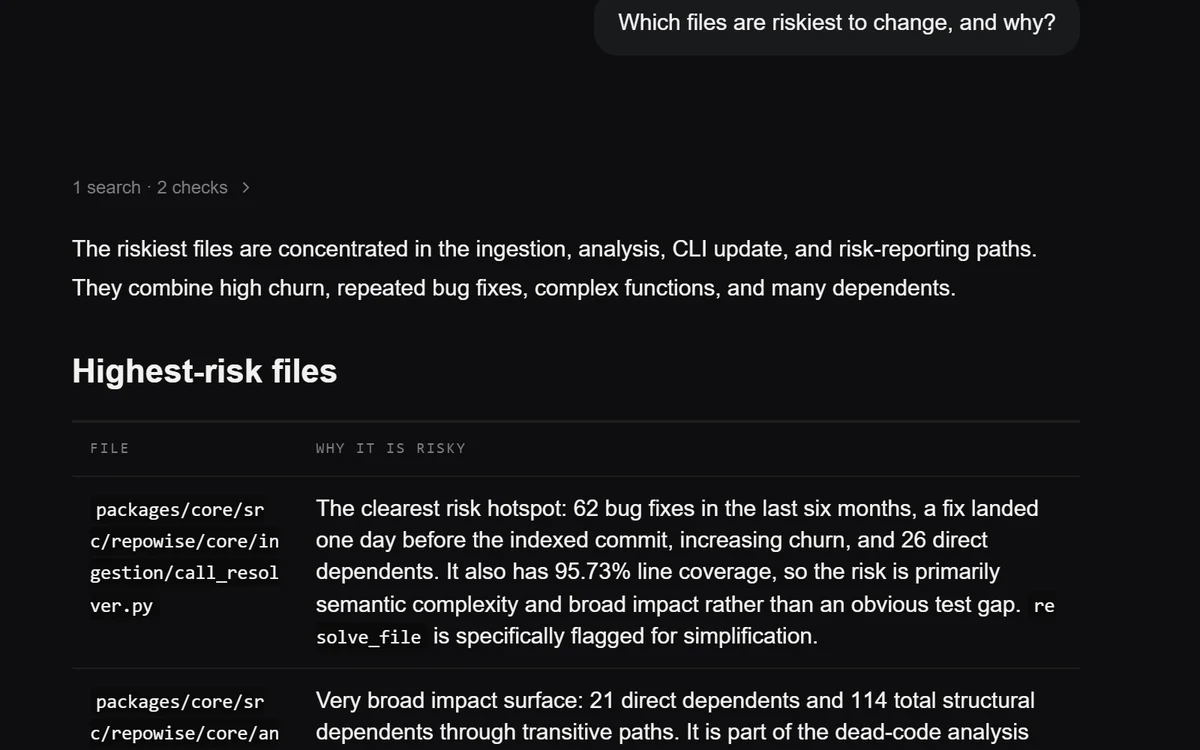
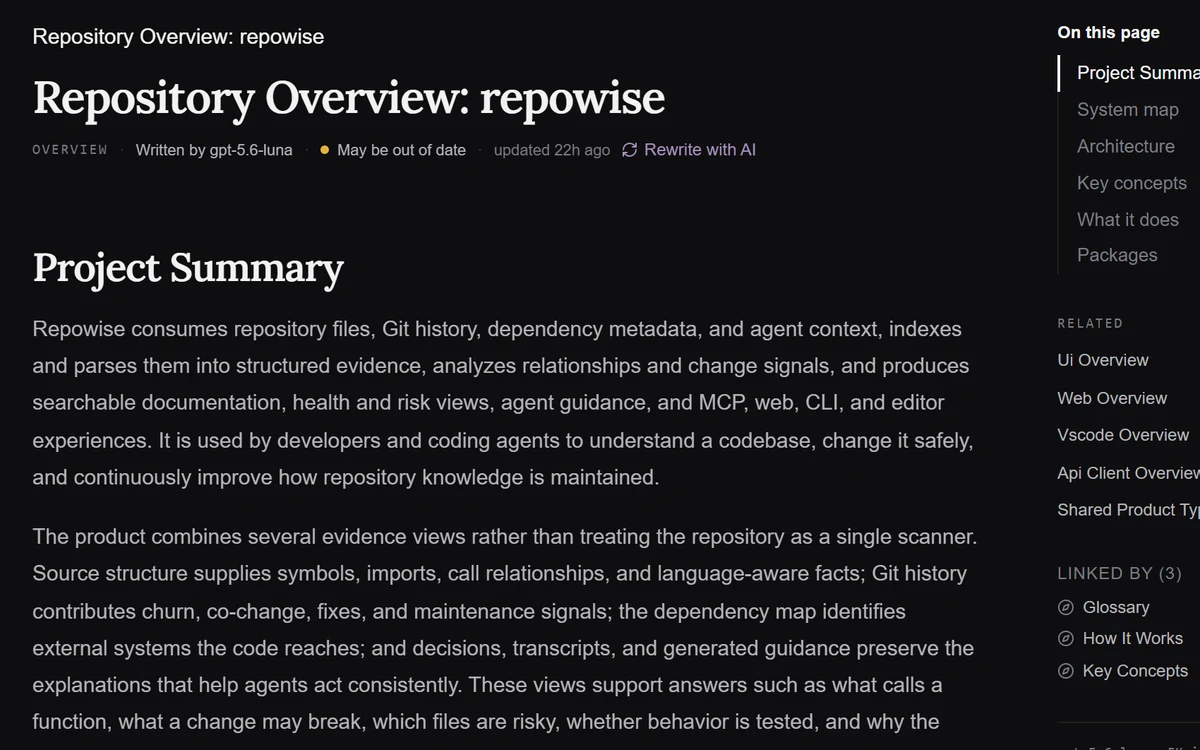
Every question it answers
Understand the code
| You ask | Repowise gives you |
|---|---|
| How does checkout work in this repo? | A cited answer built from the call graph and the generated docs, in one call. Search and answers |
| What calls this function, and what does it call? | A call graph across 28 parsed languages, every edge stamped with how it was resolved and how far to trust it, plus traced execution flows from each entry point. The graph |
| Can I get docs for this codebase? | A wiki for every module and file, rendered from the code's structure with no key, or written by a model when you choose. It updates incrementally after each commit. Docs |
| Which of our docs are wrong? | Markdown checked against the tree: every reference to a file or symbol the code no longer has, with the line to edit. Doc drift |
| Why is it built this way? | Decisions mined from ADRs, # WHY: comments, commit and PR history and your agent sessions, each tied to the code it governs and flagged when it goes stale. Decisions |
| Who knows this code? | Owners, bus factor, fading ownership when the main author goes quiet, and suggested reviewers. Ownership |
| Can I see the architecture? | An explorable dependency map, C4 views, and a Structurizr export, no model involved. Dashboard |
Change it safely
| You ask | Repowise gives you |
|---|---|
| What breaks if I change this? | Symbol-level blast radius: the callers of what you changed, the files that historically change with it but are missing from your diff, and the tests that reach it. Change risk |
| How risky is this PR? | Where the change ranks against your repository's own recent commits, with the reasons, as a directive your agent can act on. Change risk |
| Which tests should run? | The tests a diff actually exercises, from a coverage report if you have one and from the call graph if you do not. Test intelligence |
| Did this PR add untested lines? | Patch coverage, branch coverage on changed lines and path-scoped gates in CI, on GitHub, GitLab or any runner. CI gates |

Ships withrepowise
8.1k8 skills1 MCP
Stars on GitHub
Momentum
- stars in total
- 8.1k
More MCP servers from other plugins.




Questions about repowise.
- Which coding agents can use repowise?
- repowise works in any agent that reads an MCP config file: Claude Code, Codex, Cursor, Gemini CLI, GitHub Copilot, OpenCode and Windsurf. Each agent reads it from its own file; this page names the file for each one.
- How do I add repowise to Claude Code?
- Run these in order, one at a time. 1. In Claude Code: /plugin marketplace add repowise-dev/repowise 2. In Claude Code: /plugin install repowise@repowise