Warning
This project is no longer maintained. As of September 2026 the repository is archived: no updates, bug fixes or support. It may stop working when the upstream services change. Feel free to fork.
domain-check
Cross-platform, dependency-free domain availability checker — runs as a plugin in Claude Code, an extension in Gemini CLI, and a skill in Codex CLI / OpenCode, or as a plain Python CLI.




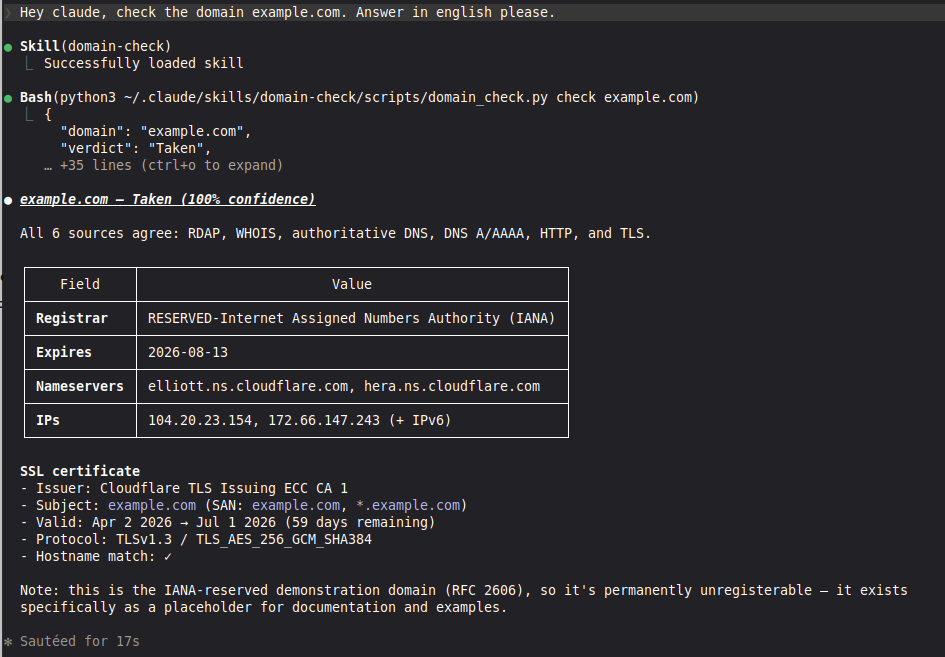
Ask your coding agent "is example.com free?" and get an evidence-backed answer with the registrar, expiration date, server IPs, and full SSL certificate inline — for any TLD on the planet, including GDPR-redacted ccTLDs like .de, .eu, .at, .ch, .es.
Single check — full evidence inline
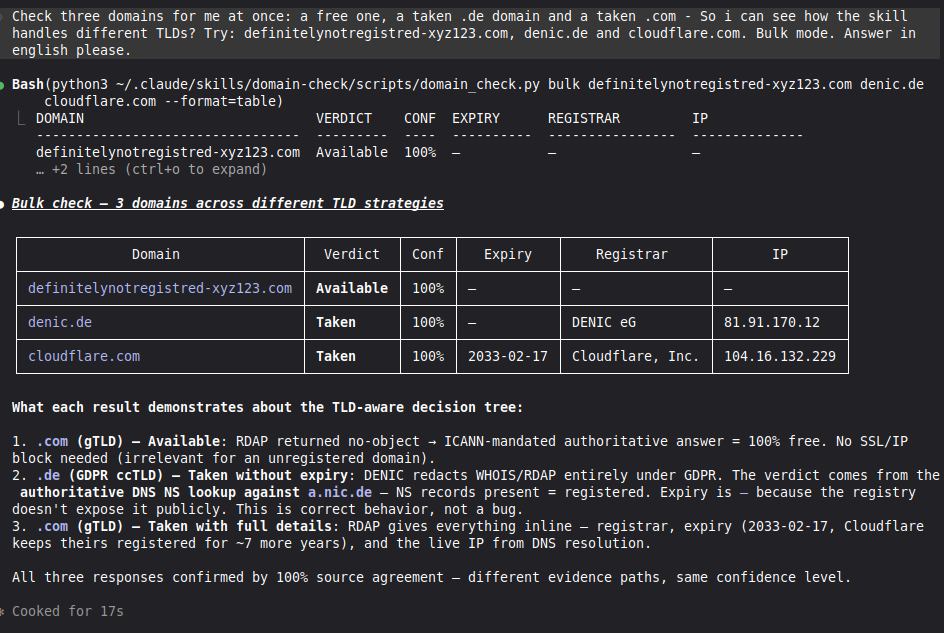
Bulk check — three TLDs, three evidence paths
The .de row legitimately has no expiry — DENIC redacts that field under GDPR. The skill says so explicitly instead of guessing.
Why this skill exists
Most domain-checker tools fail in one of three ways:
- They hit a single source and return false negatives when it's wrong.
- They require API keys and paid plans.
- They silently return "unknown" for half of all ccTLDs because GDPR redacts the registry response.
This skill solves all three:
- Five-source consensus. RDAP, WHOIS, authoritative DNS NS lookup, A/AAAA + HTTP reachability, TLS certificate. The verdict only reaches 100% confidence when sources agree.
- TLD-aware decision tree. For
.de the only reliable signal is an authoritative NS query against a.nic.de. For .com an RDAP no-object response is definitive. The skill picks the right strategy per TLD.
- Zero dependencies, zero config. Pure Python ≥ 3.11 standard library. No
pip install, no venv, no API tokens, no rate-limited free tier.
- Bulk + parallel. 30 domains in ~10–15 seconds via
asyncio.
- Built for AI agents. The
SKILL.md tells the agent when to invoke it (trigger phrases in EN + DE) and how to read the JSON output.
Features
- Binary verdict —
Available / Taken / Reserved / Unclear with a 0.0–1.0 confidence score
- Five concurrent sources, ~2–4 s per single check
- Expiration dates for both domain registration and SSL certificate, surfaced inline whenever the registry exposes them (GDPR ccTLDs legitimately redact this — the skill says so explicitly instead of guessing)
- 30+ TLD-specific WHOIS patterns plus IANA-bootstrap fallback for any unknown TLD
- GDPR-aware: authoritative registry NS lookups for
.de, .eu, .at, .ch, .es, .li, …
- Inline SSL inspection: issuer, subject, SAN, validity, fingerprint, hostname match
- IP resolution: IPv4, IPv6, reverse DNS for any URL or hostname
- Bulk mode with 8-way concurrency and NDJSON / JSON / human table output
- Naming co-pilot — generates and scores brandable domain candidates and bulk-checks the top N for actual availability
- Cross-platform: same commands on Linux, macOS, Windows
- Implements the Agent Skills open standard
Install
This repo ships as both a Claude Code plugin and a Gemini CLI extension, with a manifest for each. The skill itself lives in skills/domain-check/.
Claude Code
Once the plugin is listed in the official marketplace, install with:
/plugin install domain-check
Until then (or for any custom install), add this repo as a marketplace and install from there:
/plugin marketplace add PleasePrompto/domain-check-skill
/plugin install domain-check@domain-check-skill
Gemini CLI
gemini extensions install https://github.com/PleasePrompto/domain-check-skill
The repo is tagged with the gemini-cli-extension topic, so it appears in the Gemini Extensions Gallery automatically after Google's daily crawl.
Codex CLI / OpenCode (manual)
Codex doesn't have an official skill marketplace yet. Clone the repo and copy just the skill folder into your agent's skills directory:
git clone https://github.com/PleasePrompto/domain-check-skill.git /tmp/dc
cp -r /tmp/dc/skills/domain-check ~/.agents/skills/domain-check     # Codex CLI
cp -r /tmp/dc/skills/domain-check ~/.config/opencode/skills/        # OpenCode
rm -rf /tmp/dc
Project-local (any agent)
To pin the skill to a single repository so the whole team gets it:
git submodule add https://github.com/PleasePrompto/domain-check-skill.git .claude/plugins/domain-check
Usage
Once installed, just talk to your agent. Triggers it recognises (English + German):
- "is X.com free?" / "ist X.de frei?"
- "check this domain" / "domain prüfen"
- "bulk domain check for these names"
- "SSL cert of X" / "what IP does X resolve to?"
- "suggest names for an AI phone-bot startup"
Or run the script directly from the skill directory:
cd skills/domain-check
python3 scripts/domain_check.py check example.com
python3 scripts/domain_check.py bulk example.com example.org example.net
python3 scripts/domain_check.py ssl example.com
python3 scripts/domain_check.py resolve https://example.com/path
python3 scripts/domain_check.py suggest graph --use-case ai_tool --count 20 --check
Subcommands
| Command | Purpose |
|---|
check <domain> | Single-domain check, JSON output with full evidence |
bulk <d1> <d2> … | Up to 8 in parallel; supports --file, --stdin, --format=ndjson|json|table |
ssl <hostname> [--port 443] | TLS-only inspection: issuer, SAN, validity, fingerprint, effective IP |
resolve <url|host> | Hostname → IPv4 + IPv6 + reverse DNS for the first 3 IPs |
suggest <seed> --use-case <type> | Generate scored, buyable domain candidates |
score <name> | Heuristic score breakdown for a single bare name |
Run any command with --help for full flags.
How it works
Every check fans out asynchronously to five sources at once:
                                 ┌──────────────────┐
                                 │   tld_classifier │
                                 │  GTLD / GDPR /   │
                                 │   OPEN / UNKNOWN │
                                 └────────┬─────────┘
                                          │
       ┌──────────────────┬───────────────┼──────────────────┬──────────────────┐
       ▼                  ▼               ▼                  ▼                  ▼
  ┌─────────┐       ┌───────────┐   ┌──────────┐      ┌──────────┐       ┌──────────┐
  │  RDAP   │       │   WHOIS   │   │  AuthDNS │      │ DNS A/   │       │   TLS    │
  │ (ICANN) │       │ (port 43) │   │   (NS)   │      │   AAAA   │       │  Cert    │
  └────┬────┘       └─────┬─────┘   └────┬─────┘      └────┬─────┘       └────┬─────┘
       │                  │              │                 │                  │
       └──────────────────┴──────────────┴─────────────────┴──────────────────┘
                                          ▼
                                 ┌──────────────────┐
                                 │      verdict     │
                                 │  Available /     │
                                 │  Taken / …       │
                                 │  + confidence    │
                                 └──────────────────┘
Whether a domain is free or taken depends on which sources are authoritative for that TLD:
- gTLDs (
.com, .net, .io, .ai, .app, .pro, .club, …) — RDAP is mandatory under ICANN. RDAP no-object = 100% available.
- GDPR ccTLDs (
.de, .eu, .at, .ch, .es, .li, …) — registry redacts RDAP/WHOIS. An authoritative NS lookup against a.nic.de / x.dns.eu / etc. yields a binary answer: NS records = registered, NXDOMAIN = available.
- Unknown / reseller TLDs — WHOIS server is discovered live via
whois.iana.org and cached. If only disclaimers come back (no domain or registrar fields), the domain is treated heuristically as available.
Edge cases handled
- IDN domains (
münchen.de) — auto-converted to Punycode (xn--mnchen-3ya.de)
- GDPR TLDs without expiry —
expiration_date: null plus an expiration_note explaining why (correct behaviour, not a bug)
.ch / .li / .es — registry WHOIS port 43 blocks anonymous IPs; the authoritative DNS NS lookup is the primary source- Rate limiting (DENIC, AFNIC, SIDN) — bulk concurrency capped at 8; HTTP 429 triggers a single backoff retry
- IDNA failures — invalid IDN inputs fall back to lowercase ASCII (no crash)
Naming co-pilot
The skill doubles as a naming assistant. Ask "suggest names for an AI phone-bot startup" and it:
- Reads
skills/domain-check/references/naming_guide.md — a guide covering length sweet spots, phonetics, naming patterns, TLD strategy, LLM-citability, and a hard don't list.
- Generates scored candidates via
_lib/naming.py (length, syllables, plosive starts, alliteration, trademark / typo-squat checks).
- Optionally bulk-checks the top N for real-world availability — so you only see names you can actually buy.
python3 scripts/domain_check.py suggest cloud --use-case indie_saas --check --check-top 5
Supported use cases: tech_startup, ai_tool, dach_service, indie_saas, creative, developer, ecommerce_de, consumer_app, open_source, agency_dach.
Repository layout
domain-check-skill/
├── README.md                          # You are here
├── LICENSE
├── images/                            # Screenshots used in this README
├── .claude-plugin/plugin.json         # Claude Code plugin manifest
├── gemini-extension.json              # Gemini CLI extension manifest
└── skills/
    └── domain-check/                  # The actual skill
        ├── SKILL.md                   # Agent entry point (frontmatter + instructions)
        ├── references/
        │   └── naming_guide.md        # How to invent a great name
        └── scripts/
            ├── domain_check.py        # CLI entry, argparse subcommands
            └── _lib/                  # Importable Python package
                ├── tld_classifier.py  # TLD → GTLD_FULL / CCTLD_DSGVO / CCTLD_OPEN / UNKNOWN
                ├── rdap.py            # RDAP client + IANA bootstrap cache (24 h)
                ├── whois_client.py    # WHOIS socket + 30+ TLD patterns + IANA fallback
                ├── auth_dns.py        # Native UDP DNS resolver (RFC 1035)
                ├── presence.py        # DNS A/AAAA, HTTP/HTTPS, TLS cert with CN/SAN match
                ├── verdict.py         # Decision tree → Available/Taken + confidence
                ├── orchestrator.py    # async fan-out + final report assembly
                └── naming.py          # Heuristic candidate scorer + generator patterns
Other skills can import the library directly:
from _lib.orchestrator import check_domain
report = await check_domain("example.com")
Requirements
Zero install, zero dependencies, zero config. The entire skill runs on the Python ≥ 3.11 standard library — asyncio, socket, ssl, urllib, argparse, etc. The minimum version is required for dict | None syntax and asyncio.to_thread.


 @obra


