
Development
Plugin
add
ADD - LOOP SKILL for AI Coding Agent

Plugin Signal69/100Solid
maintained99
capable34
documented100
adopted28
Install on Claude Code
> /plugin marketplace add pilotspace/ADD> /plugin install add@add-method
What's inside
Skill(2 skills)
/addADD (AI-Driven Development) — a lean, state-tracked workflow where the AI writes the code and the human owns direction and verification. Drives every change through one atomic task node: Direction (specify · plan · red tests) → Build → Verify, red/green TDD built in, trusted on/persona-authorAuthor or improve an ADD-method persona file (a .add/personas/ slug.md) — the project-fit requirements LENS the ADD engine validates and the design/build/verify/advisor surfaces load. Use when adding a domain expert to the ADD roster, when the add-worker persona mode must DRAFT
Agent(2 agents)
add-advisorThe ADD advisor — the roster's second mind, serving EVERY beat (direction · build · verify). Spawned by `add-worker` (or the skill orchestrator) to PROPOSE a plan before a beat, PRESSURE-TEST a drafted bundle, or DECIDE a delegable ambiguity so the worker never stalls. Loads theadd-workerThe ADD execution shell — ONE agent for every EXECUTION beat of the loop. The spawn prompt names the beat (direction · build · verify) or the persona service mode; the agent loads that beat's phase guide plus the best-fit persona and becomes the specialist. Personas carry the
Badges




README
AI work doesn't fail on day one — it rots
Every AI tool ships a beautiful first feature. The failure shows up across milestones: requirements evolve, the conversation gets long, and the agent quietly re-breaks what it already got right. That decay has a name — context rot — and we measure it instead of hand-waving.
The cause turned out to be simple: context rot lives in the conversation, not in the method or the model. The same agent that decays inside one long chat holds a perfect line when every milestone restarts from state on disk.
So ADD's answer isn't a bigger context window or a smarter summary. It's this: nothing that matters lives in the chat. Spec, frozen contract, red suite, gate records — all state on disk. Close the laptop, lose the session, swap the agent: the next session resumes with one command and loses nothing.
| Same model, six evolving milestones | One long conversation | Fresh session per milestone, resumed from disk |
|---|---|---|
| Requirement coverage | .92 → .75, never recovered | 1.0 flat across all six |
| An early spec violation | carried through five more milestones, never re-examined | never introduced — each session re-derived the shape from the spec |
| New-feature quality at milestone 6 | still good — but the old promises rotted | 1.0 — new work stays good and old work holds |
Campaign report, revised edition — pinned model, deterministic probes, no LLM judge.
What ADD is
An agent already knows how to do the work — write the code, draft the analysis, reconcile the ledger. What it structurally cannot keep is everything outside one context window: what's true so far, what was promised, what must never be traded away. Teams keep that in their most senior people's heads. AI has no head that survives the session.
The agent is the hands. ADD is the memory, judgment, and conscience — the part of the team that survives when the context window doesn't.
Every faculty is a file on disk and a command that shows it — never a promise:
| Faculty | What it holds | See it yourself |
|---|---|---|
| 🧠 Memory — what is true | the board, frozen contracts, red suites, five living specs | cli.py status — a brand-new session resumes mid-build, losing nothing |
| ⚖️ Judgment — how to work here | personas propose each task's approach; gates record outcomes; lessons land on the spec they belong to | cli.py deltas — the carried inventory: every lesson recorded, by lens |
| 🛡️ Conscience — what is trusted | one freeze per feature, evidence-scored gates, tamper tripwire, security hard-stop | edit a frozen contract and watch the gate refuse — the Musts, Rejects and gives: you approved cannot move under a build |
✨ Highlights
- 📉 Your agent stops re-breaking last month's work — every decision lives on disk, so a fresh session resumes with the full picture instead of a drifting memory. Measured: quality held flat where a long conversation decayed (six-milestone benchmark, n=1 per arm, ADD 2.0.0, pinned model — report).
- ✅ Stop babysitting the build — you approve once, at the frozen contract; from there the agent drives Direction → Build → Verify on its own and only comes back when it matters.
- 🔬 Know it's correct without reading every line — trust comes from your pre-declared checks passing on a fresh receipt and a session that did not build it trying to break the green; at a plan-or-human floor the gate refuses a PASS nobody tried to refute. Never a diff that merely looks right; the contract you approved cannot be edited under a build without the change appearing in the record.
- 🎯 Evidence, not test count — every binding rule is named by a check written to fail on the most plausible wrong implementation; acceptance checks through a port are the default for code, and property, contract and mutation checkers ride the same receipt. The freeze names any rule still resting on one kind of evidence.
- 💸 Pay ceremony only where it buys something — most changes take the direct lane and never create a node at all; when one does, a thin 28-verb kernel and a 3-call walk carry it. What you get for the ceremony is concrete: a frozen contract the agent cannot edit, a run receipt bound to the checks it names, and a gate that refuses rather than waves through.
- 🔒 Never ship a security hole on autopilot — any security finding is a hard stop with you in the loop, in every mode, even the fully-autonomous ones.
- 🧠 The method adapts to your codebase — a persona proposes each task's approach, outcomes are recorded, and the lessons land on the spec they belong to.
- 🧭 The agent reasons before it drafts — a second mind pressure-tests the plan before the freeze, and returns a recommendation with its confidence per dimension instead of a confident-sounding paragraph. Fluent ≠ true.
- 🙋 "Who has to live with this?" is a question it cannot skip — every surface is swept for who receives the output and what would make it hard for them, alongside the five correctness dimensions. Provably right and unusable is a failure the freeze now catches.
- 📄 Everything about a feature in one place — rules, assumptions, contract, checks, and gate record in a single task file at
.add/tasks/<slug>.md; no doc tree to hunt through. - 👥 Grows with your team — git-native multi-user, N parallel milestones, DAG-scheduled waves.
- 🤝 Keep the agent you already use — Claude, Copilot, Cursor, Codex, Gemini; install via npm, pip, or the Claude Code plugin.
Direction before speed. Trust comes from evidence that survived a refute — not from reading code and finding it plausible.
Fine print: benchmark cells are single-rep (direction, not statistical proof). On this friendly single-app workload a strong model under spec-kit also passed the restart floors, and ran cheaper — the report's revised edition retracts our own earlier "collapse" claim after we found the meter defect behind it. ADD's case rests on the context-rot result and the structural guarantees — not on a rival's failure.
ADD vs vanilla — when it earns its keep
ADD isn't free. It asks for one thing vanilla prompting doesn't: you approve a frozen contract before any code is written. That upfront pass is the whole trade — you spend minutes on direction to buy trust that holds across milestones.
| 🏃 Vanilla — just prompt the agent | 🛡️ ADD | |
|---|---|---|
| First feature | fastest — start typing | one Direction pass first, then builds |
| Across milestones | quality decays; old promises silently break | frozen contracts + red suites re-run; trust holds |
| What you verify | you re-read the diff and hope | pre-declared checks pass and a fresh session failed to refute them, or the gate refuses |
| Resuming later | re-explain the goal, re-read the repo | one command, read back off the .add/ bundle, lossless |
| Cost | near-zero ceremony up front | one bounded direction pass per milestone — minutes, not a doc tree |
| Best for | throwaway scripts, one-shots, spikes | evolving products, multiple milestones, teams |
Rule of thumb: building something you'll throw away this week? Vanilla is fine. Building something you'll still be changing next month? The Direction pass pays for itself the first time the agent doesn't re-break a feature you shipped three milestones ago.
🚀 Get Started
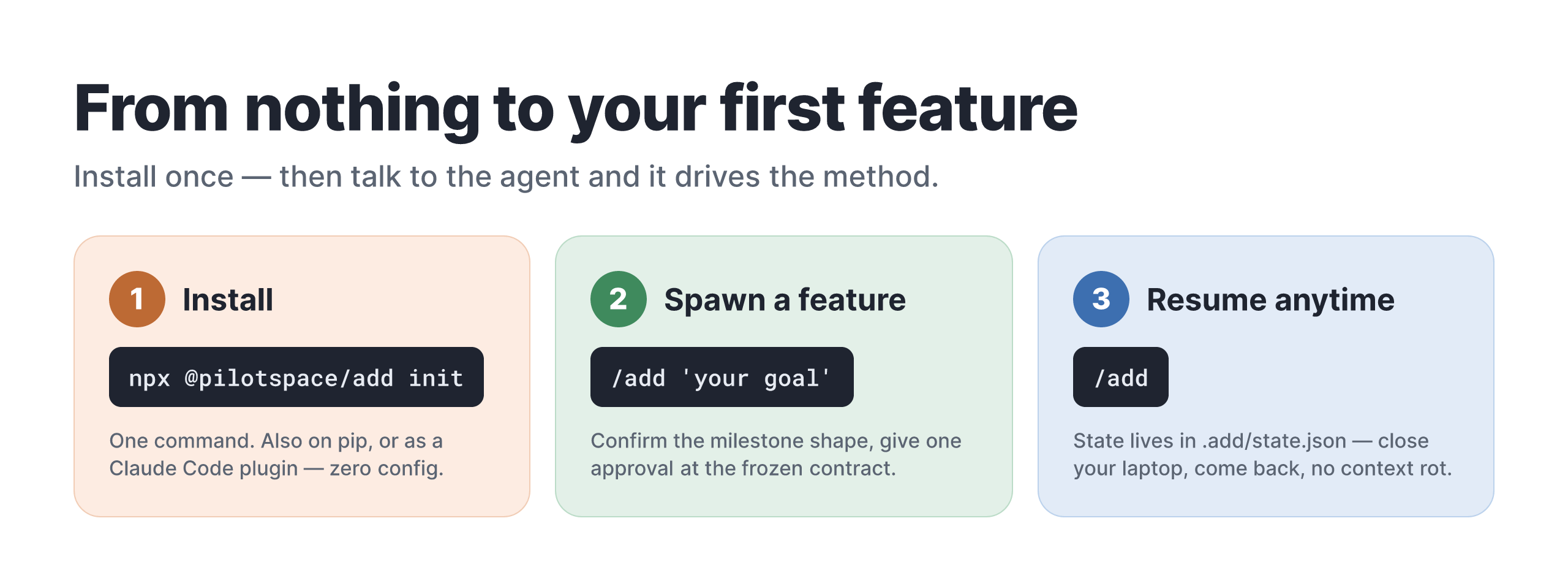
Prerequisites: Node ≥ 18 (npm path) or Python ≥ 3.10 (pip path), plus a CLI agent — Claude Code, Codex, or similar.
1 · Install into your project
From your project root, pick one ecosystem:
npx @pilotspace/add init # Node / npm
pip install pilotspace-add && pilotspace-add init # Python / pip
# Claude Code plugin — no npm or pip needed
/plugin marketplace add pilotspace/ADD
/plugin install add@add-method
Not building software? The bundle's spec lenses are chosen when the bundle is
initialised — which is the agent's first move, not the installer's. ADD ships two sets:
--profile code (the default: domain · system · experience · quality · method) and
--profile doc, which drops the build-shaped lenses for work whose artifact is a
document, a review, or an analysis. A profile selects lenses; it never changes what a
gate demands, and a name ADD does not ship is refused rather than quietly treated as
code.
Tell the agent which one you want — or set it by hand after installing:
python3 .add/tooling/cli.py init --profile doc "My Project"
See a real one: this repo's own
.add/folder.
2 · Spawn your first feature
In Claude Code, run /add and say what you want to build:
/add 'Let users log in with email + password / SSO, and keep them signed in for 30 days unless they explicitly log out.'
The agent runs the on-ramp for you:
- 🧭 Orients from
cli.py status— never re-reading your whole repo. - 📐 Sizes your request into a milestone — you confirm the shape.
- ✍️ Drafts each task's Direction bundle — Spec + Scenarios + Contract + red Tests in one pass — you give one approval, at the frozen contract.
- ✅ Runs Build → Verify to green; a security finding always stops back to you.
3 · Resume anytime
/add status | continue
State lives on disk, not in the chat. Close your laptop, come back tomorrow, and pick up exactly where you left off — no context rot.
⚙️ How ADD Works
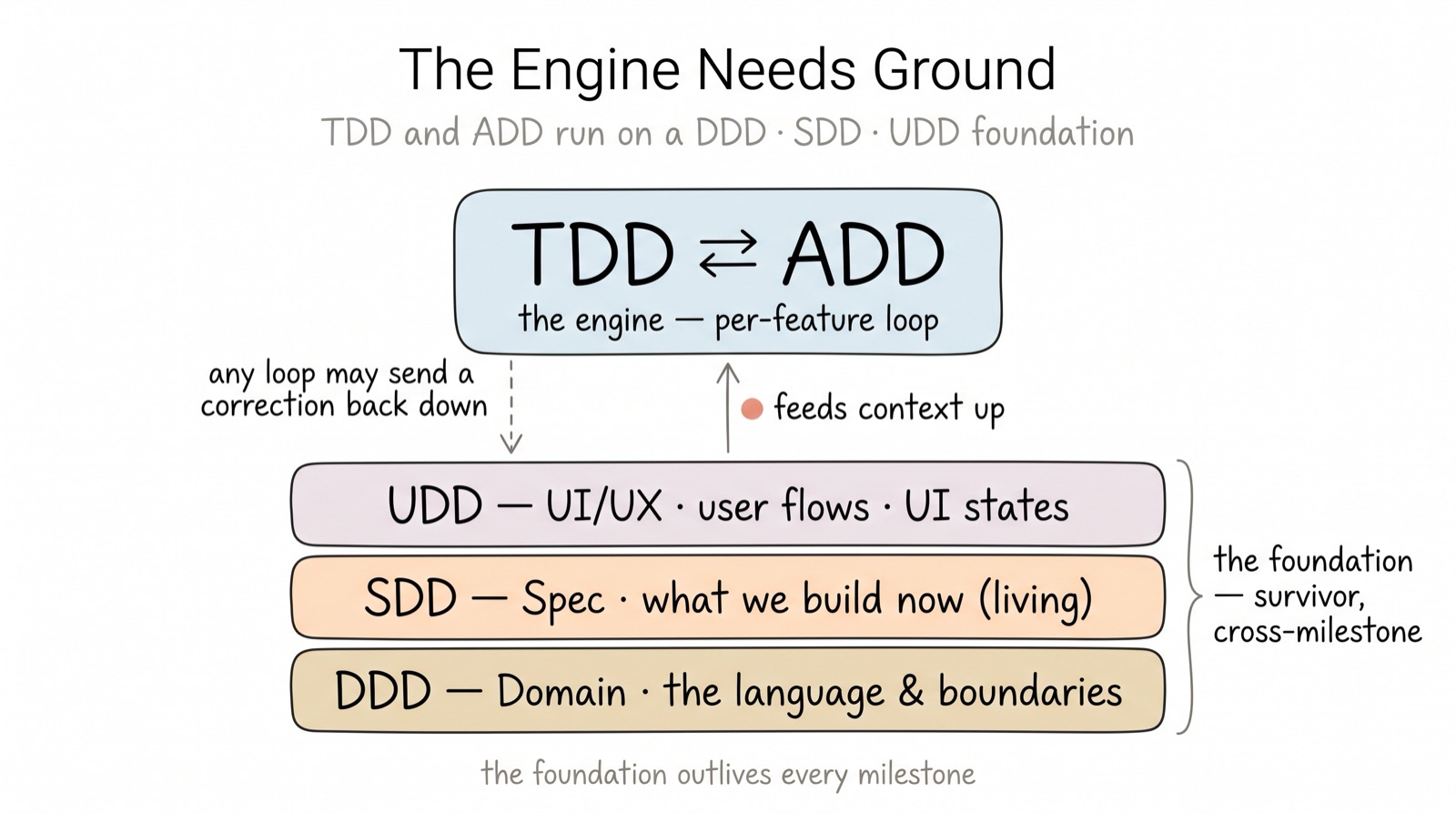
One task · three beats · one file. Every feature is a single task file at
.add/tasks/<slug>.md that fills in section by section as the agent walks three
beats — Direction (rules → assumptions → frozen contract → red checks, the one
human approval), Build (red → green, scope-fenced), Verify (a fresh receipt, a
refute-read by a session that did not build, then the gate: PASS, RISK-ACCEPTED, or HARD-STOP). The decisions are what you keep — the
output is disposable.
File tree
Showing a partial view of a very large repo.
FAQ
add is a Claude Code plugin with 2 hand-picked skills for development work, indexed on Flowy. Install it with the command on its page. It includes add, persona-author. Its skills do not fire on their own yet. Request auto-invocation to have Flowy route them as you prompt. Free and open source.
- What is add?
- ADD - LOOP SKILL for AI Coding Agent
- How do I install add?
- Run these in Claude Code: /plugin marketplace add pilotspace/ADD then /plugin install add@add-method. Then prompt normally.
- Does add auto-invoke its skills?
- Not yet. It is indexed on Flowy as a plain plugin. Request auto-invocation on its page and Flowy will route its skills for you as you prompt.
- Is add free?
- Yes. Flowy is free and open source, with nothing gated. You can read every skill in full before you install.
Is this plugin yours?
Claim it with GitHubSubmit a pluginPromote it