
Development
Plugin
join-the-team
A team-project AI harness bootstrap that gives humans and agents a shared operating contract from day one, moving AI leverage from an individual “IC superhero” advantage to a repeatable team capability on an equal playing field.

Plugin Signal79/100Solid
maintained99
capable69
documented100
adopted23
Install on Claude Code
> /plugin marketplace add jpantsjoha/ai-native-developer-experience> /plugin install join-the-team@join-the-team-marketplace
In this plugin
- skills
- adk-expert
- adversarial-gate
- cloud-checkup
- cloud-expert
- cost-guardrail
- delivery-orchestrator
- domain-validator
- frontend-performance-audit
- get-it-done
- github-manager
- governance-guardrail
- mcp-server-scaffold
- operating-model-bootstrap
- plugin-submission
- pr-reviewer
- release-manager
- release-readiness
- sitrep
- spec-first-delivery
- system-performance-guardrail
- the-architect
- using-the-harness
- commands
What's inside
Skill(22 skills)
/adk-expertGoogle ADK (Agent Development Kit) orchestration patterns — boundaries, agent composition, and tool seams. Trigger when designing or reviewing multi-agent systems built on ADK. Authoritative source: adk.dev./adversarial-gateJP's signature red-team pass — "how would I break this?" Argue against your own approach before proceeding. Trigger on any high-stakes decision, architecture choice, or before marking work complete.
- /cloud-checkup
- /cloud-expert
- /cost-guardrail
- /delivery-orchestrator
- /domain-validator
- /frontend-performance-audit
- /get-it-done
- /github-manager
- /governance-guardrail
- /mcp-server-scaffold
- /operating-model-bootstrap
- /plugin-submission
- /pr-reviewer
- /release-manager
- /release-readiness
- /sitrep
- /spec-first-delivery
- /system-performance-guardrail
- /the-architect
- /using-the-harness
Command(3 commands)
/bootstrapBootstrap the operating model and minimal delivery-planning seed (dry-run first, never overwrites)/initInitialise the planning seed and record the human team, roles, and escalation channels/validateValidate the operating-model seed — manual binding, adapter drift, adoption state, checkpoint/evidence
Hook(1 hook)
Badges


README
AI-Native Developer Experience Harness
A team-project AI harness bootstrap that gives humans and agents a shared operating contract from day one, moving AI leverage from an individual “IC superhero” advantage to a repeatable team capability on an equal playing field.
📦 Now listed on Claude Plugin Hub — install the harness as the
join-the-teamplugin for Claude Code, Codex, Kimi Code, and Google Antigravity. Jump to install.
This repository has gone through three real phases — and the progression tracks something happening across the field.
It started as a reference guide: DEVELOPER_EXPERIENCE.md
and BOOTSTRAP.md, something to read, walk through, and adapt. A concrete
baseline for teams getting serious about AI-native delivery — the operating model, the
guardrails, spec-first discipline, the Adversarial Gate.
Then it became context for your agents: CLAUDE.md and GEMINI.md here, plus the
thin AGENTS.md/CLAUDE.md/GEMINI.md adapters the bootstrap generates — drop them
into a project and the agent picks up the operating contract at session start without a
briefing. The harness shifted from something humans read to something agents use.
Now it ships as an installable plugin — join-the-team (current version in
CHANGELOG.md). One install across
Claude Code, Codex, Kimi, and Antigravity, and the full harness is live: 22 skills,
session-start orientation, slash commands, drift-checked in CI. The discipline travels
with the agent from day one, across every project, without anyone copying files or
re-explaining the contract.
The point: this stopped being something you read and became something you install.
And what you install is the operating model — that is the value proposition here. Skill libraries are everywhere now; what teams are missing is the contract: who holds authority, how risk is tiered, what evidence binds a review, what "done" actually means when humans and agents ship together. The 22 skills are the capability layer that executes inside that contract — not the other way round.
The kernel stays model-, vendor-, and IDE-agnostic throughout. Thin platform adapters handle discovery and invocation; the authority, risk, evidence, review, and completion semantics are non-negotiable.
Speed is easy. Safe speed is engineered.
This is deliberately opinionated. Refine it for your team, technology, domain, authority model, and definition of done. Keep one coherent shared contract while doing so.
New project? Bootstrap in fifteen minutes. Existing agent setup? Two ways to adopt below — by hand, or as a plugin.
Install — two ways to adopt
By hand — clone the repo and share it with your agents. Copy skills/ into
your project, keep the CLAUDE.md/GEMINI.md/AGENTS.md adapters at root, and your
assistant picks up the contract at session start. BOOTSTRAP.md is the
fifteen-minute walkthrough.
git clone https://github.com/jpantsjoha/ai-native-developer-experience
As a plugin — the harness ships as join-the-team: one canonical skill
set, thin per-harness adapters, drift-checked in CI. It is listed on
Claude Plugin Hub;
install straight from this repository into whichever coding assistant you run:
Claude Code
/plugin marketplace add jpantsjoha/ai-native-developer-experience
/plugin install join-the-team@join-the-team-marketplace
Kimi Code
/plugins install https://github.com/jpantsjoha/ai-native-developer-experience
Antigravity (Gemini)
agy plugin install https://github.com/jpantsjoha/ai-native-developer-experience
Codex — no install command needed: Codex reads AGENTS.md as its always-on adapter and
discovers skills from .agents/skills/. The by-hand clone above is the install; if you are
vendoring rather than cloning, put the directory at .agents/skills/ (or symlink it there)
so Codex finds it.
Full per-harness detail (session-start hooks, verification, update path): Claude Code · Kimi Code · Codex · Antigravity
Antigravity is a first-class surface: this harness was built and battle-tested on
Google Cloud's agent stack, and ships cloud guardrails (cloud-expert, with GCP, AWS, Azure and Alibaba Cloud references) plus adk-expert and
mcp-server-scaffold alongside the vendor-neutral contract.
The plugin composes with — never duplicates — companion skill plugins; see INTEGRATIONS.md.
Verify the install
After installing, confirm the harness is actually live rather than merely present:
which skills are available?
You should see using-the-harness plus the cloud and gate skills (cloud-expert,
adversarial-gate, pr-reviewer). Then run the built-in validator against a
bootstrapped repository:
/join-the-team:validate
Expect PASS operating-model validation. A seed profile may pass with warnings — that
is expected before the profile is promoted to active.
Usage
The harness is not a set of commands you memorise. Skills trigger on intent; three slash commands cover the lifecycle.
Three commands, in order:
/join-the-team:bootstrap    # seed the operating model (dry-run first, never overwrites)
/join-the-team:init         # record the humans: roles, authority, escalation channels
/join-the-team:validate     # check adapter drift, adoption state, evidence binding
Typical sessions — say the intent, and the router picks the skill:
| You say | What fires | What you get |
|---|---|---|
| "Design the ingestion service" | spec-first-delivery → the-architect | Spec and ADR before code |
| "Is this safe to ship?" | release-readiness | Go/no-go against failure modes and rollback |
| "Review this PR" | pr-reviewer | Structured verdict with findings |
| "How would this break?" | adversarial-gate | Red-team pass argued against your own approach |
| "We're on GCP, multi-tenant" | cloud-expert + governance-guardrail | IAM, residency and policy guardrails |
| "Where do things stand?" | sitrep | Status, blockers, next actions |
| "Get it done, I'll be back later" | get-it-done | Pursues the agreed goal to a merged outcome; banks decisions instead of blocking |
| "The Mac is slow / the tests left Chrome open" | system-performance-guardrail | Snapshot, owner attribution, bounded cleanup, before/after numbers |
| "Is everything live? Any errors this week?" | cloud-checkup | Read-only GCP checkup: one status table, one OVERALL: line, in session or on a schedule |
| "Is the page fast enough? Why is this route slow?" | frontend-performance-audit | Core Web Vitals and traces from the real authenticated page, not an estimate |
Worked example — a risk-touching change:
You:   We need to let tenants export their own audit logs.
Agent: [spec-first-delivery] Spec before code. Who is the actor, what is out of scope?
       [governance-guardrail] Multi-tenant export is R2 — data-boundary check required.
       [the-architect] ADR-00N drafted: signed URLs vs streamed export, trade-offs recorded.
       [adversarial-gate] How would I break this? Tenant A requesting tenant B's logs.
       → Named human approves the R2 classification before implementation starts.
The point is the routing, not the vocabulary: you describe intent, the contract decides which gate applies.
Configuration
The harness works unconfigured. Three seams are worth knowing:
| Seam | File | What it controls |
|---|---|---|
| Operating contract | CLAUDE.md / GEMINI.md / AGENTS.md | Always-on rules the agent loads each session |
| Project profile | PROJECT-OPERATING-PROFILE.md (generated by bootstrap) | Risk tiers, named authority, escalation, definition of done |
| Data seams | .agents/mcp_config.json | Governed MCP access — a template, not live config |
Adjust the risk tiers and authority model to your team; keep one coherent contract while you do. The MCP file ships as an example: copy an entry, rename it, point it at a source you control. See the governed-data-seam pattern.
Troubleshooting
| Symptom | Cause | Fix |
|---|---|---|
| Skills discovered but no orientation at session start | The session-start hook needs bash on PATH | Install bash; without it the plugin degrades to discovery without injection |
Antigravity reports hooks: skipped (not found) | The root hooks.json is missing from the install | Reinstall; agy plugin install must report hooks: 1 processed |
Codex-installed copy has no .agents/skills/ | Codex's install cache flattens symlinks | Expected — all 22 skills are at skills/; use .agents/skills/ only in a repo checkout |
/join-the-team:validate warns about unresolved fields | Profile is still a seed | Fine for R0/R1 work; resolve placeholders and promote to active before R2/R3 |
| Slash commands missing after install | Client not restarted | Restart the client; Claude Code applies plugin updates on restart |
| Agent ignores the contract mid-session | Context drift after a long session | /clear, then let the session-start hook re-inject the orientation skill |
Still stuck? Open an issue
with the client, version (plugin.json), and the output of make spec-conformance.
Is this the same as BMAD?
No — and the difference is the point. BMAD is a
methodology engine: it drives an idea through phased workflows — analysis, planning,
solutioning, implementation — with AI personas playing Analyst, PM, Architect, Developer.
It answers what to do next. join-the-team answers who is accountable, and what is
allowed — the contract the work runs inside: risk tiers, named human authority,
evidence bound to an exact commit, a definition of done that means the checks pass. They
scale on different axes — BMAD scales ceremony by size, this harness scales gates by
risk. So they compose rather than compete: run BMAD as the workflow engine, and let
join-the-team keep a mixed human-and-agent team coherent while it does. Reach for it the
moment "who decided this, and on what evidence?" stops being obvious. The workflow you
can borrow anywhere — the contract is the part teams keep missing.
What it looks like
Install the plugin, and at session start the using-the-harness skill grounds the agent
in the contract before any work. Ask it what the harness changes, and it answers in the
terms that matter — where the system accelerates, and where it stops:
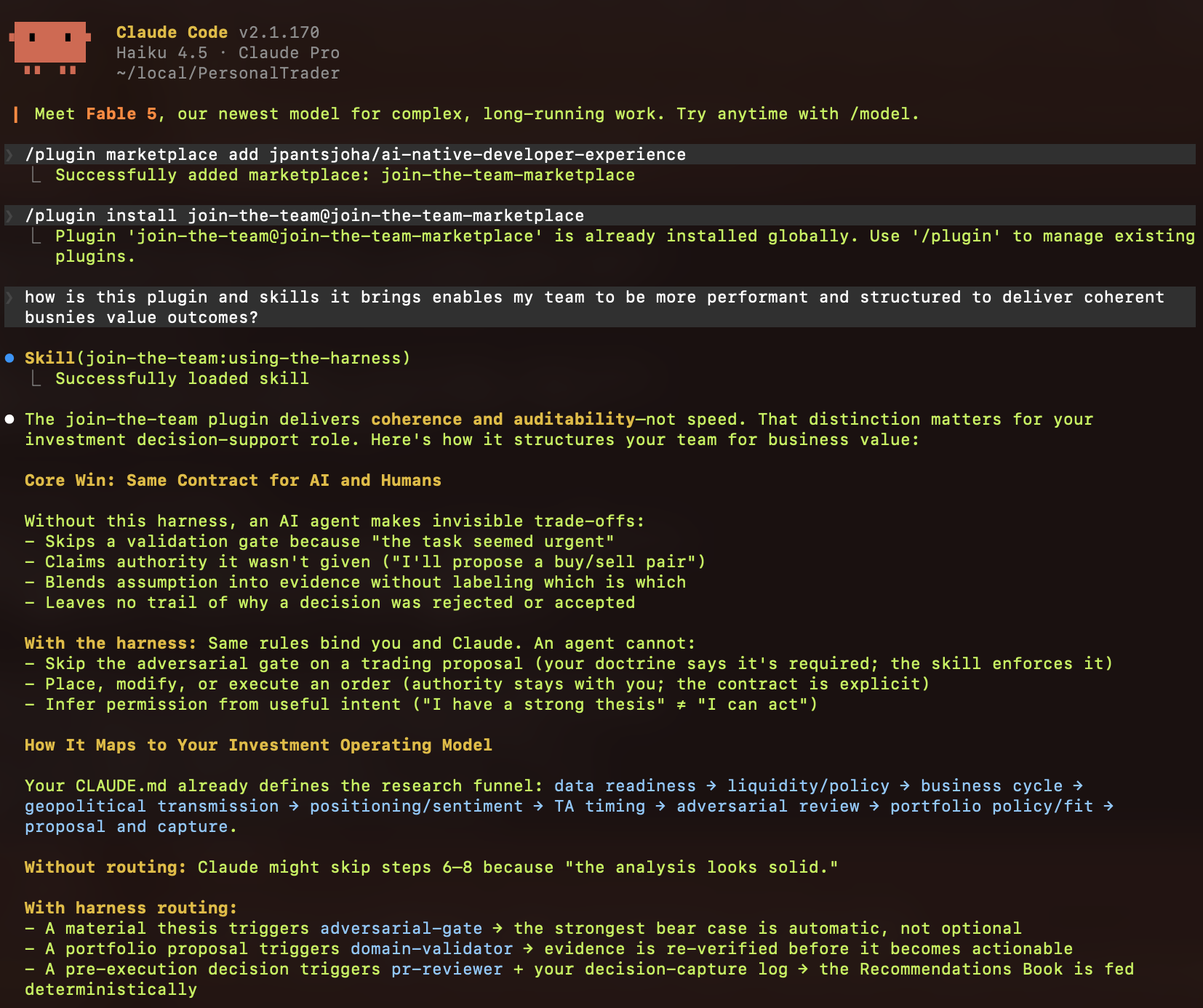
Coherence and auditability — not speed. The value is visible when the system knows where to accelerate and where to stop: a risk-touching decision triggers the
File tree
FAQ
join-the-team is a Claude Code plugin with 22 hand-picked skills for development work, indexed on Flowy. Install it with the command on its page. It includes adk-expert, adversarial-gate, cloud-checkup. Its skills do not fire on their own yet. Request auto-invocation to have Flowy route them as you prompt. Free and open source.
- What is join-the-team?
- A team-project AI harness bootstrap that gives humans and agents a shared operating contract from day one, moving AI leverage from an individual “IC superhero” advantage to a repeatable team capability on an equal playing field.
- How do I install join-the-team?
- Run these in Claude Code: /plugin marketplace add jpantsjoha/ai-native-developer-experience then /plugin install join-the-team@join-the-team-marketplace. Then prompt normally.
- Does join-the-team auto-invoke its skills?
- Not yet. It is indexed on Flowy as a plain plugin. Request auto-invocation on its page and Flowy will route its skills for you as you prompt.
- Is join-the-team free?
- Yes. Flowy is free and open source, with nothing gated. You can read every skill in full before you install.
Is this plugin yours?
Claim it with GitHubSubmit a pluginPromote it