
Development
Plugin
claude-council
A Claude Code plugin that consults multiple AI coding agents in parallel and shows you their answers side-by-side.

Install
$ npx -y skills add hex/claude-council --agent claude-code
Stats
784
Stars
96
Forks
Active
Maintenance
Shell
Language
MIT
License
18h ago
Last commit
9mo ago
Created
Repo: hex/claude-council
What's inside
Skill(4 skills)
/council-executionExecutes council queries by running the query pipeline across selected AI providers (Gemini, OpenAI, Grok, Perplexity), displaying formatted responses verbatim, and generating a synthesis of consensus, divergence, and recommendations. Invoked by the ask command during standard/deep-executionExecutes agent-enhanced council queries as one Workflow of parallel Claude analyst agents that each query a provider, evaluate response quality, ask follow-up questions, and return a schema-enforced analysis with confidence ratings and blind spot analysis. Invoked when the/local-council-executionRuns a local council when no external AI providers are configured. Spawns N independent Claude subagents (one per role, blind to each other) that each answer the question from a single assigned lens, then synthesizes their perspectives. Invoked by the ask command via --local, or/provider-integrationAdds new AI providers to claude-council, configures provider API settings, troubleshoots provider connections, and documents the provider script interface. Covers creating provider shell scripts, setting API keys, and validating connectivity. Triggers on "add provider", "new AI
Command(4 commands)
/advisePut the current conversation to the council — resolve this session's transcript, digest a bounded window of it, show what would leave the machine, and only then ask external providers for advice on it. Use when the user asks the council to look at what we have been doing, wants/askQuery multiple AI agents (Gemini, OpenAI, Grok, Perplexity, Kimi, any model OpenRouter routes to, and a local ollama model) for diverse perspectives on architecture decisions, technology choices, debugging dead-ends, and security tradeoffs. Use this whenever the user names the/resultFetch, list, or cancel background council jobs started with --async/statusCheck connectivity and configuration status of all council providers
Hook(1 hook)
README
claude-council
A Claude Code plugin that consults multiple AI coding agents in parallel and shows you their answers side-by-side. Useful when one model's bias could mislead you and the right call depends on cross-checking — architecture decisions, debugging dead ends, security reviews, framework picks.
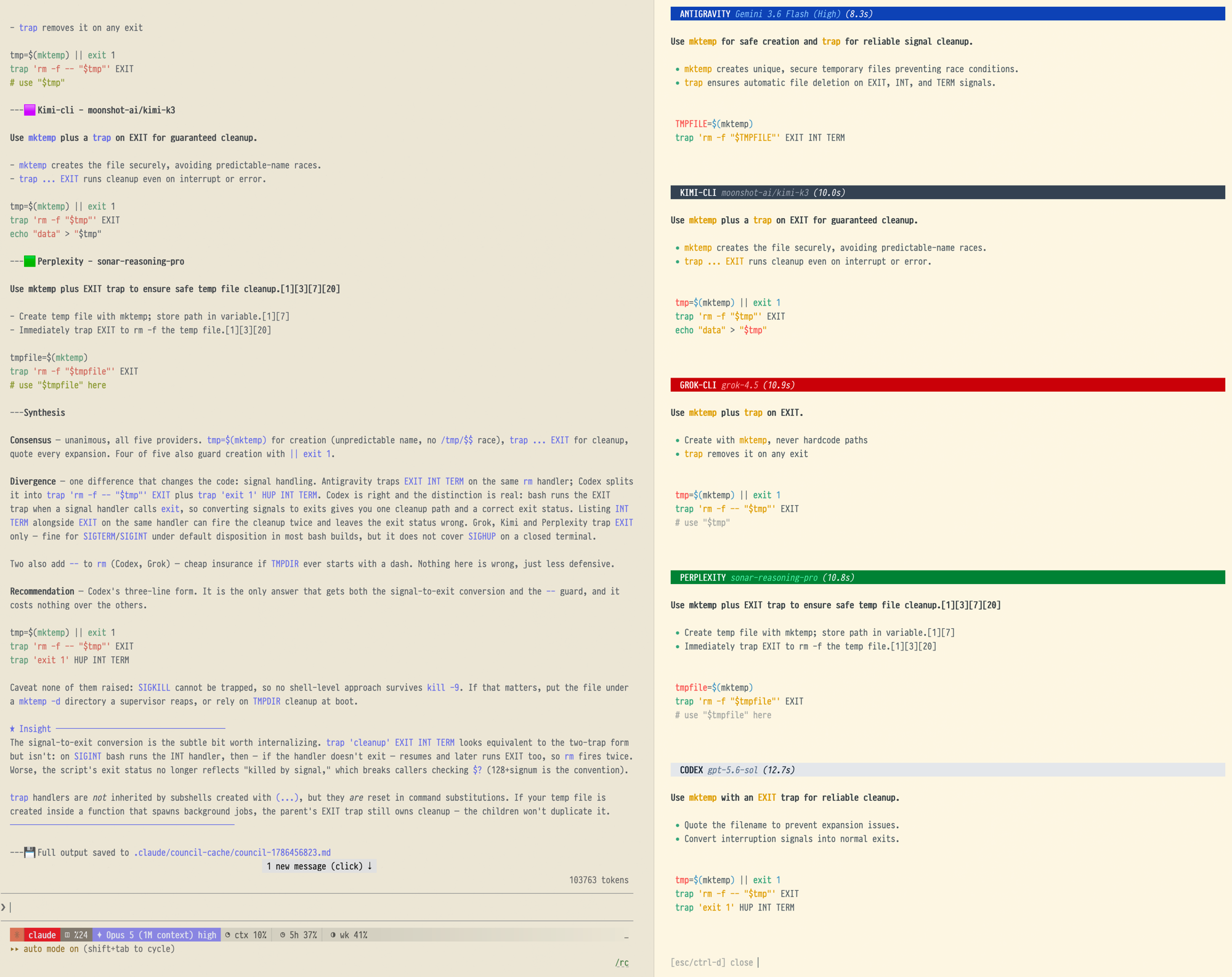
Five providers answering the same question. Each banner names the provider, the
model that answered and how long it took. The synthesis separates what they all
agreed on from where they diverged — here, whether trapping EXIT INT TERM on
one handler is correct, or whether signals should be converted into exits
first — and when they agree instead, it names the assumption the answer rests
on.
Quick start · Usage · Configuration · Reference · Development
Quick start
# 1. Install via Claude Code plugin marketplace
/plugin marketplace add hex/claude-marketplace
/plugin install claude-council

# 2. Configure at least one provider — any of these works:
export OPENAI_API_KEY="..."         # or GEMINI_API_KEY, XAI_API_KEY, PERPLEXITY_API_KEY, KIMI_API_KEY,
                                    # OPENROUTER_API_KEY
                                    # OR install the codex / antigravity (agy) / grok / kimi / cursor-agent CLIs (uses your
                                    # existing subscription — no API key needed)

# 3. Ask anything
/claude-council:ask "Should I use UUID or BIGINT primary keys for a SaaS users table?"
You get side-by-side responses from each configured provider:
🔳 Codex - default
   Use UUID primary keys — they avoid enumeration, work across distributed
   services, and survive imports/exports cleanly.

🟦 Antigravity - default
   UUIDv7 specifically: security of non-guessable IDs plus the index
   locality of time-ordered sequences.

🟥 Grok - grok-latest
   BIGINT autoincrement — smaller index, faster joins. Handle public-
   exposure concerns with a separate UUID slug column.

🟩 Perplexity - sonar-reasoning-pro
   BIGINT: 25% smaller than UUID, better cache locality, with citations
   to Postgres benchmarks.

## Synthesis
Two providers prefer UUID(v7), two prefer BIGINT. Choice depends on
whether you need distributed ID generation.
When they all agree instead, the synthesis says what that agreement rests on, because agreement is where it is easiest to stop asking:
## Synthesis
All five recommend SQLite. Read that as agreement about the reasoning, not
as verification: every provider was given the same description of a system
none of them can inspect. The answer assumes this stays single-node — the
one premise that would flip it, and the one nobody here could check.
Inside tmux, results stream into a side pane in real time with vendor-colored banners. Run /claude-council:status to confirm what's configured and connected.
Features
- Query Gemini, OpenAI (GPT/Codex), Grok, Perplexity, and Kimi (Moonshot AI) simultaneously
- Seat any model OpenRouter routes to — Anthropic's Claude by default, so the council hears the one vendor it otherwise has no voice for
- Use the
codex,agy(Antigravity),grok, andkimi(Kimi Code) CLIs (subscription auth) when installed — preferred over their API siblings - Run a local
ollamamodel as a council member — no key, no subscription, no network - Side-by-side comparison of responses with vendor-colored headers
- Streaming tmux pane that renders responses as they land
- Specialized roles, debate mode, and agent-enhanced deep analysis for high-stakes decisions
- Background jobs (
--async) for long-running queries, with/claude-council:resultto fetch, list, and cancel - Opt-in stop-gate: a second model reviews your uncommitted diff before Claude ends its turn
- Extensible provider system — add new AI agents easily
- Put the conversation itself to the council with
/claude-council:advise, which shows you what would leave the machine before it goes - Proactive agent that suggests consulting the council on architecture / debugging dead ends
Installation
From Marketplace (Recommended)
# Add the hex-plugins marketplace
/plugin marketplace add hex/claude-marketplace

# Install claude-council
/plugin install claude-council
Manual (run from a local clone)
For normal use, prefer the marketplace or GitHub install above — both persist across sessions. A manual clone is for running from a local working copy (development, or offline). Clone the repo anywhere, then point Claude Code at the repo root for the current session:
git clone https://github.com/hex/claude-council.git
claude --plugin-dir /path/to/claude-council    # repo root; loaded for this session only
Cloned it and nothing loads? Two traps to avoid:
- Don't clone into
~/.claude/plugins/(Windows:%USERPROFILE%\.claude\plugins\). That's Claude Code's managed install cache — it is never scanned for manually-added plugins, so the plugin won't appear in the Installed tab or respond to its slash commands.pluginDirectoriesinsettings.jsondoes nothing — it isn't a real setting, so it's silently ignored (no error shown). Use--plugin-dirabove for a local clone, or install via the marketplace / GitHub for a persistent setup.
Usage
Slash Commands
# Query all configured providers
/claude-council:ask "How should I structure authentication in this Express app?"

# Query specific providers
/claude-council:ask --providers=gemini,openai "What's the best approach for caching here?"

# Include a specific file for review
/claude-council:ask --file=src/auth.ts "What's wrong with this implementation?"

# Attach a screenshot for visual critique
/claude-council:ask --image=shot.png "Why does this dialog render off-center?"

# Export response to markdown file
/claude-council:ask --output=docs/auth-decision.md "How should we implement authentication?"

# Quiet mode - show only synthesis
/claude-council:ask --quiet "What's the best caching strategy?"

# Check connectivity and configured models for each provider
/claude-council:status

# Run a long query in the background, fetch it later
/claude-council:ask --async "Deep-dive the tradeoffs of event sourcing here"
/claude-council:result <job-id>
Quick Reference
| Flag | Description |
|---|---|
--providers=list | Query specific providers (e.g., gemini,openai,codex). Naming one in plain words works too: "check with grok" runs the council with that provider alone. There is no --grok style flag |
--roles=list | Assign roles (e.g., security,performance, a preset like balanced, or provider=role pairs) |
--debate | Enable two-round debate mode |
--file=path | Include specific file in context |
--image=path | Attach one image (e.g. a screenshot) for vision-capable providers |
--output=path | Export response to markdown file |
--quiet | Show only synthesis, hide individual responses |
--agents | Agent-enhanced analysis, one Claude analyst per provider (slower, deeper) |
--local | Local Claude-only council when you have no provider keys (see below) |
--async | Detach the query as a background job; fetch with /claude-council:result |
--no-cache | Force fresh queries, skip cache |
--no-auto-context | Disable automatic file detection |
--no-pane | Disable streaming tmux pane (default: on inside tmux) |
--verbosity=LEVEL | Response style: brief / standard / detailed |
Specialized Roles
Assign different perspectives to each provider for more comprehensive reviews:
# Use specific roles
/claude-council:ask --roles=security,performance,maintainability "Review this auth code"

# Use a preset
/claude-council:ask --roles=balanced "Review this implementation"

# Bind a role to a named provider instead of a position
/claude-council:ask --roles=openrouter-2=security,perplexity=devil "Review this design"
Available roles:
security- Security Auditor (vulnerabilities, OWASP Top 10)performance- Performance Optimizer (efficiency, bottlenecks)maintainability- Maintainability Advocate (clarity, future changes)devil- Devil's Advocate (challenges assumptions)simplicity- Simplicity Champion (identifies over-engineering)scalability- Scalability Architect (growth, scaling)dx- Developer Experience (API ergonomics)compliance- Compliance Officer (GDPR, regulations)
Presets:
balanced- security, performance, maintainabilitysecurity-focused- security, devil, compliancearchitecture- scalability, maintainability, simplicityreview- security, maintainability, dx
A bare list is positional: the first role goes to the first provider
discovery returns, the second to the second, and so on. That is fine for a fixed
roster and fragile for a growing one — adding a provider script shifts every
later provider's role by one, and reordering OPENROUTER_MODELS reassigns which
router seat plays which part. Both happen silently, because only non-empty roles
are printed.
provider=role pairs bind the two explicitly and survive both. The two forms
cannot be mixed in one --roles (a bare entry alongside a keyed one is
ambiguous); a pair naming a provider that is not being queried, or naming one
provider twice, is refused rather than resolved; and any provider left without a
role is named on stderr:
Note: no role for openai grok
Debate Mode
Enable multi-round discussions where providers critique each other:
/claude-council:ask --debate "How should I structure the database schema?"
How it works:
- Round 1: All providers answer the question normally
- Round 2: Each provider sees the others' responses and provides rebuttals
- Synthesis: Incorporates debate insights, consensus shifts, and unresolved tensions
Debate mode surfaces blind spots and stress-tests recommendations. The synthesis includes:
- Strongest criticisms raised
- Where providers changed positions after seeing alternatives
- Genuine disagreements that remain
Combine with roles for focused debates:
/claude-council:ask --debate --roles=security,performance,simplicity "Review this architecture"
Agent-Enhanced Analysis (--agents)
For complex decisions where deeper analysis justifies the extra time and cost, --agents runs
one Workflow of parallel Claude analyst agents that each independently query, evaluate, and
analyze their provider's response before the orchestrator synthesizes everything. Each analysis
is returned as schema-enforced structured output, and an interrupted run can be resumed with the
finished analysts served from cache. Needs a Claude Code with the Workflow tool.
# Explicit flag
/claude-council:ask --agents "Should we migrate from REST to GraphQL? What are the tradeoffs?"

# Combine with other flags
/claude-council:ask --agents --roles=security,scalability --providers=gemini,openai "Review this auth architecture"
What each analyst does (beyond a simple API call):
- Queries the provider
- Evaluates response quality - did it actually address the question?
- If the response is vague or off-topic, reformulates and retries
- Asks follow-up questions to surface deeper insights
- Extracts structured analysis: key recommendations, confidence level, blind spots
Enhanced synthesis includes:
- Confidence-weighted consensus (high-confidence agreement weighted more)
- Cross-provider blind spot analysis
- Divergence with context (why providers disagree)
Natural language triggers: The command also detects complex questions automatically. If your question contains architecture, security review, tradeoff analysis, or similar signals, you'll be asked whether to enable agent mode.
File tree
FAQ
claude-council is a Claude Code plugin with 4 hand-picked skills for development work, indexed on Flowy. Install it with the command on its page. It includes council-execution, deep-execution, local-council-execution. Its skills do not fire on their own yet. Request auto-invocation to have Flowy route them as you prompt. Free and open source.
- What is claude-council?
- A Claude Code plugin that consults multiple AI coding agents in parallel and shows you their answers side-by-side.
- How do I install claude-council?
- Run these in Claude Code: npx -y skills add hex/claude-council --agent claude-code. Then prompt normally.
- Does claude-council auto-invoke its skills?
- Not yet. It is indexed on Flowy as a plain plugin. Request auto-invocation on its page and Flowy will route its skills for you as you prompt.
- Is claude-council free?
- Yes. Flowy is free and open source, with nothing gated. You can read every skill in full before you install.
Is this plugin yours?
Claim it with GitHubSubmit a pluginPromote it