
Automation
Plugin
adobe-premiere-pro-mcp
Operate local Adobe Premiere Pro projects through MCP. 283 Premiere tools behind search_tools / invoke_tool, 13 context resources, and 10 guided prompts for Codex, Claude Code, Claude Desktop, and other MCP clients.

Plugin Signal65/100Solid
maintained92
capable29
documented75
adopted59
Install on Claude Code
> /plugin marketplace add hetpatel-11/Adobe_Premiere_Pro_MCP> /plugin install premiere-pro-mcp@adobe-premiere-pro-mcp
Stats
593
Stars
117
Forks
Active
Maintenance
TypeScript
Language
MIT
License
17d ago
Last commit
1y ago
Created
Repo: hetpatel-11/Adobe_Premiere_Pro_MCP
In this plugin
See everything inside What's inside
Skill(2 skills)
/edit-premiere-projectInspect, edit, verify, and export an open Adobe Premiere Pro project through the local Premiere MCP Bridge./premiere-pro-mcpInstall, verify, troubleshoot, and operate the Adobe Premiere Pro MCP server. Use when a user wants an agent to set up Premiere MCP, connect Claude Code/Codex/Claude Desktop, control Premiere, import media, build sequences, edit timelines, apply effects, or diagnose bridge
README
MCP Bridge for Adobe Premiere Pro
Operate local Adobe Premiere Pro projects through MCP.
283 Premiere tools behind search_tools / invoke_tool, 13 context resources, and 10 guided prompts for Codex, Claude Code, Claude Desktop, and other MCP clients. CEP is the supported production bridge; UXP remains experimental.






Website: premiere-mcp.com
Languages: English | 日本語 | Tiếng Việt | 简体中文 | 繁體中文 | 한국어 | Deutsch | Español | Français | Italiano | Dansk | Polski | Русский | Bosanski | العربية | Norsk | Português (Brasil) | ไทย | Türkçe | ភាសាខ្មែរ
Start here: install the local bridge, open it in Premiere, then run verify_premiere_connection before editing. MCP hosts see a small always-on set; call search_tools then invoke_tool for the rest.
Website | Install | Codex plugin | Claude Code plugin | Verify | Telemetry | Privacy Policy | Terms of Service | Security
Install
The supported bridge is the included CEP panel. Install the npm package on the same computer as Premiere Pro and your MCP client:
npm install -g adobe-premiere-pro-mcp
premiere-pro-mcp --install-cep
premiere-pro-mcp --doctor
--install-cep installs the CEP bridge, enables the required Adobe CEP debug setting, prepares the bridge directory, and configures supported local MCP clients. --doctor verifies the server build, CEP installation, bridge directory, debug setting, and client configuration.
Then restart Premiere Pro, open Window > Extensions > MCP Bridge (CEP), set the bridge directory shown by the installer, and start the bridge.
Requirements:
- Node.js 20+
- Adobe Premiere Pro 2020+
- Premiere Pro, the MCP client, and this package on the same computer
The bundled uxp-plugin is an experimental preview. It is shipped for evaluation but is not a replacement for the validated CEP bridge and is not installed by the CLI.
Codex plugin
From a clone of this repository, install the Codex plugin that bundles the MCP configuration and Premiere editing skill:
codex plugin marketplace add .
codex plugin add premiere-pro-mcp@adobe-premiere-pro-mcp
The plugin still requires the local CEP bridge. Run premiere-pro-mcp --install-cep, restart Premiere, start Window > Extensions > MCP Bridge (CEP), then ask Codex to run get_capabilities followed by verify_premiere_connection.
Claude Code plugin
From a clone of this repository:
/plugin marketplace add .
/plugin install premiere-pro-mcp@adobe-premiere-pro-mcp
Install and start the CEP bridge with the same steps as above before using the plugin.
Claude Desktop one-click bundle
Each GitHub release includes an .mcpb bundle for Claude Desktop. Download the matching adobe-premiere-pro-mcp-<version>.mcpb asset and open it in Claude Desktop to install the local MCP server. Its first launch installs the bundled CEP bridge for the current user.
Restart Premiere Pro, open Window > Extensions > MCP Bridge (CEP), set the bridge directory, and start the bridge. Then ask Claude:
Run
verify_premiere_connection. Make no changes.
The MCPB bundle is unsigned. Install it only from this repository's GitHub Releases. CEP release archives are labeled accurately as unsigned or self-signed; self-signed does not mean Adobe Marketplace trusted.
MCP client configuration
The installer configures Claude Desktop on macOS and Claude Desktop plus GitHub Copilot in VS Code on Windows. For another MCP client, configure it to run:
{
  "mcpServers": {
    "premiere-pro": {
      "command": "premiere-pro-mcp"
    }
  }
}
To opt out of anonymous usage telemetry, add "env": { "PREMIERE_MCP_TELEMETRY": "0" } to that server entry. See Telemetry.
Install from source
Use source setup when developing the MCP, modifying the CEP panel, or troubleshooting a package install:
git clone https://github.com/hetpatel-11/Adobe_Premiere_Pro_MCP.git
cd Adobe_Premiere_Pro_MCP
npm install
npm run build
npm run setup:mac # macOS
On Windows, use npm run setup:win from PowerShell after npm install and npm run build.
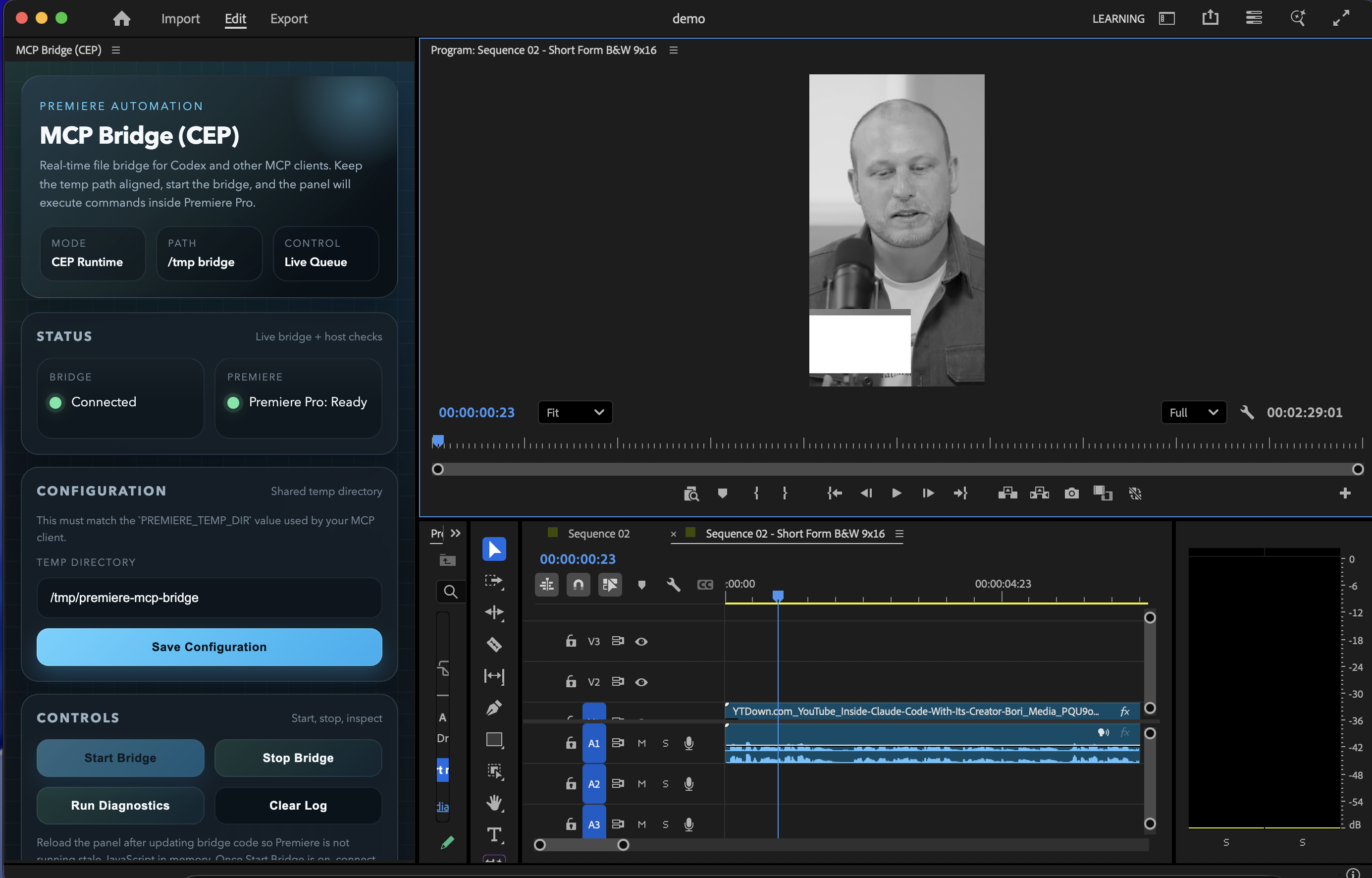
Current CEP panel UI inside Premiere Pro, using the refreshed bridge controls and status layout.
Current Status
This repository is currently validated for:
- macOS
- Windows installer/config smoke checks through GitHub Actions
- Adobe Premiere Pro 2020+ (actively used and tested on Premiere Pro 26.0)
- Node.js 20+
- MCP v2 server transport with modern stateless protocol discovery
- the included macOS installer path for Claude Desktop
- the included Windows installer path for GitHub Copilot in VS Code and Claude Desktop config
- manual MCP registration for Codex, Claude Code, and similar MCP clients
Current catalog status as of August 31, 2026:
283catalog tools (search_tools,get_tool_schema,invoke_tool, plus 280 Premiere operations)tools/listadvertises the small always-on set by default (search_tools,get_tool_schema,invoke_tool,verify_premiere_connection,list_sequences). SetPREMIERE_MCP_TOOLSET=fullto list every tool, which is what Claude Code native tool search indexes- coverage spans project setup, media ingest, bins, sequences, timeline editing, transitions, effects, keyframes, captions, markers, metadata, proxies, multicam, color, audio, exports, and higher-level assembly workflows
- the catalog includes practical agent workflows such as product-spot assembly, motion-graphics demos, timeline razoring, caption reads, audio ducking, scene edit detection, EDL import, export readiness validation, and linked audio/video operations
Most recent completed local live validation:
283catalog tools;get_capabilitiesreportscatalog.advertisedvscatalog.tools, local installation, and optional live connection state.verify_premiere_connectionis the canonical read-only bridge and host readiness check0known parked or placeholder tools are advertisedimport_ae_compsis intentionally not advertised because Premiere returnedfalsefor real.aepfixtures in this environment and a generic.aepimport can wedge the CEP bridge
The full live sweep output is written to /tmp/premiere-mcp-bridge/live-tool-sweep.json when you run the verifier.
What You Get
The server covers project operations, ingest, sequence creation, timeline editing, transitions, effects, keyframes, metadata, exports, and higher-level assembly workflows.
Example prompts:
- "List all sequences and show me which one is active."
- "Import these three shots and build a rough product spot."
- "Add cross dissolves to every cut on video track 1."
- "Apply Gaussian Blur to the middle clip."
- "Apply the
Black & Whiteeffect to the active short-form clip." - "Razor the interview sequence at 12.5 seconds across all audio and video tracks."
- "Export the active sequence as FCP XML."
For monochrome looks, prefer apply_effect with Black & White instead of trying to force black and white through generic saturation-only adjustments.
Before editing, you can also attach the premiere://config/get_instructions resource to give the model Premiere-specific operating guidance.
For a predictable start to every session, first run verify_premiere_connection. It confirms that the CEP bridge responded and returns the Premiere build, open project, and active sequence without modifying the project.
High-level workflow tools included:
build_motion_graphics_demoassemble_product_spotbuild_brand_spot_from_mogrt_and_assets
assemble_product_spot and build_brand_spot_from_mogrt_and_assets now support an optional clipPlan argument so an LLM can direct per-clip timing, track placement, transitions, motion, trims, effects, and color adjustments instead of relying on fixed template defaults.
Agent Skill
If you want Codex, Claude Code, or another agent to handle installation, verification, and day-to-day usage correctly, install the included Agent Skill:
npx skills add hetpatel-11/Adobe_Premiere_Pro_MCP --skill premiere-pro-mcp
Or install directly from the skill path:
npx skills add https://github.com/hetpatel-11/Adobe_Premiere_Pro_MCP/tree/main/skills/premiere-pro-mcp
The skill teaches agents how to install the MCP, start and verify the CEP bridge, use the Premiere tools safely, import real media before editing, prefer sequence-aware operations, and run diagnostics when something fails.
Advanced Setup and Verification
For source installs, client-specific MCP configuration, Windows installer flags, diagnostics, and the live tool sweep, use QUICKSTART.md. It is the canonical setup guide and keeps this page focused on choosing and using the product.
The short version:
- Install with
npm install -g adobe-premiere-pro-mcp, then runpremiere-pro-mcp --install-cep. - Restart Premiere Pro and your MCP client, then start
Window > Extensions > MCP Bridge (CEP). - Run
premiere-pro-mcp --doctor, then ask the client to callverify_premiere_connectionwithout making changes.
For manual registration in any MCP client, use the global command after npm installation:
{
  "mcpServers": {
    "premiere-pro": {
      "command": "premiere-pro-mcp"
    }
  }
}
The supported UI bridge is CEP. If Premiere does not expose the extension, enable UXP Plugins > Enable developer mode in Premiere preferences, restart Premiere, and reopen the CEP panel. The bundled UXP panel remains experimental.
For a real-host sweep, use a disposable Premiere project and run node scripts/live-tool-sweep.mjs; it creates temporary Sweep ... sequences in the current project.
How the Bridge Works
+-----------+        +-----------+        +-----------+
|  Client   |  MCP   | Node.js   | Files  | CEP Panel |
| (Codex+)  |<------>| MCP Server|<------>| (Premiere)|
+-----------+        +-----------+        +-----------+
                                                 |
                                                 v
                                          +-----------+
                                          | Premiere  |
                                          | DOM / QE  |
                                          +-----------+
- The client calls an MCP tool.
- The Node server generates ExtendScript plus shared helpers.
- The script is written into
/tmp/premiere-mcp-bridge. - The CEP panel polls that directory and runs the script through
CSInterface.evalScript().
File tree
FAQ
adobe-premiere-pro-mcp is a Claude Code plugin with 2 hand-picked skills for automation work, indexed on Flowy. Install it with the command on its page. It includes edit-premiere-project, premiere-pro-mcp. Its skills do not fire on their own yet. Request auto-invocation to have Flowy route them as you prompt. Free and open source.
- What is adobe-premiere-pro-mcp?
- Operate local Adobe Premiere Pro projects through MCP. 283 Premiere tools behind search_tools / invoke_tool, 13 context resources, and 10 guided prompts for Codex, Claude Code, Claude Desktop, and other MCP clients.
- How do I install adobe-premiere-pro-mcp?
- Run these in Claude Code: /plugin marketplace add hetpatel-11/Adobe_Premiere_Pro_MCP then /plugin install premiere-pro-mcp@adobe-premiere-pro-mcp. Then prompt normally.
- Does adobe-premiere-pro-mcp auto-invoke its skills?
- Not yet. It is indexed on Flowy as a plain plugin. Request auto-invocation on its page and Flowy will route its skills for you as you prompt.
- Is adobe-premiere-pro-mcp free?
- Yes. Flowy is free and open source, with nothing gated. You can read every skill in full before you install.
Is this plugin yours?
Claim it with GitHubSubmit a pluginPromote it