📦 npm •
📖 Documentation •
🎬 Demo film •
📝 Changelog •
📚 Citation




Claw Orchestrator runs Claude Code, Codex, Antigravity, Grok Build, OpenCode and any
Agent Client Protocol agent (Kimi Code, dsh) as persistent sessions behind one API.
A run counts as done only when checks the agent did not write pass: you declare the checks, the runtime runs them
and reads the exit codes, and the evidence stays on disk. Runs are checkpointed workflows that survive a crash, and
every turn on every engine is recorded with its model, tokens and cost.
The 40-second film, with sound
News
- [2026-11] v7.21.0: the plugin loads when OpenClaw installs it, with no native module to build.
- [2026-11] v7.20.0: a fan-out agent can run as a goal, so several agents can each work a copy of a
project until it is done, in parallel.
- [2026-11] v7.19.0: a fan-out agent can run in a directory of its own, so several agents can write code
in parallel, one copy each.
- [2026-11] v7.18.0:
CLAWO_CLAUDE_GATEWAY=1 runs a claude session on any model your own
Anthropic-compatible gateway serves, by its own name.
- [2026-11] v7.17.0: an agent can resume a paused autoloop run itself (
autoloop_resume), and a Codex goal
that hits a model at capacity is resumed on its thread instead of failing.
- [2026-10] v7.16.0:
clawo goal --engine claude runs a goal on Claude Code's /goal, with the same
checkpointing, resume and verification as a Codex goal.
- [2026-10] ResearchBoost-Agent, an autonomous agent
that profiles, optimizes and validates AI training code, now runs its goal mode on Claw Orchestrator.
- [2026-10] v7.14.0: any Agent Client Protocol agent runs as a session (
engine: 'acp'), with presets for
Kimi Code and dsh.
- [2026-10] v7.13.0:
clawo goal keeps a Codex /goal running for hours on one thread, reattaches it after a
crash, and judges the result with your checks.
- [2026-09] Declare, Compile, Look, built on Claw Orchestrator,
was presented as a talk at the ECCV 2026 Workshop on Multimodal Digital Agents.
- [2026-08] v6.0.0: the durable run kernel and the verification plane. A run survives its own process dying, and
a run with an acceptance contract is judged by the runtime, not by the agent.
Highlights
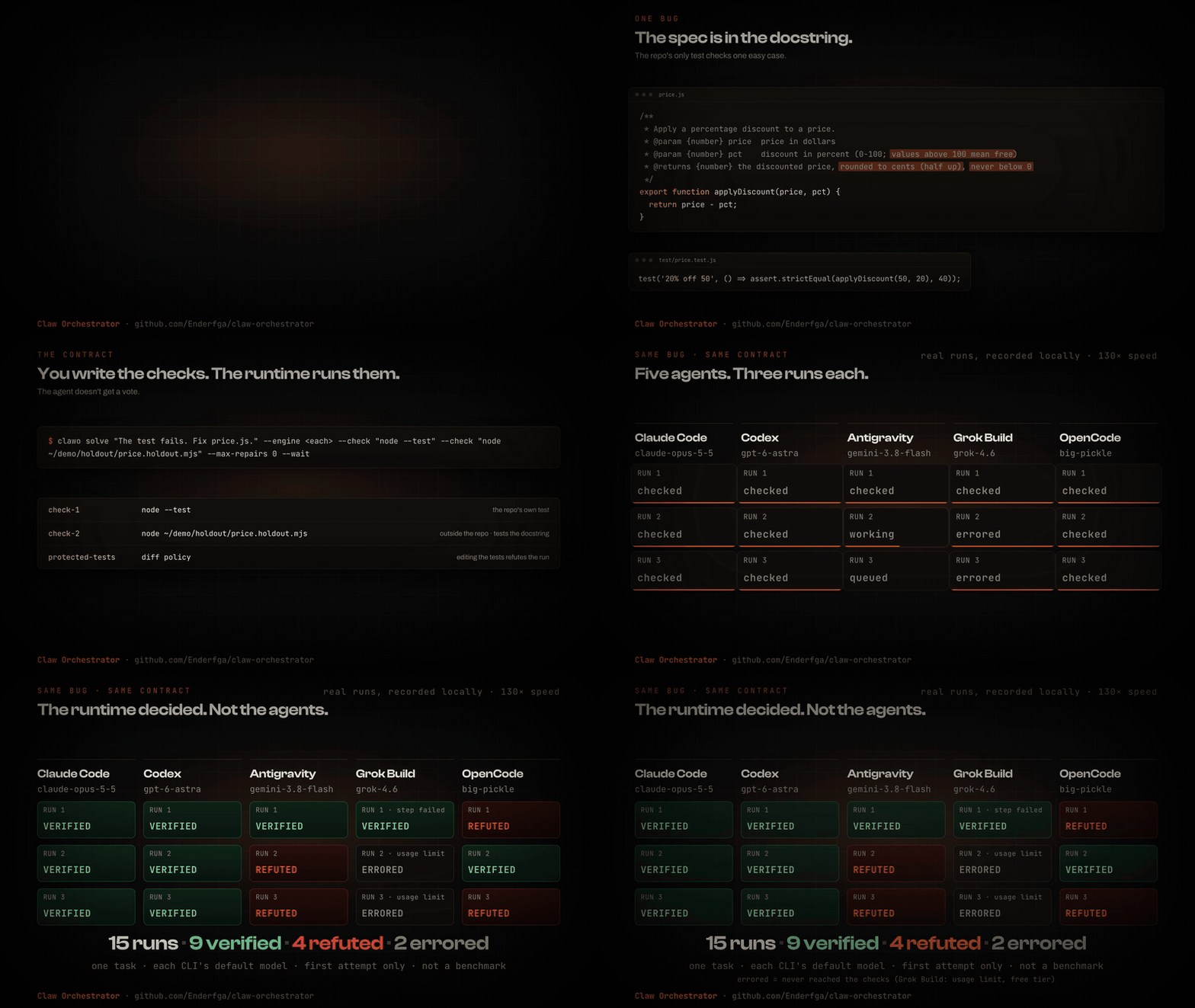
- ✅ Verdicts the agent cannot write: acceptance contracts (commands, HTTP probes, screenshots, diff policy, file
assertions) run by the runtime. A run ends
verified, refuted or unverified, and editing the tests its contract
runs refutes it (guide).
- 🔀 Many vendors, one API: Claude Code, Codex, Antigravity, Grok Build, OpenCode, any ACP agent and custom CLIs.
clawo fanout asks several at once; session_handoff moves a live conversation to another engine in the same
workspace (guide).
- 💾 Survives a crash: every state transition is checkpointed; resume, retry, timeout, cancel and steer come from
the kernel (guide).
- 🎯 Long goals:
clawo goal runs a Codex /goal unattended on one thread, resumes it after usage limits within a
bound, optionally inside your own sandbox (guide).
- 💰 Known cost: one per-turn ledger across engines (
clawo runs) and a maxBudgetUsd cap the runtime enforces on
every engine (guide).
- 🔌 Fits your tools: a CLI, an MCP server, an ACP agent for editors, an OpenAI-compatible endpoint, a TypeScript
SDK and an OpenClaw plugin (ways to run).
claude-squad, Conductor and Vibe Kanban are interfaces for running agents side by side in worktrees; Claude Code
subagents and Codex's parallel attempts stay within one vendor. Claw Orchestrator is a headless runtime underneath:
several vendors behind one API, durable workflows, and a verification step the agents cannot edit. They can be used
together.
Quick Start
Requires Node 22+ and at least one engine CLI installed and logged in (claude, codex, agy, grok or opencode).
npm install -g @enderfga/claw-orchestrator
clawo serve &    # local runtime + dashboard on 127.0.0.1:18796
clawo solve "The test fails. Fix price.js." --engine codex \
  --check "npm test" --check "node ../holdout/price.spec.mjs" --wait
clawo verify <runId>    # each check, why it failed, the files that changed
clawo runs --since 1h   # every turn on every engine: model, tokens, cost, verdict
clawo fanout "How would you speed up this test suite?" --engines claude,codex,grok --synthesize --wait
clawo goal --objective-file GOAL.md --check "npm run bench:check" --check-timeout 120 --wait
The server writes an access token to ~/.openclaw/server-token and the CLI reads it from there. To sign in the
browser once, open http://127.0.0.1:18796/login?token=<token>&redirect=/dash. The token grants full control,
including running commands as the server's user, so keep it private; see
Security model before exposing the server beyond localhost.
- 🧪 Acceptance contracts and evidence bundles (guide)
- 🔁 Workflows, resume and the goal node (guide)
- 🖥️ Every CLI command (guide)
- 🧰 All 79 tools (guide)
Ways to run
| For | Start here |
|---|
| CLI and dashboard | Terminals and scripts | clawo serve, then cli.md |
| MCP server | Claude Code, Claude Desktop, Cursor, Cline, Continue, Zed, Windsurf, Goose, Hermes Agent | claude mcp add clawo -- clawo-mcp, then mcp.md |
| ACP agent | Zed, JetBrains, Neovim, Emacs, the VS Code ACP extension, dsh | clawo acp, then acp.md |
| OpenAI-compatible endpoint | Any OpenAI SDK client or webchat, without changing call sites | POST /v1/chat/completions (openai-compat.md) |
| TypeScript SDK | Embedding the runtime in your own service | import { SessionManager } from '@enderfga/claw-orchestrator' (below) |
| OpenClaw plugin | Every OpenClaw agent gets all 79 tools | curl -fsSL https://raw.githubusercontent.com/Enderfga/claw-orchestrator/main/install.sh | bash |
import { SessionManager } from '@enderfga/claw-orchestrator';

const manager = new SessionManager();
await manager.startSession({ name: 'fix-tests', engine: 'claude', cwd: '/project' });
const result = await manager.sendMessage('fix-tests', 'Fix the failing tests');
From an MCP host, ask for workflow_start with template solve, a task, and a contract such as
{"checks":[{"type":"command","cmd":"npm","args":["test"]}]}. In an ACP editor, the model selector is grouped by
engine, so one dropdown switches between Claude, Codex, Antigravity and Grok models mid-session.
Engine compatibility
| Engine | CLI | Tested version |
|---|
| Claude Code | claude | 2.1.322 |
| Codex | codex | 0.167.0 |
| Antigravity | agy | 1.5.3 |
| Grok Build | grok | 1.0.77 |
| OpenCode | opencode | 1.19.5 |
| ACP agent | any | Kimi Code 2.3.1, dsh 0.2.1-rc.2 |
| Custom CLI | any | — |
An agent that serves the Agent Client Protocol on stdio runs as
engine: 'acp'; any other coding CLI that runs as a
subprocess can be wired up as a custom engine.
How the table stays current
The versions above are what the weekly sweep last ran. scripts/sweep.ts measures each core engine's installed,
pinned and upstream version, diffs the flags the wrapper passes against the binary's --help, runs one live turn
through the real wrapper class, smokes the ACP and MCP entry points, and checks src/models.ts against the
OpenAI, Anthropic and xAI published price tables. It contains no model call, so the check that reports a wrapper as broken does not
share the wrapper's failure modes.
scripts/sweep-workflow.json wraps the same script as a durable run on this project's own kernel: verifier → router
→ an agent that drafts the alignment on a sweep/<date> branch → a human gate. A person reviews and merges; the
orchestrator does not edit its own code unattended.
All features
| Capability | What it does | Reference |


 @mattpocock


