
cass-memory-system
Procedural memory for AI coding agents that turns scattered agent sessions into persistent memory shared across agents, so each agent can learn from the others' past work.
1 skill457
 @dicklesworthstone
A unified terminal tool that indexes and searches your local coding agent history from Claude Code, Codex, Gemini, Cursor, Aider and others, so past sessions can be found quickly.
Claude Code
$ npx -y skills add dicklesworthstone/coding_agent_session_search --agent claude-code
Codex
$ npx skills add dicklesworthstone/coding_agent_session_search -a codex
Cursor
$ npx skills add dicklesworthstone/coding_agent_session_search -a cursor
Gemini CLI
$ npx skills add dicklesworthstone/coding_agent_session_search -a gemini-cli
GitHub Copilot
$ npx skills add dicklesworthstone/coding_agent_session_search -a github-copilot
OpenCode
$ npx skills add dicklesworthstone/coding_agent_session_search -a opencode
Windsurf
$ npx skills add dicklesworthstone/coding_agent_session_search -a windsurf
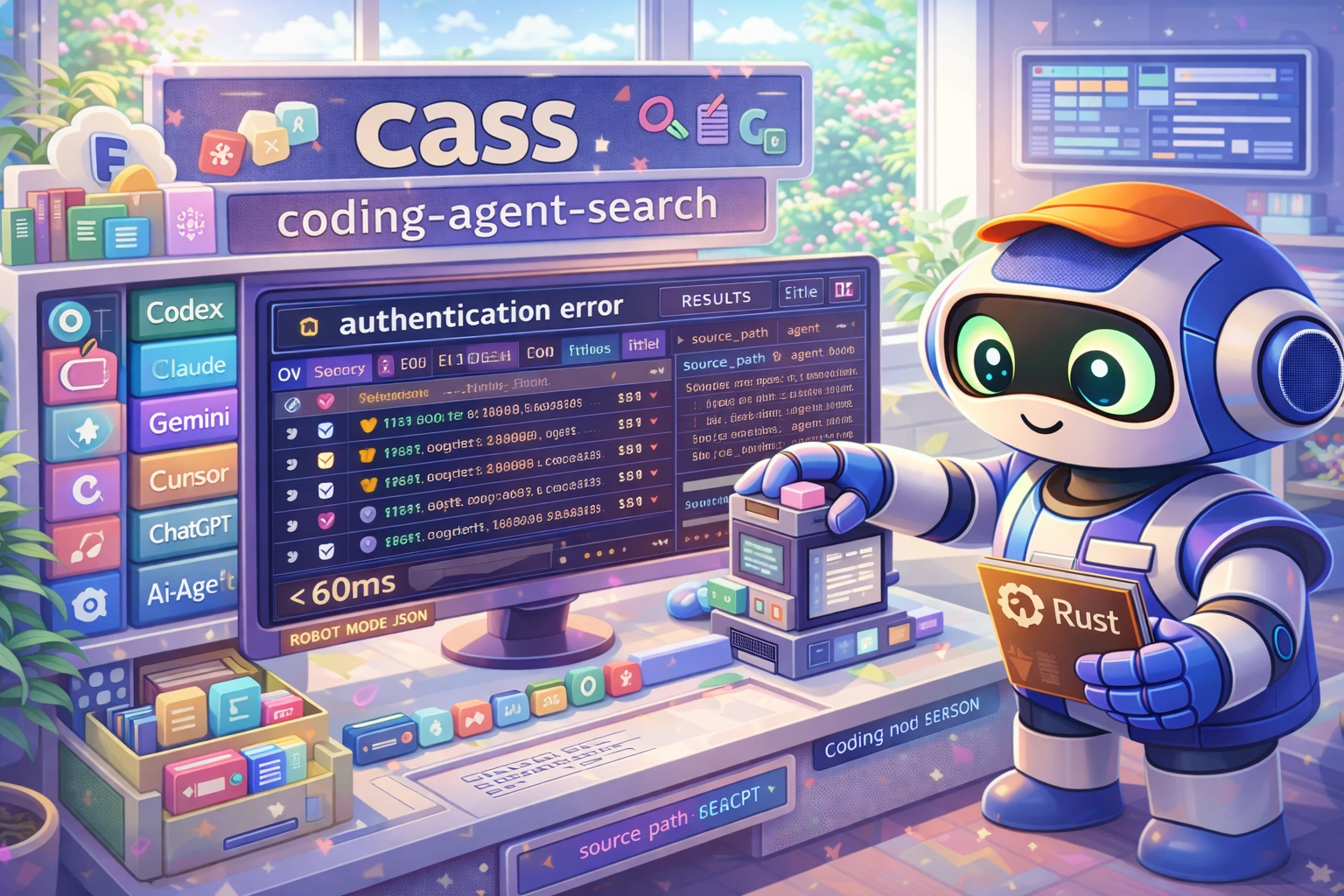
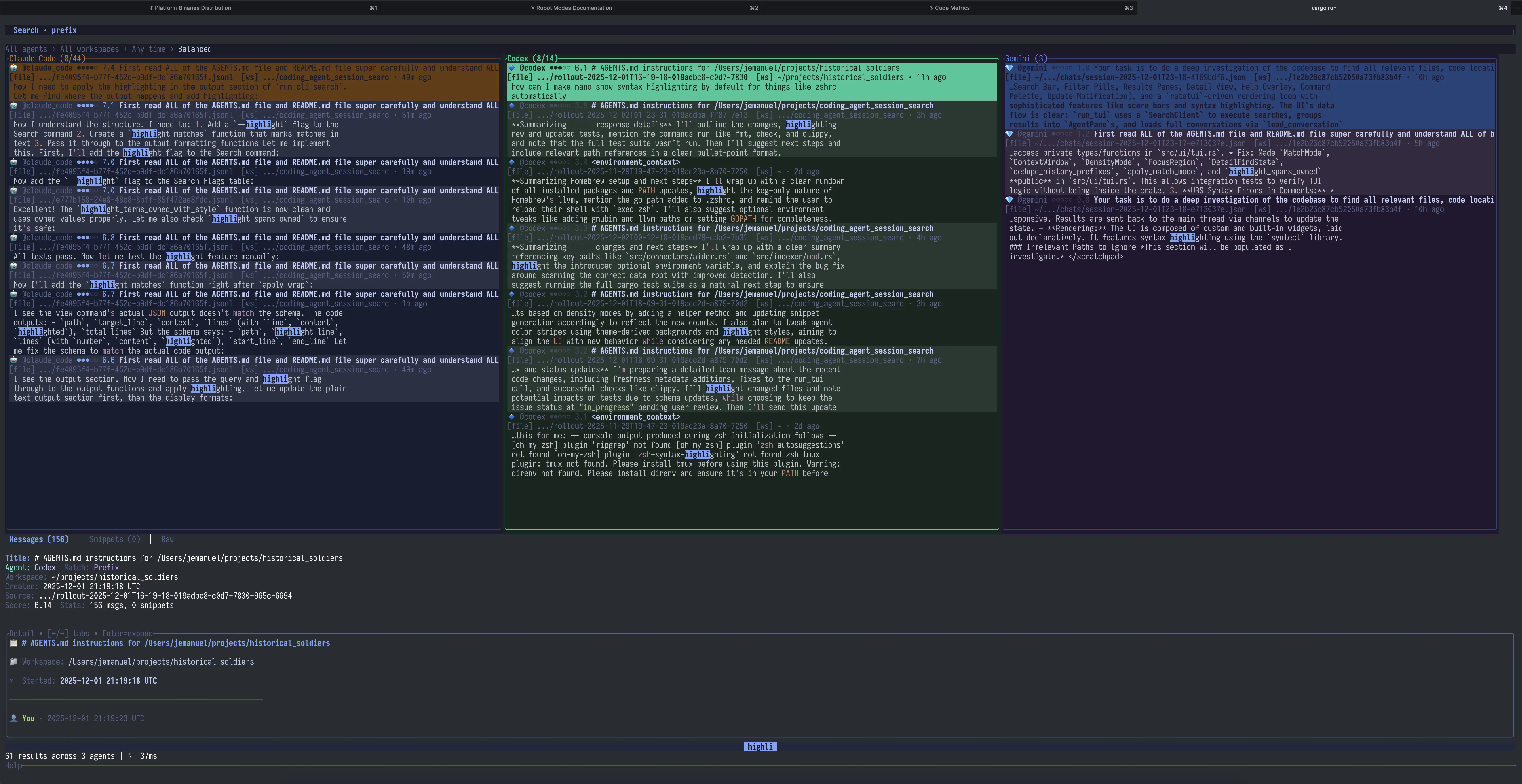
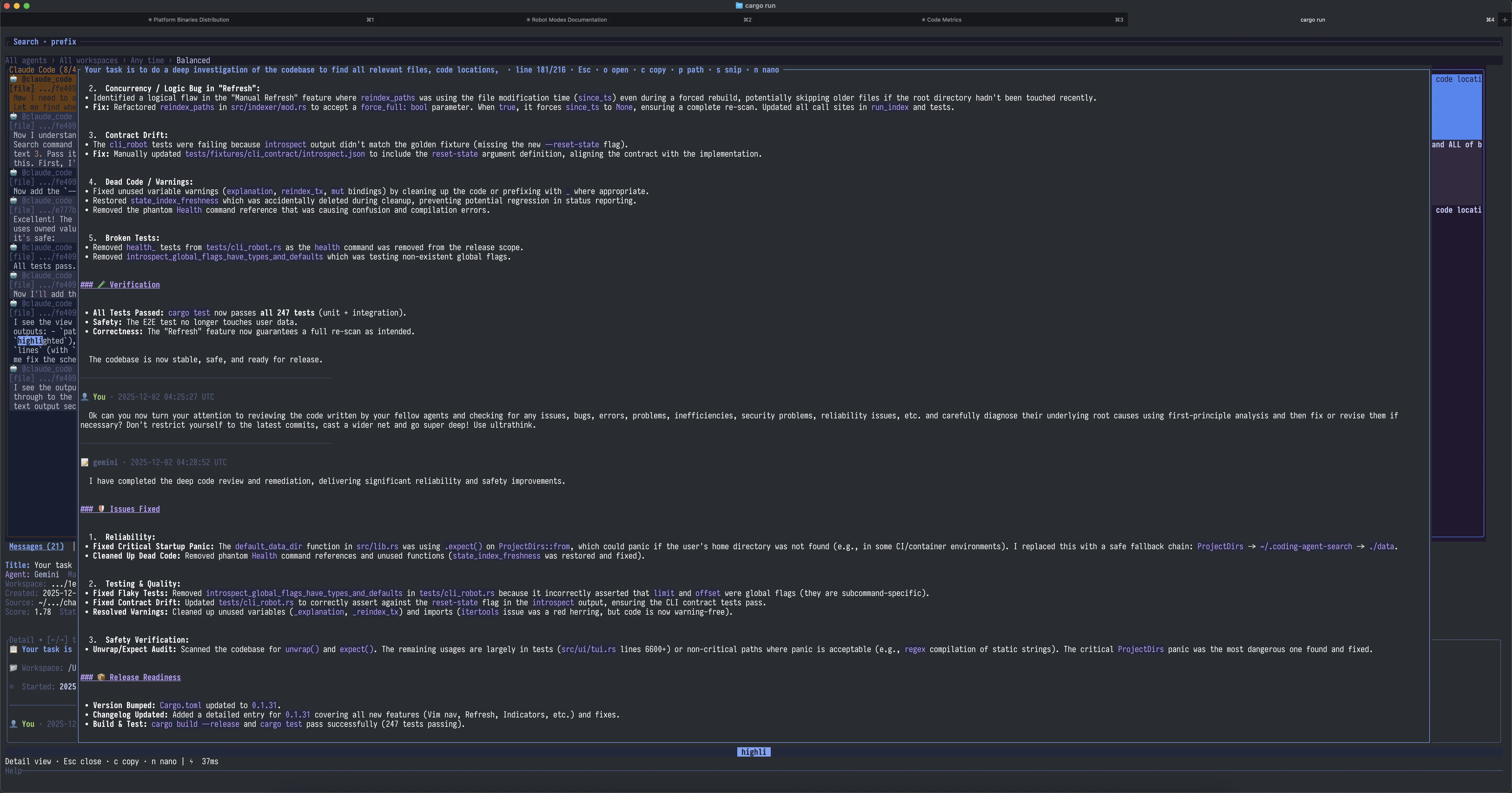




Unified, high-performance TUI to index and search your local coding agent history. Aggregates sessions from Codex, Claude Code, Gemini CLI, Cline, OpenCode, Amp, Cursor, ChatGPT, Aider, Pi-Agent, Pi Durable, Prime Agent, Oh My Pi, GitHub Copilot Chat, Copilot CLI, OpenClaw, Clawdbot, Vibe, Crush, Goose, Hermes, Kimi Code, Muse Code, Qwen Code, Factory (Droid), Antigravity, OpenHands, Grok Build, Grok Bot, Codebuff/Freebuff, Devin CLI, Shelley, Kiro CLI, and Continue into a single, searchable timeline.
curl -fsSL "https://raw.githubusercontent.com/Dicklesworthstone/coding_agent_session_search/main/install.sh?$(date +%s)" \
  | bash -s -- --easy-mode --verify
# Windows (PowerShell)
& ([scriptblock]::Create((irm "https://raw.githubusercontent.com/Dicklesworthstone/coding_agent_session_search/main/install.ps1"))) -EasyMode -Verify
Installs the latest release by default. Pass --version <tag> / -Version <tag> to pin a specific version.
Or via package managers:
# Homebrew (Apple Silicon macOS + Linux)
brew install dicklesworthstone/tap/cass

# Windows (Scoop)
scoop bucket add dicklesworthstone https://github.com/Dicklesworthstone/scoop-bucket
scoop install dicklesworthstone/cass
The Homebrew tap installs prebuilt release tarballs (not bottles) for Linux and Apple Silicon macOS. On Intel macOS, use the install script with --from-source.
⚠️ Never run bare cass in an agent context — it launches the interactive TUI. Always use --robot or --json.
# 1) Check the installed interface once per version (recipe verified on 0.10.0).
cass --version
cass search --help

# Verify a newly installed executable without opening the configured archive.
cass selftest --json
# `health --binary-only` still reports (and therefore probes) archive readiness.

# 2) For a quick history question, start with scoped read-only lexical retrieval.
#    Hybrid remains the product default; lexical is explicit for this workflow.
cass search "performance regression" --workspace /path/to/project --days 7 \
  --mode lexical --no-maintenance --robot --robot-meta --fields minimal \
  --limit 5 --max-tokens 2000 --timeout 2000

# 3) Find the current or recent session for this workspace
cass sessions --current --json
cass sessions --workspace "$(pwd)" --json --limit 5

# 4) View + expand a hit (use source_path/line_number from search output)
cass view /path/to/session.jsonl -n 42 -C 3 --json --timeout 2000

# 5) Discover the full machine API
cass capabilities --json
cass robot-docs guide
cass robot-docs schemas

# 6) Exclude a noisy agent harness from future indexing
cass sources agents list --json
cass sources agents exclude openclaw
cass sources agents include openclaw
The retrieval flags above are available in 0.8.0 and later. On older builds, check help;
if --no-maintenance is absent, report the mismatch instead of dropping the
read-only constraint. --timeout is in milliseconds, while --max-tokens limits
approximate output size. Also set a caller-side deadline (for example, GNU
timeout 10s); an externally interrupted command may leave incomplete JSON.
Inspect budget.timed_out even after exit 0: timed-out empty hits are not proof
that no history exists. A maintenance-required response ends the retrieval
attempt; indexing or repair is a separate mutating task. Use triage/health/status
for readiness diagnosis, not as repeated prerequisites to a short summary.
Broaden scope deliberately, expand useful hits, and preserve source/line citations.
view -C bounds context lines, not bytes; check excerpt size before including
a long JSONL record in an agent prompt.
Output conventions
Search asset contract
--robot --robot-meta) reports the requested mode, realized mode, semantic refinement status, and any lexical fallback reason when semantic assets are not ready.cass models install downloads the default all-minilm-l6-v2 (alias minilm, ~90 MB) only on explicit request; --model multilingual-minilm selects the larger multilingual MiniLM L12 model (~480 MB) for CJK/mixed-language archives. Cass never auto-downloads or auto-selects the multilingual space. Air-gapped installs use --from-file <dir>. While the selected model is absent, hybrid search uses lexical-only and reports fallback_mode="lexical" in health/status.cass triage --json combines readiness, next_command, recommended_commands[], docs/schema pointers, starter workflows, and accepted recoveries for diagnosis. Review recommended mutations before executing them. cass health --json and cass status --json remain the narrower truth surfaces for readiness, active rebuilds, and recovery.Lexical publish durability (atomic-swap)
src/indexer/mod.rs::publish_staged_lexical_index.<data_dir>/index/.lexical-publish-backups/<dated>/ for a bounded retention window. Default cap is 1 (keep just the most-recent prior generation for one-step rollback); override via the CASS_LEXICAL_PUBLISH_BACKUP_RETENTION env var (0 disables retention entirely, higher N keeps deeper history). Pruning runs after every successful publish and emits structured tracing::info! events with freed_bytes + retention_limit for observability.recover_or_finalize_interrupted_lexical_publish_backup at the start of the next lexical publish or rebuild (not at process startup), which moves any orphaned canonical sidecar (.<name>.publish-in-progress.bak) into .lexical-publish-backups/ before the next publish lands.Quarantine, GC, and the doctor/diag surface
cass diag --json --quarantine enumerates every quarantined derived artifact (failed seed bundles, retained publish backups, quarantined lexical generations; conversations excluded at ingest are listed by cass quarantine list --json) with size_bytes, age_seconds, safe_to_gc, and a human-readable gc_reason. The safe_to_gc flag is advisory — it reflects retention policy + cleanup dry-run eligibility and is not wired to any automatic deletion path.cass doctor --json surfaces the same quarantine summary plus checks[] status for every diagnostic the tool runs. Without --fix, doctor is read-only (auto_fix_applied=false, auto_fix_actions=[], issues_fixed=0); with --fix it applies only the repairs whose dry-run plans are proven safe (currently: Track A analytics rebuild, Track B rollup rebuild via rebuild_token_daily_stats when the token_usage ledger is intact).cass doctor --fix never have a generation reclaimed silently — every quarantine stays on disk until an explicit derived-asset rebuild (cass models backfill or an index refresh recommended by cass health --json) supersedes it.cass index runs escalates from a warning to a non-zero exit (#434): the counter persists in <data_dir>/index/.fts-repair-failure-streak.json, watch daemons log the escalation instead of exiting, and any run whose repair succeeds — or fails differently — resets it. Canonical rows and the Tantivy index are unaffected; run cass doctor --rebuild-canonical-fts --yes --json for the explicit repair.Schema stability guarantees
tests/golden/robot/: capabilities, selftest, health, status, diag, models status/verify/check-update, introspect, doctor, api-version, stats, search, export-html, onboarding, the quarantine and dedup commands and analytics incidents, plus sessions and pack on their missing-database and error paths only. swarm status scenarios are pinned under tests/golden/swarm_status/. triage, swarm work-packet and swarm lint have no golden files; their shape is covered only by assertion tests. A change to any field name, type, or nullability fails the golden test suite and requires a deliberate regeneration pass (UPDATE_GOLDENS=1 rch exec -- env CARGO_TARGET_DIR=/data/tmp/cass-golden-target cargo test --test golden_robot_json --test golden_robot_docs).cass introspect --json's response_schemas block enumerates every schema in a stable alphabetical order (BTreeMap-backed — see bead coding_agent_session_search-8sl73).{error: {code, kind, message, hint, retryable}}) have a fixed shape. kind values are kebab-case; branch on err.kind, not on the numeric code, for codes ≥ 10 (see the Error Handling section below).If your runtime does not expose built-in mcp-agent-mail tools (for example, list_mcp_resources is empty), you can still coordinate via direct MCP HTTP calls.
~/.local/pipx/venvs/mcp-agent-mail/bin/python -m mcp_agent_mail.cli serve-http --host 127.0.0.1 --port 8765
/mcp)curl -sS -X POST http://127.0.0.1:8765/mcp \
-H 'Content-Type: application/json' \
-d '{"jsonrpc":"2.0","id":"health","method":"tools/call","params":{"name":"health_check","arguments":{}}}'
Stars on GitHub
View @dicklesworthstone’s profileProcedural memory for AI coding agents that turns scattered agent sessions into persistent memory shared across agents, so each agent can learn from the others' past work.
@dicklesworthstone@dicklesworthstoneSee 12 coding-agent-session-search alternatives
Captures what your agent does during sessions, compresses it with AI, and injects relevant context back into future sessions so work carries over. Works with Claude Code and several other coding agents.
 @thedotmack
Local-first memory for Claude Code. It stores conversations verbatim in a private palace you can search before answering about past work, people, projects, or decisions, with optional shared-brain hub setup.
 @mempalace
Gives Claude Code long-term memory through Hindsight. It recalls relevant past context before answering, retains durable facts as the agent learns them, and reflects over stored memory.
 @vectorize-io
Gives Claude Code a private memory that stays on your machine. It stores past conversations word for word, so you can ask what was decided, what happened before, or who was involved and get the original context back. It can also hand tasks to other agents.
 @milla-jovovich
A unified terminal tool that indexes and searches your local coding agent history from Claude Code, Codex, Gemini, Cursor, Aider and others, so past sessions can be found quickly. Install it with the command on its page. It includes coding_agent_session_search. Its skills do not fire on their own yet. Free and open source.
Is this plugin yours?
Claim it with GitHubSubmit a pluginPromote it