English | 简体中文 | 日本語 | Русский | 한국어 | Español | Français | Deutsch | Português (Brasil) | Italiano
Note
OmO 5.0: OmO ❤️ Pi
Install it with curl -fsSL https://get.omo.dev/install.sh | bash. Memory system, CodeMode, Anthropic subscriptions, all covered.
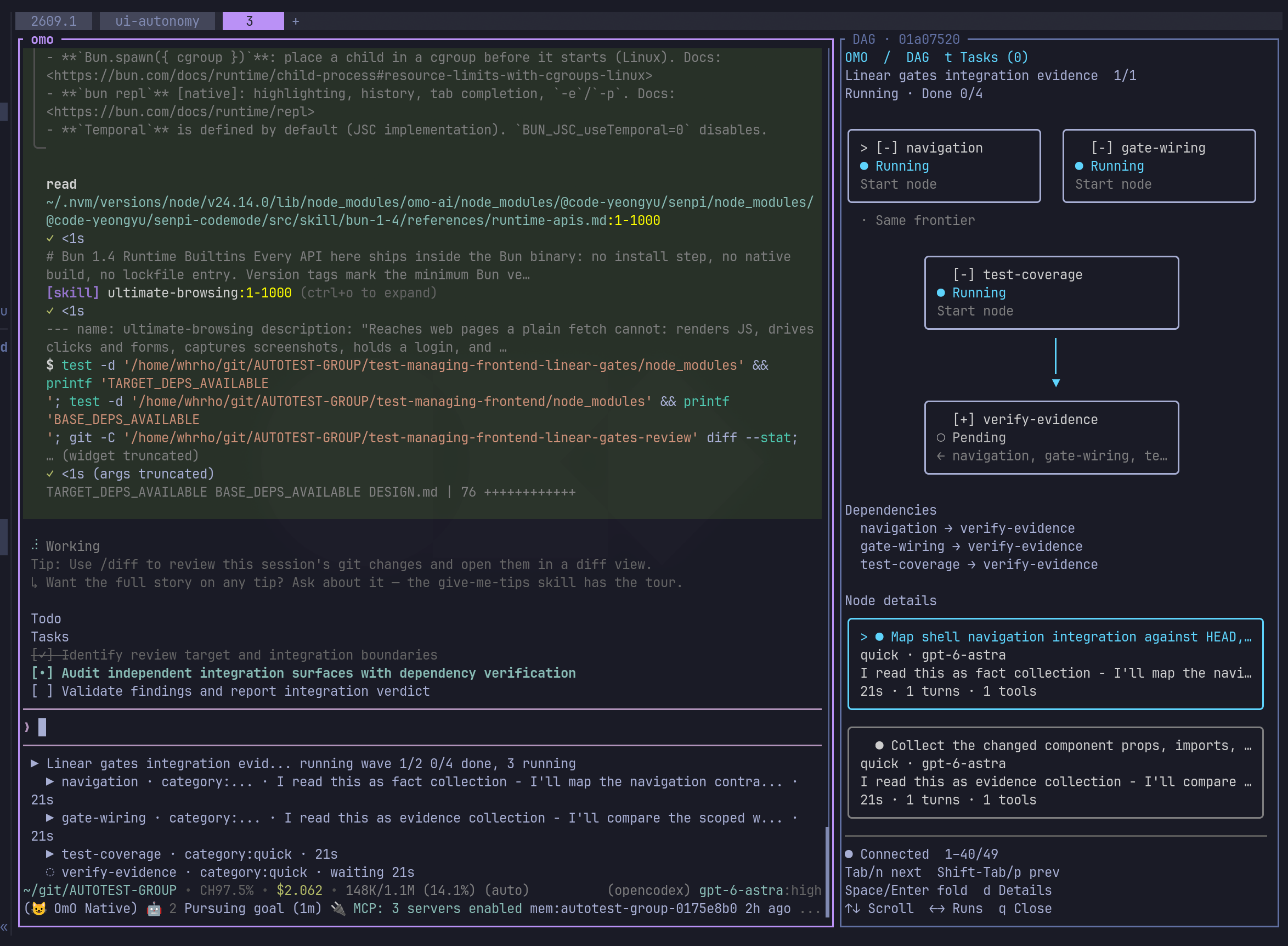
Just type "mass ulw" with your prompt - now you are the master of graph engineering. Multi-model ultracode, together with a better memory system. (The right panel is omo-herdr-dag.)
Sponsors
These are our sponsors. They help keep OmO going as a personal side project.
 | OpenGateway sponsors OmO. An OpenAI-compatible gateway that puts many model providers behind one API. Thank you for backing open source. |
|---|
Tip
Be with us!
 | Join our Discord community to connect with contributors and fellow OmO users. |
|---|
 | Updates for OmO used to be posted on my X account. Since it was mistakenly suspended, @justsisyphus now posts updates on my behalf. |
 | Follow @code-yeongyu on GitHub for more projects. |

OmO
Your tool for real work. But it's an agent.






OmO is one omo command that turns your tokens into finished work: research across ten thousand sources, a deck people actually get, backends, frontends, code. It runs on senpi, our fork of pi, with everything below built in.
Install
curl -fsSL https://get.omo.dev/install.sh | bash
omo
On Windows, in PowerShell: irm https://get.omo.dev/install.ps1 | iex. The script installs the native omo binary for your OS and CPU into ~/.local/bin, checks it against the release checksums, and falls back to GitHub Releases when the mirror is unreachable. Add -s -- beta (or a version such as -s -- 5.1.1) after bash to pick another channel. Windows CMD, fixing your PATH, updating and uninstalling are covered at omo.dev/docs/install.
Prefer a package manager? bun add -g omo-ai (or npm i -g omo-ai) installs the same OmO. The package is omo-ai; the unrelated omo package on npm is someone else's.
Open your project, run omo, describe the job. That's the whole setup.
In a session, /thinking <level> sets how hard the model thinks (/thinking alone opens a picker), Shift+Tab cycles through the levels, and /efforts <level> sets the reasoning effort directly on models with effort grades. To pick up earlier work, /resume (or /sessions) opens your past sessions; from the shell, omo -c continues the last one and omo -r opens the picker. /help lists everything else.
Coming from the OpenCode edition or LazyCodex? Run omo setup once. It carries your provider keys, custom providers, MCP servers, skills and model picks across. omo doctor then shows which task categories your providers can run and what the old install left behind, and omo doctor --models shows which model each category and agent runs and in what order (keep one out everywhere with exclude_models). The full walkthrough is Migrating from OpenCode.
To update, run the install line again (a package-manager install updates with omo update). rm ~/.local/bin/omo removes the binary install; bun remove -g omo-ai (or npm uninstall -g omo-ai) removes the package install.
Why OmO
ultrawork. Skip the study. If a task feels hard, add ultrawork (or ulw) to your prompt. The agent reads the codebase before touching a line, plans, proves each step before moving on, checks the result on the real surface, and stops when it's done.
Hundreds of agents, one keyword. Type mass ulw and the whole job becomes a graph of agents: deep research over thousands of sources, a full machine-learning pipeline, a migration nobody wants to do. Each part runs on the model that fits it, in parallel, and gets checked before anything is called done.
Kibitzer. Your agent doesn't forget you, or your work. Memory lives in a git repository of markdown files. A small, cheap model sits beside the expensive main agent, reads what you've done before, and nudges the main agent before it repeats a mistake. You stop re-explaining yourself.
Mix models without thinking about it. Use the frontier models you love together with the cheap ones. Just sign in: /login covers Claude, ChatGPT, Kimi and GLM subscriptions. Every model ships with a system prompt tuned for it, so you never pick the wrong one.
High-quality skills, only the ones you need. Your model is smart, but it still doesn't know a lot about solving real-world problems. OmO ships the missing knowledge as skills, browser use included, and loads only what the task needs.
Everything else is crafted. Independent tool calls run together in one small program, so twenty reads are one round trip. Malformed tool arguments are repaired before they run. Waiting on a build or a deploy is a subscription, not polling. Long work keeps a record of what was checked, so a restarted session picks up where it stopped. Config, skills and prompts reload live.
Configuration
Opinionated defaults, adjustable if you insist. Your settings live in ~/.omo/omo.jsonc, and a project can add its own .omo/omo.jsonc; the closest file wins. Every key is in the configuration reference.
Docs
Reporting a bug
The fastest way to report a bug is /bug inside a session (available in the omo app). It lists what it includes and lets you see the exact report before you send it, then sends it to the OmO team: the recent engine log, your environment and config with secrets blanked, the session transcript, and identity lines - your device name and, when telemetry is on, an install id and a session hash, plus your account details (email, name, account, user and device ids, plan, device name) when you report from the desktop app, so we can reply. Everything but the identity lines goes through the upload redactor. GitHub issues stay open for anyone who cannot use the in-app report.
Reviews
"It made me cancel my Cursor subscription. Unbelievable things are happening in the open source community." - Arthur Guiot
"If Claude Code does in 7 days what a human does in 3 months, OmO does it in 1 hour." - B, Quant Researcher
"You guys should pull this into core and recruit him. Seriously. It's really, really, really good." - Henning Kilset
Author's Note
When I have to take the wheel back from an agent, that isn't teamwork. The system failed. OmO is built on that idea. You say what you want; the agent researches, plans, writes code you couldn't tell from a senior engineer's, verifies it, and keeps going until it's finished. It spends tokens when they buy real speed and routes the easy parts to cheap models.
I'm this project's most obsessive user. Which model has the sharpest logic? Who writes the best prose? What did everyone else ship this week? OmO is where those answers land. Have a better way? PRs welcome.
The goal is an agent you stop noticing. You flip the switch, the light turns on. The long version is the Ultrawork Manifesto.
No affiliation with any project or model mentioned. The Ultragoal and UltraQA ideas come from oh-my-codex, reimplemented from concept for OmO.
Loved by professionals at
Indent, makers of Spray (influencer marketing solution), vovushop (cross-border commerce platform) and vreview (AI commerce review marketing solution). Google. Microsoft. Vercel. ELESTYLE, makers of elepay (multi-mobile payment gateway) and OneQR (mobile application SaaS for cashless solutions). Deepgram.

 @code-yeongyu



