
Development
Plugin
memorix
Open-source cross-agent memory layer for coding agents via MCP. Compatible with Claude Code, Codex, Cursor, Windsurf, Gemini CLI, Antigravity, OpenClaw, Hermes Agent, Oh-my-Pi, Pi, Copilot, Kiro, OpenCode, and Trae.

Plugin Signal73/100Solid
maintained99
capable46
documented75
adopted62
Install
$ npx -y skills add AVIDS2/memorix --agent claude-code
Stats
795
Stars
66
Forks
Active
Maintenance
TypeScript
Language
Apache-2.0
License
6h ago
Last commit
7mo ago
Created
Repo: AVIDS2/memorix
What's inside
Skill(7 skills)
/memorix-git-memoryUse when the task depends on commit history, what changed, when a fix shipped, or linking engineering evidence to reasoning memory./memorix-memoryUse when prior workspace context, past decisions, solved bugs, handoff state, or durable project knowledge would help a coding task./memorix-mini-skillsUse when durable project knowledge, gotchas, workflows, or repeated fixes should become reusable agent guidance instead of ordinary memory.
MCP(1 mcp)
Badges
README
Maintainer status and the current public work boundary live in ACTIVE_WORK.md. It is the repository's single living work tracker.
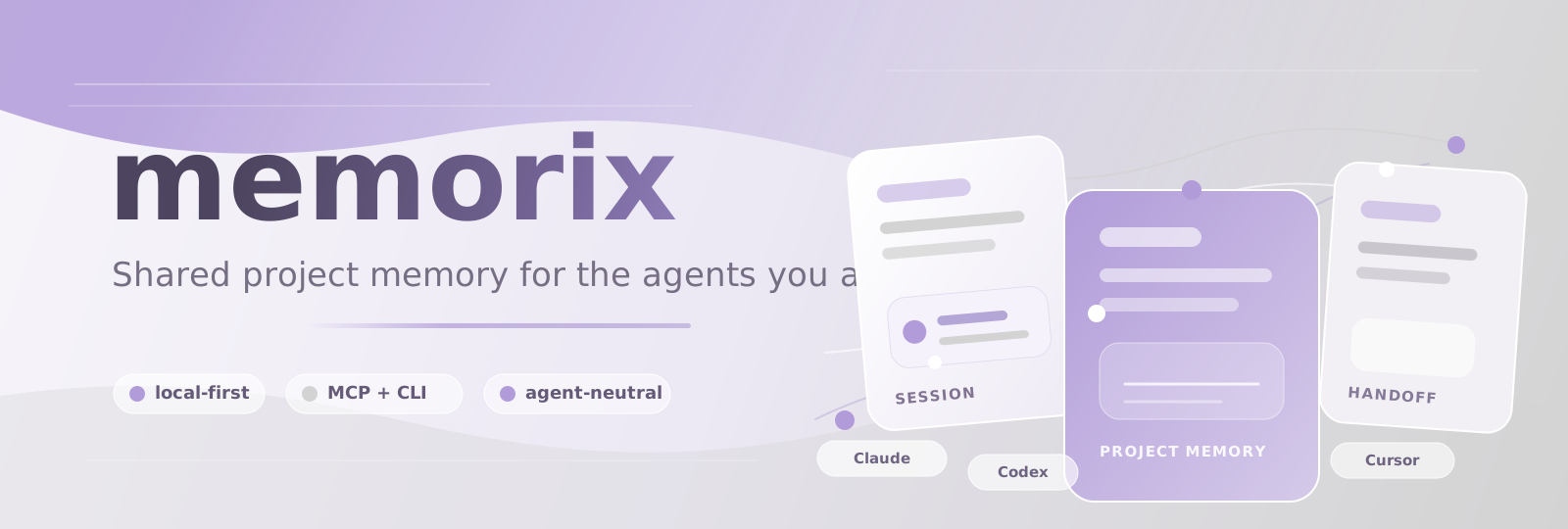
Memorix gives the AI coding agents you already use a shared, searchable project memory that survives new chats, IDE switches, terminal sessions, and handoffs. The memory lives under the Git project, not inside one chat window or one tool.
Use Claude Code today, Codex tomorrow, and Cursor in the afternoon. The agent can change; the project memory stays the same.
Use Memorix when you keep re-explaining the same project to a new agent session: the last session already figured something out, another IDE cannot see it, or a design decision is buried in a chat you cannot find anymore.
| Problem | What Memorix adds |
|---|---|
| The next session forgets what the last session learned | Project-scoped memory, session summaries, timelines, and detail retrieval |
| Different agents know different things | One local memory pool available through MCP, hooks, CLI, SDK, and the bundled terminal agent |
| Git records what changed, but agents cannot recall it well | Git Memory turns commits into searchable engineering facts |
| Architecture decisions disappear into old chats | Reasoning Memory stores why choices were made, with alternatives and trade-offs |
| Static rule files drift | Gotchas, fixes, and project skills evolve from real work |
| Parallel agent work gets messy | memorix orchestrate coordinates task context, handoffs, locks, verification, and review loops |
Memorix is local-first. SQLite is the canonical store. Small projects use the in-process Orama path; larger projects use a persistent SQLite FTS5 candidate index and, when available, an optional local LanceDB semantic shadow index. Both indexes are rebuildable and are never a limit on how many durable memories you can keep. LLM-backed formation and embedding remain optional.
Capabilities
Memorix is more than a memory store. It also installs agent integrations, keeps useful work events, turns commits into project facts, exposes a local control plane, and can coordinate multi-agent work when a task needs it.
| Capability | What it does | Entry point |
|---|---|---|
| Memory Autopilot | A bounded task Workset with start files, current memory, source-backed knowledge, workflow starts, cautions, and verification. Compact JSON receipts keep fallback CLI use bounded too. | memorix context "..." --brief-json, memorix resume "..." --brief-json, memorix_project_context |
| Observation Memory | Searchable facts, fixes, gotchas, session summaries, and implementation notes scoped to the current Git project | memorix memory, MCP memory tools |
| Curated Long-term Memory | Deliberately reviewed episodic, semantic, and procedural memory with source evidence. Only an explicitly portable user item can cross local projects | memorix memory long-term |
| Code State and Code Memory | Versioned local code snapshots, source-backed TypeScript/JavaScript symbols and relations, file/symbol links, and freshness checks. Other languages keep the honest Lite fallback; an already-indexed local CodeGraph or SCIP result can add a bounded external outline without taking over the local index. | memorix codegraph status|refresh|init|sync, automatic context refresh |
| Git Memory | Commit-derived engineering facts that answer what changed, where, and why it matters | memorix ingest commit, git hook |
| Reasoning Memory | Design rationale, alternatives, trade-offs, and risks that should survive beyond one chat | memorix reasoning, memory formation |
| Knowledge Workspace | Review-gated source-backed claims, Markdown pages, and canonical project workflows; proposals never overwrite reviewed pages silently | memorix knowledge, memorix knowledge workflow |
| Agent setup | One setup path for MCP, rules, hooks, skills, plugins, bundles, or extensions depending on the agent | memorix setup --agent <agent> |
| Agent doctor | Checks whether agent MCP config and guidance are current, then repairs Memorix-owned entries when needed | memorix doctor agents, memorix repair agents |
| Hooks and skills | Optional capture from supported agents, plus reusable project skills promoted from durable knowledge | memorix hooks, memorix skills |
| Dashboard and HTTP | A local web UI and shared MCP endpoint for browsing memory, project state, teams, diagnostics, and preview-first cleanup, consolidation, deduplication, and retention actions | memorix dashboard, memorix background start |
| Orchestration and team work | Task planning, worker handoffs, file locks, messages, verification gates, and review loops | memorix orchestrate, memorix team, memorix lock |
| memcode | A bundled terminal coding agent that already reads and writes the same project memory | memorix, memcode |
| CLI and SDK | Scriptable access for automation, imports/exports, diagnostics, and custom integrations | memorix ..., createMemoryClient() |
| Optional multi-device sync | Project-scoped, privacy-filtered observation events with local SQLite kept canonical; GitHub JSONL, filesystem, S3, or Postgres relay | memorix sync store status|push|pull |
Memorix connects through the interfaces each agent already supports: plugin packages, MCP, project rules, hooks, skills, or the bundled terminal agent. memorix setup chooses the right setup for each agent and keeps stdio MCP as the default transport.
File tree
Showing a partial view of a very large repo.
FAQ
memorix is a Claude Code plugin with 7 hand-picked skills for development work, indexed on Flowy. Install it with the command on its page. It includes memorix-git-memory, memorix-memory, memorix-mini-skills. Its skills do not fire on their own yet. Request auto-invocation to have Flowy route them as you prompt. Free and open source.
- What is memorix?
- Open-source cross-agent memory layer for coding agents via MCP. Compatible with Claude Code, Codex, Cursor, Windsurf, Gemini CLI, Antigravity, OpenClaw, Hermes Agent, Oh-my-Pi, Pi, Copilot, Kiro, OpenCode, and Trae.
- How do I install memorix?
- Run these in Claude Code: npx -y skills add AVIDS2/memorix --agent claude-code. Then prompt normally.
- Does memorix auto-invoke its skills?
- Not yet. It is indexed on Flowy as a plain plugin. Request auto-invocation on its page and Flowy will route its skills for you as you prompt.
- Is memorix free?
- Yes. Flowy is free and open source, with nothing gated. You can read every skill in full before you install.
Is this plugin yours?
Claim it with GitHubSubmit a pluginPromote it