
Development
Plugin
booping
A self-learning, project-scoped sprint workflow for Claude Code. booping turns a feature idea into a durable, on-disk loop — groom → develop → retro → learn — that uses sub-agents to avoid context rot, with an optional second-model cross-review of every plan.

Install on Claude Code
> /plugin marketplace add A/claude-booping> /plugin install booping@booping
Stats
14
Stars
2
Forks
Active
Maintenance
Python
Language
MIT
License
6d ago
Last commit
5mo ago
Created
Repo: A/claude-booping
In this plugin
See everything inside What's inside
Skill(2 skills)
/releaseCut a booping plugin release — verify the version bump against the last published tag, draft public-voiced release notes, merge the release branch into master, tag, and publish the GitHub release. Use when cutting a vX.Y.Z release of this repo./playbookRun a user-authored playbook from the vault: a multi-step guided procedure. Lists available global and local playbooks, selects one by trigger, and drives its steps in order — spawning per-step sub-agents or running inline, pausing at review gates.
Agent(2 agents)
booping-developerDeveloper worker for booping. Implements one milestone group at a time from a plan, briefed by the orchestrator.booping-researcherResearcher for booping. Encapsulates heavy reads (many files, web pages, repo histories) and returns a focused summary so the orchestrator's context stays clean. Use when the answer requires processing more material than the orchestrator should ingest directly.
README
booping
A self-learning, project-scoped sprint workflow for Claude Code. booping turns a feature idea into a durable, on-disk loop — groom → develop → retro → learn — that uses sub-agents to avoid context rot, with an optional second-model cross-review of every plan. Every artifact (plans, retros, lessons, sprint snapshots) lives under ~/Claude/{project}/, one folder per codebase.
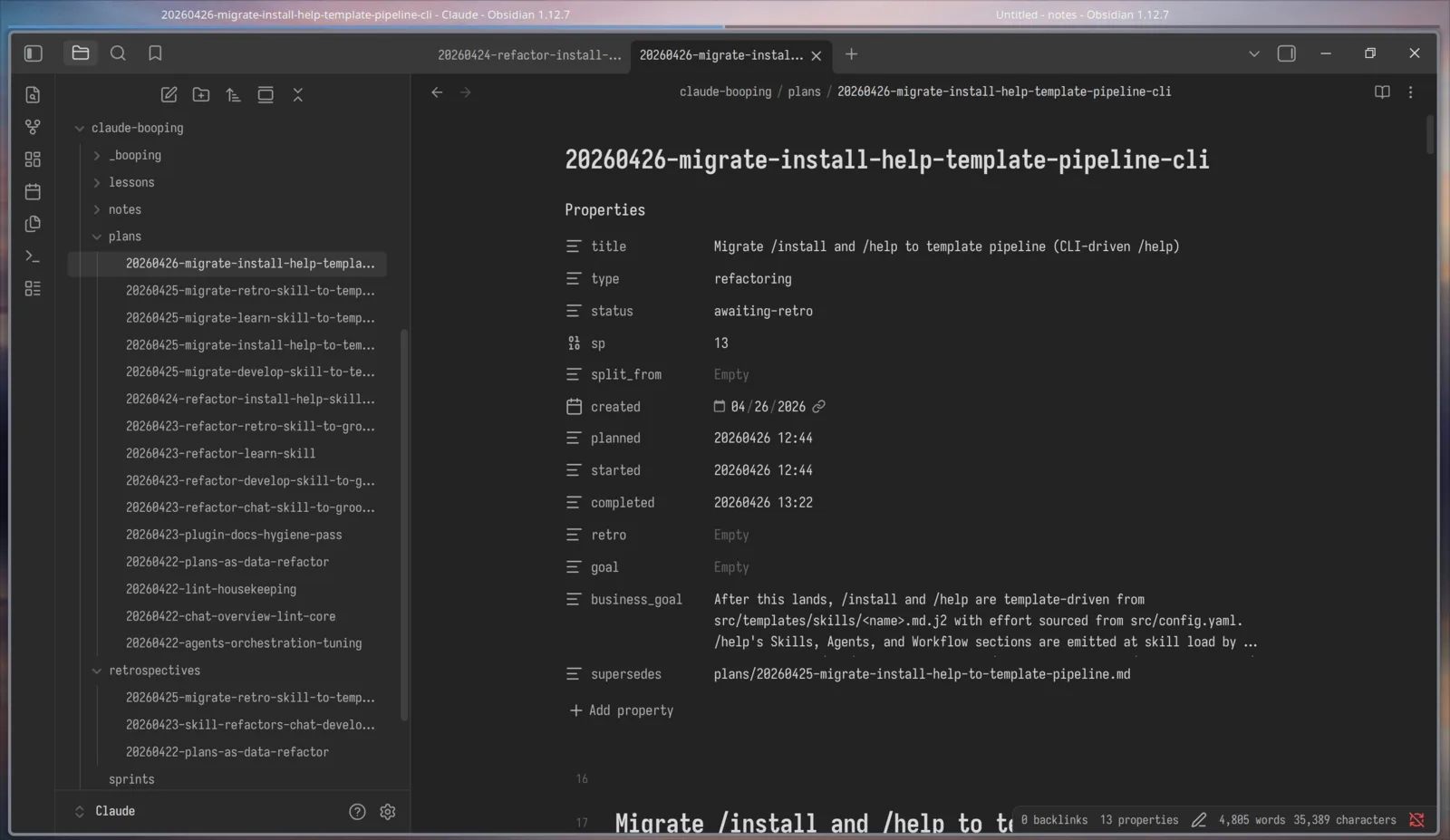
Each project's vault is a plain Obsidian-friendly folder of markdown files.
What it's for
Take a feature at whatever maturity it arrives — a rough idea over an existing codebase, a half-formed brief, a detailed PRD — and drive it through one loop: groom it into a plan, develop it, review the diff, retro what shipped.
booping is not spec-driven development — it doesn't keep specs as a living mirror of the codebase. It's closer to scrum sprints: a plan is a sprint artifact, done and forgotten once it ships; what persists is the vault's history and the lessons the loop distils from it. Playbooks are plain markdown procedures — when the shipped loop doesn't fit, you write your own (see Extensibility).
Obsidian-ready by design
The vault at ~/Claude/{project}/ is markdown-only with YAML frontmatter that Obsidian renders natively as Properties. One vault per project, side-by-side with whatever else you keep in ~/Claude/. No lock-in — just files you can grep, version, and edit by hand.
This repo is developed with booping itself, and its vault is checked in at vault/ — browse a finished plan, the targeted lessons the loop has accumulated, or a retrospective.
Disclaimer
booping is aimed at experienced developers and tech leads — people comfortable making architectural calls, decomposing work, and telling a sharp plan from a vague one, a sound diff from a sloppy one.
It's built for iterative, agile-style development: maintenance, incremental features, or growing a project sprint by sprint. It is not a waterfall tool — don't hand it a whole-project spec and expect a finished product. One plan is one sprint; the loop compounds across many.
Drop a config.yaml into your vault and it overrides the defaults — sprint scale, task types, branch conventions and agent wiring are the natural targets. The code-review playbook (/playbook code-review) is a side-route for stack-aware review of a finished plan's diff, recorded as its own artifact under codereviews/.
A note on maturity: v1.0 works — the whole loop is dogfooded on this repo — but it's beta-grade. Expect rough edges (eval suites pending review, some skills-era legacy in the core). Installation trouble? Run /playbook setup and discuss the issue with it.
Dependencies
Required: uv and git. Optional: a cross-review agent named in your config, for a second-model review of every drafted plan.
# macOS
brew install uv git

# Linux (Debian/Ubuntu)
sudo apt install -y git
curl -LsSf https://astral.sh/uv/install.sh | sh
Installation
Inside Claude Code, register the marketplace once, then install the plugin:
/plugin marketplace add A/claude-booping
/plugin install booping@booping
Update later via /plugin update booping (or from the /plugin UI).
After installing, cd into the target repo and run /playbook setup. It settles the machine config, then scaffolds the vault (plans/, retrospectives/, codereviews/, _lessons/, notes/) and writes the .booping marker. Anything already in place is detected and skipped. The booping CLI logs its invocations to .booping.log at the vault root.
Quick start
For a hand-holding walkthrough and per-command reference, see the docs site. Its recipes section holds guides for non-trivial uses — wiring external agents and running model benchmarks.
The full loop is five steps, each a playbook driven by /playbook — the plugin's one shipped skill and single entry point. Run them in order:
# Inside the target repo, once:
/playbook setup

# Spec a feature, bug, or refactor — free-text description.
# The more detailed your brief, the sharper the resulting plan:
/playbook groom — add per-tenant rate limiting to the public API

# Execute the plan (bare invocation resolves it from the vault queue):
/playbook develop
# …or name it:
/playbook develop — plans/202604260930_per-tenant-rate-limiting/index.md

# Retrospect on what shipped:
/playbook retro

# Fold the retro's findings into durable rules:
/playbook learn
Candidates are listed if you forget the exact path.
Workflow
groom shapes the spec and waits for explicit user approval before handing off; develop claims the next ready plan and executes milestone by milestone; retro compares what shipped to the original spec; learn distils the retrospective into rules that bind the next sprint.
A plan is a directory, not a file: plans/{slug}/index.md carries the frontmatter, the approach and a generated ## Milestones table, while each milestone gets a directory of its own under milestones/. Inside it sits the milestone file — same name as the directory — holding that milestone's tasks, definition of done and verification, joined during the sprint by whatever that milestone accumulates, currently a feedback.md written when an attempt is sent back. That milestone file is what develop hands a coding agent as its contract, with index.md alongside as context; the agent implements it and runs its verification, leaving the work uncommitted, and develop validates the working tree against the definition of done, commits it, and moves the milestone on.
There is no shared status table — each playbook has its own status vocabulary and advances its own run artifact through it. Groom and develop run on the plan, so its status: frontmatter is whatever those two last wrote, and the plan track ends when develop closes it — at done, or at fail or cancelled. Retro and learn are a separate track over a standalone retrospective under retrospectives/; code review is a third, over one file per run under codereviews/. The statuses those tracks write are their own artifact's, never the plan's.
groom       framing → researching → drafting → cross-reviewing → presenting
            → awaiting-approval → ready-for-dev (terminal)
            (loopbacks: drafting → researching, awaiting-approval → drafting)
            (any non-terminal status → cancelled (terminal))

develop     awaiting-approval → ready-for-dev → in-progress
            → done (terminal) | fail (terminal)
            (any non-terminal status → cancelled (terminal))

retro       awaiting-retro → awaiting-learning (terminal)     [on retrospectives/{slug}.md]

learn       awaiting-learning → done (terminal)               [on retrospectives/{slug}.md]

code-review in-agent-review → human-review → done (terminal)  [on codereviews/{dir}/{ts}.md]
The tracks join the plan by frontmatter, not by status. A finished plan carries retro: null until a retrospective covers it, at which point retro stamps the retrospective's path there (or skipped when you skip it) — that null is the retro queue. Review joins by a list: code_reviews: starts empty and every closing review appends its path, so the key reads as history rather than a queue flag, and the review queue is every done plan, re-review included.
Statuses
A plan's frontmatter status is written by groom or develop. Retro and learn write their own statuses onto the retrospective instead, and code review onto its own review file.
groom
framing— clarifying the request and settling scope.researching— the blast-radius and web-research passes are running.drafting— design is being settled with you in conversation and written intoindex.mdand one milestone directory per milestone.awaiting-clarification— the run hit a question it can't answer itself, wrote it into aclarifications.mdfile beside the plan, and ended. It's a parking status, not a dead end: answer the questions in that file and the next groom run on the plan picks up where it left off, returning to whichever status parked it (framingordrafting). Reached only when a run has no live conversation to ask in — a task-tracker-driven run; in chat, groom just asks you.cross-reviewing— a second model is reviewing the draft (skipped when no reviewer is configured).presenting— the approval screen is on the table.awaiting-approval— waiting for your explicit approval or change request; groom's single review gate.ready-for-dev(groom's terminal) — approved, queued for develop to claim.
develop
awaiting-approval— develop's entry status when a run starts on a plan still parked at groom's approval gate. Handing the plan to develop counts as the approval: it advances toready-for-devwithout asking.in-progress— develop has claimed the plan and is executing milestones.done(develop's terminal) — all milestones done and verification green. The end of the plan lifecycle; retro and code review pick the plan up from here through frontmatter, without moving it again.fail(develop's terminal) — an unrecoverable blocker after two documented fix attempts, with your approval to abort.
groom / develop
cancelled(terminal in both machines) — you called the run off. Reachable from every non-terminal status of either machine. Groom snapshots the plan into the vault on the way out; develop stampscompleted:.
retro / learn — on the retrospective at retrospectives/{slug}.md, not on a plan.
awaiting-retro— retro's entry status, set when the run starts.awaiting-learning(retro's terminal) — the retrospective is written and signed off. Learn claims from here.done(learn's terminal) — every accepted lesson is written to its target.
Skipping a plan's retro writes no retrospective at all: the plan is stamped retro: skipped, taking it out of the queue while leaving its status: done alone.
code-review — on the review file at codereviews/{dir}/{ts}.md, one per run, not on a plan.
in-agent-review— the review file is open on a confirmed scope and the review pass is producing findings.human-review— the findings are recorded and your verdict on them is pending.done(code-review's terminal) — every finding is applied, delegated or dropped, and the record is closed. Closing stampsreviewed_atand appends the review's path to the reviewed plan'scode_reviews:list; an ad-hoc review (plan: null) links to nothing. The plan's ownstatus:is never touched.
This README narrates the statuses — each playbook is the authority on its own transition rules and gates.
Sprints & SPs
In booping, a plan is a sprint — the unit groom produces and develop executes end-to-end. Story Points (SP) measure the sprint's complexity and review burden, not effort or time. A 20-SP sprint might take a couple of hours on one project and a full day on another.
The 1–5 scale:
- 1 SP — Simple text/config change, no risk.
- 2 SP — Simple task, predictable, no risk.
- 3 SP — Medium task, minor risks but predictable overall.
- 4 SP — Complex task, medium risk, may need small research but clear enough.
- 5 SP — Research task — developer needs to clarify and decompose further before proceeding.
File tree
FAQ
booping is a Claude Code plugin with 2 hand-picked skills for development work, indexed on Flowy. Install it with the command on its page. It includes release, playbook. Its skills do not fire on their own yet. Request auto-invocation to have Flowy route them as you prompt. Free and open source.
- What is booping?
- A self-learning, project-scoped sprint workflow for Claude Code. booping turns a feature idea into a durable, on-disk loop — groom → develop → retro → learn — that uses sub-agents to avoid context rot, with an optional second-model cross-review of every plan.
- How do I install booping?
- Run these in Claude Code: /plugin marketplace add A/claude-booping then /plugin install booping@booping. Then prompt normally.
- Does booping auto-invoke its skills?
- Not yet. It is indexed on Flowy as a plain plugin. Request auto-invocation on its page and Flowy will route its skills for you as you prompt.
- Is booping free?
- Yes. Flowy is free and open source, with nothing gated. You can read every skill in full before you install.
Is this plugin yours?
Claim it with GitHubSubmit a pluginPromote it