


cmem
MCPShips with claude-mem: Persistent Context Across Sessions for Every Agent – Captures everything your agent does during sessions,…
 @thedotmackInstall MCP
Ships with deja-vu: Coding agent memory for Claude Code, Codex, Cursor and 40 more, built from the session history already on your disk. Local search, MCP and hooks, no LLM, one Go binary.
Claude Code
> /plugin marketplace add vshulcz/deja-vu> /plugin install deja-vu@deja-vu
Codex
$ npx skills add https://github.com/vshulcz/deja-vu --skill deja-search # skills CLI: Claude Code, Cursor, Goose, Copilot…
Cursor
$ npx skills add https://github.com/vshulcz/deja-vu --skill deja-search # skills CLI: Claude Code, Cursor, Goose, Copilot…
Gemini CLI
$ npx skills add https://github.com/vshulcz/deja-vu --skill deja-search # skills CLI: Claude Code, Cursor, Goose, Copilot…
GitHub Copilot
$ npx skills add https://github.com/vshulcz/deja-vu --skill deja-search # skills CLI: Claude Code, Cursor, Goose, Copilot…
OpenCode
$ npx skills add https://github.com/vshulcz/deja-vu --skill deja-search # skills CLI: Claude Code, Cursor, Goose, Copilot…
Windsurf
$ npx skills add https://github.com/vshulcz/deja-vu --skill deja-search # skills CLI: Claude Code, Cursor, Goose, Copilot…
Security report
Not enough data
Known flaws
Not published
Signed build
Not published
Maintained
Nov 1, 2026
Last push
Licence
MIT
Runs as
Local process
On your machine
Deprecated
Not published
Signals from public registries, not an audit. Checked Nov 11, 2026.



curl -fsSL https://raw.githubusercontent.com/vshulcz/deja-vu/main/install.sh | sh
deja install --auto
deja with no arguments opens a terminal search across every agent's history — starting with
the sessions behind your uncommitted changes, then recent work in the current project.
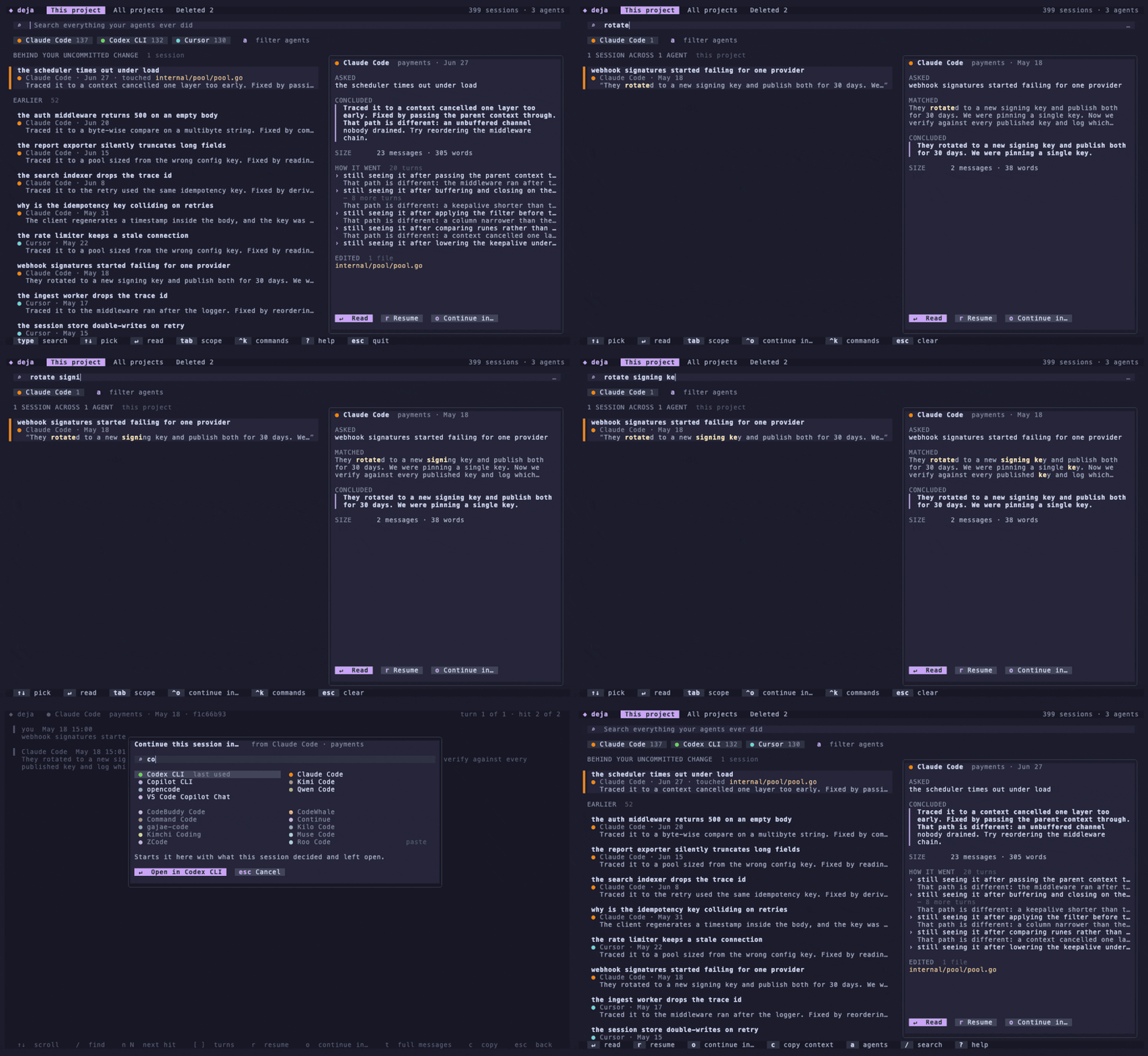
↑↓ picks a session, ↵ opens at the match, / searches inside a session, ] [ jump between turns, ^s toggles date/relevance sort (deja search --sort date).codex:), time (today, yesterday, week, month), or project (in:<project>).r reopens the session in its native agent; o continues it in another agent with its goal, decisions and open work.tab switches between this project, all projects, and Deleted (sessions an agent purged that deja still holds); R restores one, D deletes (deja delete <id>), ? lists all keys.Prefer a browser? deja view exports the store — sessions, the recall audit trail, and promoted notes — into one local HTML file (try the live demo). With DEJA_TUI=0 (or deja brief), deja prints a plain-text summary.
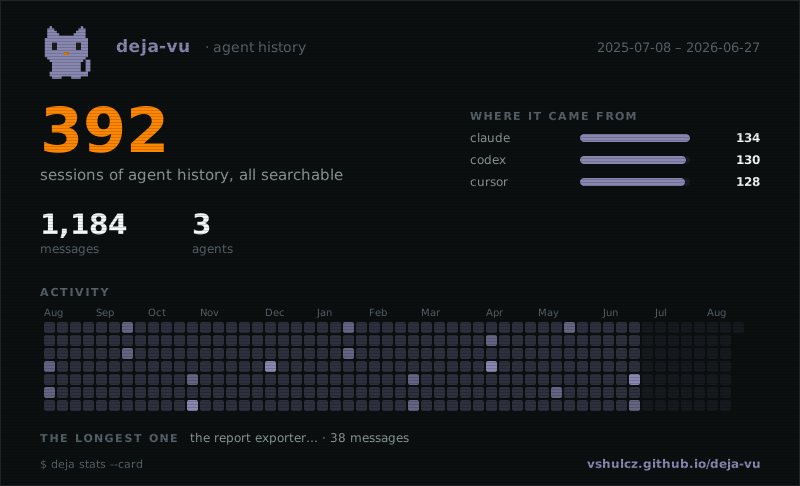
Edit spans (deja blame <file>:<line>, deja restore <path>).deja promote <id> --state rejected marks a reverted approach so later hits warn why it was dropped (--state accepted takes the mark back), and hits report when files touched by a session have changed since.deja stats --card draws your yearly agent activity in the terminal or writes an SVG for your GitHub profile (convert to PNG in browser).
install.sh places the deja binary in ~/.local/bin, and deja install --auto wires MCP recall and hooks into every detected agent and builds the initial index (~10s).
Open a new session in any wired agent and it already knows what you solved in that repository — or ask it directly (have we dealt with jwt refresh rotation before?).
Homebrew, Windows (Scoop / winget), npm, plugin marketplaces, and binary-only setup
brew install deja-vu, go install github.com/vshulcz/deja-vu/cmd/deja@latest,
or npx @vshulcz/deja-vu "query" to try it without installing anything. Desktop apps that
take MCP servers as bundles can open the .mcpb from the
latest release; it carries the binary.
Codex CLI, opencode, Claude Code, Qwen and OpenClaw can also install the plugin
bundle directly from their own marketplaces or registries (see
Harnesses with a package of their own,
plus cursor-plugin/ for Cursor). Copilot CLI installs the
marketplace bundle too, though it takes only the skill there — use
deja install copilot-auto for hooks and MCP:
codex plugin marketplace add https://github.com/vshulcz/deja-vu && codex plugin add deja-vu@deja-vu
opencode plugin opencode-deja
claude plugin marketplace add vshulcz/deja-vu && claude plugin install deja-vu@deja-vu
On Windows the install script exits with unsupported OS — it is a shell script. Use
Scoop, from the main bucket every Scoop install already has, or winget, which ships with Windows:
scoop install deja-vu
winget install vshulcz.deja-vu
Or take deja-vu_<version>_windows_amd64.zip from the
latest release and put deja.exe on
your PATH, e.g. in %USERPROFILE%\.local\bin.
The binary alone is a complete install for searching: index, search, show, ctx, blame,
--json and redaction need nothing else. deja install is what wires MCP into your agents
and turns on session-start recall — worth having, and optional. On a binary-only setup
deja doctor reports every MCP target as config missing, or not-wired where the agent
is installed, which is that setup working as intended. deja warmup also leaves a skill at ~/.agents/skills/deja-search/SKILL.md
that teaches an agent the CLI contract — deja recall, ctx, blame, how to read the
recall page and ask for the next one — so it knows history is searchable without MCP. The copy in the repo is
skills/deja-search/SKILL.md.
deja install --all is --auto without the session-start recall: agents answer from memory
when they decide to call it, rather than starting each session with it. The
agent setup guide covers what each
harness supports, aider's read-only context file, and the Windows cmd /c deja mcp wrapper.
What gets written into each agent's own guidance file
Install also writes user-level guidance for the harnesses it detects: Claude Code, Codex, opencode, Gemini CLI, Antigravity, Qwen, Kimi Code, pi, Senpi, Copilot, VS Code Copilot Chat, Goose, OpenClaw, Hermes, Roo Code, omp, Amp, prime-agent, DeepSeek Harness, Continue, Crush, CodeBuddy Code, WorkBuddy, Zed, TRAE CLI, TRAE IDE, Muse Code, CodeWhale, ZCode and Junie each get it in their own guidance file (or under the configured XDG_CONFIG_HOME). Re-run rewrites deja's skill or marked block without changing surrounding user content. Use deja install --all --no-guidance to opt out; Grok Build and Devin CLI get the shared skill in ~/.agents/skills, which is what they read; the ~/.grok/GROK.md written beside it is for the unrelated community CLI that shares that directory. Cursor has no user-level instructions file, so it gets the shared skill in ~/.agents/skills — one of the four places Cursor reads skills from — read only when something looks relevant rather than every session. Kilo Code, gajae-code, Kimchi, Command Code, Cherry Studio and Reasonix get the skill, MiniMax Code gets it inside the plugin package, and Kiro the skill and a steering file, from their own install target.
Indexing and search are local. The network is used only by deja update, deja sync ssh,
the version check in deja doctor, deja embed against an endpoint you configure (and,
once it has built the semantic sidecar, each search, which sends the query to that

Stars on GitHub
Ships with claude-mem: Persistent Context Across Sessions for Every Agent – Captures everything your agent does during sessions,…
@thedotmackInstall MCPShips with mempalace: Local-first AI memory. Verbatim storage, pluggable backend, 96.6% R@5 raw on LongMemEval — zero API calls.
 @mempalaceInstall MCP
Ships with mempalace: Local-first AI memory. Verbatim storage, pluggable backend, 96.6% R@5 raw on LongMemEval — zero API calls.
 @milla-jovovichInstall MCP
Ships with mksglu-context-mode: The other half of the context problem. Used across teams at
 @mksgluInstall MCP