
Documentation
Plugin
scaccogatto-okf
**Teach your coding agent to author, maintain, validate, and visualize portable knowledge bundles: markdown your team and your agents both read.** Built for OKF v0.2: trust signals, provenance, staleness.

Plugin Signal75/100Solid
maintained93
capable46
documented100
adopted55
Install on Claude Code
> /plugin marketplace add scaccogatto/okf-skills> /plugin install okf@scaccogatto
What's inside
Skill(4 skills)
Agent(2 agents)
bundle-weaverFold event analyses into an OKF knowledge bundle in deterministic sequence. This is the only agent that writes `.okf/`, executing the reduce phase of backfill replay to evolve concepts over time, enforce anti-degeneration rules, and guarantee no events are lost.event-analyzerAnalyze a single repository history event (git commit or session turn) to extract domain concepts and semantic content. Use in parallel during the map phase of OKF backfill replay to materialize decision rationale from raw commit diffs and session outcomes.
Hook(1 hook)
MCP(1 mcp)
README
📚 okf: the Open Knowledge Format toolkit for Claude Code
Teach your coding agent to author, maintain, validate, and visualize portable knowledge bundles: markdown your team and your agents both read.
Built for OKF v0.2: trust signals, provenance, staleness.





▶ Open the live demo: a real OKF bundle as an interactive graph
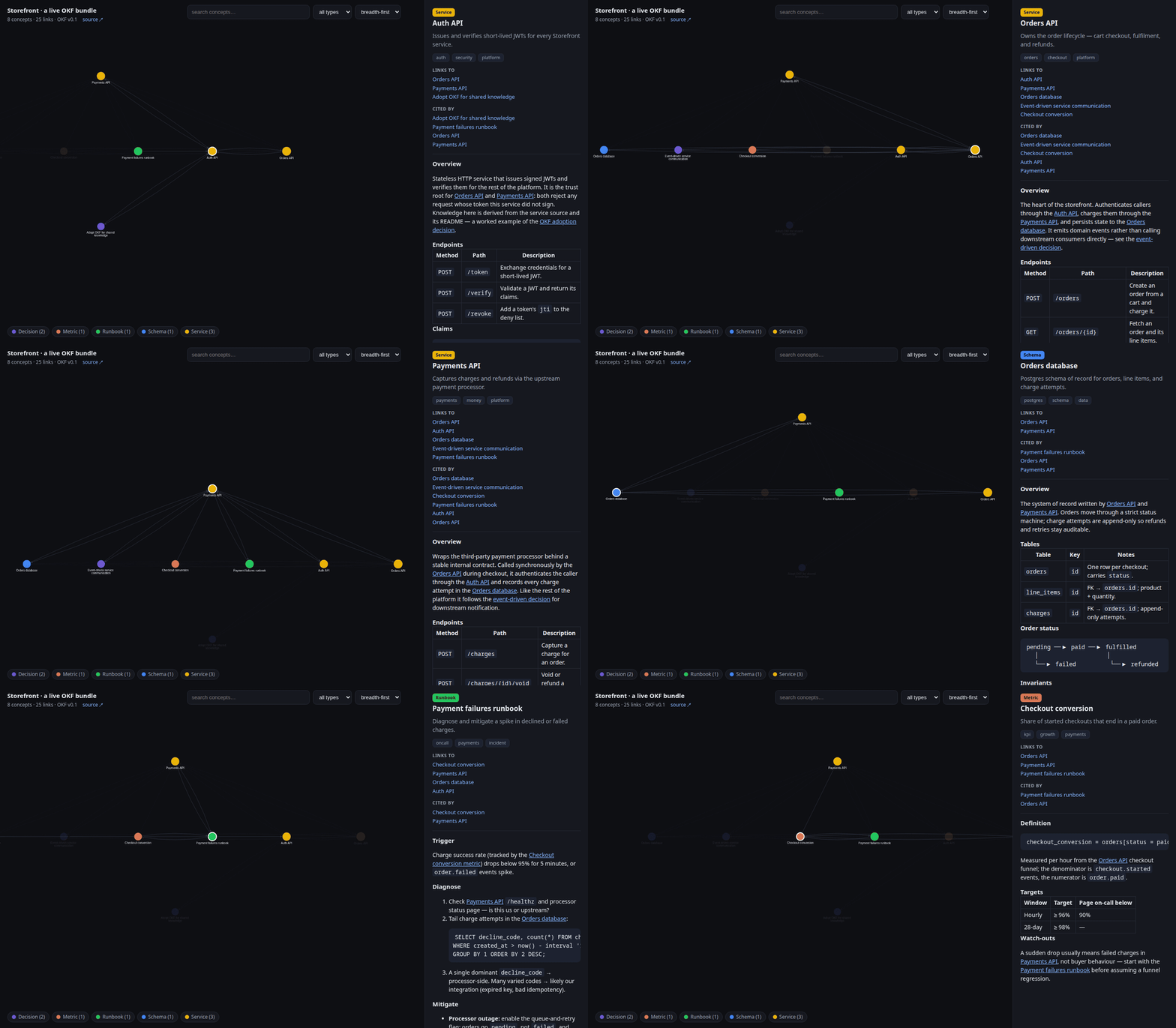
Click any node for rendered markdown, the derived trust tier and staleness, provenance with its credibility signals, and "Links to / Cited by" backlinks. No backend, nothing leaves the page.
/plugin install okf@scaccogatto
npx skills add scaccogatto/okf-skills
OKF is an open, vendor-neutral format (announced by Google Cloud, June 2026) that represents knowledge (the context and curated insight around your systems) as a directory of markdown files with YAML frontmatter. No schema registry, no runtime, no SDK. If you can
cata file you can read it; if you cangit clonea repo you can ship it.
This is the Claude Code-native OKF toolchain. It teaches Claude to
produce, maintain, consume, validate, and visualize OKF bundles as a normal
part of how it already works, driven by the verbatim spec, backed by a
deterministic conformance checker, with a self-contained graph renderer. Ships as
a Claude Code plugin, as agent skills (Cursor, Codex, and 20+ agents), as
a GitHub Action for repos with no agent at all, and as a read-only MCP
server for hosts whose agents cannot reach the files. This one is v0.2
throughout: trust signals, provenance and staleness, validated by
skills/validate/scripts/okf_validate.py.
🪞 This repo documents itself in OKF. The architecture, skills, and decisions behind okf-skills live in
.okf/, explorable as a live self-graph. CI validates that bundle on every push (dogfooding the conformance checker).
Install
As a Claude Code plugin:
/plugin marketplace add scaccogatto/okf-skills
/plugin install okf@scaccogatto
As agent skills via skills.sh (Claude Code, Cursor, Codex, and 20+ agents):
npx skills add scaccogatto/okf-skills # the okf, validate & visualize skills
Local development (no marketplace): claude --plugin-dir /path/to/okf-skills.
Both layouts coexist in this one repo: .claude-plugin/ makes it a plugin
marketplace, skills/<name>/SKILL.md makes it skills.sh-discoverable. Scripts live
inside their skills and are referenced via ${CLAUDE_SKILL_DIR}, so they work in
either path. The scripts need uv (or python3 + pyyaml).
Use it
Capture knowledge: ask Claude to "document the auth service in OKF", or run:
/okf:okf produce .okf
Validate before committing:
/okf:validate .okf --strict
# or directly, zero-config:
uv run skills/validate/scripts/okf_validate.py .okf --strict
# gate in CI while some warnings are still outstanding:
uv run skills/validate/scripts/okf_validate.py .okf --max-warnings 5
Gate it in CI: the composite action works in any repo, with or without Claude Code:
- uses: scaccogatto/okf-skills@v1
  with:
    bundle: .okf
    strict: "true"      # or: max-warnings: "5"
@v1 follows every release (the repo is pre-1.0, so it tracks the latest one
rather than a major line). Pin an exact @okf--v<version> tag instead if you
want the action frozen.
The step also exposes a report output: the validator's JSON report
(--json), for a later step to post or parse via ${{ steps.<id>.outputs.report }}.
Visualize the knowledge graph, a self-contained viz.html that opens in any
browser (live example):
/okf:visualize .okf
# or directly, with a title and a back-link to your repo:
uv run skills/visualize/scripts/okf_visualize.py .okf \
  -o viz.html --title "My project" --link "https://github.com/me/project"
Above 1000 concepts the default layout falls back to a linear one (force layout
freezes the page); override with --layout cose, or refuse oversized bundles
with --max-nodes N.
Every concept gets a shareable deep link (viz.html#services/auth-api opens with
that concept selected). Each panel carries two derived badges: the §5.3 trust
tier (unverified / machine-confirmed / human-reviewed) and staleness once
stale_after is past. OKF stores neither (a stored tier is a stored opinion, and
it goes stale), so both are computed at render time.
Read a bundle over MCP. A read-only server exposes any bundle to a host that speaks MCP, for agents that have no file tools of their own:
| Tool | What it returns |
|---|---|
search_concepts(query, limit) | Matching concepts as cards: id, type, title, description, status, stale_after. Metadata hits rank above body-only hits. |
read_concept(concept_id) | One concept verbatim, frontmatter included. concept_id is the bundle path without .md; index and log work too. |
get_neighbors(concept_id) | outgoing and incoming cards, from markdown links and bundle-internal sources. External URLs are not neighbours. |
Nothing writes, and no concept_id resolves outside the bundle root.
It ships with the plugin and starts with it, reading ./.okf, so inside Claude
Code there is nothing to configure: the tools appear as
mcp__plugin_okf_bundle__search_concepts and friends. In a project with no
bundle the server still connects and says so on the first call.
Standalone, or for any other MCP host:
uv run servers/okf_mcp.py .okf # stdio; a bundle path, else $OKF_BUNDLE, else ./.okf
{ "mcpServers": { "okf": { "command": "uv",
    "args": ["run", "/path/to/okf-skills/servers/okf_mcp.py", "/path/to/.okf"] } } }
Worth saying plainly: for Claude Code this duplicates Read and Grep, and it was declined on those grounds in July 2026. It ships for parity with a category that now expects one, and decisions/mcp-server.md records that as the reason instead of inventing a user need.
Keep it up to date. Two opt-in ways to make upkeep automatic:
- Soft mode: paste
templates/CLAUDE-okf.mdinto your project'sCLAUDE.md(or~/.claude/CLAUDE.md) to have Claude consult.okf/before tasks and write knowledge back after changes. - Enforced mode: add
upkeep: enforcedto.okf/index.md's frontmatter to arm the plugin's dormantStophook, which then blocks finishing when tracked files changed but.okf/log.mdwasn't updated. Off by default; a user overrides any bundle withOKF_HOOK=off. Full gate sequence: stop-hook concept.
What's inside
| Component | What it does |
|---|---|
/okf:okf skill | Produce / maintain / consume bundles, applying the spec and templates. Auto-triggers when a repo has an OKF bundle. |
/okf:validate skill | Deterministic §11 conformance check (not an eyeball pass). |
/okf:backfill skill | Reconstruct an OKF bundle from git history and Claude session transcripts for repos that predate this toolchain. |
/okf:visualize skill | Render a bundle to a self-contained interactive HTML graph (viz.html). |
skills/okf/scripts/okf_init.py | Scaffold a conformant starter bundle in one shot. |
skills/validate/scripts/okf_validate.py | Standalone, zero-config validator (uv run, PyYAML via PEP 723). |
skills/visualize/scripts/okf_visualize.py | Standalone bundle→viz.html renderer. |
servers/okf_mcp.py | Read-only MCP server over a bundle: search_concepts, read_concept, get_neighbors. Ships with the plugin via .mcp.json. |
skills/okf/reference/SPEC.md | The OKF v0.2 spec, vendored verbatim: the source of truth. |
templates/CLAUDE-okf.md | Snippet that turns on automatic consume/maintain in your project. |
action.yml | Composite GitHub Action to gate a bundle in any repo's CI, no Claude Code needed. |
examples/sample-bundle/ | The conformant bundle behind the live demo. |
How a bundle looks
A bundle is a directory of markdown files; a concept's path is its ID. The only
rule for conformance is YAML frontmatter with a non-empty type; everything else
is optional.
.okf/
├── index.md                  # progressive disclosure (root carries okf_version)
├── log.md                    # ISO-dated change history, newest first
├── services/auth-api.md      # one concept = one file; path is its ID
├── decisions/use-okf.md
└── metrics/checkout-conversion.md
---
type: Service
title: Auth API
description: Issues and verifies short-lived access tokens.
resource: https://github.com/acme/auth
status: stable
generated: { by: doc_agent/1.0, at: 2026-06-14T10:00:00Z }
verified: { by: human:dana, at: 2026-06-20T09:00:00Z }
sources:
  - id: auth-readme
    resource: https://github.com/acme/auth#readme
    title: Auth service README
---

# Endpoints
Tokens live 15 minutes.[^auth-readme]

[^auth-readme]: Auth service README
What OKF v0.2 adds
v0.2 assumes a corpus that agents keep writing, so it makes four things answerable
from frontmatter alone. All optional; a concept carrying only type is still fully
conformant. Full normative detail is in SPEC.md.
| Family | Fields | Answers |
|---|---|---|
| Provenance | sources[] + author / usage_count / last_modified, usage_window | Where did this come from, and how credible is that source? |
| Trust | generated: {by, at}, verified[], actor convention (human: / process: / agent/version) | Who wrote it, who confirmed it? |
| Lifecycle | status, stale_after | Is it current? Is it still true? |
| Attestation | type: Attested Computation + runtime, parameters, executor, attester | Was this number produced the sanctioned way? |
Upgrading from v0.1? --migrate rewrites the two superseded constructs
(timestamp → generated.at, body # Citations → sources) in place, textually
and idempotently. The tools read both meanwhile and flag the old forms as warnings,
never errors; --strict is the nudge, --migrate is the door:
uv run skills/validate/scripts/okf_validate.py .okf --migrate --strict
What has actually been measured
Two experiments live in benchmark/, both pre-registered and tagged
before their measurement run, both published with their transcripts and with the
defects the runs exposed. Read the results files rather than these two lines; the
headline numbers are smaller than they look.
| Question | Result | Where |
|---|
File tree
FAQ
scaccogatto-okf is a Claude Code plugin with 4 hand-picked skills for documentation work, indexed on Flowy. Install it with the command on its page. It includes backfill, okf, validate. Its skills do not fire on their own yet. Request auto-invocation to have Flowy route them as you prompt. Free and open source.
- What is scaccogatto-okf?
- **Teach your coding agent to author, maintain, validate, and visualize portable knowledge bundles: markdown your team and your agents both read.** Built for OKF v0.2: trust signals, provenance, staleness.
- How do I install scaccogatto-okf?
- Run these in Claude Code: /plugin marketplace add scaccogatto/okf-skills then /plugin install okf@scaccogatto. Then prompt normally.
- Does scaccogatto-okf auto-invoke its skills?
- Not yet. It is indexed on Flowy as a plain plugin. Request auto-invocation on its page and Flowy will route its skills for you as you prompt.
- Is scaccogatto-okf free?
- Yes. Flowy is free and open source, with nothing gated. You can read every skill in full before you install.
Is this plugin yours?
Claim it with GitHubSubmit a pluginPromote it