

Auto-invoked
Data
MCP
superlocalmemory
Ships with superlocalmemory: Open-source governed, local-first memory control plane for AI agents and teams. arXiv:2608.08253
Claude Code
> /plugin marketplace add qualixar/superlocalmemory> /plugin install superlocalmemory@qualixar
Codex
$ npm install -g superlocalmemory # add --media to also turn on pictures and documents
Cursor
$ npm install -g superlocalmemory # add --media to also turn on pictures and documents
Gemini CLI
$ npm install -g superlocalmemory # add --media to also turn on pictures and documents
GitHub Copilot
$ npm install -g superlocalmemory # add --media to also turn on pictures and documents
OpenCode
$ npm install -g superlocalmemory # add --media to also turn on pictures and documents
Windsurf
$ npm install -g superlocalmemory # add --media to also turn on pictures and documents
Security report
Info
Not enough data
Known flaws
Not published
Signed build
Not published
Maintained
Oct 28, 2026
Last push
Licence
AGPL-3.0
Runs as
Local process
On your machine
Deprecated
Not published
Signals from public registries, not an audit. Checked Nov 11, 2026.
superlocalmemory README


The governed memory brain for every AI agent. It lives on your machine. It never bluffs.
One memory for every agent you and your team use — Claude Code, Codex, Cursor, Copilot, Antigravity, Hermes, ChatGPT, Claude on the web, Grok Bot, Muse and any harness that speaks MCP or runs a command. Decisions, documents, screenshots and PDFs, recalled the way you ask for them, governed like company data, shared through a mesh where your local agents and web bots talk to each other, and answered honestly: when the answer isn't there, your agent hears "That isn't in SuperLocalMemory." — not a confident guess.






Install · See it work · Full demo · Every capability · Docs · Website
⭐ If SuperLocalMemory keeps your agents from guessing, star the repo. It helps other developers find it.
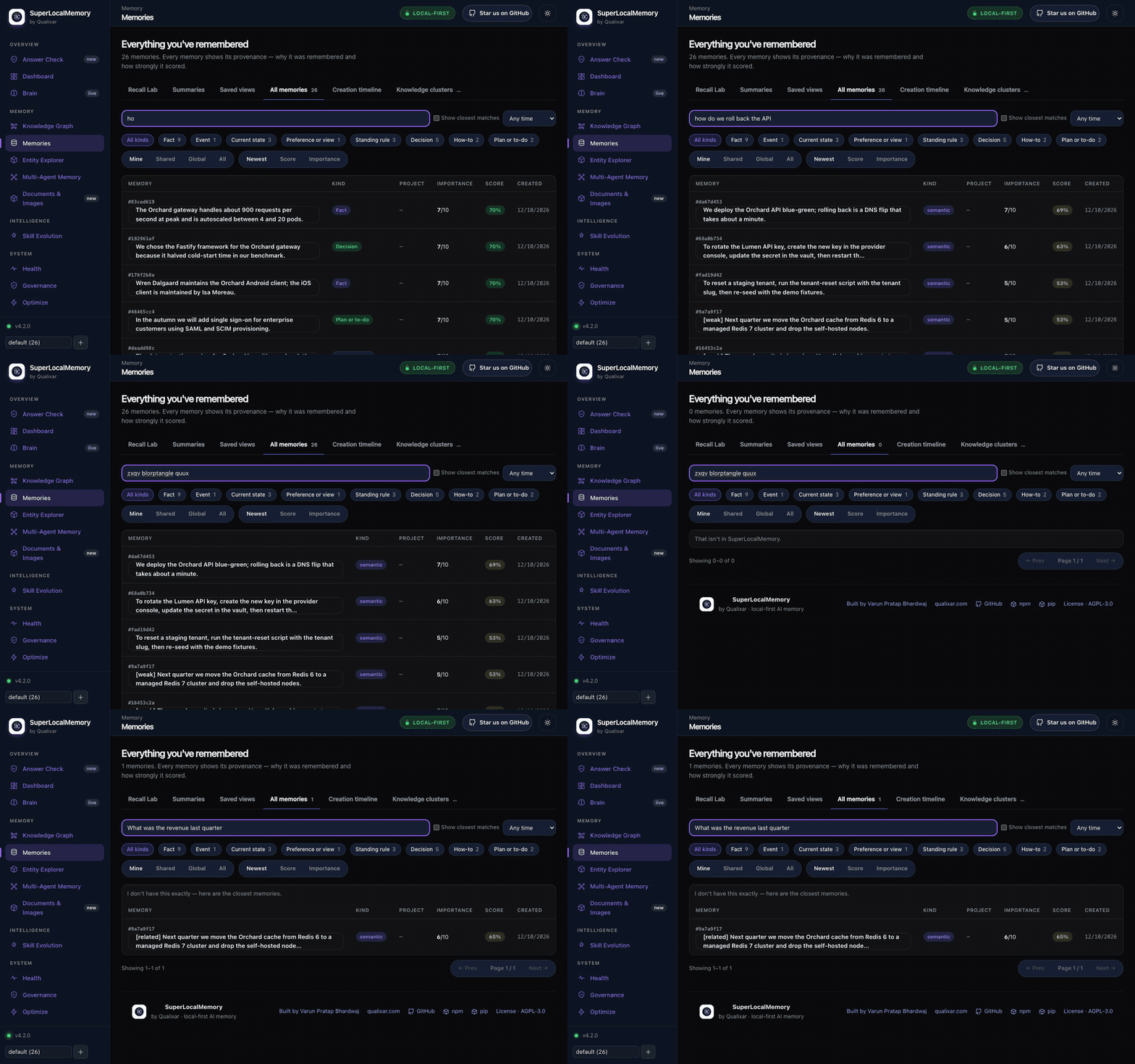
Agents forget everything between sessions. The usual fix — a vector store with a save button — makes it worse: it always returns something, even when nothing it holds answers the question, and your agent builds on it. This is a memory brain, not a bucket: it understands what was saved (who, what, when, which project), keeps it true over time, governs who may see it, and refuses to bluff. Four arXiv papers describe how it works.
In Mode A, core remember and recall make no model-provider call: no API key, no cloud account, no Docker. Anything that sends data out is a choice you make, and the docs say exactly what goes.
Install
The easiest way: let your AI agent install it. Copy the block below into Claude Code, Codex, Cursor or any agent that can run commands. It reads the setup guide, asks you one question, sets everything up and tells you what works. No terminal commands for you to learn.
Install SuperLocalMemory on this computer for me. Follow
https://github.com/qualixar/superlocalmemory/blob/main/SETUP_FOR_AGENTS.md
step by step and show me what each step printed. Ask me only one question,
before turning on anything optional: whether I also want to find my pictures,
screenshots and PDFs by describing them. Connect SuperLocalMemory to the agent
I am using. When you finish, run slm doctor and tell me in plain words what works.
No AI agent? One line in Terminal (macOS and Linux). It brings its own Python, sets everything up, connects the AI tools it finds and opens the dashboard; no Python or npm needed beforehand:
curl -fsSLo get-slm.sh https://raw.githubusercontent.com/qualixar/superlocalmemory/main/scripts/get-slm.sh && sh get-slm.sh
Add pictures and documents from the start with sh get-slm.sh --media at the end. It downloads the script first, so you can read it before it runs. Windows: use the agent prompt above, or npm or pip below.
Prefer the terminal? Both routes end in the same setup: your text memory on this machine, and, if you say yes, your pictures and documents too.
npm, the primary route (Node 18+). It installs SLM into a package-owned virtual environment:
npm install -g superlocalmemory   # add --media to also turn on pictures and documents
slm setup                         # pick Mode A to keep everything on this machine
slm connect claude-code           # or codex, cursor, windsurf, zed, claude-desktop, jetbrains, opencode ...
pip, the other primary route (Python 3.12 to 3.14), in a Python virtual environment you activate:
python3 -m venv .venv
source .venv/bin/activate         # Windows: .venv\Scripts\activate
python -m pip install superlocalmemory   # or, without a venv: pipx install superlocalmemory
slm setup
slm connect claude-code
slm media enable                  # optional: pictures and documents (about 1.5 GB; needs 16 GB of memory)
uv: uv tool install --python 3.12 superlocalmemory installs slm as an isolated tool, with nothing to activate; see Linux install.
Claude Code plugin: claude plugin marketplace add qualixar/superlocalmemory, then claude plugin install superlocalmemory@qualixar. Codex: slm connect codex, then slm codex install.
Two models, one memory. Text is searched with a small local text model (nomic). If you turn on pictures and documents, a second local model (Google's EmbeddingGemma 2) reads them, and one recall returns both. The picture model unloads after 30 minutes without use, so it holds no memory while you only work with text. Details: pictures and documents, getting started, agent setup steps.
Repository clone: ./scripts/install.sh install (macOS, Linux) or .\scripts\install.ps1 -Action Install (Windows). Runs on Windows, Linux and Apple Silicon macOS (platforms).
30-second example
$ slm remember "We deploy the API blue-green; rollback is a DNS flip." --kind decision
Queryable ✓ 1 facts
$ slm remember "Staging DB is Postgres 16 on port 5433."

$ slm recall "how do we roll back the API"
  1. [0.67] We deploy the API blue-green; rollback is a DNS flip.

$ slm recall "zxqv plorth wimble"
  That isn't in SuperLocalMemory.

$ slm remember "Staging DB moved to Postgres 17 on port 5434." --replaces <id>
Replaced ✓ 1 fact(s). To undo: slm review-correction ... rollback 1
$ slm recall "which port does staging postgres use"
  1. [0.68] Staging DB moved to Postgres 17 on port 5434.
Real output from a fresh Mode A install, trimmed. Scores rank memories; they are not probabilities.
Why SuperLocalMemory: twelve superpowers
1. It knows when it doesn't know. Every recall comes back in one of three tiers: a supported answer; the closest memories, labelled "I don't have this exactly — here are the closest memories"; or "That isn't in SuperLocalMemory." for nonsense. Just after a start it says it is still warming up and shows what it has found, so you never hear "empty" when the truth is "not ready yet". Your agent stops building on the wrong memory.
2. A second opinion that never leaves your Mac. On Apple Silicon, SLM installs Laya, a small on-device model that judges whether the memories found actually answer the question. Prefer the cloud, or not on a Mac? Jev does the same check online, only after you tick its consent.
3. Your documents and screenshots become a knowledge base you can ask. Save a photo, a screenshot or a PDF and find it weeks later by describing it — "the slide with the quarterly numbers". The picture model is  Google's EmbeddingGemma 2, running on your computer: one model reads both your words and your pictures, so a description finds the image. OCR runs locally too, every PDF page is indexed by its picture and its text, and every answer cites its file and page. No generative model ever looks at your files.
4. Karpathy's LLM-wiki idea, built in — with search kept. Andrej Karpathy's LLM-wiki pattern turns raw documents into an organised knowledge base with an index and a health check. SLM does that from the data it already stores — a document index of every file with its people, projects and dates, and a document health check that finds empty pages, unlinked documents, duplicate pages and contradicted facts — while keeping real hybrid search for the moment you need to find something.
5. It looks after itself. Memory health describes your older memories in the background — dates, names, projects, kinds — only ever by adding, never touching what you wrote. Anything that moves or deletes waits for your Fix, and Undo puts it back.
6. Governed, not just stored. Every save passes an admission check and gets a receipt. Every read respects roles, workspaces and scopes. Every erasure reaches every copy — summaries, caches, indexes, picture mirrors — and comes with a verifiable receipt. Every action lands in a hash-chained audit trail. Built for teams and for GDPR, not bolted on.
7. Memory with a sense of time. Every fact knows when it happened and when SLM learned it. Ask what was true last month, or what SLM knew before a date. Corrections replace a fact and stay undoable; unused memories fade the way human memory does.
8. It never floods your context window. Layered recall gives an agent a one-line glance, the facts, or the full surrounding context — under a hard token budget it sets. The agent digs deeper with expand only when it needs to, and cache and reversible compression stop you paying for the same output twice.
9. Many agents, one brain. Every write records which agent made it, with trust scores against memory poisoning, so ten agents can share one memory without poisoning it.
10. Your agents talk to each other — even across the internet. Through SLM-Mesh, the agents on your computer and the bots on the web finally share one conversation. Claude Code, Codex and Hermes sessions exchange messages, waits, locks and shared state, on one machine or several, so one agent can hand work to another and two never edit the same file at once. And the bots you allow — ChatGPT, Claude on the web, Grok Bot, Muse — join the same mesh: a bot in your browser can message the agent on your laptop by name and read its reply. Every message arrives labelled as data, never as instructions; a web bot reads new messages when its next turn starts.

Ships withsuperlocalmemory
27016 skills4 agents1 MCP
Stars on GitHub
Momentum
- stars in total
- 270
More MCP servers from other plugins.


Auto-invoked
agentmemory
MCPShips with agentmemory: #1 Persistent memory for AI coding agents based on real-world benchmarks
 @rohitg00Install MCP
skill-seekers
MCPShips with skill-seekers: 🧠 The data layer for AI systems. Skill Seekers turns documentation sites, GitHub repos, PDFs, videos,…
 @yusufkaraaslanInstall MCP
Questions about superlocalmemory.
- Which coding agents can use superlocalmemory?
- superlocalmemory works in any agent that reads an MCP config file: Claude Code, Codex, Cursor, Gemini CLI, GitHub Copilot, OpenCode and Windsurf. Each agent reads it from its own file; this page names the file for each one.
- How do I add superlocalmemory to Claude Code?
- Run these in order, one at a time. 1. In Claude Code: /plugin marketplace add qualixar/superlocalmemory 2. In Claude Code: /plugin install superlocalmemory@qualixar