
open-browser-use
Platform-neutral guidance for installing, verifying, troubleshooting, and operating Open Browser Use, an open-source Chrome automation stack for AI agents.
1 skill422
 @ifuryst
Lets an AI agent or MCP client control a computer's desktop apps on macOS, Linux, and Windows through the accessibility layer, without taking over the screen. Use it to automate clicks and typing in apps that have no API.
Claude Code
$ npx -y skills add ifuryst/open-computer-use --agent claude-code
Codex
$ npx skills add ifuryst/open-computer-use -a codex
Cursor
$ npx skills add ifuryst/open-computer-use -a cursor
Gemini CLI
$ npx skills add ifuryst/open-computer-use -a gemini-cli
GitHub Copilot
$ npx skills add ifuryst/open-computer-use -a github-copilot
OpenCode
$ npx skills add ifuryst/open-computer-use -a opencode
Windsurf
$ npx skills add ifuryst/open-computer-use -a windsurf






Tip Interested in Browser Use? Check out open-browser-use.
open-computer-use is an open-source Computer Use service wrapped as MCP. Any AI agent or MCP client can use it to run Computer Use on macOS, Linux, and Windows.
This project was inspired by OpenAI's Codex Computer Use. It showed that non-intrusive CUA can be built on top of Accessibility, so I decided to build an open-source version.
I started this repo with my harness template, a template for quickly spinning up AI-first projects. It has been one of our most useful workflows lately, especially for nearly 100% AI-generated projects. I also wrote a post about the methodology behind it.
open-computer-use used as Computer Use in Codex App and Codex CLI, matching the official experience.
Gemini CLI connects to open-computer-use through MCP and runs full Computer Use actions.
https://github.com/user-attachments/assets/e036b1c8-2200-4896-abd4-19225915cf66
open-computer-use running on Linux.
Locked Use is now supported on macOS. OCU temporarily unlocks your Mac after it has been locked so the agent can continue working, with protective services such as a full-screen shield in place during use.
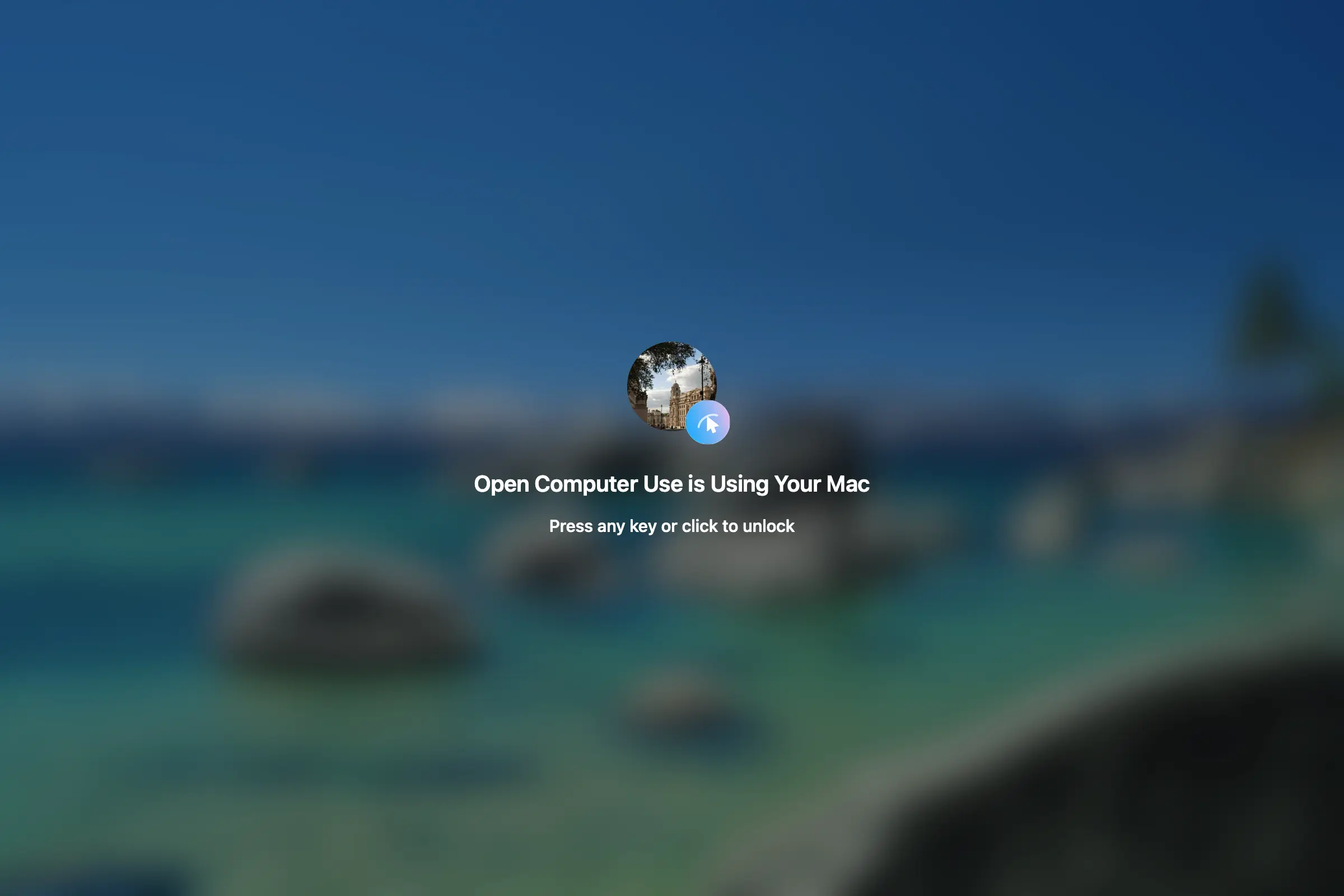
See the Locked Use guide for setup, installed components, and permissions
npm i -g open-computer-use
The npm package also exposes ocu as the short CLI alias.
Important The macOS runtime requires macOS 14.0 or later.
On macOS, run it once and grant Accessibility and Screen Recording. Windows and Linux do not need this step.
open-computer-use
# or
ocu
Before using it, install it into your agent:
# Install into Codex by writing to ~/.codex/config.toml
open-computer-use install-codex-mcp
ocu install-codex-mcp
Or add it to your own client manually:
{
  "mcpServers": {
    "open-computer-use": {
      "command": "open-computer-use",
      "args": ["mcp"]
    }
  }
}
Install the skill directly:
# Install for Codex
npx skills add iFurySt/open-computer-use -g -a codex --skill open-computer-use -y
npx skills ls -g -a codex | rg 'open-computer-use'
Install for Claude Code:
npx skills add iFurySt/open-computer-use -g -a claude-code --skill open-computer-use -y
Update an existing global install, including the Codex install created above:
npx skills update open-computer-use -g -y
You can also manually download and install the
open-computer-use skill.
Besides the MCP JSON config above, you can also use the built-in commands:
# Install into Codex by writing to ~/.codex/config.toml
open-computer-use install-codex-mcp

# Install as a Codex plugin, mainly for Codex App
open-computer-use install-codex-plugin

# Install into Claude Code by writing to ~/.claude.json
open-computer-use install-claude-mcp

# Install into Gemini CLI for the current project by writing to ./.gemini/settings.json
open-computer-use install-gemini-mcp

# Install into Gemini CLI user config instead
open-computer-use install-gemini-mcp --scope user

# Install into opencode by writing to ~/.config/opencode/opencode.json (or the active config file)
open-computer-use install-opencode-mcp

# Call a single Computer Use tool and print the MCP-style JSON result
open-computer-use call list_apps
ocu call list_apps
open-computer-use call get_app_state --args '{"app":"TextEdit"}'

# Run a sequence in one process so element_index state can be reused
# Sequence runs sleep 1s between successful operations by default
open-computer-use call --calls '[{"tool":"get_app_state","args":{"app":"TextEdit"}},{"tool":"press_key","args":{"app":"TextEdit","key":"Return"}}]'
open-computer-use call --calls-file examples/textedit-overlay-seq.json --sleep 0.5

# Check permissions; onboarding only opens when something is missing
open-computer-use doctor

# macOS: query permission JSON without opening onboarding
ocu doctor --json

# Show help
open-computer-use -h
ocu -h
ocu supports global configuration starting with version 1.0.0 to accommodate different workflows and use cases. The default configuration file is ~/.config/ocu/config.json. You can edit the file directly or use the ocu config subcommands. See the configuration guide for details.
Stars on GitHub
View @ifuryst’s profilePlatform-neutral guidance for installing, verifying, troubleshooting, and operating Open Browser Use, an open-source Chrome automation stack for AI agents.
@ifurystSee 12 open-computer-use alternatives
Fair-code platform to build and deploy AI agents and workflows. Combine a visual canvas with custom code, run it self-hosted or in the cloud, and connect to 1500+ integrations. AI automation you can trust with real work, from prototype to production.
 @n8n-io
A browser automation plugin for Claude Code with skills for direct browser control, scraping, testing, and QA scoring of websites, plus guidance on the Browser Use cloud browser API and Python library.
 @browser-use
Organizes your AI agents into a team that runs around the clock, handling hiring, scheduling, delegation and reporting so you can stay in charge without staying online.
 @lobehub
A browser automation command line tool for AI agents, letting them navigate pages, fill forms, click buttons, take screenshots and extract data from websites.
 @vercel-labs-2
Install it with the command on its page. It includes open-computer-use. Its skills do not fire on their own yet. Free and open source.
Is this plugin yours?
Claim it with GitHubSubmit a pluginPromote it