

promptschat
Gives Claude Code access to the prompts.chat library, letting you search, retrieve and improve AI prompt templates, and find and install Agent Skills from its registry.
2 skills2 agents2 commands1 MCP+3+2+2+2+1+1+1+1177k
 @gh-f
A skill for Claude Code and Codex that turns a website URL, brand name, or screenshots into a brand system with design tokens, a browsable brand book, and a landing page in the brand's layout style.
Claude Code
$ npx -y skills add echowang97/brandbook-skill --agent claude-code
Codex
$ npx skills add echowang97/brandbook-skill -a codex
Cursor
$ npx skills add echowang97/brandbook-skill -a cursor
Gemini CLI
$ npx skills add echowang97/brandbook-skill -a gemini-cli
GitHub Copilot
$ npx skills add echowang97/brandbook-skill -a github-copilot
OpenCode
$ npx skills add echowang97/brandbook-skill -a opencode
Windsurf
$ npx skills add echowang97/brandbook-skill -a windsurf
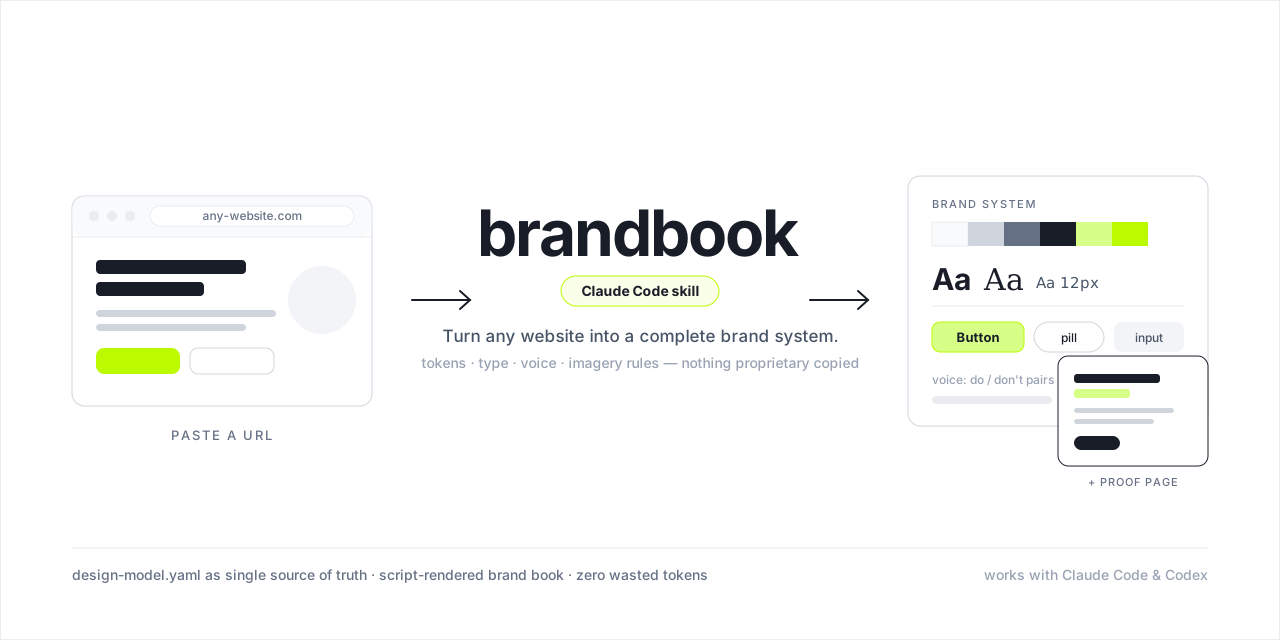
An open-source Claude Code / Codex skill: paste any website URL and get a complete brand system — design tokens, a browsable brand book, and a proof landing page in that brand's own layout language. Not just a UI kit.
Give your AI coding agent taste. Install once; every UI it builds after that matches the brand.
Paste a URL, a brand name, or screenshots. Get back:
| Artifact | How it's made | What it's for |
|---|---|---|
design-model.yaml | AI analysis | Single source of truth: tokens, voice, imagery spec, components with provenance, anti-patterns |
brandbook.html | script-rendered, zero AI tokens | The shareable brand book: palettes, type specimens, logo rules, voice do/don'ts, imagery treatments, component gallery, social/slide/email mockups |
landing-page.html | AI hand-crafted | The proof: one page in the brand's own layout language, showing the system captured what you fell for |
Works on Claude Code, Codex, and compatible agents.
hue is excellent and inspired this project — the design-model-as-source-of-truth, observed/derived provenance, and anti-AI-default ban lists all come from it. brandbook makes two different bets:
git clone https://github.com/echowang97/brandbook-skill ~/.claude/skills/brandbook
cd ~/.claude/skills/brandbook && npm i yaml
Codex: clone into ~/.agents/skills/brandbook instead.
Then in any session: "make a brandbook from stripe.com" / "extract this brand" / paste screenshots.
Skill quality tracks the model running it. The architecture hardens what it can: extraction is a shipped script (scripts/extract.js, no improvised probing), the brandbook renders deterministically (identical output on any model), and scripts/validate.mjs mechanically blocks broken output. What still varies with model capability: the fit-check judgment, brand-voice copy, and the hand-crafted landing proof — weaker models are instructed to degrade gracefully (simpler page, done correctly) rather than attempt and break.
Tested on: Claude (Fable/Opus-class — best results; landing proofs reach "squint-test" fidelity). On smaller models expect a correct brandbook and a plainer proof page.
node scripts/render-brandbook.mjs examples/hyperbound/design-model.yaml
This skill extracts design systems: tokens, type, spacing, components, voice. Some sites' identity isn't a system — it's a crafted asset (a WebGL scene, full-bleed video, art-directed photography). For those, the skill runs a fit check first and tells you the honest proportion: "~80% of this site is the 3D scene; I can distill the type, color and motion personality around it, plus a labeled slot where the asset lives — but no token file reproduces the scene itself. That takes the original assets or a 3D artist." You'll get that verdict before any generation, so you can decide whether the extractable 20% is worth it. A quiet-but-accurate brand system beats a loud fake.
Two-line version: design facts (colors, spacing, sizes, structure) are extractable; expression (logos, mascots, slogans, copy, illustrations, photos, icon glyphs, font files) is never reproduced. Expression slots get honest placeholders, free-licensed fallbacks, and disclaimers.
The skill also asks whether the brand is yours or third-party. Your own brand: ship everything. Third-party: outputs are study reproductions for internal reference and learning — the landing proof carries a visible notice, uses no real slogans or characters, and all copy is original. Observed values are labeled observed; invented ones are labeled derived with written justification. Nothing proprietary is redistributed.
MIT.
Stars on GitHub
Gives Claude Code access to the prompts.chat library, letting you search, retrieve and improve AI prompt templates, and find and install Agent Skills from its registry.
@gh-fA Claude Code skill for generating editable PPTX presentations and slides from a workflow, with reusable brand, style, layout, and deck workspaces, native charts, speaker notes, and template filling.
 @hugohe3
Gives AI agents control over Word, Excel and PowerPoint files, with skills for building .docx reports, academic papers, Excel dashboards and Morph-style animated slides.
 @iofficeai
A skill that builds animation-rich HTML presentations from scratch or converts PowerPoint files to web slides. Useful for anyone turning a deck into a web presentation.
 @zarazhangrui
A skill for Claude Code and Codex that turns a website URL, brand name, or screenshots into a brand system with design tokens, a browsable brand book, and a landing page in the brand's layout style. Install it with the command on its page. It includes brandbook-skill. Its skills do not fire on their own yet. Free and open source.
Is this plugin yours?
Claim it with GitHubSubmit a pluginPromote it