
Development
Plugin
cadence
Appearance is cheap. Verification is the work. Cadence is for developers using Claude Code on software they will still own after the session ends. Claude can write a convincing plan, produce working code, and tell you the job is finished.

Plugin Signal84/100Strong
maintained100
capable88
documented100
adopted17
Install on Claude Code
> /plugin marketplace add crenshawdev/cadence> /plugin install cadence@cadence
Stats
5
Stars
0
Forks
Active
Maintenance
JavaScript
Language
MIT
License
9h ago
Last commit
2mo ago
Created
Repo: crenshawdev/cadence
In this plugin
- skills
- cad-adopt
- cad-assumptions-analyzer-contract
- cad-audit
- cad-capture
- cad-config
- cad-context
- cad-coverage
- cad-debug
- cad-decision-review
- cad-docs-verify
- cad-execute
- cad-executor-contract
- cad-health
- cad-help
- cad-land
- cad-milestone
- cad-minimalism-review
- cad-new-project
- cad-pause
- cad-phase
- cad-plan-checker-contract
- cad-plan-review
- cad-plan
- cad-planner-contract
- cad-progress
- cad-report
- cad-reviewer-contract
- cad-spike
- cad-suggest
- cad-task
- cad-undo
- cad-verifier-contract
- cad-verify
- cad-why
- agents
- cad-assumptions-analyzer-high
- cad-assumptions-analyzer-low
- cad-assumptions-analyzer-max
- cad-assumptions-analyzer-medium
- cad-assumptions-analyzer
- cad-executor-low
- cad-executor-max
- cad-executor-medium
- cad-executor-xhigh
- cad-executor
- cad-plan-checker-high
- cad-plan-checker-max
- cad-plan-checker-medium
- cad-plan-checker-xhigh
- cad-plan-checker
- cad-planner-low
- cad-planner-max
- cad-planner-medium
- cad-planner-xhigh
- cad-planner
- cad-reviewer-low
- cad-reviewer-max
- cad-reviewer-medium
- cad-reviewer-xhigh
- cad-reviewer
- cad-verifier-low
- cad-verifier-max
- cad-verifier-medium
- cad-verifier-xhigh
- cad-verifier
What's inside
Skill(34 skills)
/cad-adoptInitialize .planning/ from a repo that already exists - PROJECT.md, REQUIREMENTS.md and a remaining-work ROADMAP.md derived from the code and the git history/cad-assumptions-analyzer-contractInternal role contract, preloaded into every cad-assumptions-analyzer rung agent. Not a user command./cad-auditPre-ship traceability audit - every requirement traced to a phase, plan and verification, orphan detection both directions, a FAIL gate before shipping
- /cad-capture
- /cad-config
- /cad-context
- /cad-coverage
- /cad-debug
- /cad-decision-review
- /cad-docs-verify
- /cad-execute
- /cad-executor-contract
- /cad-health
- /cad-help
- /cad-land
- /cad-milestone
- /cad-minimalism-review
- /cad-new-project
- /cad-pause
- /cad-phase
- /cad-plan-checker-contract
- /cad-plan-review
- /cad-plan
- /cad-planner-contract
- /cad-progress
- /cad-report
- /cad-reviewer-contract
- /cad-spike
- /cad-suggest
- /cad-task
- /cad-undo
- /cad-verifier-contract
- /cad-verify
- /cad-why
Agent(30 agents)
cad-assumptions-analyzer-highThe `high` rung of `cad-assumptions-analyzer`; `bin/route.mjs` picks it, not the user.cad-assumptions-analyzer-lowThe `low` rung of `cad-assumptions-analyzer`; `bin/route.mjs` picks it, not the user.cad-assumptions-analyzer-maxThe `max` rung of `cad-assumptions-analyzer`; `bin/route.mjs` picks it, not the user.
- cad-assumptions-analyzer-medium
- cad-assumptions-analyzer
- cad-executor-low
- cad-executor-max
- cad-executor-medium
- cad-executor-xhigh
- cad-executor
- cad-plan-checker-high
- cad-plan-checker-max
- cad-plan-checker-medium
- cad-plan-checker-xhigh
- cad-plan-checker
- cad-planner-low
- cad-planner-max
- cad-planner-medium
- cad-planner-xhigh
- cad-planner
- cad-reviewer-low
- cad-reviewer-max
- cad-reviewer-medium
- cad-reviewer-xhigh
- cad-reviewer
- cad-verifier-low
- cad-verifier-max
- cad-verifier-medium
- cad-verifier-xhigh
- cad-verifier
Badges




README
Cadence
Appearance is cheap. Verification is the work.
Cadence is for developers using Claude Code on software they will still own after the session ends.
Claude can write a convincing plan, produce working code, and tell you the job is finished. The harder part is keeping the decisions that led there, stopping a long session from becoming the project record, and establishing that what you got is what you asked for.
Cadence keeps the project in the repository. Decisions, plans, progress, review findings and verification live under .planning/, where a new session reads them off disk. A planner, an executor, reviewers and a verifier each work in fresh context, and nothing is certified by the thing that wrote it. You are the engineer of record: you approve the plan, triage what the reviewers find, and authorize every push.
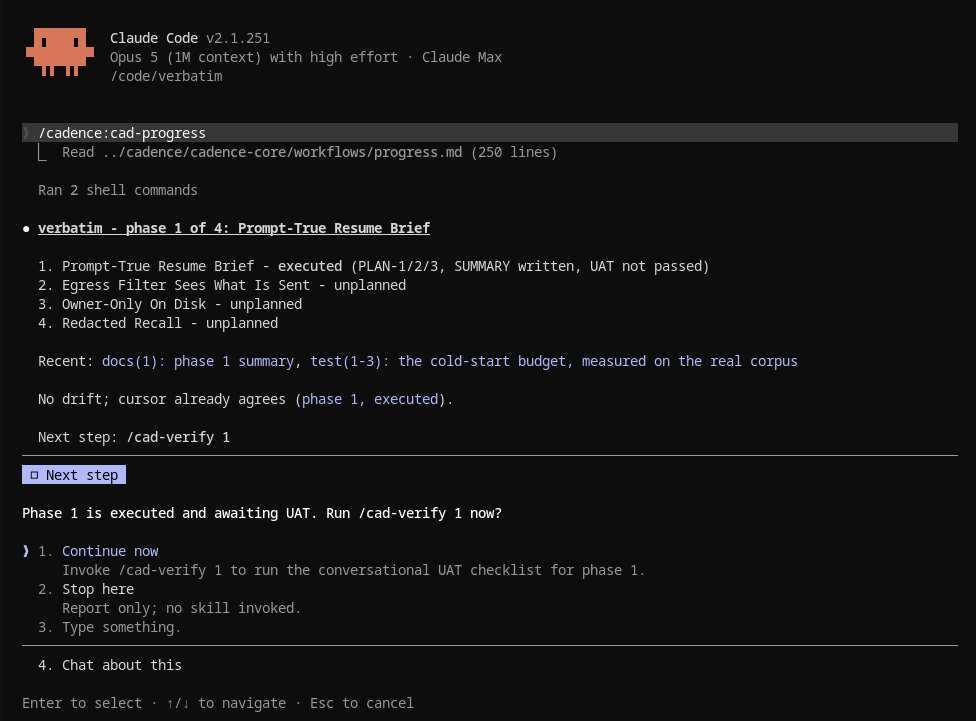
Cadence rebuilds Verbatim's state from the repo, finds phase 1 executed and awaiting UAT, and offers /cad-verify 1 as the next step.
Cadence is deliberately not an autopilot. If you want to describe a feature and come back to a merged PR, this is the wrong tool.
The methodology ships as controls. Each step of the loop has named checks around it, each check records that it ran, and a check that did not run is not a check that passed. The record is a file in your repo, not a claim in a chat window.
Install
Cadence is a Claude Code plugin. Add the marketplace, then install:
/plugin marketplace add https://github.com/crenshawdev/cadence.git
/plugin install cadence@cadence
Update with /plugin update cadence@cadence, remove with /plugin uninstall cadence@cadence. Requires Claude Code with plugin support, plus node, git and one forge CLI - tea, gh or glab - on your PATH, because Cadence resolves a forge and an issue tracker when it sets a project up. Those are host prerequisites: the scripts inside are zero-dependency, and there is no npm install, ever.
The loop
Cadence runs as slash commands namespaced /cadence:cad-* (for example /cadence:cad-new-project). They are written below without the cadence: prefix for brevity. A project moves through five steps, each its own command:
/cad-new-projectdefine the project through deep questioning: what, why, who, done./cad-context <phase>gather locked decisions and acceptance criteria before planning./cad-plan <phase>turn a phase into an executable, checkable plan./cad-execute <phase>build it, one atomic commit per task./cad-verify <phase>confirm the phase delivered what it promised.
Step 1 has a second door. /cad-adopt is the entrance for a project that already exists: it reads the repo, the manifests and the git history, writes what the code already does into PROJECT.md as shipped work and what is left into a remaining-work ROADMAP.md, and asks only what the repo cannot answer. Same .planning/ on disk either way, so step 2 onward is identical.
Step 1 also takes a shortcut when the questioning already happened somewhere else: /cad-new-project --brief <file> reads the design brief that conversation produced, treats what it settles as answered, and asks only about what it leaves open. docs/DISCOVERY.md is how you get there from a freeform conversation.
/cad-progress tells you where you stand and what's next at any point: it finds incomplete or paused work and offers to resume it.
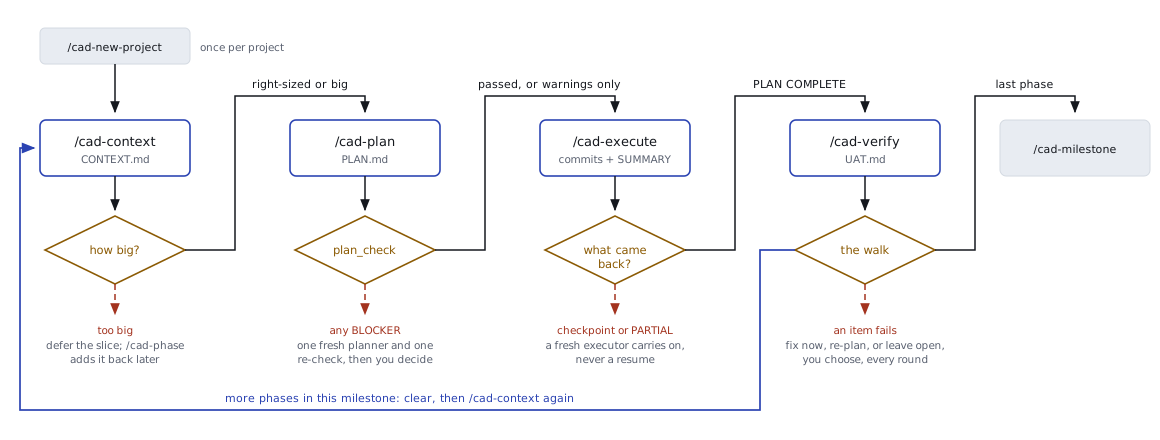
That is five commands out of twenty-eight. /cad-help prints the full reference inside a session, and cadence-core/references/COMMANDS.md is that same reference in the repo, readable before you install anything.
The controls
Eight of them, and every one hands its decision to you rather than deciding for you.
| Control | Where it fires | What it does |
|---|---|---|
| Plan review | before any code is written | an adversarial reviewer tries to break the plan, findings come back as a numbered list you triage |
| Risk surface | on each plan's completed commit range | checks the diff against eight named surfaces, and blocks on a match by default |
| Push rail | every git push a workflow attempts | a PreToolUse hook, cadence-core/bin/git-guard.mjs, stops and asks you. No exemption exists |
| Protected branch | a commit on main or master | asks, refuses, or allows, per git.on_protected |
| Verification | after a phase is built | conversational UAT plus a goal-backward pass, claims scored verified, failed, or uncertain |
| Traceability audit | before a release ships | /cad-audit traces every requirement to a phase, a plan and a verification, both directions |
| Coverage audit | on a completed phase | /cad-coverage reads the assertions rather than counting test files |
| The record | every dispatch, always | .planning/trace.jsonl prices each subagent, /cad-report reads it back as receipts |
Two of those rows, at work:
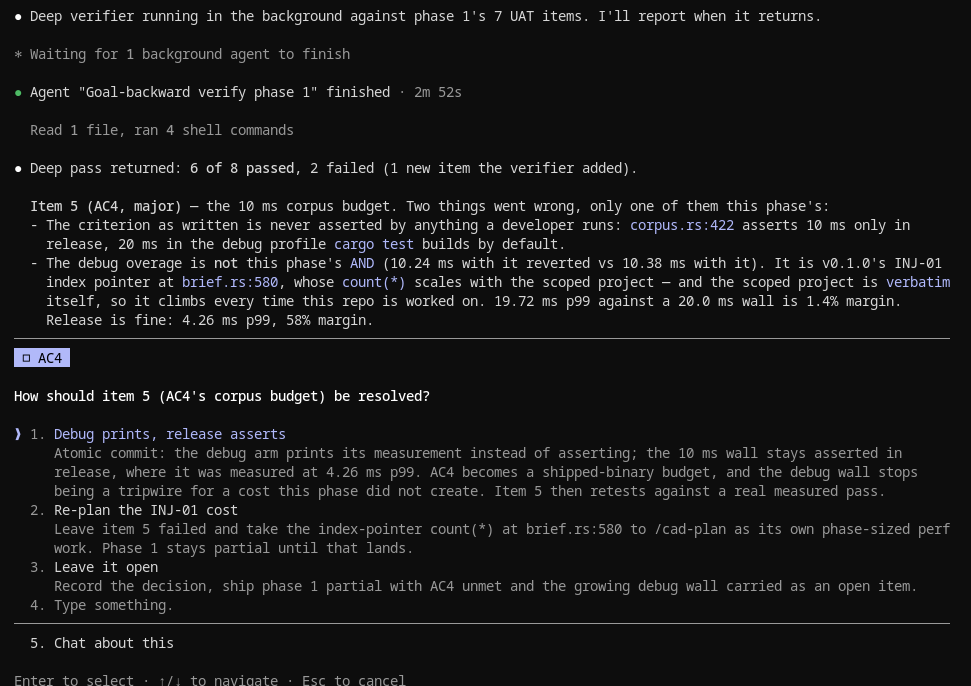
The goal-backward pass scores 6 of 8, and both failures are specific: an acceptance criterion no developer-run test actually asserts, and a performance cost that belongs to an earlier version rather than this phase. It asks how to resolve the failure rather than deciding.
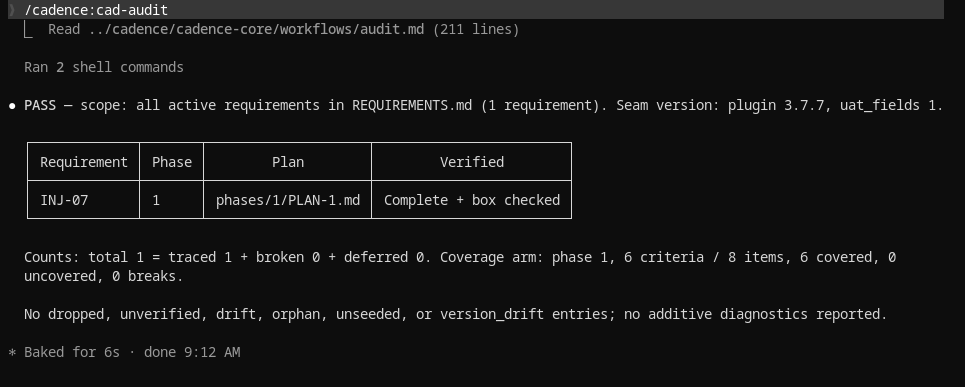
With verification resolved, the audit traces Verbatim's active requirement to its phase, its plan and a checked verification box, and reports the criteria coverage behind it.
/cad-report renders one phase's record as a narrative, and /cad-suggest reads the same record back the other way: it turns what the dispatches actually cost and what the gates actually caught into retune suggestions, each carrying its config key, the value in force, a direction and a target, and it offers to route the ones you accept to /cad-config. The controls generate the evidence, and that is what the evidence is for.
The reviewers are adversarial by construction, because you cannot personally re-derive everything the model wrote and neither can I. The default reviewer is a fresh-context Claude subagent and needs no API key. An OpenAI, Gemini, or DeepSeek key runs the identical job as a direct API call, which lets you put up to four independent voices on one plan and have your main session adjudicate against the cited code. Every backend returns the same shape on purpose, because an adjudicator that could tell which finding came from the free reviewer and which from the paid one would start discounting findings for being cheap. The one signal treated as strong is convergence, two reviewers landing on the same defect independently. What survives comes back as a multi-select prompt whose default is none of it, never a queue the model starts working through.
/cad-minimalism-review points the same posture at code that works and should not exist, an abstraction with one implementation, flexibility nothing exercises, config nobody sets, and hands back a ranked delete-list. It applies none of it.
How it works
Cadence assumes the model will fail. Not that it is bad at the job, that it will now and then hand you something that looks finished and is not, and that you will not always catch it by reading. Everything else follows: the state stays durable, the workers stay disposable, and the rails sit where a worker cannot argue with them.
Nothing important lives in the conversation. The roadmap, the plans, the summaries, the verification checklist and the four-line state cursor all sit in .planning/ and in git history, and every command rebuilds what it needs from disk. Clear the window at any phase boundary and you lose nothing. There is no resume, a continuation is a fresh spawn that reads the prior artifact off disk, and every one of those spawns lands in the run record where you can read what it cost.
A check that could not run never passes a gate. A reviewer that failed says why out loud instead of quietly dropping out of the set. The verifier scores every claim as verified, failed, or uncertain, and uncertain counts toward neither side. A test that would still pass if the behavior were wrong is not coverage, which is why the coverage audit reads assertions.
The git rails are a PreToolUse hook rather than a paragraph of instructions, because a model will talk itself around a paragraph and it will not talk itself around a hook.
That shape was expensive to learn, and I paid for it twice. First a predicate called isPlainPush that would recognize a safe push and wave it through, very clever, and four rounds of adversarial review found four ways around it. Then a shell tokenizer, which took two milestones and the 2,251 lines v2.2.0 deleted before I admitted it could be switched off entirely by a long enough command line, in a hook that fails open. Both are gone. The one sanctioned push runs through a subprocess the hook never sees, built from an argument vector rather than a shell string, and what the guard reads now is eighty-five lines: a command counts if it starts with the word git. bash -c "git push" is invisible to it, and that is written down rather than left to be discovered.
METHOD.md is the full account of what the planner, executor, verifier and reviewers do and where each rule is enforced. INTERNALS.md is the mechanism underneath: routing, the publish seam, and why the decision cores are pure functions. docs/WORKFLOW.md is the same material as a diagram, five figures and the four tables behind them. docs/EVIDENCE.md defines the three weight terms and gives the weight.mjs commands that print the current numbers for any tree. docs/COST.md is what a run costs on my own account. docs/EXAMPLE.md walks one small project through the whole cycle.
What each role costs
Cadence used to ask how much you wanted a dispatch to cost, and then it asked what a break in the project would cost. Both were one word standing in for twelve decisions somebody else had already made for you. It asks you the twelve now, one role at a time:
/cad-config --roles
File tree
FAQ
cadence is a Claude Code plugin with 34 hand-picked skills for development work, indexed on Flowy. Install it with the command on its page. It includes cad-adopt, cad-assumptions-analyzer-contract, cad-audit. Its skills do not fire on their own yet. Request auto-invocation to have Flowy route them as you prompt. Free and open source.
- What is cadence?
- Appearance is cheap. Verification is the work. Cadence is for developers using Claude Code on software they will still own after the session ends. Claude can write a convincing plan, produce working code, and tell you the job is finished.
- How do I install cadence?
- Run these in Claude Code: /plugin marketplace add crenshawdev/cadence then /plugin install cadence@cadence. Then prompt normally.
- Does cadence auto-invoke its skills?
- Not yet. It is indexed on Flowy as a plain plugin. Request auto-invocation on its page and Flowy will route its skills for you as you prompt.
- Is cadence free?
- Yes. Flowy is free and open source, with nothing gated. You can read every skill in full before you install.
Is this plugin yours?
Claim it with GitHubSubmit a pluginPromote it