


openclaw
Skills for the OpenClaw personal AI assistant, covering browser automation, routing requests to coding agents, presenting canvas widgets, running apps on temporary machines, and sharing diffs.
78 skills394k
 @steipete
Multi-agent teams for real work: measured, not assumed. Docs · Quickstart · Teams · Benchmark · Featured in Tech Forum: Does a Team of AI Coding Agents Beat One?
Claude Code
> /plugin marketplace add BichengWang/multi-agents> /plugin install multi-agents@multi-agents
Codex
$ npx skills add BichengWang/multi-agents -a codex
Cursor
$ npx skills add BichengWang/multi-agents -a cursor
Gemini CLI
$ npx skills add BichengWang/multi-agents -a gemini-cli
GitHub Copilot
$ copilot plugin marketplace add BichengWang/multi-agents$ copilot plugin install multi-agents@multi-agents
OpenCode
$ npx skills add BichengWang/multi-agents -a opencode
Windsurf
$ npx skills add BichengWang/multi-agents -a windsurf
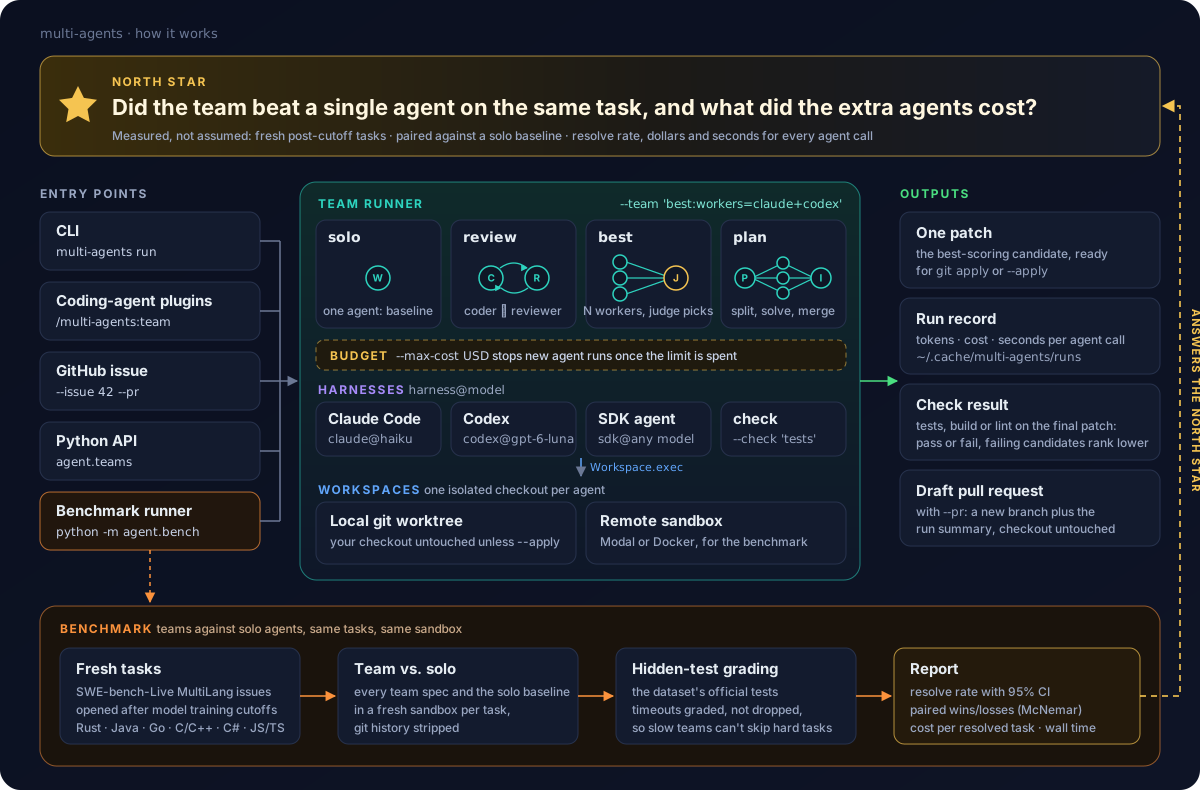
Multi-agent teams for real work: measured, not assumed.



Docs · Quickstart · Teams · Benchmark · Roadmap
Featured in Tech Forum: Does a Team of AI Coding Agents Beat One?
North star: most agent orchestrators skip one question, and the benchmark here answers it: did the team beat a single agent on the same task, and what did the extra agents cost?
Run a team of coding agents on a task in your repository: a single agent, a coder ⇄ reviewer
loop, or several agents with a judge. Workers are the coding CLIs you already use (Claude Code,
Codex) or a built-in agent that can use any model through the OpenAI Agents SDK. Each worker
gets its own git worktree. You get one patch back, plus an itemized record of every agent call:
tokens, cost and seconds. Your working tree is untouched unless you pass --apply.
The evidence on teams of coding agents points both ways:
So the answer depends on the topology, the models and the task, and published numbers may be contaminated. This project measures it on tasks created after the models' training cutoffs, with paired comparisons and cost.
Requirements: Python 3.10+, uv, git, and at least one logged-in
coding CLI (claude or codex). CLI harnesses use your existing login; no API keys needed.
The package is multi-agent on PyPI and the command is multi-agents: run it with uvx as below,
or keep it installed with uv tool install multi-agent (or pipx install multi-agent).
uvx --from multi-agent multi-agents run \
  --repo ~/code/myproject \
  --team 'best:workers=claude@haiku+codex@gpt-6-luna' \
  "Make the tests in test_slug.py pass without editing the tests."
Real output from that command on a small repository:
Team: best:workers=claude@haiku+codex@gpt-6-luna,judge=claude@haiku
role   ┃ harness@model           ┃ tokens in/cached/out ┃    cost ┃ secs
━━━━━━━╇━━━━━━━━━━━━━━━━━━━━━━━━━╇━━━━━━━━━━━━━━━━━━━━━━╇━━━━━━━━━╇━━━━━
worker │ claude@claude-haiku-5-5 │       236k/201k/1.5k │ $0.0096 │ 34.8
judge  │ claude@claude-haiku-5-5 │       194k/157k/2.6k │ $0.0102 │ 42.8
worker │ codex@gpt-6-luna        │         107k/94k/667 │ $0.0025 │ 31.6
judge  │ claude@claude-haiku-5-5 │       192k/149k/3.8k │ $0.0119 │ 52.3
Total: 729k/604k/8.5k tokens, cost $0.0342, 85.0s
scores: [8.0, 8.0]
chosen: 1
Files changed: 1
  slug.py  +6 -3
The run prints the exact git apply command for the final patch and saves a JSON record
outside your repository (~/.cache/multi-agents/runs/).
| Spec | What happens |
|---|---|
solo:worker=H | One agent works on the task. This is the baseline. |
review:coder=H,reviewer=H[,rounds=N] | The coder works; the reviewer scores the patch in a separate copy and sends feedback; the coder resumes its session and revises. Returns the best-scoring patch, not the last one. |
best:workers=H+H[+H...][,judge=H] | Workers run in parallel, each in its own worktree, possibly different CLIs and models. The judge scores each patch and the best one wins. |
plan:planner=H,workers=H[+H...][,integrator=H][,max_tasks=N][,replans=N][,reviewer=H][,rounds=N] | A planner splits the task into independent subtasks, workers solve them in parallel worktrees, and the patches are merged; an integrator resolves conflicts and gets one fix pass if the check fails. Subtasks whose worker failed or changed nothing go back to the planner (replans, default 1, 0 = never) for new subtasks that rotated workers solve. With reviewer (and rounds, default 3) every subtask is a coder ⇄ reviewer loop in its own worktree and its best patch is merged. |
H is claude, codex or sdk, optionally with @model, for example claude@haiku,
codex@gpt-6-luna or sdk@litellm/openrouter/<model>. check (the --check command) can be the
reviewer or the judge: a test-driven loop with no LLM reviewer. Details:
team runner guide.
--check runs your tests (or build, or lint) against the final patch in a separate worktree and
records pass/fail; with an LLM judge, candidates that fail it rank below those that pass. --issue
takes the task from a GitHub issue, and --pr commits the result to a new branch and opens a draft
pull request with the run summary, without touching your checkout.
multi-agents run --repo . --issue 42 --pr \
  --team 'plan:planner=claude@haiku,workers=claude@haiku+codex@gpt-6-luna' \
  --check 'python3 -m unittest -q'
A real plan run on a repository with two unrelated bugs (without --issue/--pr):
role    ┃ harness@model           ┃ tokens in/cached/out ┃    cost ┃ secs
planner │ claude@claude-haiku-5-5 │       187k/150k/2.0k │ $0.0101 │ 16.8
worker  │ claude@claude-haiku-5-5 │        141k/104k/510 │ $0.0088 │  8.7
worker  │ codex@gpt-6-luna        │          55k/37k/349 │ $0.0024 │  9.7
Total: 385k/291k/2.9k tokens, cost $0.0212, 26.8s
subtask 1 [applied]: Fix word_count in textstats.py (claude@haiku)
subtask 2 [applied]: Fix format_cents in money.py (codex@gpt-6-luna)
check: passed (exit 0, 0.0s) python3 -m unittest -q
Issue text is untrusted input to the agents: don't combine --issue on public repositories with
--permissions bypass or the sdk harness.
This repository is also a plugin marketplace for both coding CLIs, so a running agent can hand a task to a team and then show you the patch. Install it once:
# Claude Code
claude plugin marketplace add BichengWang/multi-agents
claude plugin install multi-agents@multi-agents

# Codex
codex plugin marketplace add BichengWang/multi-agents
codex plugin add multi-agents@multi-agents
Then, inside Claude Code (the optional spec comes first; the default is a cheap coder ⇄ reviewer pair that pairs the other CLI with the one you are in):
/multi-agents:team make the tests pass
/multi-agents:team best:workers=claude@haiku+codex@gpt-6-luna fix the flaky retry in client.py
In Codex, ask for the skill by name, for example Use $multi-agents:multi-agents to make the tests pass. Either way the agent runs the published CLI, shows you the summary and the patch, and applies
it only after you say so. The skill is in
plugins/multi-agents.
--permissions safe) each CLI runs inside its own sandbox: edits
and test commands are confined to the worktree. --permissions bypass turns those checks off and
is meant for disposable machines and containers only. The sdk harness has no permission system.--max-cost USD stops new agent runs once that much has been spent; the team then
returns the patch it has so far. It is a stop on new work, not a ceiling: runs already in flight
finish (parallel workers run side by side), so the total can overshoot by their cost. An unpriced
run cannot be counted, so after one the budget refuses further runs. The CLI therefore rejects
a team with an unpriced harness before it starts, unless you pass --allow-unpriced, which counts
those runs as $0 and leaves their spend outside the limit. The record and summary show the
spend and any refused runs.The benchmark runs team specs against solo agents on GitHub issues opened after the models'
training cutoffs (SWE-bench-Live MultiLang:
Rust, Java, Go, C/C++, C#, JS/TS), each in a fresh sandbox (Modal, or --backend docker on your
own Docker daemon) with git history stripped. Patches are graded with the dataset's official
hidden tests. The report gives resolve rate with 95%
confidence intervals, paired wins and losses against the solo baseline on the same tasks (exact
McNemar test), cost per task and per resolved task, and wall time. Timeouts are graded rather than
dropped, so slow teams cannot shrink the comparison to the easy tasks.
uv sync --locked --extra bench
python -m agent.bench tasks --since 2026-07-01 --limit 5 --seed 7    # no credentials needed
Setup, methodology, cost estimates and limitations: benchmark guide.
First results (October 2026): on 48 fresh tasks, Claude Haiku 5.5 resolved 27 solo, 29 with a reviewer and 28 as best of 3, at $0.061, $0.098 and $0.17 per task. The teams' one or two extra tasks are not significant (paired p = 0.5 and 1.0): the reviewer approved 47 of 48 final patches, and the judge's top scores were tied on 32 of 48 tasks. Table, analysis and data: pilot results.
| Area | State |
|---|---|
Team runner (solo, review, best, plan), Claude Code and Codex harnesses | ✅ Working; smoke-tested with real CLIs |
--check, --issue, --pr, plugins for both CLIs | ✅ Working; smoke-tested end to end |
--max-cost run budget; plan re-planning (replans) and per-subtask review (reviewer) | ✅ Working; smoke-tested with real CLIs |
| SDK harness (any model) | 🧪 Implemented and tested offline; not yet run against a live model |
| Benchmark | ✅ Runs live on Modal (also detached, remote) and on local Docker |
| Results | ✅ Pilot: Haiku 5.5, 48 tasks × solo, review, best of 3 |
Plans are in docs/ROADMAP.md.
Stars on GitHub
Skills for the OpenClaw personal AI assistant, covering browser automation, routing requests to coding agents, presenting canvas widgets, running apps on temporary machines, and sharing diffs.
@steipeteGives Claude Code users skills to drive Orca-managed worktrees, terminals and the embedded browser through the orca CLI, plus Jira and Linear ticket work and inline HTML chat visuals. Covers chart, table and mockup output.
 @stablyai
Orchestrates teams of AI agents to run work like a company, with a Node.js server and React UI. Adds skills for delegating tasks, following up on results, reviewing team status, and managing Paperclip tasks from Hermes.
 @paperclipai
Organizes your AI agents for round-the-clock operation, with tools to hire, schedule and report on your agent team. Lets you oversee the agents without staying online yourself.
 @lobehub
Multi-agent teams for real work: measured, not assumed. Docs · Quickstart · Teams · Benchmark · Featured in Tech Forum: Does a Team of AI Coding Agents Beat One? Install it with the command on its page. It includes multi-agent-skill, multi-agents. Its skills do not fire on their own yet. Free and open source.
Is this plugin yours?
Claim it with GitHubSubmit a pluginPromote it