Three AI models. One synthesis. Zero lost progress.
Multi-model research pipeline for Claude Code — Claude, Gemini, and Codex debate, cross-verify, and synthesize publication-ready artifacts.





Why MAGI? •
Get Started •
Features •
Usage •
Roadmap •
Changelog
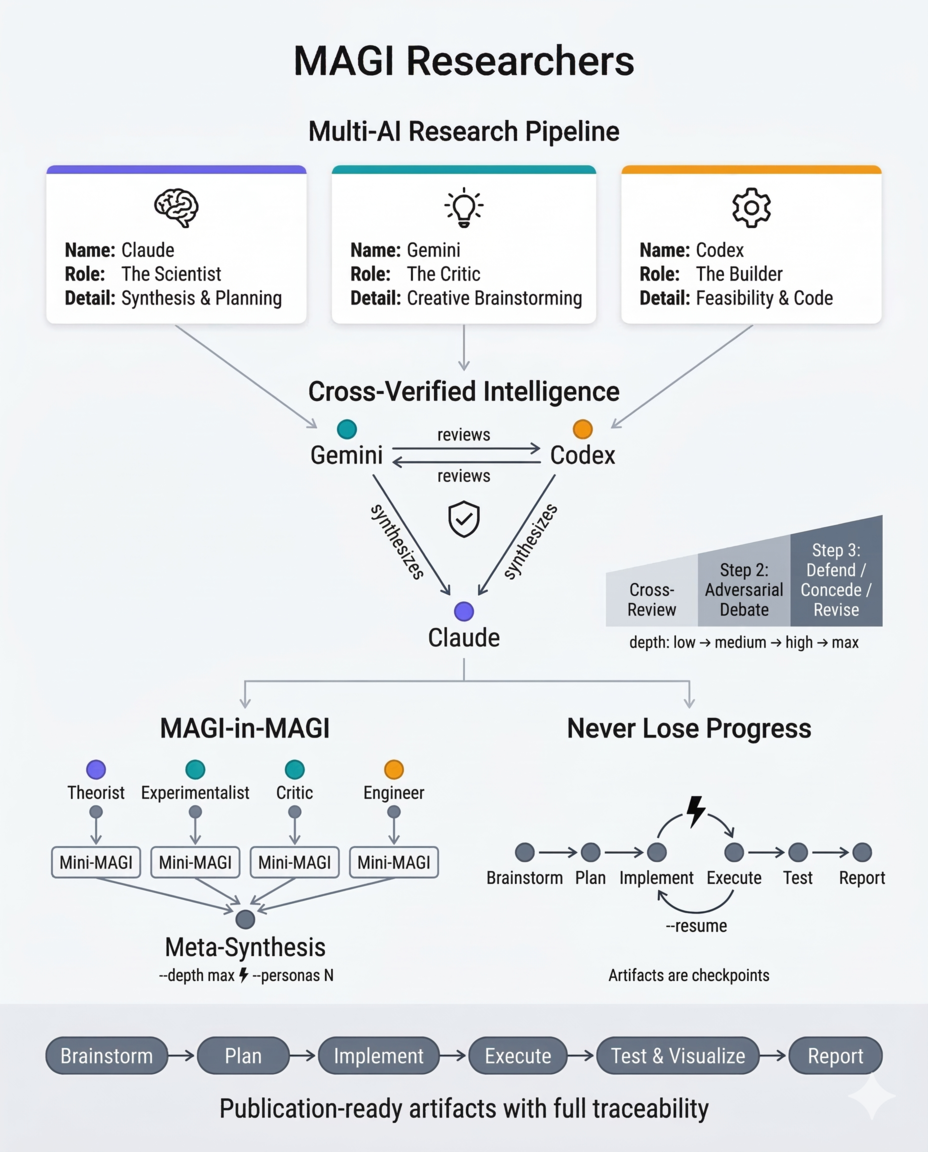
Like the MAGI system in Evangelion — three supercomputers cross-verifying each other — this plugin orchestrates Claude, Gemini, and Codex for rigorous, multi-perspective research.
Why MAGI?
Single-model research has blind spots. One model hallucinates a citation or misses a critical constraint — and nobody catches it.
| Single Model | MAGI (3 Models) |
|---|
| Brainstorming | One perspective | Three independent perspectives |
| Verification | Self-review (unreliable) | Cross-model peer review |
| Blind spots | Undetected | Caught by competing models |
| Output | Raw text | Structured report with consensus & divergence analysis |
- Claude (MELCHIOR) — The Scientist. Active third MAGI personality — synthesis, planning, implementation, and original analytical contributions.
- Gemini — The Critic. Creative brainstorming, cross-verification, broad knowledge.
- Codex — The Builder. Feasibility analysis, code review, implementation focus.
Case Study: Damped Oscillator Equation Discovery
We gave all three single models and MAGI the same physics problem: discover an unknown damping function from noisy sensor data. No single model proposed combining classical diagnostics with modern ML — only MAGI's cross-verification caught that gap.
| Source | Score | Highlight |
|---|
| MAGI | 90 | Staged pipeline: rapid diagnostics → symbolic discovery → validation → fallback |
| Claude | 84 | Best code coverage — runnable snippets for every approach |
| Codex | 80 | Elegant physics-informed neural ODE constraints |
| Gemini | 67 | Most accessible for general audience |
Experiment details
Get Started
Prerequisites: Claude Code + Python 3.11+ with uv + Gemini CLI + Codex CLI
1. Install the plugin (inside Claude Code):
/plugin marketplace add Axect/magi-researchers
/plugin install magi-researchers@magi-researchers-marketplace
2. Set up MCP servers (one-time):
claude mcp add -s user gemini-cli -- npx -y gemini-mcp-tool
claude mcp add -s user codex-cli -- npx -y @cexll/codex-mcp-server
claude mcp add -s user context7 -- npx -y @upstash/context7-mcp@latest
3. Run your first research:
/magi-researchers:research "your research topic" --domain physics
MAGI generates cross-verified hypotheses, writes implementation code, renders publication-quality plots, and synthesizes a structured report — all saved to outputs/{topic}/.
Alternative: Local Development
git clone https://github.com/Axect/magi-researchers.git
claude --plugin-dir /path/to/magi-researchers
uv add matplotlib SciencePlots numpy
Features
Research Pipeline
| Phase | What Happens | Output |
|---|
| Brainstorm | Three models generate and cross-review ideas with expert personas | brainstorm/ |
| Plan | Concrete research plan with execution metadata, stress-tested by a hostile reviewer | plan/ |
| Implement | Language-agnostic implementation with dry-run verification and frontmatter update | src/ |
| Execute | Deterministic code execution from plan frontmatter; generates result artifacts | results/ |
| Test & Visualize | Workspace-aware two-tier testing + publication-quality plots | tests/ + plots/ |
| Report | Structured report with cross-verified claim-evidence integrity | report.md |
Highlights
- MAGI-in-MAGI —
--depth max scales to N domain specialists, each running a full mini-MAGI brainstorm in parallel with adversarial meta-debate
- Adversarial review — Models debate, cross-verify, and attack each other's plans (murder board) before synthesis
- Resume anywhere —
--resume picks up from existing artifacts. No state files — your outputs are the checkpoints.
- Publication-quality output —
matplotlib + scienceplots (Nature theme), LaTeX math, PNG 300 dpi + vector PDF, structured reports with MAGI traceability
All features
Quality Assurance
- Holistic & weighted scoring — Default expert-judgment ranking; optionally supply explicit JSON weights or
adaptive prompt-analyzed weights
- Dynamic persona casting — Each model gets a topic-specific expert identity, sharpening ideation
- Phase gates — Automated quality checkpoints with conditional MAGI mini-review before each user approval step
Resilience
- Artifact contracts — Each phase validates upstream files before running. Catches silent failures before they cascade.
- Agent substitution —
--substitute "Gemini -> Opus" replaces a rate-limited model with Claude across all pipeline stages.
- Workspace anchor —
.workspace.json locks the output directory path, preventing artifact drift after context compression.
- Gemini fallback chain — Resilient 3-tier model fallback:
gemini-3.1-pro-preview → gemini-2.5-pro → Claude
More
- MAGI traceability review — All three models cross-verify the final report for orphaned claims and figures
- Report gap detection — Auto-generates missing visualizations from existing data
- Domain templates — Built-in context for Physics, AI/ML, Statistics, Mathematics, and Paper Writing
- Journal strategy — Venue recommendations for Physics, AI/ML, and Interdisciplinary research
Under the hood
- Plot manifest — Structured
plot_manifest.json with metadata, section hints, and captions for automated report integration
- Common Restrictions — Phase 4 enforces four output-interface contracts:
plot_manifest.json (fixed schema), PNG + PDF/SVG dual format, execution evidence, dependency spec file. Internal process is autonomous.
- Workspace Detection — Phase 3 and 4 detect languages and ecosystems from actual
src/ files (package managers first, then file extensions). Priority: reality (src/) > plan intent > domain defaults.
- Two-tier testing — Tier 1 (unit, mock-based, always runs) and Tier 2 (integration, depends on
results/, skipped gracefully if absent). Test frameworks match the detected workspace language.
- Deterministic execution — Phase 3.5 reads
execution_cmd and dry_run_cmd directly from research_plan.md YAML frontmatter. No heuristics, no entry-point guessing.
research_plan.md frontmatter — Carries languages, ecosystem, execution_cmd, dry_run_cmd, expected_outputs, and estimated_runtime fields as machine-readable metadata for downstream phases.- Cross-phase artifact contracts — Each phase validates incoming artifacts before running (tool-based Glob/Read, not LLM guesswork)
- Depth-controlled token budget —
--depth low skips cross-review for fast/cheap runs; --depth high enables full adversarial debate
@filepath artifact references — MCP tool calls use @filepath syntax instead of inline content, so large artifacts are read directly from disk with zero truncation
Usage
| Command | Description |
|---|
/magi-researchers:research "topic" | Full pipeline (Brainstorm → Plan → Implement → Execute → Test → Report) |
/magi-researchers:research-brainstorm "topic" | Brainstorming with cross-verification |
/magi-researchers:research-write --source <dir> | Collaborative writing from research artifacts |
/magi-researchers:research-explain "concept" | Concept explanation with Teacher/Critic pipeline |
/magi-researchers:research-implement | Language-agnostic implementation (needs existing plan) |
/magi-researchers:research-execute | Execute research code; generate results/ artifacts |
/magi-researchers:research-test | Workspace-aware testing & visualization |
/magi-researchers:research-report | Report generation |
Depth Control
The --depth flag controls how thoroughly models review each other's work:
| Depth | What Happens | Cost |
|---|
low | Independent brainstorming, no cross-review | Cheapest |
medium (default) | Cross-model peer review + synthesis | Standard |
high | Full adversarial debate (defend/concede/revise) | Higher |
max | MAGI-in-MAGI: N specialist subagents, each running a full mini-MAGI | Highest |
All flags
| Flag | Values | Default | Description |
|---|
--domain | physics ai_ml statistics mathematics paper | auto-inferred | Research domain for context |
--weights | JSON / adaptive | holistic | Scoring mode: omit for expert-judgment ranking, JSON for weighted, adaptive for prompt-analyzed |
--depth | low medium high max | medium | Review thoroughness |
--personas | 2–5 | auto | Number of domain-specialist subagents for --depth max |
--resume | <output_dir> | — | Resume an interrupted pipeline from the last completed phase |
--claude-only | flag | off | Replace Gemini/Codex with Claude subagents for single-model usage |
--substitute | "Gemini -> Opus" "Codex -> Opus" | — | Replace a specific model with Claude when hitting rate limits |


 @n8n-io