
VerifiedPlugin
wenlan
Wenlan is a knowledge base for the AI-native age. Your AI agents capture what they learn, Wenlan keeps it current and distills it into source-cited wiki pages you can trust
15 skills3 agents1 MCP+2+2+173
 @7xuanlu
Ultrapowers is a dynamic build workflow for Claude Code. It takes a goal or a task list and builds it for you, unattended: it plans, builds each task test-first, has a stronger model review every task, loops a critic until the goal is met, and hands back one
> /plugin marketplace add 7xuanlu/ultrapowers> /plugin install ultrapowers@7xuanlu
Repo: 7xuanlu/ultrapowers
What's inside
Ultrapowers is a dynamic build workflow for Claude Code. It takes a goal or a task list and builds it for you, unattended: it plans, builds each task test-first, has a stronger model review every task, loops a critic until the goal is met, and hands back one reviewed branch. You step in at two points only, approving the plan and reviewing the result.
The build discipline is Superpowers' work by Jesse Vincent (@obra), embedded with gratitude. Ultrapowers' part is the host: it runs that discipline on a deterministic JavaScript coordinator, so a long, many-task build runs hands-off without filling up your chat session. The name comes from a Superpowers proposal obra declined; see Why it exists.
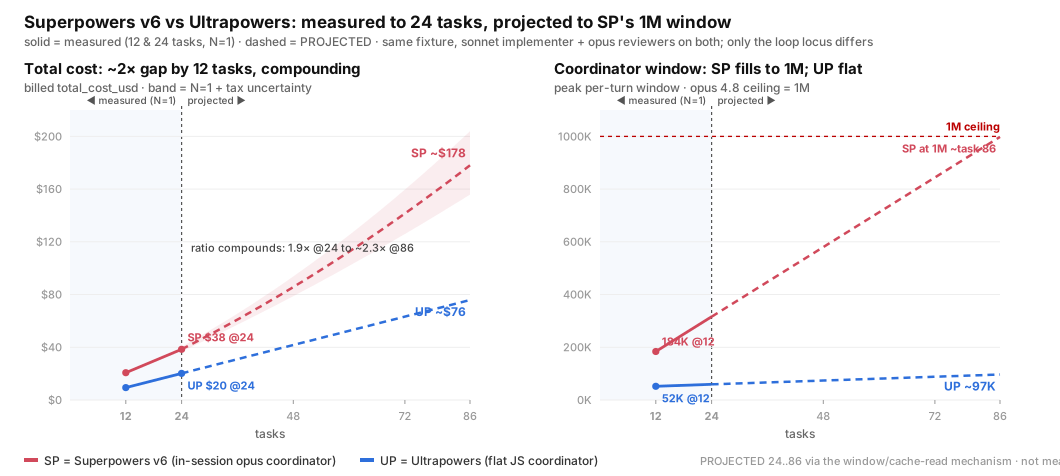
Two findings, from a model-fair head-to-head against superpowers v6 (same sonnet implementer and opus reviewers on both sides; the only structural difference is where the orchestration loop runs):
/plugin marketplace add 7xuanlu/claude-plugins
/plugin install ultrapowers@7xuanlu
Or install this repo directly (it is its own single-plugin marketplace, also named 7xuanlu):
/plugin marketplace add 7xuanlu/ultrapowers
/plugin install ultrapowers@7xuanlu
Then:
/workflows-driven-development help
/workflows-driven-development "your goal here"
The command dispatches the bundled engine directly by scriptPath, so it works immediately on a
fresh install, with no symlink or by-name registration, and the engine stays out of your slash list.
Requirements: Claude Code with the Workflow tool, and Node (the engine is checked on Node 20;
newer is fine). The default implementer (claude) needs no external CLI. The optional codex and
gemini implementers need those CLIs installed plus a sandbox carve-out; see Safety.
Ultrapowers is a Claude Code Workflow (a deterministic JavaScript coordinator) that runs Superpowers' SDD/TDD discipline on disposable subagents:
goal ─▶ plan
        ⏸ GATE 1: you approve the plan, then walk away
        ─▶ per task (SERIAL):
             implement (cheap model, strict TDD red-green-refactor)
               ─▶ deterministic gate (run the real test suite)
               ─▶ re-witness RED   (strip the impl, prove the test fails without it)
               ─▶ spec review  (capable model, fail-closed, "do not trust the report")
               ─▶ quality review (capable model, fail-closed, YAGNI/anti-gaming)
               ─▶ fix-loop
        ─▶ dry-until-clean critic adds tasks until the goal is met (opt-in)
        ─▶ final adversarial integration review
        ⏸ GATE 2: every finding from the run surfaces to you, before merge
The build runs unattended between the two gates. A Workflow takes no mid-run human input, so the harness never stops to ask. Anything it hits (a failed task, a BLOCKED implementer, gaps the critic reopened, the integration verdict) is collected and surfaced to you at GATE 2 as a reviewable branch and a verdict, not a stream of interruptions.
The whole design follows from one fact: the coordinator is code, not a model turn.
That is what makes "hand off a whole goal and walk away" actually hold.
Most of Ultrapowers is Superpowers, and we do not pretend otherwise. The build discipline it
runs (watch-it-fail TDD, the merged fail-closed review, least-powerful-model routing) is
Superpowers' work by Jesse Vincent (@obra), embedded verbatim, with
gratitude (see NOTICE). Expect the same harness guarantees you would get from
Superpowers on everything it covers, no more and no less.
Superpowers is prompt-driven and in-session by design, and obra has been deliberate about it: asked whether orchestration should move to an external coordinator, he answered that there is "a ton of value in external orchestrators, but moving to that model is dramatically more complicated for most users" (#1041). For Superpowers' broad audience that is the right call, and we respect it.
The name comes from a proposal Superpowers declined: #1647, "a new workflow-driven-development skill-command … the workflow-native sibling of SDD", opened by @codename-cn and closed not-planned by obra as an untested, agent-authored RFC ("made up by an agent that didn't even test it"). That critique is the spec: Ultrapowers is that idea built and tested, hosting the SDD/TDD discipline on Anthropic's deterministic Workflow primitive, proven by a reproducible re-witness-RED self-test and a measured benchmark, for the narrower audience that wants to hand off a whole goal and walk away.
So this is complement, not replace: for interactive, human-in-the-loop work use Superpowers, the parent, which is better at it; Ultrapowers is for unattended hand-offs, where it adds a dynamic loop-until-clean critic and the mechanical re-witness-RED check. Thanks to @obra for the discipline and a principled decline, and to @codename-cn for the original idea.
What is ours, and what is not. The flat coordinator is a property of Anthropic's Workflow
primitive, not our invention; our move is choosing to host SDD/TDD on it. It is a scaling
property: at small sizes the bill is a tie (the N=5 two-task head-to-head was $3.90 vs $4.03 median,
ranges overlap; one task under superpowers v6 is $0.76 vs $0.88), and a dollar gap emerges as tasks
accumulate (about 2× by 12 to 24 tasks against superpowers v6, N=1). Dynamic task-adding critics already exist (CAMEL Workforce,
Magentic-One); ours is novel only in this combination. re-witness RED is the one mechanism we could
not find shipped in any comparable build loop, and it is the headline. The SDD/TDD discipline is
inherited. Detail and sources are in docs/research/oss-landscape.md.
Ultrapowers takes a goal or a plan and gives back a reviewed branch. The plan can come from anywhere: a Superpowers brainstorming and writing-plans session, some other planning tool, or a raw goal you hand it and let it decompose.
any goal or plan ─▶ UP /workflows-driven-development ─▶ reviewed branch + GATE 2 verdict ─▶ your merge step
 (e.g. SP brainstorming      (build it, unattended,                                           (e.g. SP
  + writing-plans)            until the goal is met)                                          finishing-a-branch)
It begins where you would otherwise reach for superpowers:subagent-driven-development: same plan, same
discipline, but on a flat coordinator, so a long, many-task build does not grow the controlling
session. Superpowers is one
good front end (its interactive friction is load-bearing) and superpowers:finishing-a-development-branch is one good way
to take the output to merge, but neither is required.
The figure at the top of this README is a re-run of the head-to-head against superpowers v6, on
one task axis split at a task-24 cutoff. Solid lines are measured (an N=1 ladder at 12 and 24 tasks,
billed total_cost_usd); past the cutoff the dashed lines are a projection. The arms are model-fair
(same sonnet implementer, same opus reviewers; the only structural difference is where the loop
runs). Source and full methodology:
docs/benchmarks/cost-and-context-ladder-2026-06-17.md.
Measured (N=1 per point, same fixture and models on both arms):
Projected (24 to 86 tasks, stopping at the 1M window): a long goal accumulates context in superpowers' in-session coordinator, which is re-read every turn (a cache-read tax that compounds as the window grows) until it reaches the opus 1M ceiling around task 86; Ultrapowers' coordinator is bounded, so its cost stays about linear. We stop the projection at that ceiling rather than model the forced-compaction regime beyond it. Extrapolating the measured mechanism:
| tasks | SP window | SP cost | UP cost | ratio |
|---|---|---|---|---|
| 12 (measured) | 184K | $20.72 | $9.43 | 2.2× |
| 24 (measured) | ~316K | $38.49 | $20.19 | 1.9× |
| 48 | ~580K | ~$86 | ~$42 | ~2.1× |
| 72 | ~844K | ~$142 | ~$63 | ~2.2× |
| 86 (SP at 1M) | ~1M | ~$178 | ~$76 | ~2.4× |
Within that range the gap compounds: as superpowers' window fills from 184K toward 1M, the cost ratio climbs from 1.9× at 24 tasks to about 2.4× at task 86, while Ultrapowers' coordinator stays bounded near 100K. Past 1M both arms would compact, which we do not project.
The dashed region is projected, not measured. It extrapolates an N=1 ladder via the window/cache-read mechanism, anchored on the measured window growth (184K over 201 turns at task 12) and the measured cache-read (12.44M to 26.6M) rather than on the two noisy cost points (the 12-task run ran hot). The band is single-run plus tax uncertainty, about 2.0× to 2.7× at task 86.
View @7xuanlu’s profileWenlan is a knowledge base for the AI-native age. Your AI agents capture what they learn, Wenlan keeps it current and distills it into source-cited wiki pages you can trust
@7xuanluFAQ
ultrapowers is a Claude Code plugin with 1 hand-picked skill for automation work, indexed on Flowy. Install it with the command on its page. It includes workflows-driven-development. Its skills do not fire on their own yet. Request auto-invocation to have Flowy route them as you prompt. Free and open source.
Is this plugin yours?
Claim it with GitHubSubmit a pluginPromote it