
Development
Plugin
sd0x-dev-flow
Language: English | 繁體中文 | 简体中文 | 日本語 | 한국어 | Español The harness layer for Claude Code. Let the model choose the path. Keep "done" verifiable. Full control plane on Claude Code. Skills-only distribution for Codex CLI and other compatible agents.

Plugin Signal90/100Strong
maintained94
capable100
documented100
adopted48
Install on Claude Code
> /plugin marketplace add sd0xdev/sd0x-dev-flow> /plugin install sd0x-dev-flow@sd0xdev-marketplace
Stats
189
Stars
25
Forks
Active
Maintenance
JavaScript
Language
MIT
License
16d ago
Last commit
7mo ago
Created
Repo: sd0xdev/sd0x-dev-flow
In this plugin
- skills
- adr
- architecture
- ask
- best-practices
- bug-fix
- bump-version
- check-coverage
- claude-health
- code-explore
- code-investigate
- codex-architect
- codex-brainstorm
- codex-cli-review
- codex-code-review
- codex-explain
- codex-implement
- codex-review-branch
- codex-review-doc
- codex-review-fast
- codex-review
- codex-security
- codex-setup
- codex-test-gen
- codex-test-review
- contract-decode
- create-pr
- create-request
- de-ai-flavor
- debug
- deep-analyze
- deep-explore
- deep-research
- dep-audit
- dev-security-audit
- doc-refactor
- doc-review
- epic-merge
- feasibility-study
- feature-dev
- feature-verify
- fp-brief
- generate-runner
- git-investigate
- git-profile
- install-hooks
- install-rules
- install-scripts
- issue-analyze
- jira
- load-pr-review
- merge-prep
- necessity-audit
- next-step
- obsidian-cli
- op-session
- orchestrate
- plan-review
- portfolio
- post-dev-recap
- post-dev-test
- pr-comment
- pr-review
- pr-summary
- pre-pr-audit
- precommit-fast
- precommit
- project-audit
- project-brief
- project-setup
- push-ci
- recap-ask
- recap-doc
- refactor
- remind
- repo-intake
- req-analyze
- request-tracking
- review-spec
- risk-assess
- runbook
- safe-remove
- security-review
- seek-verdict
- sharingan
- simplify
- skill-health-check
- smart-commit
- smart-rebase
- statusline-config
- tech-brief
- tech-spec
- test-deep
- test-health
- test-review
- ui-first-principles
- update-docs
- verify
- watch-ci
- zh-tw
- agents
What's inside
Skill(99 skills)
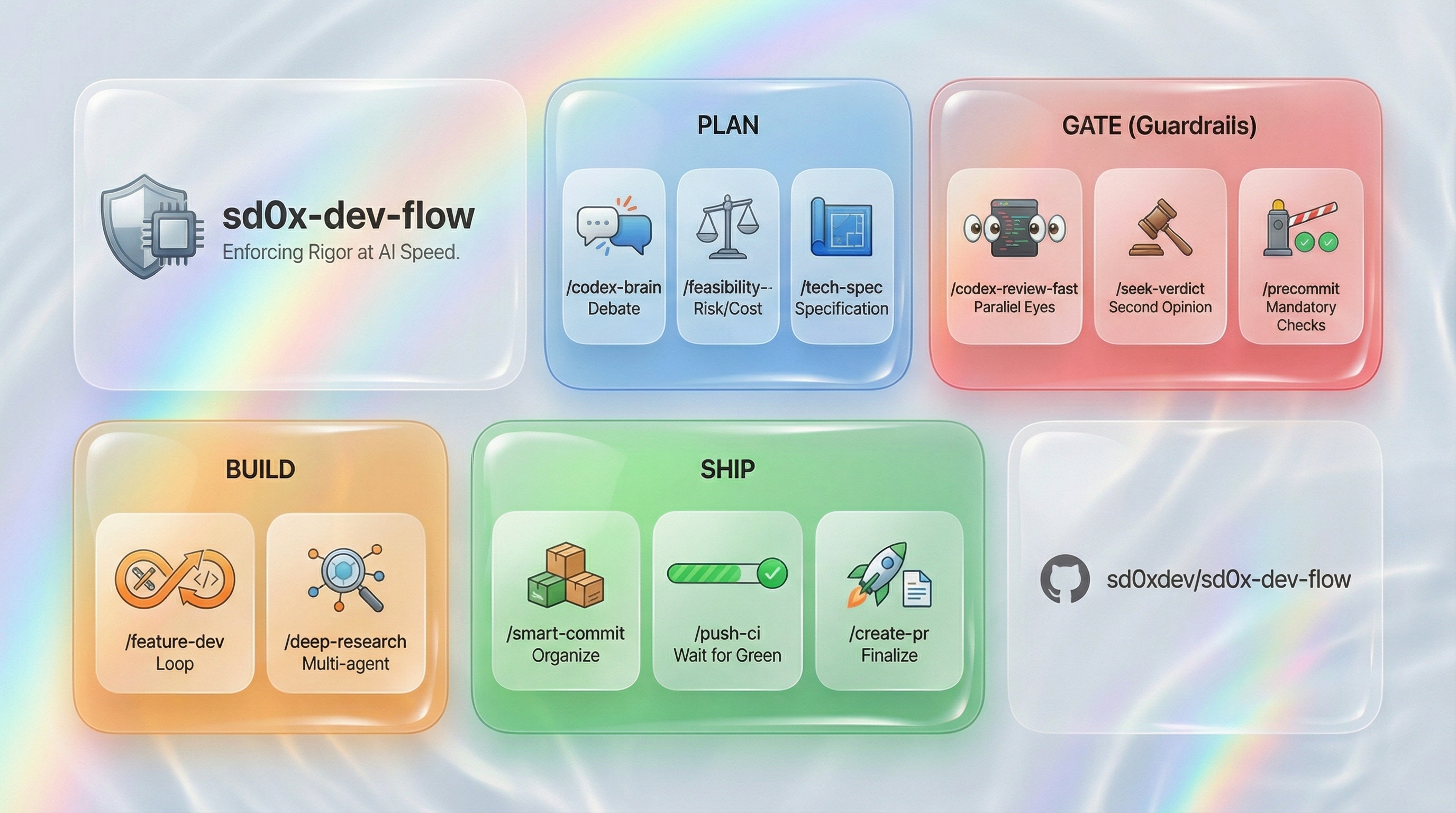
/adrWrite an Architecture Decision Record (ADR) for a feature — Context / Decision / Status / Consequences / Alternatives, filed as docs/features/<feature>/adr-<NNN>-<title>.md with a 3-digit zero-padded number. Handles the Superseded case: bidirectional linking when a new ADR/architectureArchitecture design and documentation. Produces 3-architecture.md with component diagrams, data flow, integration points, and architecture decisions. Reads existing tech-spec as input. Use when: designing system architecture, documenting component interactions, creating/askContext-aware Q&A with auto context gathering. Use when: user has a quick question about codebase, git history, rules, docs, or skills during development. Not for: code changes (use feature-dev), code review (use codex-review-fast), deep research (use deep-research), full code
- /best-practices
- /bug-fix
- /bump-version
- /check-coverage
- /claude-health
- /code-explore
- /code-investigate
- /codex-architect
- /codex-brainstorm
- /codex-cli-review
- /codex-code-review
- /codex-explain
- /codex-implement
- /codex-review-branch
- /codex-review-doc
- /codex-review-fast
- /codex-review
- /codex-security
- /codex-setup
- /codex-test-gen
- /codex-test-review
- /contract-decode
- /create-pr
- /create-request
- /de-ai-flavor
- /debug
- /deep-analyze
- /deep-explore
- /deep-research
- /dep-audit
- /dev-security-audit
- /doc-refactor
- /doc-review
- /epic-merge
- /feasibility-study
- /feature-dev
- /feature-verify
- /fp-brief
- /generate-runner
- /git-investigate
- /git-profile
- /install-hooks
- /install-rules
- /install-scripts
- /issue-analyze
- /jira
- /load-pr-review
- /merge-prep
- /necessity-audit
- /next-step
- /obsidian-cli
- /op-session
- /orchestrate
- /plan-review
- /portfolio
- /post-dev-recap
- /post-dev-test
- /pr-comment
- /pr-review
- /pr-summary
- /pre-pr-audit
- /precommit-fast
- /precommit
- /project-audit
- /project-brief
- /project-setup
- /push-ci
- /recap-ask
- /recap-doc
- /refactor
- /remind
- /repo-intake
- /req-analyze
- /request-tracking
- /review-spec
- /risk-assess
- /runbook
- /safe-remove
- /security-review
- /seek-verdict
- /sharingan
- /simplify
- /skill-health-check
- /smart-commit
- /smart-rebase
- /statusline-config
- /tech-brief
- /tech-spec
- /test-deep
- /test-health
- /test-review
- /ui-first-principles
- /update-docs
- /verify
- /watch-ci
- /zh-tw
Agent(16 agents)
architecture-designerArchitecture design expert. Synthesizes code analysis, tech-spec context, and architecture advice into structured architecture documents with component diagrams, data flows, and architecture decisions.brief-writerPM/CTO executive summary expert. Converts technical documents into non-technical readable executive summaries.code-simplifierCleanup refactoring expert. Simplifies code, eliminates duplication, preserves behavior.
Badges
README
sd0x-dev-flow
Language: English | 繁體中文 | 简体中文 | 日本語 | 한국어 | Español
The harness layer for Claude Code.
Let the model choose the path. Keep "done" verifiable.
v4 gives Claude discretion inside a closed, test-pinned anchor set; hooks are digest-bound reminders that survive compaction, and Codex reviews independently.
Full control plane on Claude Code. Skills-only distribution for Codex CLI and other compatible agents.
99 bundled · 99 public skills · 16 agents — ~4% of Claude's context window


Quick Start
# Claude Code — full control plane
/plugin marketplace add sd0xdev/sd0x-harness
/plugin install sd0x-dev-flow@sd0xdev-marketplace

# Configure your project
/project-setup
One command auto-detects framework, package manager, database, entrypoints, and scripts. Installs a subset of rules and hooks; the full plugin bundles 16 rules + 6 hooks. Use --lite to only configure CLAUDE.md (skip rules/hooks).
# Codex CLI / Cursor / Windsurf / Aider — skills only
npx skills add sd0xdev/sd0x-harness
Then, inside Codex CLI, generate the AGENTS.md kernel and install the commit-msg hook. The pre-push gate is opt-in — add --with-push-gate to install it too:
$codex-setup init
| Method | Tools | Coverage |
|---|---|---|
| Plugin install | Claude Code | Full (99 bundled skills, hooks, rules, auto-loop) |
npx skills add | Codex CLI, Cursor, Windsurf, Aider | Skills only (99 public skills) |
$codex-setup init | Codex CLI | AGENTS.md kernel + commit-msg hook (pre-push gate opt-in) |
Requirements: Claude Code 2.1+ | Node.js 18+ | jq (pre-edit-guard and post-edit-format parse their hook payload with it — without jq both exit 0, so the sensitive-path guard and auto-formatting are silently off) | Codex CLI (optional to install the plugin; the default reviewer for the /codex-* review gates — on codex_fail — the adapter's start or resume exiting 1, and nothing else — the gate is carried by a contract-aware fallback reviewer under the same mechanism, fail-closed per family contract with [REVIEWER_FALLBACK] recorded; a missing adapter, a configuration error, an unfinished run, or an alloc/cleanup failure dispatches no fallback, records no marker and leaves the gate open, and only when every carrier is exhausted does the review surface ⚠️ Need Human instead of a verdict)
Codex exec setup
The review loop talks to Codex through codex exec, driven by a small adapter. There is no MCP
server to register: this plugin no longer dispatches through codex mcp-server.
1. In a shell — install the Codex CLI (>= 0.149.0) and sign in:
codex --version
2. In Claude Code — install the transport adapter into this project. This is a slash command, not a shell command; typed into a terminal it would try to run an absolute path:
/sd0x-dev-flow:install-scripts codex-exec.js
Step 2 is optional: the first review that needs the adapter auto-installs it, using the same
three-level lookup precommit-fast uses for its runner. Run it explicitly when you would rather the
install not happen inside a review.
Model and reasoning effort now live in a Codex profile, not on a registration command. Name one
in rules/auto-loop-project.md:
## Codex Profile

review
That name resolves to $CODEX_HOME/<name>.config.toml — the profile-v2 form codex exec -p layers
on top of your base user config (codex exec --help: "Layer $CODEX_HOME/<name>.config.toml on top
of the base user config"). So a review profile holding model_reasoning_effort = "high" gives the
review loop the depth the old -c override gave it, and leaves your interactive Codex sessions
alone. Leaving ## Codex Profile empty is fine: the adapter then passes no -p and Codex uses its
own default configuration.
The adapter pins the sandbox and the approval policy itself for every dispatch, so neither is a
setup decision — see skills/codex-code-review/references/codex-transport.md for the full contract.
Why v4
Frontier models can plan, batch, and recover from structured state — they no longer need the harness to dictate every next command. v4 moves from choreography to contracts: the harness stopped scripting the model's moves and started defining what must be true when the work is declared done, without relaxing a single safety or review anchor.
| Dimension | v3 (choreography) | v4 (contracts) |
|---|---|---|
| Hook role | Emit the next command to run | Print reminders + [AUTO_LOOP_STATE] facts — change class, per-plane verdict state |
| Completion | Scripted step sequence ("fix → immediately re-review") | Terminal completion invariant: every gate the change class requires has passed after the last edit |
| Rule force | Uniform — every rule reads as mandatory | Three tiers: Anchor (never), Default (deviate with a stated signal), Guidance (advisory) |
| Review depth | Maximum by default | Risk-scaled tiers (fast / standard / thorough); security and data integrity always escalate |
| Stall detected / round cap hit | Hand off to the human | First hit: structured self-diagnosis + one bounded adjustment, then resume — unless a human exit applies (security/data-integrity, architecture-level change, requirement ambiguity); the same change hitting the cap again after its diagnosis: always human |
The non-negotiable core lives in a closed Anchor Register (rules/discretion.md) that no project override can downgrade — resolution is Anchor-first, and a test suite fails by design if a Register entry is removed. Inside that boundary, ownership is explicit:
| Owner | Owns |
|---|---|
| Model | Batching, timing, review depth escalation, Default-tier deviations (stated, then keep working) |
| Harness | Digest-bound reminder state, git-level guards (commit-msg by default, pre-push opt-in), the closed anchor set |
| Human | Irreversible approvals (push, commit, merge) and the enumerated exit points |
The model owns the path. The harness owns the evidence and non-negotiable boundaries. The human retains irreversible authority.
What's New in 4.4
If you notice review quality drop after upgrading to 4.4.0 — real defects slipping through, or reviews converging too eagerly — please open an issue. This release changes review judgment, and field reports are the only way to validate it.
The plain-language version: the auto-loop used to let reviews dig ever deeper — a reviewer would flag a weak test, the fix added a stronger guard, the next round attacked that guard, and so on. We measured a real case: 9 review rounds where 7 of 8 blocking findings were about the test guards' own strength, and none were about the delivered change. 4.4 draws a line: once a property is demonstrated in both directions on its real path, further hardening of that property is non-blocking unless an AC or security invariant requires it.
| What changed | Before | After |
|---|---|---|
| Where assurance stops | A guard could always be asked to guard the guard | A refusing test proves both directions on the actual path — that representative proof is the boundary; deeper hardening is a non-blocking Nit unless an AC or security invariant demands it |
| The "Prevention" field | Read as "every fix must add another guard artifact" — the seed of the spiral | An explanation of which existing control catches the class; usually the regression test the fix already ships |
| Review dispatch | Re-dispatches could accumulate "attack X next" directions, anchoring reviewers deeper each round | A fixed three-part contract: frozen task (task, baseline, ACs, user-supplied focus), current facts, fixed review contract — attack lists are a prohibited pattern |
| Reviewer framing | "Focus on finding issues" | "Focus on material defects" — plus an assurance boundary and a boundary check replacing the open-ended gap check |
| Design thinking | Left to review, after the code exists | Nudged at write time: when the shape is non-obvious, name the simplest design chosen and why — questions, not quotas |
Why we believe this is right (and why we still want your reports): IFScale measures model-specific adherence degradation as instruction density rises from 10 to 500 simultaneous instructions; context-rot research finds longer contexts and topically related distractors reduce reliability; and Vercel's agent evals found an always-present documentation index scored 100% where a skill with explicit trigger instructions scored 79% — instruction load and unclear contracts have measurable costs. The auto-loop core is untouched: the terminal completion invariant, edit-reopens-gate, sub-threshold discipline, stall diagnosis, and every safety anchor remain exactly as they were.
What This Harness Does
Harness engineering is the discipline of engineering everything around the LLM — tool loops, context management, hooks, state machines, safety layers — as opposed to training the model itself. Mitchell Hashimoto coined the term in Feb 2026; Anthropic engineering and Martin Fowler have published on it; arXiv 2603.05344 formalizes it.
sd0x-dev-flow is a reference implementation. Each row below maps a canonical harness sub-problem to concrete code you can study:
| # | Harness sub-problem | sd0x-dev-flow implementation | Code evidence |
|---|---|---|---|
| 1 | Tool loop control | Terminal completion invariant — every gate a change class requires must pass after the last edit; the model chooses when and how to run them | rules/auto-loop.md + scripts/review-state.js |
| 2 | Digest-bound reminder state | Verdicts are noted by the model (node scripts/review-state.js note <plane> <pass|fail>) and bound to the tree digest — an edit re-opens its plane's reminder because the digest changed; gate sentinels (✅ Ready / ## Overall: ✅ PASS) stay behaviour-layer signals | scripts/review-state.js + rules/auto-loop.md (§ Gate Sentinels, § Enforcement) |
| 3 | Context recovery across compaction | Git baseline (branch + uncommitted files) and owed-gate reminders re-injected after SessionStart(compact) | hooks/post-compact-auto-loop.sh |
| 4 | Lifecycle interceptors | 5 hook event types dispatched to 6 scripts — 4 advisory reminder hooks, an auto-formatter, and one blocking security guard (SessionStart additionally runs scripts/namespace-hint.sh): PreToolUse / PostToolUse / Stop / SessionStart / UserPromptSubmit | hooks/ (6 scripts) + .claude/settings.json |
File tree
FAQ
sd0x-dev-flow is a Claude Code plugin with 99 hand-picked skills for development work, indexed on Flowy. Install it with the command on its page. It includes adr, architecture, ask. Its skills do not fire on their own yet. Request auto-invocation to have Flowy route them as you prompt. Free and open source.
- What is sd0x-dev-flow?
- Language: English | 繁體中文 | 简体中文 | 日本語 | 한국어 | Español The harness layer for Claude Code. Let the model choose the path. Keep "done" verifiable. Full control plane on Claude Code. Skills-only distribution for Codex CLI and other compatible agents.
- How do I install sd0x-dev-flow?
- Run these in Claude Code: /plugin marketplace add sd0xdev/sd0x-dev-flow then /plugin install sd0x-dev-flow@sd0xdev-marketplace. Then prompt normally.
- Does sd0x-dev-flow auto-invoke its skills?
- Not yet. It is indexed on Flowy as a plain plugin. Request auto-invocation on its page and Flowy will route its skills for you as you prompt.
- Is sd0x-dev-flow free?
- Yes. Flowy is free and open source, with nothing gated. You can read every skill in full before you install.
Is this plugin yours?
Claim it with GitHubSubmit a pluginPromote it