
Plugin
Agent Orchestration
Plugin
navigator
Finish What You Start Sessions that last. AI that learns. Features that ship.
Plugin Signal81/100Strong
maintained99
capable76
documented75
adopted54
Install
$ npx -y skills add qf-studio/navigator --agent claude-code
Stats
354
Stars
20
Forks
Active
Maintenance
Python
Language
MIT
License
1d ago
Last commit
1y ago
Created
1h ago
Added
In this plugin
- skills
- backend-endpoint
- backend-test
- database-migration
- frontend-component
- frontend-test
- nav-brief
- nav-compact
- nav-deep-research
- nav-diagnose
- nav-features
- nav-graph
- nav-init
- nav-loop
- nav-marker
- nav-onboard
- nav-pilot
- nav-profile
- nav-release
- nav-simplify
- nav-skill-creator
- nav-sop
- nav-start
- nav-stats
- nav-sync-claude
- nav-task
- nav-triz
- nav-upgrade
- nav-workflow
- plugin-slash-command
- product-design
- visual-regression
- agents
What's inside
Skill(31 skills)
/backend-endpointCreate REST/GraphQL API endpoint with validation, error handling, and tests. Auto-invoke when user says "add endpoint", "create API", "new route", or "add route"./backend-testGenerate backend tests (unit, integration, mocks) for existing code. Auto-invoke when user says "write test for", "add test", "test this", or "create test"./database-migrationCreate database migration with schema changes and rollback. Auto-invoke when user says "create migration", "add table", "modify schema", or "change database".
- /frontend-component
- /frontend-test
- /nav-brief
- /nav-compact
- /nav-deep-research
- /nav-diagnose
- /nav-features
- /nav-graph
- /nav-init
- /nav-loop
- /nav-marker
- /nav-onboard
- /nav-pilot
- /nav-profile
- /nav-release
- /nav-simplify
- /nav-skill-creator
- /nav-sop
- /nav-start
- /nav-stats
- /nav-sync-claude
- /nav-task
- /nav-triz
- /nav-upgrade
- /nav-workflow
- /plugin-slash-command
- /product-design
- /visual-regression
Agent(6 agents)
deep-research-criticAdversarial reader of a nav-deep-research draft. Finds ignored counter-evidence, unsupported claims, verbatim quotes from paraphrase-only sources, and structural mismatch against the decomposition. Writes a findings JSON the patcher applies; cannot edit the report. Spawned oncedeep-research-fetcherFetches one disjoint batch of URLs into a nav-deep-research run as fenced source notes. Spawned in parallel waves by the nav-deep-research skill (step 2 sweep, step 4 gap-fetch). Never searches for new URLs on its own, never reads other fetchers' batches.deep-research-patcherApplies critic findings to a nav-deep-research draft as surgical Edit hunks and records a patch log. Tool-locked so it cannot regenerate the report. Spawned once at step 5 by the nav-deep-research skill.
Hook(1 hook)
README
Navigator
Finish What You Start
Sessions that last. AI that learns. Features that ship.


What is Navigator?
Navigator is a Claude Code plugin that implements context engineering for AI-assisted development.
Instead of loading all your documentation upfront (and crashing at exchange 7), Navigator loads what you need, when you need it—keeping 94% of your context window available for actual work.
For developers using Claude Code who want sessions that finish features instead of crash mid-way.
The Loop You're Stuck In
You know the pattern:
Exchange 5:  Claude forgets your recent changes
Exchange 7:  Hallucinations start ("that function doesn't exist")
Exchange 8:  "Context limit reached"

Restart. Reload. Re-explain everything. Repeat.
You loaded 150k tokens of documentation "just in case."
You used 8k.
The rest? Noise drowning out signal.
Break The Loop
Navigator implements context engineering—load what you need, when you need it.
| Metric | Without Navigator | With Navigator |
|---|---|---|
| Tokens loaded | 150,000 | 12,000 |
| Session length | 5-7 exchanges | 20+ exchanges |
| Context at end | 95% (crashed) | 35% (comfortable) |
| Token savings | — | 92% |
Result: Sessions that actually finish what they start.
And Your AI Gets Smarter
Navigator v5.0 adds Theory of Mind—Claude learns you.
nav-profile: Remembers your preferences across sessions
"Remember I prefer concise explanations"
→ Applied in future sessions
→ Auto-learns from corrections
nav-diagnose: Catches collaboration drift
Same correction twice → Quality check triggered
"You're not getting this" → Re-anchoring prompt
Loop Mode (v5.1): Run until done
"Run until done: add user authentication"
→ Structured completion with progress tracking
→ Dual-condition exit (heuristics + explicit signal)
→ Stagnation detection prevents infinite loops
Knowledge Graph (v6.0): Project memory that persists
"What do we know about auth?"
→ Unified search across tasks, SOPs, system docs
→ Experiential memory: patterns, pitfalls, decisions
→ Auto-surfaces relevant context on session start
Reply modes (v7.9): the reply shaped for you, switched by a sentence
"adhd mode on"
→ One next action first, bullets over prose, lists capped at five
→ Follows you across repos; "adhd mode off" ends it
→ STE mode (one idea per sentence, active voice) ships in v8.3.0
See Where You Are
Since v8 the workflow is enforced by a runtime that runs inside Claude Code, not by prose in a config file. It gates task-shaped prompts, guards fan-out reads, records what each turn finished, and writes one line to a reject log every time it says no. It also draws.
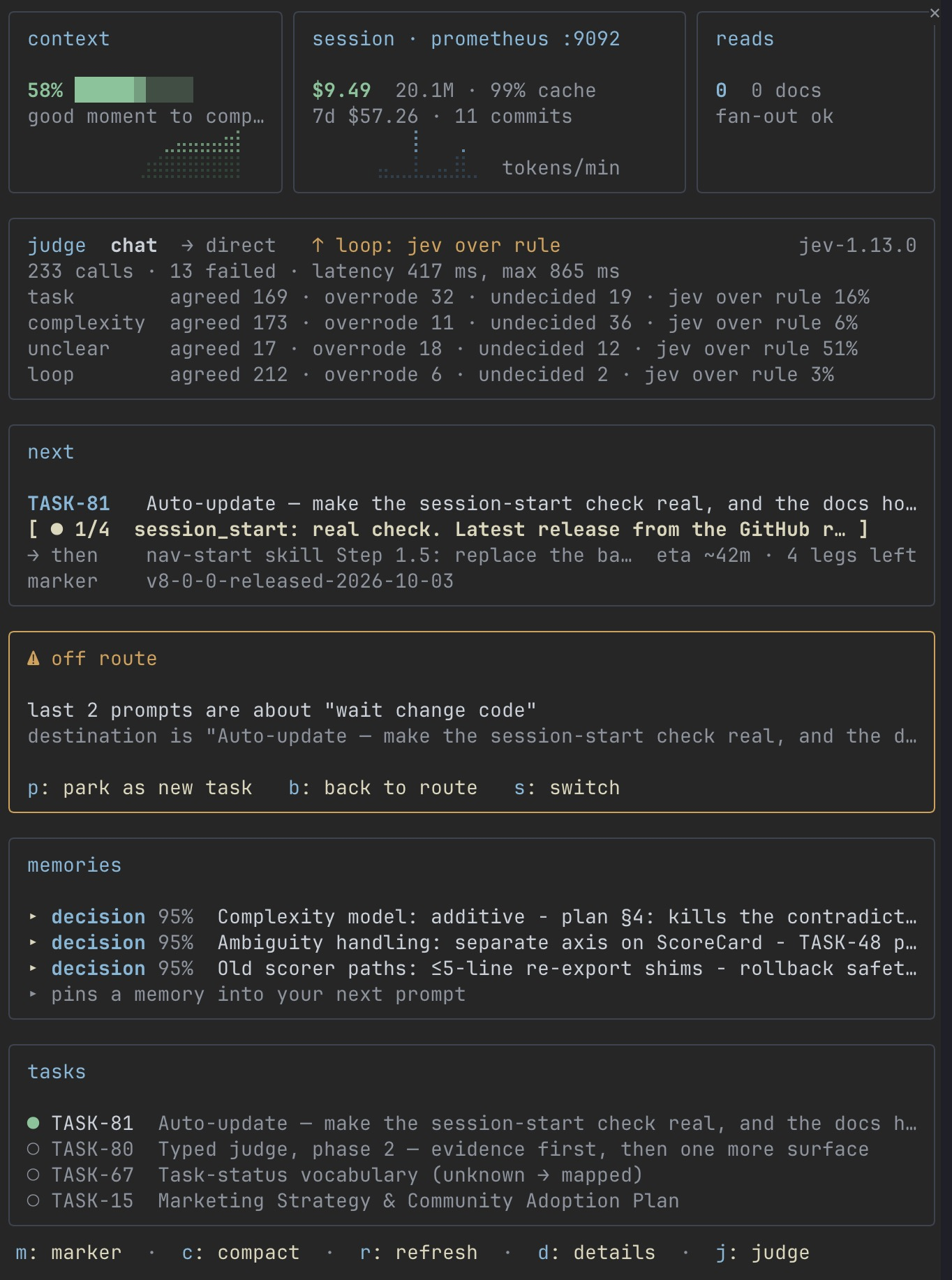
Type /nav and a pane opens beside your session:
| Card | What it tells you |
|---|---|
| context | Fill percentage, trend, and whether this is a good moment to compact |
| session | Today's cost, tokens, cache hit rate, tokens/min |
| reads | Fan-out verdict and today's reject count |
| judge | What the typed judge decided about your last prompt, and what Navigator did |
| next | The current leg of the active task as a button that submits it, with an ETA |
| memories | Knowledge-graph memories for the open task; pin one into your next prompt |
A one-line status band above the prompt shows the phase, context fill and next action without opening the pane. Requires Claude Code 2.1.287 or newer; older versions run the same behaviors through the Python fallback, without the pane.
Same Workflows. More Capabilities.
Navigator is a superset. Everything you'd expect, plus context engineering.
| Feature | Navigator | Others |
|---|---|---|
| Structured workflows | ✅ Full skill suite | ✅ |
| Component generation | ✅ | ✅ |
| Test generation | ✅ | ✅ |
| Session longevity | 20+ exchanges | 5-7 exchanges |
| Token savings | 92% verified | None |
| Code simplification | ✅ | ❌ |
| Task Mode | ✅ | ❌ |
| Theory of Mind | ✅ | ❌ |
| Knowledge Graph | ✅ | ❌ |
| TRIZ divergent solving | ✅ | ❌ |
| Web deep research (cited, gate-checked) | ✅ | ❌ |
| Loop mode | ✅ | ❌ |
| Runtime-enforced workflow (in-process mod + Python fallback) | ✅ | ❌ |
Live /nav pane and status band | ✅ | ❌ |
| Reject log (every refusal, one JSON line) | ✅ | ❌ |
| Reply modes (ADHD, STE) | ✅ | ❌ |
| OpenTelemetry metrics | ✅ | ❌ |
| Figma MCP integration | ✅ | ❌ |
Same foundation. Superior context management.
Proof, Not Promises
Not estimates. Verified via OpenTelemetry.
╔══════════════════════════════════════════════════════╗
║          NAVIGATOR EFFICIENCY REPORT                 ║
╚══════════════════════════════════════════════════════╝

📊 TOKEN USAGE
━━━━━━━━━━━━━━━━━━━━━━━━━━━━━━━━━━━━━━━━━━━━━━━━━━━━
Your project documentation:     150,000 tokens
Loaded this session:             12,000 tokens
Tokens saved:                   138,000 tokens (92% ↓)

📈 SESSION METRICS
━━━━━━━━━━━━━━━━━━━━━━━━━━━━━━━━━━━━━━━━━━━━━━━━━━━━
Context usage:                        35% (excellent)
Efficiency score:                  94/100 (excellent)
Check yours: type /nav for the live pane, or say "show my stats".
Quick Start
Install
# Claude Code plugin marketplace
/plugin marketplace add qf-studio/navigator
/plugin install navigator

# Restart Claude Code (2.1.287+ for the in-process runtime and the /nav pane)
Code intelligence (optional). Install a language-server plugin for your stack
(/plugin install pyright-lsp@claude-plugins-official, typescript-lsp, gopls-lsp, …;
the server binary must be on your PATH) and the research agent answers symbol questions
with go-to-definition, references and outlines instead of text search. Without one it
uses Grep exactly as before. Measured on this repo: a who-calls question went from 9
requests and 284k context tokens to 5 requests and 142k, with the complete call-site list.
Initialize
"Initialize Navigator in this project"
Start Every Session
"Start my Navigator session"
That's it. Navigator handles the rest.
Optional: Typed Prompt Judge
Navigator's loop-trigger, complexity and ambiguity detectors are keyword matchers. With a TypeSafe key they get a typed judge behind them (v7.7.0): one request per prompt, decisive answers override, everything else falls back to the keywords. Measured on 60 labeled prompts, tier accuracy went from 38 to 53. Off by default because the prompt text is sent to the API.
export TYPESAFE_API_KEY=... # or: write it to ~/.config/typesafe/api_key (chmod 600)
Then say enable judge and verify with python3 hooks/nav_hook_lib/judge.py --check
from the plugin root. Setup and tuning: .agent/sops/integrations/typesafe-judge-setup.md.
What You Get
Skills that auto-invoke on natural language:
"Start my Navigator session"              → Session with 92% savings
"Create a React component for profile"    → Component + tests + styles
"Add an API endpoint for posts"           → Endpoint + validation + tests
"Create context marker: checkpoint"       → 97% context compression
"Run until done: add dark mode"           → Loop mode completion
"Deep research on WebGPU browser support"  → Cited report + graph memories
"Enable judge"                             → Typed Jev judgments behind the prompt gates
"adhd mode on"                             → Replies shaped for you, across repos
/nav                                       → Live pane: context, cost, rejects, next leg
No commands to memorize. Skills detect intent and execute.
Stop Restarting. Start Shipping.
Your sessions crash because context management is broken by default.
Navigator fixes this with context engineering—the same principles Anthropic recommends.
92% token savings. 20+ exchange sessions. Verified metrics.
/plugin marketplace add qf-studio/navigator
/plugin install navigator
Finish what you start.
Troubleshooting
Skill loads but prints docs instead of executing, or /nav is missing
claude plugin update navigator@navigator-marketplace
Then restart Claude Code. Outdated plugin version, or the pane needs 2.1.287+.
Links
- Docs site — guides, configuration, the
/navpane - Documentation index
- Philosophy
- Release Notes
- GitHub
- QuantFlow Studio — the studio behind Navigator and Pilot
License
MIT License - See LICENSE
File tree
More plugins by @qf-studio.
 View @qf-studio’s profile
FAQ
navigator is a Claude Code plugin with 31 hand-picked skills, indexed on Flowy in the Agent Orchestration category. Install it with the command on its page. It includes backend-endpoint, backend-test, database-migration. Its skills do not fire on their own yet. Request auto-invocation to have Flowy route them as you prompt. Free and open source.
- What is navigator?
- Finish What You Start Sessions that last. AI that learns. Features that ship.
- How do I install navigator?
- Run these in Claude Code: npx -y skills add qf-studio/navigator --agent claude-code. Then prompt normally.
- Does navigator auto-invoke its skills?
- Not yet. It is indexed on Flowy as a plain plugin. Request auto-invocation on its page and Flowy will route its skills for you as you prompt.
- Is navigator free?
- Yes. Flowy is free and open source, with nothing gated. You can read every skill in full before you install.
Is this plugin yours?
Claim it with GitHubSubmit a pluginPromote it