

Plugin
AI & Agents
Plugin
model-message-stream-protocol
Integrate every model the same way, and keep one API in your head instead of one per provider.
Plugin Signal69/100Solid
maintained100
capable23
documented100
adopted44
Install
$ npx -y skills add Prism-Shadow/model-message-stream-protocol --agent claude-code
Stats
115
Stars
13
Forks
Active
Maintenance
TypeScript
Language
Apache-2.0
License
3h ago
Last commit
9mo ago
Created
4h ago
Added
What's inside
Skill(2 skills)
/mmsp-pythonGuidance for using the MMSP Python SDK (`mmsp`). Use when developing agents that call different LLM APIs, need a unified interface for LLM providers, mention MMSP, request `mmsp`, or already import it./mmsp-typescriptGuidance for using the MMSP TypeScript SDK (`@prismshadow/mmsp`). Use when developing agents that call different LLM APIs, need a unified interface for LLM providers, mention MMSP, request `@prismshadow/mmsp`, or already import it.
Badges




README
MMSP - Model Message Stream Protocol
Integrate every model the same way, and keep one API in your head instead of one per provider.
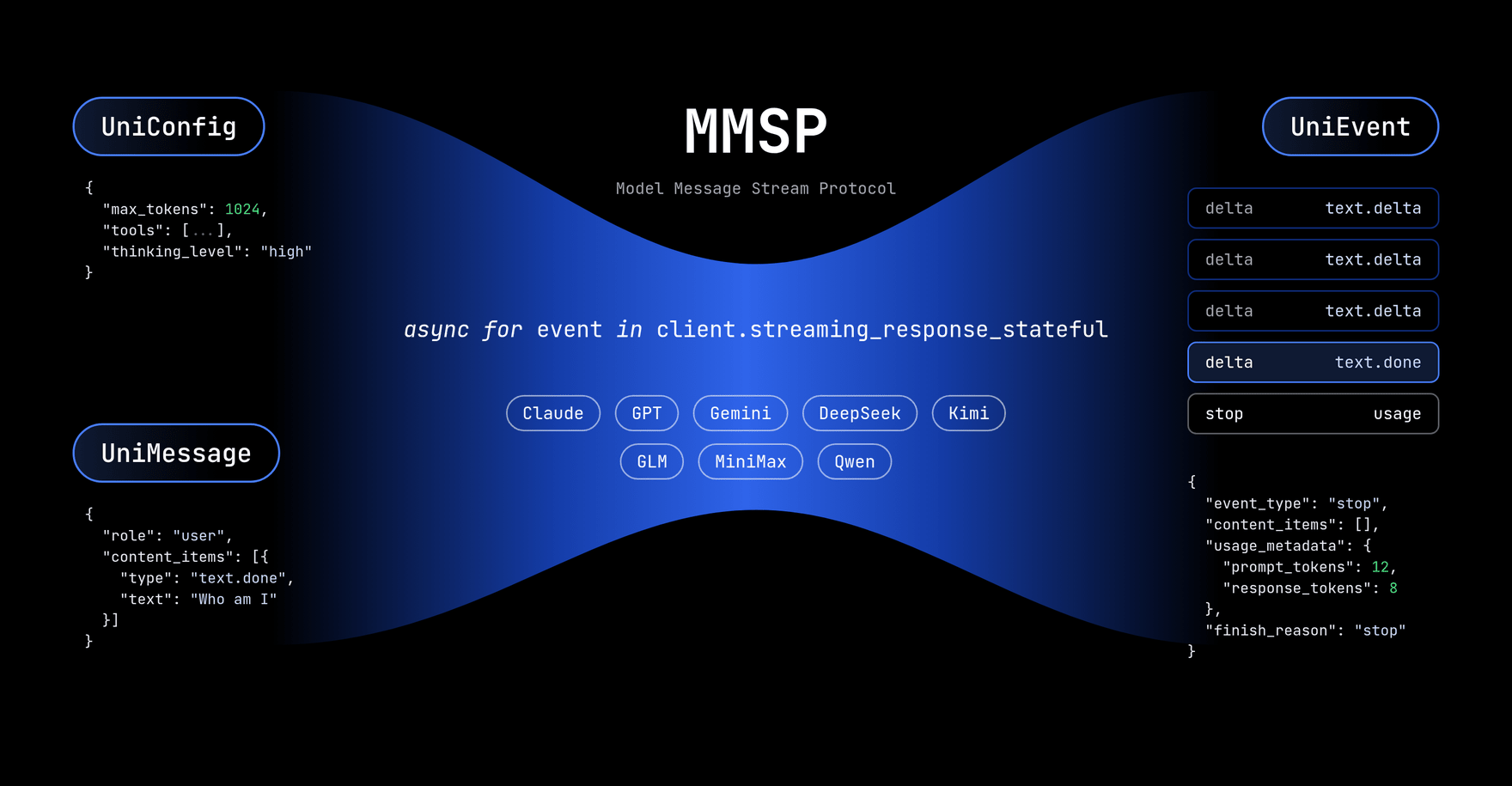
MMSP, the Model Message Stream Protocol, takes the per-provider differences off a developer's mind: one message format and one streaming grammar for every model provider, in Python and TypeScript.
📖 Documentation: mmsp.penguin.ooo
Design: the rules MMSP keeps and the decisions that changed it, one RFC each, live in design/.
Using a coding agent? Install the MMSP SKILL files from skills/ so it can use MMSP correctly in generated code.
📢 Follow us on 
Why MMSP?
-
🔗 Unified: A consistent and intuitive interface for developing agents across different LLMs.
-
🎯 Precise: Automatically handles interleaved thinking during multi-step tool calls, preventing performance degradation.
-
🧭 Traceable: Provides lightweight yet fine-grained tracing for debugging and auditing LLM executions.
Features
AutoLLMClient (Python & TypeScript)
Switch different LLMs with zero code changes and no performance loss.
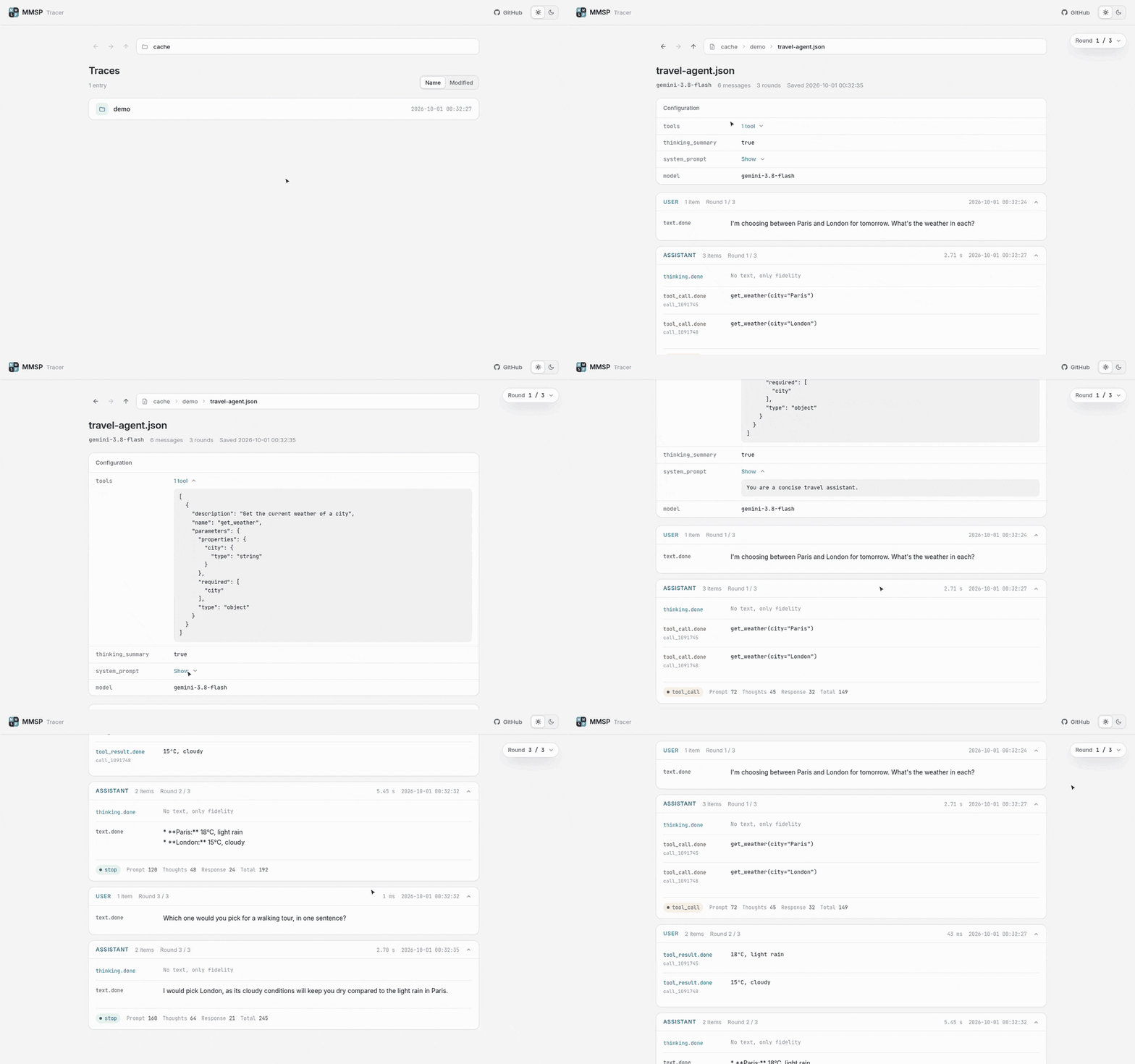
Built-in Observability
Audit LLM executions by adding a single trace_id parameter, no database required.
Supported Models
| Model Name | Vendor | Example Model ID | Input Modalities | Output Modalities |
|---|---|---|---|---|
| Gemini 4 Argon | Official/Google Vertex AI | gemini-4-argon | Text, Image | Text |
| Gemini 3-3.8 | Official/Google Vertex AI | gemini-3.8-flash | Text, Image | Text, Image, Speech, Embedding |
| Claude 4.6-5.5 | Official/Amazon Bedrock/UModelVerse | claude-opus-5-5 | Text, Image | Text |
| GPT-5.4-6.1 | Official/OpenRouter/UModelVerse | gpt-6.1-sol | Text, Image | Text, Embedding |
| Kimi-K2.5/K2.6/K3 | Official/OpenRouter/SiliconFlow/TokenDance | kimi-k3 | Text, Image | Text |
| DeepSeek V4 | Official/OpenRouter/SiliconFlow/TokenDance | deepseek-flash | Text, Image | Text |
| GLM-5.1-5.3 | Official/OpenRouter/SiliconFlow/TokenDance | glm-5.3 | Text, Image | Text |
| MiniMax-M3/M3.1 | Official/OpenRouter/TokenDance | MiniMax-M3.1-Flash | Text, Image | Text |
| Qwen3.8 | OpenRouter/SiliconFlow/TokenDance/vLLM | qwen/qwen3.8-27b | Text, Image | Text, Embedding |
Clients
AutoLLMClient takes a model id and a client_type. An official client speaks its
vendor's own API, knows the vendor's models, and reads the vendor's key from the environment;
a compatible client speaks one wire protocol for any endpoint that serves it.
client_type | Speaks | Key and endpoint |
|---|---|---|
openai-official | OpenAI Responses; text-embedding-* models through OpenAI Embeddings | OPENAI_API_KEY, OPENAI_BASE_URL |
anthropic-official | Anthropic Messages | ANTHROPIC_API_KEY, ANTHROPIC_BASE_URL |
google-official | Gemini Interactions | GEMINI_API_KEY, GEMINI_BASE_URL |
zai-official | Z.AI Chat Completions | ZAI_API_KEY, ZAI_BASE_URL |
moonshot-official | Moonshot Chat Completions | MOONSHOT_API_KEY, MOONSHOT_BASE_URL |
deepseek-official | DeepSeek Responses | DEEPSEEK_API_KEY, DEEPSEEK_BASE_URL |
minimax-official | MiniMax Responses | MINIMAX_API_KEY, MINIMAX_BASE_URL |
openai-responses | OpenAI Responses, served by OpenAI, OpenRouter, DeepSeek, Z.AI, MiniMax | OPENAI_API_KEY, OPENAI_BASE_URL |
openai-chat (openai) | OpenAI Chat Completions, served by most gateways, SiliconFlow, vLLM | OPENAI_API_KEY, OPENAI_BASE_URL |
openai-chat-vllm-adapter | Chat Completions as vLLM serves it, mapping thinking_level onto the template's switches | VLLM_API_KEY, VLLM_BASE_URL |
openai-embedding | OpenAI Embeddings, served by any embedding endpoint | OPENAI_API_KEY, OPENAI_BASE_URL |
ant-messages | Anthropic Messages, served by Anthropic, OpenRouter, DeepSeek, Z.AI, MiniMax | ANTHROPIC_API_KEY, ANTHROPIC_BASE_URL |
google-genai | Google generateContent, served by Vertex AI, the Gemini API, and gateways that proxy it | GEMINI_API_KEY, GEMINI_BASE_URL |
mmsp | MMSP itself, served by an MMSP server | MMSP_API_KEY, MMSP_BASE_URL |
client_type may be omitted for a model id that begins with a known family: gpt- and
text-embedding- route to openai-official, claude- to anthropic-official, gemini- to
google-official, glm- to zai-official, kimi- to moonshot-official, deepseek- to
deepseek-official, minimax- to minimax-official. Any other id raises and asks for a
client_type. The CLIENT_TYPE environment variable names one for every client the code does
not.
Gemini on Google Vertex AI takes client_type="google-genai" and the service-account JSON key as
the API key: Vertex AI's Interactions endpoint, which google-official speaks, serves none of these
models.
Claude on Amazon Bedrock takes client_type="anthropic-official", base_url="bedrock://<region>"
and "ACCESS_KEY,SECRET_KEY" as the API key, with a Bedrock inference profile as the model id, such
as global.anthropic.claude-opus-5-5.
TokenDance serves Chat Completions, Responses and Embeddings at https://tokendance.space/gateway/v1
and Anthropic Messages at https://tokendance.space/gateway, all with one key.
Where a gateway serves more than one protocol, prefer "openai-responses": OpenRouter serves it
for every model it hosts, while SiliconFlow serves Chat Completions only.
The full machine-readable list — model, base URL, client, input/output modalities, context window, and per-million-token list pricing in USD or CNY:
from mmsp import list_supported_models

models = list_supported_models(currency="CNY")  # "USD" by default
import { listSupportedModels } from "@prismshadow/mmsp";

const models = listSupportedModels("CNY"); // "USD" by default
Installation
Python package
Install from PyPI:
uv add mmsp
# or
pip install mmsp
Build from source:
cd src_py && make
See src_py/README.md for comprehensive usage examples and API documentation.
TypeScript package
Install from npm:
npm install @prismshadow/mmsp
Build from source:
cd src_ts && make install && make build
See src_ts/README.md for comprehensive usage examples and API documentation.
Agent Skills
MMSP provides Codex/Claude Code skill files for assistants that need to help users consume the SDK packages:
- Python skill:
skills/mmsp-python/SKILL.md - TypeScript skill:
skills/mmsp-typescript/SKILL.md
APIs
AutoLLMClient is the main class for interacting with the MMSP SDK. It is constructed with model and client_type (see Clients; a model id of a known family names its official client on its own), plus optional api_key, base_url, and default_headers — headers sent with every request, for endpoints that demand their own. It provides the following methods:
A key goes only where it was given for. A key passed in is used, with the base_url passed in, else the client's <P>_BASE_URL (see Clients), else its default endpoint. Without a key, a client reads its <P>_API_KEY only when it is given no base_url or its own default endpoint: deepseek-official with no base_url or https://api.deepseek.com uses DEEPSEEK_API_KEY. Any other base_url without a key raises ApiKeyRequiredError at construction: pass the key with it, or drop it and set <P>_API_KEY, plus <P>_BASE_URL for an endpoint other than the default. Two clients are the exception, because their servers may take no key: mmsp and openai-chat-vllm-adapter call a base_url given without a key keyless, and their default endpoint too when <P>_API_KEY is unset (http://127.0.0.1:25752/v1, and http://127.0.0.1:8000/v1, where vllm serve answers); the vLLM adapter sends vLLM's placeholder key EMPTY. The rest of OpenAI's environment (OPENAI_ORG_ID, OPENAI_PROJECT_ID, OPENAI_ADMIN_KEY, OPENAI_WEBHOOK_SECRET and the headers OPENAI_CUSTOM_HEADERS lists) goes only where OPENAI_API_KEY goes: a client built on the OpenAI SDK sends none of it to a gateway, a vLLM server or another vendor's API. @prismshadow/mmsp/credentials and mmsp.credentials export the rule as data for hosts.
(async) streaming_response(messages, config): Streams the response of LLMs in a stateless manner.(async) streaming_response_stateful(message, config): Streams the response of LLMs in a stateful manner.(async) list_models(): Lists the model ids the configured endpoint serves. A protocol client (openai-chat,openai-chat-vllm-adapter,openai-responses,ant-messages,openai-embedding,google-genai,mmsp) is named explicitly and lists everything the endpoint serves; a client deduced from a model id lists only the ids that deduce back to it.clear_history(): Clears the history of the stateful LLM client.get_history(): Returns the history of the stateful LLM client.set_history(history): Replaces the history of the stateful LLM client with a copy of the provided list.
File tree
More plugins by @prism-shadow.
 View @prism-shadow’s profile
FAQ
model-message-stream-protocol is a Claude Code plugin with 2 hand-picked skills, indexed on Flowy in the AI & Agents category. Install it with the command on its page. It includes mmsp-python, mmsp-typescript. Its skills do not fire on their own yet. Request auto-invocation to have Flowy route them as you prompt. Free and open source.
- What is model-message-stream-protocol?
- Integrate every model the same way, and keep one API in your head instead of one per provider.
- How do I install model-message-stream-protocol?
- Run these in Claude Code: npx -y skills add Prism-Shadow/model-message-stream-protocol --agent claude-code. Then prompt normally.
- Does model-message-stream-protocol auto-invoke its skills?
- Not yet. It is indexed on Flowy as a plain plugin. Request auto-invocation on its page and Flowy will route its skills for you as you prompt.
- Is model-message-stream-protocol free?
- Yes. Flowy is free and open source, with nothing gated. You can read every skill in full before you install.
Is this plugin yours?
Claim it with GitHubSubmit a pluginPromote it