
Operations
Plugin
agentic-chatops
AI agents that triage infrastructure alerts, investigate root causes, and propose fixes — while a solo operator sleeps.

Plugin Signal76/100Solid
maintained99
capable67
documented75
adopted43
Install
$ npx -y skills add papadopouloskyriakos/agentic-chatops --agent claude-code
What's inside
Skill(20 skills)
/bootstrapMeta-skill chaining /specify → /constitute → /plan → /tasks → spec-validation → dispatch-ready. Greenfield project from idea to parallel-dev-ready in one flow. Halts with clear remediation if any phase fails the DoD gate./constitutePhase C of greenfield project bootstrap. Produce constitution.md (5-15 non-negotiable articles) + steering/*.md (cross-cutting agent-wide rules). Pauses for operator review before exit./planPhase D of greenfield project bootstrap. Produce design.md + data-model.md + contracts/{openapi,asyncapi,schemas/*} + adr/NNNN-*.md. Validates contracts via swagger-cli/asyncapi/ajv before exit.
Agent(4 agents)
architectProduce design + contracts (OpenAPI/AsyncAPI/JSON Schema) + ADRs for a greenfield feature. Wraps /plan. Use when the spec exists but design/contracts don't yet. Reads existing PROJECT.json, constitution.md, requirements.md as input.spec-authorInterview the operator and produce EARS-format requirements + PROJECT.md/.json + Gherkin acceptance scenarios. Iterates until ears-lint passes. Use this subagent when running /specify in a fresh context, especially for complex projects where the orchestrator's main context isspec-verifierRun validate-project-spec.py against a project and report gaps in human-readable form. Cheap (haiku model) read-only check. Use as Phase F gate before invoking project-onboard.sh.task-decomposerAtomize a designed feature into tasks.json with files_owned + dependencies + parallelizable + acceptance_test + risk_score per task. Wraps /tasks. Iterates until task-DAG + collision validators pass.
README
agentic-chatops
AI agents that triage infrastructure alerts, investigate root causes, and propose fixes — while a solo operator sleeps.
For the complete technical reference, see README.extensive.md.
The Problem
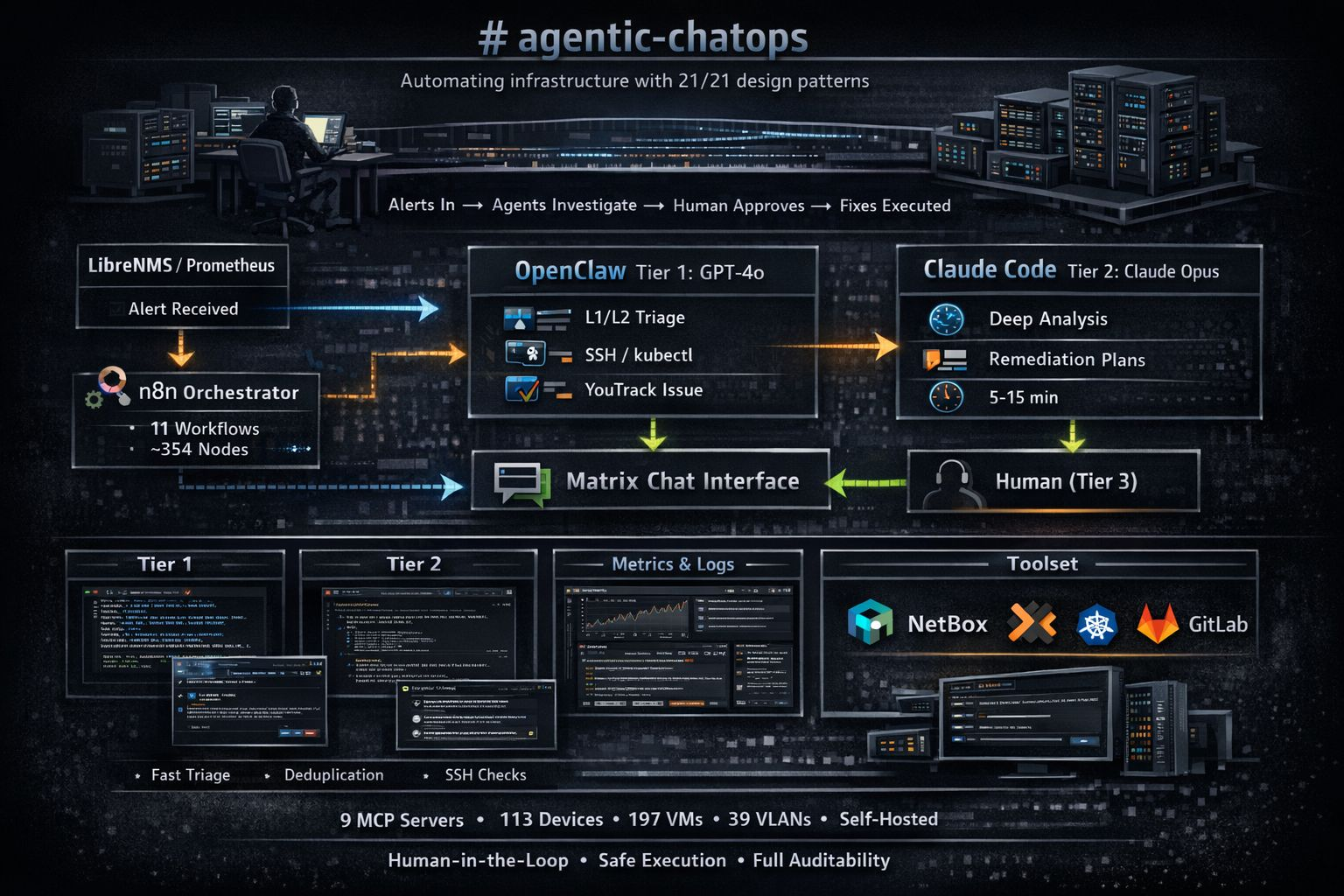
One person. 310+ infrastructure objects across 6 sites. 3 firewalls, 12 Kubernetes nodes, self-hosted everything. When an alert fires at 3am, there's no team to call. There never is.
The Solution
Three agentic subsystems that handle the detective work — ChatOps (infrastructure), ChatSecOps (security), ChatDevOps (CI/CD) — built on n8n orchestration, Matrix as the human interface, and a tiered agent architecture (deterministic triage scripts → Claude Code → human). The human stays in the loop for every infrastructure change: the system never acts without a thumbs-up or poll vote, and since 2026-06-09 a remediation proposal cannot even reach the approval poll without a machine-computed consequence prediction attached (see Infragraph below).
What Makes This Different
Self-Improving Prompts — now with A/B trials (nobody else does this)
The system evaluates its own performance and auto-patches its prompts. Every session is scored by an LLM-as-a-Judge on 5 quality dimensions (gemma3:12b local-first since 2026-04-19; max-effort calibration via gw-mistral-large on the shared LiteLLM). When a dimension averages below threshold over 30 days, the preference-iterating patcher (IFRNLLEI01PRD-645, 2026-04-20) generates 3 candidate instruction variants (concise / detailed / examples) and assigns each future matching session to one arm via deterministic BLAKE2b hash — plus a no-patch control. A daily cron runs a one-sided Welch t-test once every arm reaches 15 samples; the winner is promoted only if it beats control by ≥ 0.05 points with p < 0.1. Otherwise the trial is aborted. Prompt-level policy iteration — no model weights are ever fine-tuned.
Session → LLM Judge (5 dims) → dimension trending below threshold
  → prompt-patch-trial.py generates 3 candidate variants + 1 control
  → future sessions hash-routed to arms → Welch t-test at 15+ samples/arm
  → winner promoted to config/prompt-patches.json (source: "trial:N:idx=I")
  → next eval cycle scores the new patch → loop continues
Infragraph — a Causal World Model with a Non-Bypassable Prediction Gate (2026-06-09)
The system maintains a causal dependency graph of the entire infrastructure (361 nodes / 468 edges in the causal layer; 721 entities / 661 relationships in the combined GraphRAG+infragraph knowledge graph) seeded daily from five truth layers — live Proxmox cluster API (0.95 confidence), LibreNMS dependency parents (0.90), NetBox devices + physical cables (0.85–0.90), operator-declared edges, and a statistical incident-co-occurrence miner deliberately capped at 0.75 — with per-edge dynamics (expected alert cascades, propagation delays, recovery times) learned from 159 chaos experiments and the full triage history. This is a genuine model-free → model-based shift enforced in control flow, not data:
- Prediction is computed outside the LLM — deterministic graph traversal (
infragraph-query.py), called by the n8n orchestrator, never at the model's discretion. - Prediction is mandatory — the Runner commits a plan-hash-keyed prediction artifact before any approval poll; a remediation proposal without one is rewritten to
[POLL-WITHHELD:NO-PREDICTION]and demoted to analysis-only. The kill-switch (INFRAGRAPH_DISABLED=1) fails the remediation lane closed. - Verification is mechanical — after execution, code (never the LLM that proposed the action) diffs observed alerts against the prediction and writes a
match / partial / deviationverdict; deviation = surprise = never auto-resolve.
The eval is falsifiable by design: a degree-preserving shuffled-graph negative control runs alongside every prediction. The 2026-05-11 cascade backtest passed the criterion (control ratio 0.367 ≤ 0.5×) only after four honest iteration rounds, each driven by what the misses revealed. Suppression authority is granted per rule by the operator — the system proposes (control YouTrack issue with evidence table), the human approves, and closing the control issue instantly revokes. Runbook: docs/runbooks/infragraph.md.
Autonomy-Forward Gate — Human as Circuit-Breaker, not Gatekeeper (2026-06-16)
Most "human-in-the-loop" systems assume the human is watching. Ours measured that the operator had voted on almost none of the approval polls in the prior two months — so the loop was a dead-end: reversible work stalled on a 30-min pause and genuinely-critical work paged no one. The fix is a 3-band risk gate (classify-session-risk.py): reversible, Infragraph-prediction-backed changes auto-resolve; a tightly-scoped critical set (HIGH-risk, P0-host blast, irreversible, model deviation) is the only thing that pages the operator by SMS. The safety floor is mechanical and non-configurable, and the whole gate flips on/off with a single touch/rm of a sentinel file — no workflow edit, instant kill-switch. Runbook: docs/runbooks/risk-based-auto-approval.md.
Self-Verifying Reliability Layer — the system watches itself (2026-06-21)
The defining failure mode here was never a crash — it was months of silent darkness (the auto-resolve pipeline dead across 5 layers, scanners dark 5 weeks, an apiserver crash-looping 27 days) where nothing alerted because standard alerting treats no data as no problem. So the autonomy loop is now a continuously-verified subsystem:
- Control-plane dead-man's-switch —
gateway-watchdog.shemits a heartbeat every 5 min via atrap … EXIT; a Prometheus alert with anabsent()clause pages by SMS if the heartbeat goes stale or vanishes (node_exporter/host down). It watches the thing that watches the pipeline. - Synthetic-incident canary — a daily probe drives the real classify→predict spine end-to-end against an isolated throwaway DB, so it proves the spine is alive (3 stages + plan-hash coherence) while structurally being unable to pollute production, collide a real fail-closed gate, or trigger remediation. A tier-1 SMS fires if it ever leaks a row into the live DB.
- False-auto-resolve governance — the system measures its own root-cause discipline: a pattern it auto-resolved that recurs within 24h is a false-auto-resolve, and a repeat offender (≥3×/30d) is auto-demoted so the gate escalates it instead of auto-closing it again — automatically, reversibly (30-day expiry), with no human review (human-as-circuit-breaker, not gatekeeper). Intentionally-suppressed flappy alerts are excluded so it never re-introduces suppressed noise.
- Bi-temporal knowledge — infragraph edges and compiled-wiki facts carry a contradiction/supersession axis with time-since-confirmation decay (reporting-only — it flags edges for re-ratification, never silently changes a prediction).
- Self-learning scheduled-reboot suppression (2026-06-29) — hosts with a discovered and promoted reboot schedule (observe-≥2-boots-before-live, strict DST-correct cron windows) get their on-schedule reboot alerts suppressed before any session spawns, with a two-phase verify that reopens + pages if the boot wasn't a clean
systemd-reboot. Safety floor: critical-never, allowlisted rules only, sentinel kill-switch, fail-open. Runbook:docs/runbooks/scheduled-reboot-suppression.md.
Orchestrator Control-Plane — the system governs itself (2026-06-26)
The agentic federation grew to ~10 subsystems and 363 components (320 at the 2026-06-26 landing) — Cronicle jobs, 57 n8n workflows, hooks, and the RAG / infragraph / teacher / chaos subsystems — coordinated only by convention, a shared SQLite, and the Prometheus textfile bus. Nothing owned their liveness as a set, and a 2026-06-25 audit proved the cost: MemPalace hooks, the OTel span sink, the tool-call log, and even the self-audit itself had run dark for weeks-to-months, each invisible because standard alerting reads no data as no problem. The fix is a thin governing layer (IFRNLLEI01PRD-1421) — three bricks built on the existing Prometheus + SQLite substrate, no platform rewrite (the research explicitly rejected adopting LangGraph / Temporal / Airflow / Dagster / Backstage):
- Component Registry (
scripts/registry-check.py) auto-discovers all 363 components (199 cronicle-job + 77 prom-writer + 57 n8n-workflow + 28 db-table + 2 cron, as of 2026-07-08), each with a declared liveness expectation — 15 critical, 0 critical-dark, ~10 known-dark-by-design. The dark-component failure class is now caught mechanically (RegistryCriticalDark, tier-1 SMS) instead of by a manual quarterly sweep. - Interaction Graph (
scripts/interaction-graph.py) static-analyzes 313 scripts into a read/write asset graph (Dagster's model in ~250 lines): currently 0 GAPs (the Session-End → reconcile orphan-consumer hole that silently darkened 4 analytics tables is closed), 0 cron-clashes, and 23 multi-writer conflicts surfaced for review. - Orchestration Benchmark (
scripts/orchestration-benchmark.py) replays a synthetic incident stream through the isolated classify→predict spine and scores 4 orchestration invariants — score 1.0, 4/4, including safety-composition: an irreversible incident is never auto-resolved, verified across the whole stream rather than case-by-case (OrchestrationSafetyFailure, tier-1).
All five rules are live in-cluster (infra MRs !347 + !348), and a fault-injection drill proved the alerts actually fire, not merely evaluate. The control-plane monitors its own three bricks — the who-watches-the-watcher gap is fully closed.
Plane-A self-healing platform controller — the actuator half (2026-06-26). The bricks detect; a Kubernetes-style self-healing operator (scripts/platform-controller.py, */5, armed) acts — closing the loop the absent human left open. It heals only idempotent platform operations: reactivate an inactive critical n8n workflow (it monitors all 57), re-run a failed safe-list Cronicle job, restart Cronicle, plus a consolidated watchdog heal-library. Heals are rate-limited by exponential heal-backoff → CrashLoopBackOff → SMS escalation, exactly as a k8s controller would. Crucially it draws the same Plane-A / Plane-B line k8s does between keeping pods alive and deciding app logic: Plane-A keeps the platform alive (crons, Cronicle, bricks, writers, n8n); Plane-B is the mission (resize a VM, reboot a host, resolve an incident) — the controller NEVER touches B. That stays the autonomy-forward lane's job. It consolidated the standalone watchdog into one operator, and carries its own dead-man.
Cronicle scheduler — every job has run-history now (2026-06-26). All cron jobs (180 at migration: 107 gateway + 72 agora-quant; 199 registered as of 2026-07-08) migrated off raw crontab to a native Cronicle scheduler: per-job run history, per-job-death alerting (the gap a flat crontab can't see — a crontab line that silently stopped firing looks identical to one that never existed), a REST API the registry seeds from, and auto-quarantine of a repeatedly-failing job.
File tree
FAQ
agentic-chatops is a Claude Code plugin with 20 hand-picked skills, indexed on Flowy in the Operations category. Install it with the command on its page. It includes bootstrap, constitute, plan. Its skills do not fire on their own yet. Request auto-invocation to have Flowy route them as you prompt. Free and open source.
- What is agentic-chatops?
- AI agents that triage infrastructure alerts, investigate root causes, and propose fixes — while a solo operator sleeps. For the complete technical reference, see README.extensive.md.
- How do I install agentic-chatops?
- Run these in Claude Code: npx -y skills add papadopouloskyriakos/agentic-chatops --agent claude-code. Then prompt normally.
- Does agentic-chatops auto-invoke its skills?
- Not yet. It is indexed on Flowy as a plain plugin. Request auto-invocation on its page and Flowy will route its skills for you as you prompt.
- Is agentic-chatops free?
- Yes. Flowy is free and open source, with nothing gated. You can read every skill in full before you install.
Is this plugin yours?
Claim it with GitHubSubmit a pluginPromote it