
Development
Plugin
codex-claude-loop
A gated build loop between Claude Code and Codex CLI. Codex writes the plan, Claude approves it, Codex implements that same plan from the same thread, Claude reviews the diff against it.

Plugin Signal61/100Solid
maintained78
capable37
documented100
adopted18
Install on Claude Code
> /plugin marketplace add ozzaii/codex-claude-loop> /plugin install codex-claude-loop@codex-claude-loop
Stats
6
Stars
3
Forks
Maintained
Maintenance
Shell
Language
MIT
License
1mo ago
Last commit
2mo ago
Created
Repo: ozzaii/codex-claude-loop
What's inside
Skill(5 skills)
/codex-claude-loopUse when driving a gated build loop where Claude orchestrates and Codex CLI implements — Claude plans and judges, Codex plans/implements from a persistent thread, with approve-the-plan and review-the-diff gates that refuse to be skipped. For delegating serious multi-file work to/doctorCheck the codex-claude-loop substrate (codex CLI, jq, git, repo, verdict schema)/promptSend an additional request to the exact Codex session for an implemented codex-claude-loop lane, sequenced behind its writer lock
Badges

README
codex-claude-loop
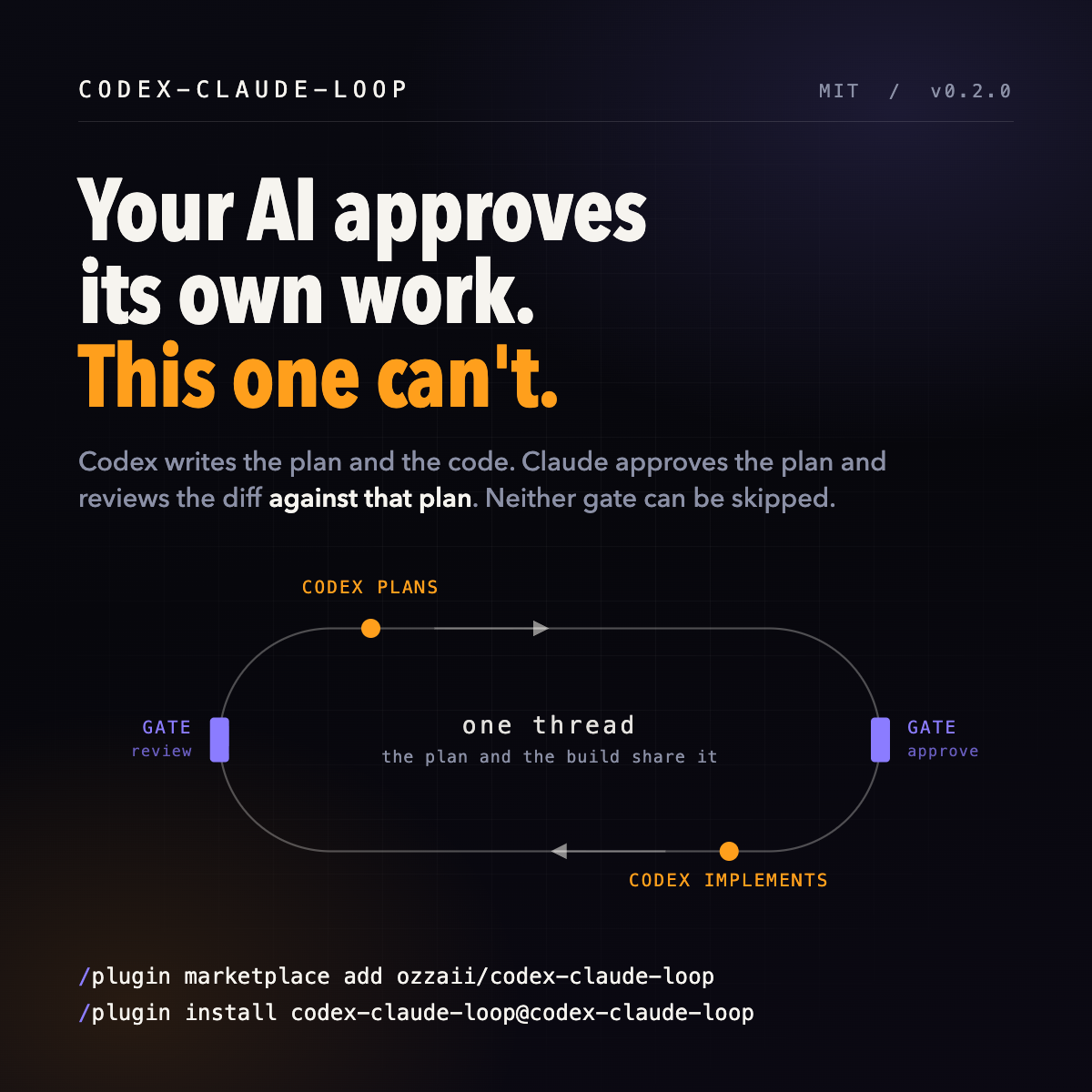
A gated build loop between Claude Code and Codex CLI. Codex writes the plan, Claude approves it, Codex implements that same plan from the same thread, Claude reviews the diff against it.
brief → codex plans → CLAUDE APPROVES → codex implements → CLAUDE REVIEWS → release
                          ▲ gate 1                              ▲ gate 2
                          cl_impl                               cl_release
                          refuses without it                    refuses without it
Both gates have a consumer, which is what makes them gates rather than notes: cl_impl
refuses to run unless the plan is approved and the plan file still hashes to what was
approved; cl_release refuses unless the review is approved and the tree still hashes
to what was reviewed.
Bash around codex exec. No MCP server, no daemon, no Python.
Install
In Claude Code (recommended, updates handled for you):
/plugin marketplace add ozzaii/codex-claude-loop
/plugin install codex-claude-loop@codex-claude-loop
Anywhere else (installs the skill into ~/.claude/skills/):
curl -fsSL https://raw.githubusercontent.com/ozzaii/codex-claude-loop/main/install.sh | sh
The installer runs doctor when it finishes, so you learn straight away whether your
Codex can drive the loop. Flags: --dir <path>, --ref <tag>, --uninstall.
You need Codex CLI (npm i -g @openai/codex
then codex login), plus jq and git.
Use
In Claude Code: /codex-claude-loop:wave <slug> <brief.md> walks the whole cycle and
stops at both gates for your judgment. /codex-claude-loop:status shows where every slug
stands. /codex-claude-loop:doctor checks the substrate, and says plainly that it never took a
turn, so a green doctor is not read as proof that quota and model availability are fine.
cl_status exits 3 when an implementation is standing with no review approval covering the
current tree, so a script can tell that work is waiting on a human.
From a shell:
source ~/.claude/skills/codex-claude-loop/lib/codex-claude-loop.sh

cl_doctor
cl_plan  auth-rl briefs/auth-rl.md         # codex writes the plan, thread stays open
#   read the plan. Try to refute it. Then:
cl_record_verdict auth-rl plan approve "contracts and migration order hold"
cl_impl  auth-rl                           # same thread implements it, holds the lock
cl_review_human auth-rl                    # adversarial review of the diff vs the plan
cl_revise auth-rl "1) bucket resets on deploy, persist it  2) …"
cl_record_verdict auth-rl review approve "blockers cleared, tests green"
cl_release auth-rl                         # refuses unless both gates hold right now
cl_status
cl_wave <slug> <brief.md> drives the same sequence one step at a time. It returns 3
when it is your turn (read the plan, review the diff) and 0 once both gates hold, so you
re-run it after each judgment instead of watching it block.
Unattended, with nobody to judge: cl_codex_gate <slug> runs a Codex reviewer bound to
verdict.schema.json. It
defaults to revise, and an approve carrying blocking items gets downgraded on disk.
Prompt the same lane
Claude can send a follow-up into the implemented lane without making Codex re-read the repository into a cold thread:
/codex-claude-loop:prompt auth-rl "add the missing retry regression test"
# shell equivalent:
cl_prompt auth-rl "add the missing retry regression test"
cl_prompt uses the stored session id with
codex exec resume,
never --last. It takes the same writer lock as cl_impl and cl_revise. If one of
those is running, the follow-up waits; after that process exits, the lane re-checks its
state and only then resumes the session. It never injects a second Codex process beside a
live writer.
The lane must already have an approved plan and a successful implementation. A prompt is allowed to write, so it clears the review approval before it runs, restores the implementation marker only on a clean Codex exit, keeps a distinct JSONL/Markdown transcript, and prints Codex's final response back to Claude. Re-review afterwards.
Git publication guard
The Claude Code plugin registers a
PreToolUse hook for normal
git commit, git push, git merge, and git tag Bash calls. If any successful
implementation is not covered by current plan and review approvals, the command is denied
before it runs and the message names the pending slugs.
A verdict stores both the strict HEAD-plus-tree id and the reviewed content tree. That
means committing the exact reviewed working tree does not manufacture a false "changed
after review": a later, separate git push remains allowed. push and tag check the
published HEAD tree rather than the combined working tree, so committing only half the
reviewed change is still refused. Change one byte after the review and the guard closes
again.
This guard ships only with the plugin install, not the standalone curl | sh skill
install. It binds ordinary Claude Code Bash calls, not a human terminal, Codex's sandbox,
or deliberately wrapped/aliased git commands; it is a workflow rail, not a security
boundary. For an intentional one-session bypass, start Claude Code with
CL_GIT_GUARD=0.
Why the same thread
Most Claude + Codex setups paste a plan into a fresh Codex prompt, so Codex implements a
summary of reasoning it never did. Here cl_plan opens a persistent thread, has Codex
author the plan as the implementer, and stores the thread id. cl_impl resumes that
exact thread. The review gate judges the diff against the stored plan file, so "it built
something else, but nice" is a blocking finding rather than a shrug.
Two lanes, pipelined
Implementation is the only serialized step, so planning the next brief is free to run
during it. Reviewing is not: a reviewer reading a tree that a writer is editing judges
half-written files, so cl_review_human and cl_codex_gate refuse while the writer lock
is held.
impl(N)        [======= writes tree, lock held =======]
plan(N+1)      [== read-only, overlaps freely ==]  approve ✓ → impl(N+1) next
review(N-1)                                        [== after the lock clears ==]
Genuine review/implement overlap needs the lanes in separate worktrees, one
CL_REPO each. That is what CL_WRITABLE_ROOTS exists for. Set
CL_ALLOW_CONCURRENT_REVIEW=1 only if you accept reviewing a moving tree.
What it refuses to do
A gate that always approves is worse than no gate.
cl_implrefuses unless the plan verdict isapprove- an approval is bound to the plan text that was read: edit
plan.mdafterwards and the approval stops counting, because the verdict carries the plan's hash. A plan that cannot be hashed at all (deleted file, no sha256 tool) also voids it, rather than reading as "no mismatch found" cl_record_verdictrefuses to record an approval it could never verify later, and refuses one that does not describe what you were shown: the plan gate and the review record what they printed, so a plan or a tree that moved between reading and approving is refused instead of being approved unreadcl_implrefuses without a stored thread id, and never falls back toresume --lastcl_promptrefuses without a successful implemented lane, resumes its exact stored session, and sequences behind the same writer lock instead of competing in the worktree- review refuses when no implementation succeeded, and while a writer holds the lock
- the Claude Code plugin refuses normal git publication commands while a successful implementation is not covered by both current approvals
cl_releaserefuses unless the review approved this content: it stores the strict HEAD-plus-tree id and the full reviewed content tree, so an exact commit survives but a byte change does not. It refuses outright when any path carriesassume-unchangedorskip-worktree, because a lying index would otherwise hold that digest still while the file changedcl_revisekeeps every round's blocking items, and each later review is handed them with instructions to judge intent rather than wording: a fix that satisfies the sentence and misses the point is still blocking- a fresh
cl_planclears both verdicts, the recorded base, and the success marker;cl_implandcl_reviseclear the review approval before they touch the tree - a failed autonomous gate leaves the slug unapproved: the standing verdict is cleared before the attempt, so a crash can never leave yesterday's approval in place
approveplus a non-emptyblocking[]becomesrevise, rewritten in the file. Ablockingthat is not an array is refused outright rather than counted as zero- a second
cl_implwaits on the lock. A stale lock is reclaimed by renaming it, so two waiters cannot both reclaim, and only the owning pid may release - a lock is reclaimed only once the recorded writer pid is gone, not merely the shell
that launched it. A silent log is not evidence: codex goes quiet while it runs tests. If
no writer pid was recorded, the lock refuses to clear itself and points at
cl_lock_recover, which still refuses while anything it can identify is alive cl_reviserefuses a blocking item that starts a line with=====, the fence the harness uses to delimit its sections, because such an item breaks the prompt's structure. This is not injection defence: findings and instructions are the same kind of text at the same level, so a heading or plain English does the same job. Keep a human between an untrusted reviewer and aworkspace-writethread
Surviving a Codex update
The CLI moves, and a moved flag used to mean a lane that died silently into its log.
cl_doctorprobes the four capabilities the loop depends on (exec --json,exec -o,exec --output-schema,exec resume) by the exact spelling the driver invokes- the thread id is read from a documented thread-start event, including renamed events and keys; a drifted shape is announced in the log, and an id that does not look like an id is refused rather than resumed
- a codex family outside the tested set prints one warning, then continues
- every phase declares the capabilities it needs, so a missing verb or flag produces a refusal that names the capability instead of a lane that dies in its log
Config
| Env | Default | Notes |
|---|---|---|
CL_REPO | git root of $PWD | the tree Codex writes |
CL_STATE | ~/.codex-claude-loop/<repo>-<hash of its path> | plans, verdicts, thread ids, logs, kept outside the repo. The path hash keeps ~/a/app and ~/b/app apart |
CL_ALLOW_CONCURRENT_REVIEW | 1 lets a review run while a writer holds the lock | |
CL_SANDBOX | workspace-write | implementation sandbox |
CL_PLAN_SANDBOX, CL_REVIEW_SANDBOX | read-only | raise only on hosts where sandboxing itself fails |
CL_IMPL_MODEL, CL_PLAN_MODEL, CL_REVIEW_MODEL | codex default | plan cheap, review strong |
CL_WRITABLE_ROOTS | needed when CL_REPO is a linked worktree | |
CL_NET | 1 grants the sandbox network for test gates | |
CL_LOCK_TIMEOUT | 7200 | seconds to wait for the writer lock |
CL_GIT_GUARD | 1 | 0 disables the Claude Code git publication hook for that session |
Field notes
Each of these cost hours before it became a line of code.
codex exec resume <id>rejects global flags placed afterresume.-C/-s/-ogo
File tree
FAQ
codex-claude-loop is a Claude Code plugin with 5 hand-picked skills for development work, indexed on Flowy. Install it with the command on its page. It includes codex-claude-loop, doctor, prompt. Its skills do not fire on their own yet. Request auto-invocation to have Flowy route them as you prompt. Free and open source.
- What is codex-claude-loop?
- A gated build loop between Claude Code and Codex CLI. Codex writes the plan, Claude approves it, Codex implements that same plan from the same thread, Claude reviews the diff against it.
- How do I install codex-claude-loop?
- Run these in Claude Code: /plugin marketplace add ozzaii/codex-claude-loop then /plugin install codex-claude-loop@codex-claude-loop. Then prompt normally.
- Does codex-claude-loop auto-invoke its skills?
- Not yet. It is indexed on Flowy as a plain plugin. Request auto-invocation on its page and Flowy will route its skills for you as you prompt.
- Is codex-claude-loop free?
- Yes. Flowy is free and open source, with nothing gated. You can read every skill in full before you install.
Is this plugin yours?
Claim it with GitHubSubmit a pluginPromote it