


rea
Reverse engineer anything with agents, from app behavior down to native binaries.
420k
 @morluto
Scans and scores the trust of AI agent capabilities such as skills, MCP servers, hooks, and plugins before you install them. Helps Claude Code users check whether a skill is safe to add.
Claude Code
$ npx -y skills add OpenLatch/saferskills --agent claude-code
Codex
$ npx skills add OpenLatch/saferskills -a codex
Cursor
$ npx skills add OpenLatch/saferskills -a cursor
Gemini CLI
$ npx skills add OpenLatch/saferskills -a gemini-cli
GitHub Copilot
$ npx skills add OpenLatch/saferskills -a github-copilot
OpenCode
$ npx skills add OpenLatch/saferskills -a opencode
Windsurf
$ npx skills add OpenLatch/saferskills -a windsurf


saferskills.ai · Methodology · Discussions · Slack · Security
No install needed — npx runs the prebuilt native binary:
npx saferskills info mcp-server-github      # score, four-axis breakdown, findings & report URL
npx saferskills install mcp-server-github   # install to your detected agents — score re-checked, severity-gated
npx saferskills capability ./my-skill       # scan a local file/dir — or a public GitHub URL
npx saferskills agent                       # behaviorally scan a running agent against ~20 adversarial tests
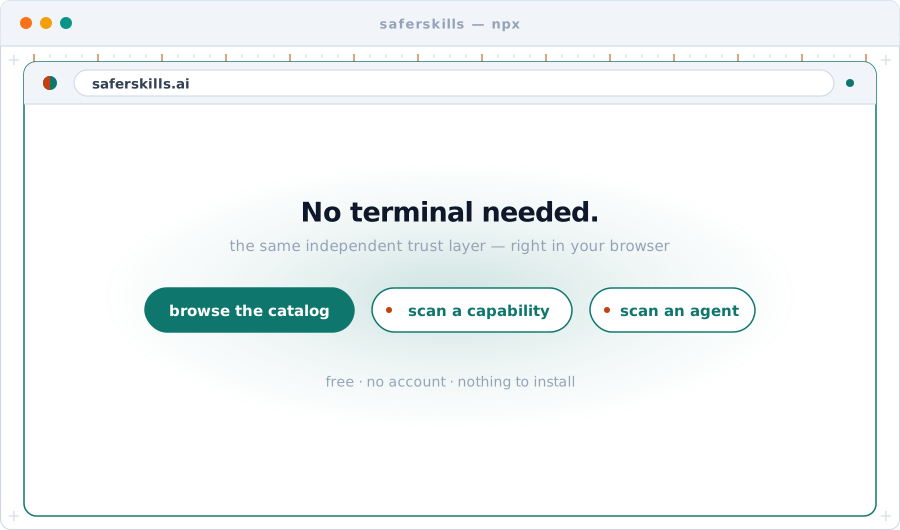
Prefer it installed? npm install -g saferskills or cargo install saferskills. No terminal at all? Everything the CLI does is in your browser at saferskills.ai — browse the catalog, scan a capability, or run a behavioral agent scan, with no account and nothing to install. Full command + flag reference: cli/README.md.
SaferSkills is v0.x, built in the open — the catalog is filling in as ingestion scales toward the public launch.
You install a Claude skill, an MCP server, a Cursor rules file, or a Codex hook. It runs with your file-system access. It can read your .env. It can curl | bash. It can quietly ship your repo to a paste site. And across the tens of thousands of such items now circulating, there is no public, transparent record of what each one actually does.
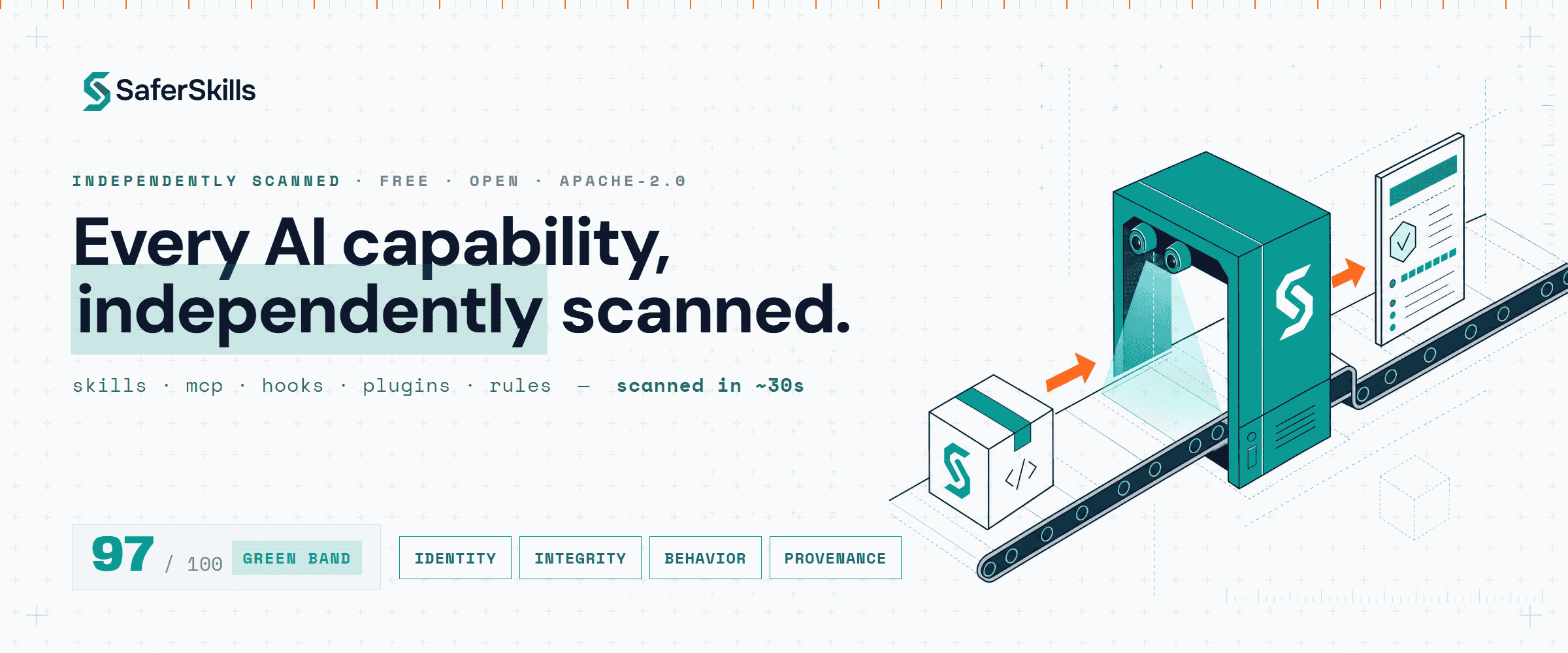
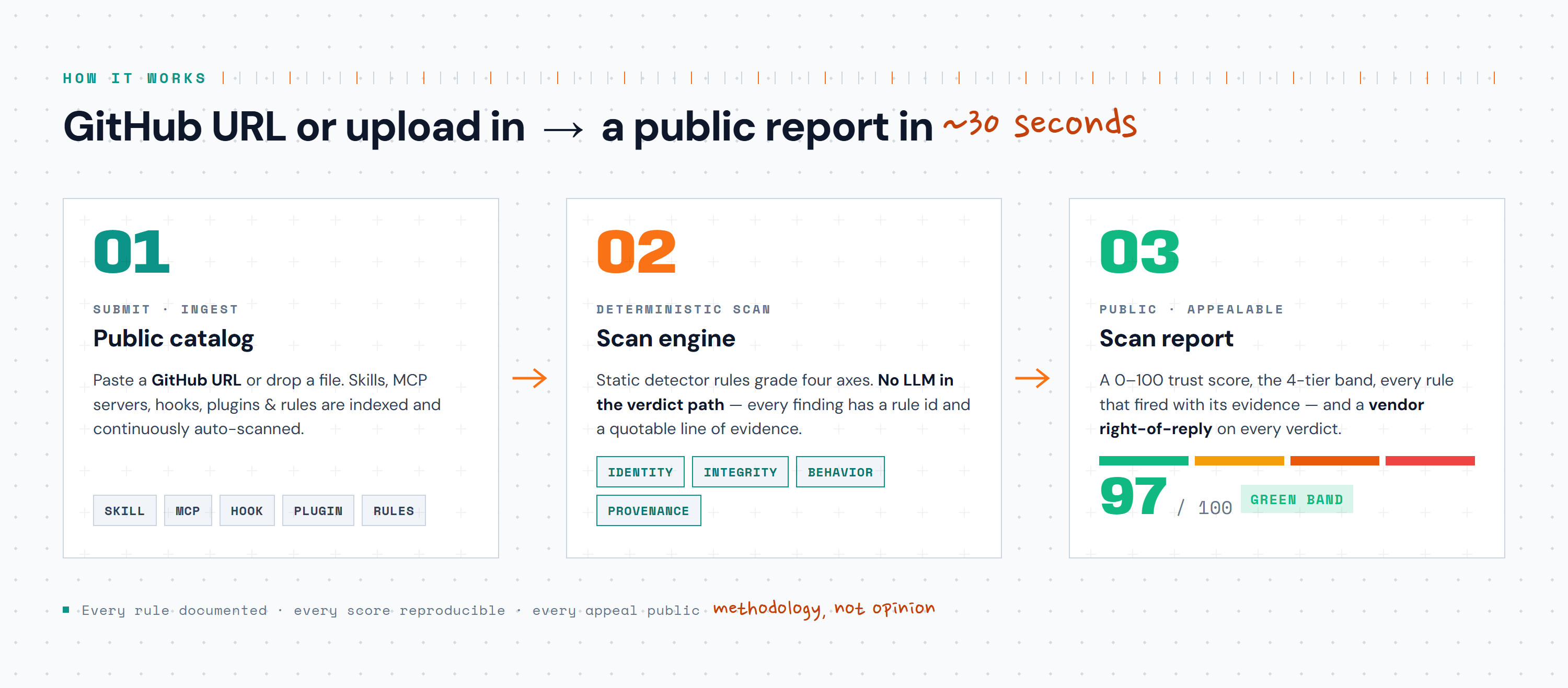
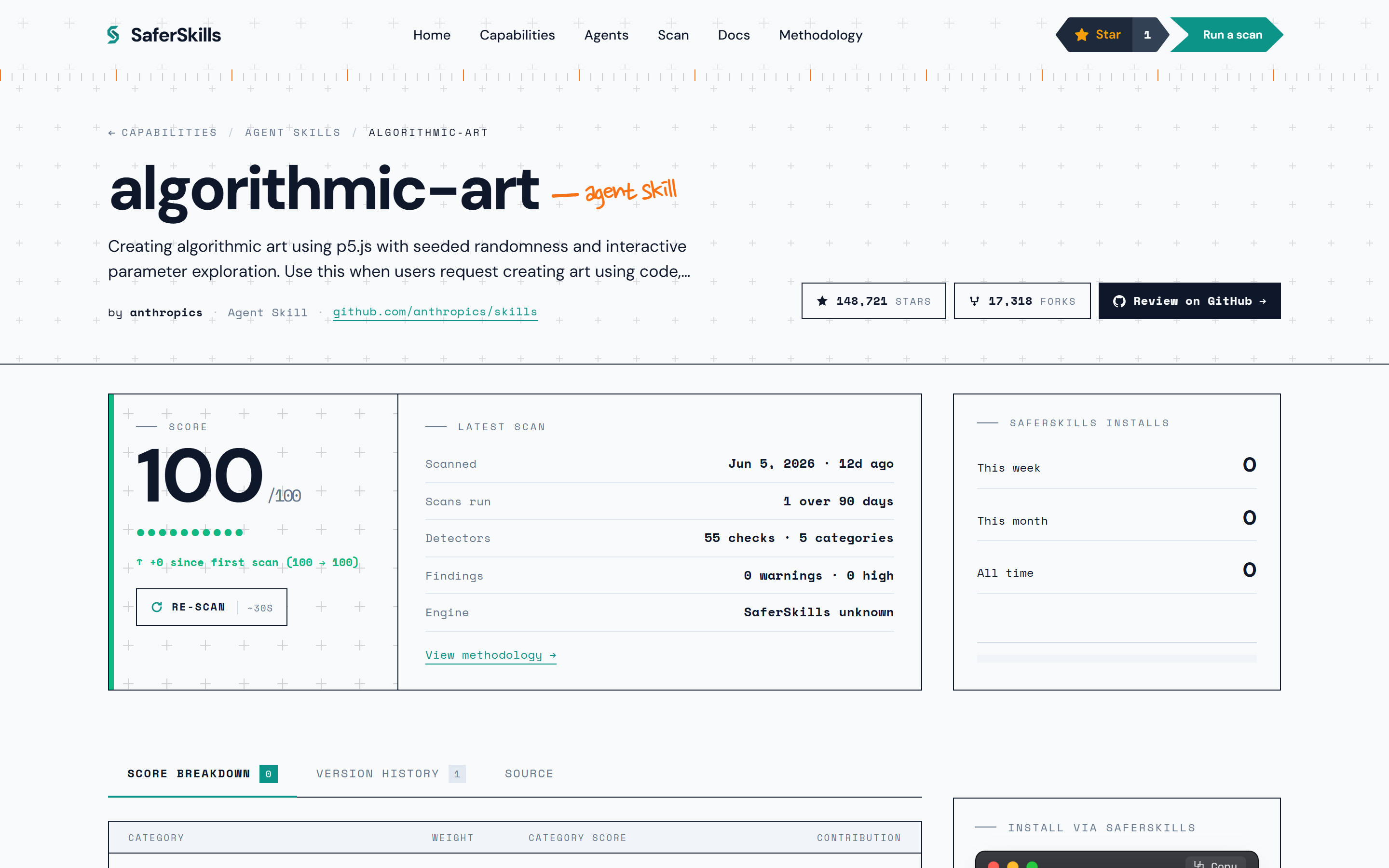
SaferSkills is that record. Anyone — a developer, a vendor, a researcher — submits a GitHub URL (or uploads a file), and a ~30-second deterministic scan returns a Yuka-style report: an aggregate trust score (0–100), a four-axis breakdown, every detector that fired, the rule that fired it, the exact line of evidence, the remediation, and a permalink the vendor can dispute.
Methodology, not opinion. Every rule is documented. Every score is reproducible. Every appeal is public.
The verdict path is fully deterministic — there is no LLM deciding your score. Every finding carries a static rule_id and a quotable line of evidence, so a verdict is reproducible from the trace alone. The result is a public report permalink:
| Tier | Range | Meaning |
|---|---|---|
| 🟢 Green | 80–100 | Indexed, signed, behaviorally clean, provenance-verified |
| 🟡 Yellow | 60–79 | Known author, no critical findings, some lower-severity flags |
| 🟠 Orange | 40–59 | Anonymous author or mid-severity finding or provenance unclear |
| 🔴 Red | 0–39 | Critical finding — prompt injection / shell RCE / secret exfil / supply-chain |
Sub-scores are weighted: Identity 25% · Integrity 25% · Behavior 30% · Provenance 20%. A single critical finding floors the aggregate into the red tier regardless of the other axes. Full rubric and every detection rule → saferskills.ai/methodology.
| Mode | Best for | Status |
|---|---|---|
Service — browse saferskills.ai, share a report permalink | every dev, every researcher | live — catalog + scan reports |
CLI — npx saferskills install <name> (score re-checked at install) | individual installers | shipped — npm + crates.io |
Self-host — docker compose up (this repo) | privacy-strict / air-gapped orgs | scan engine shipped |
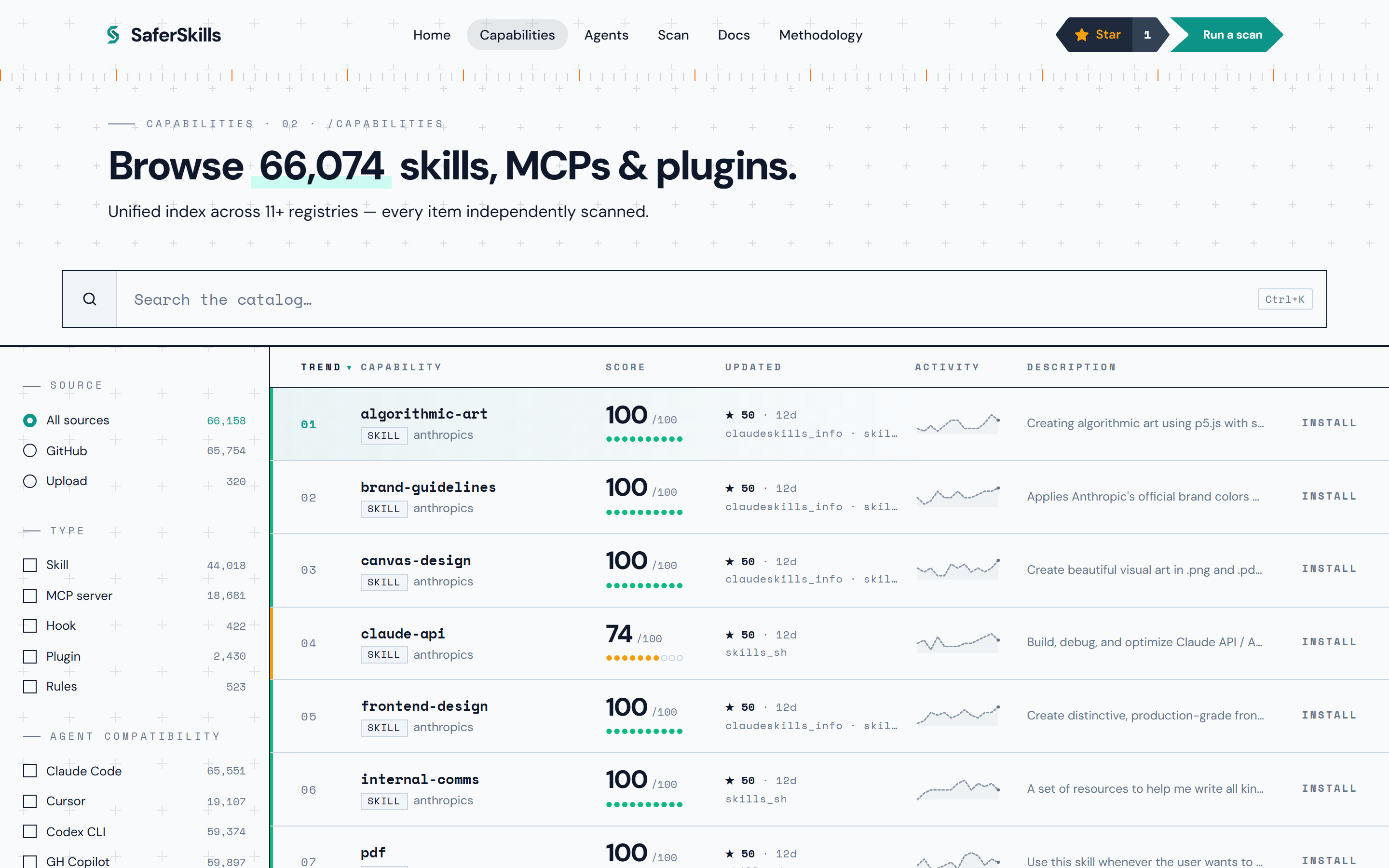
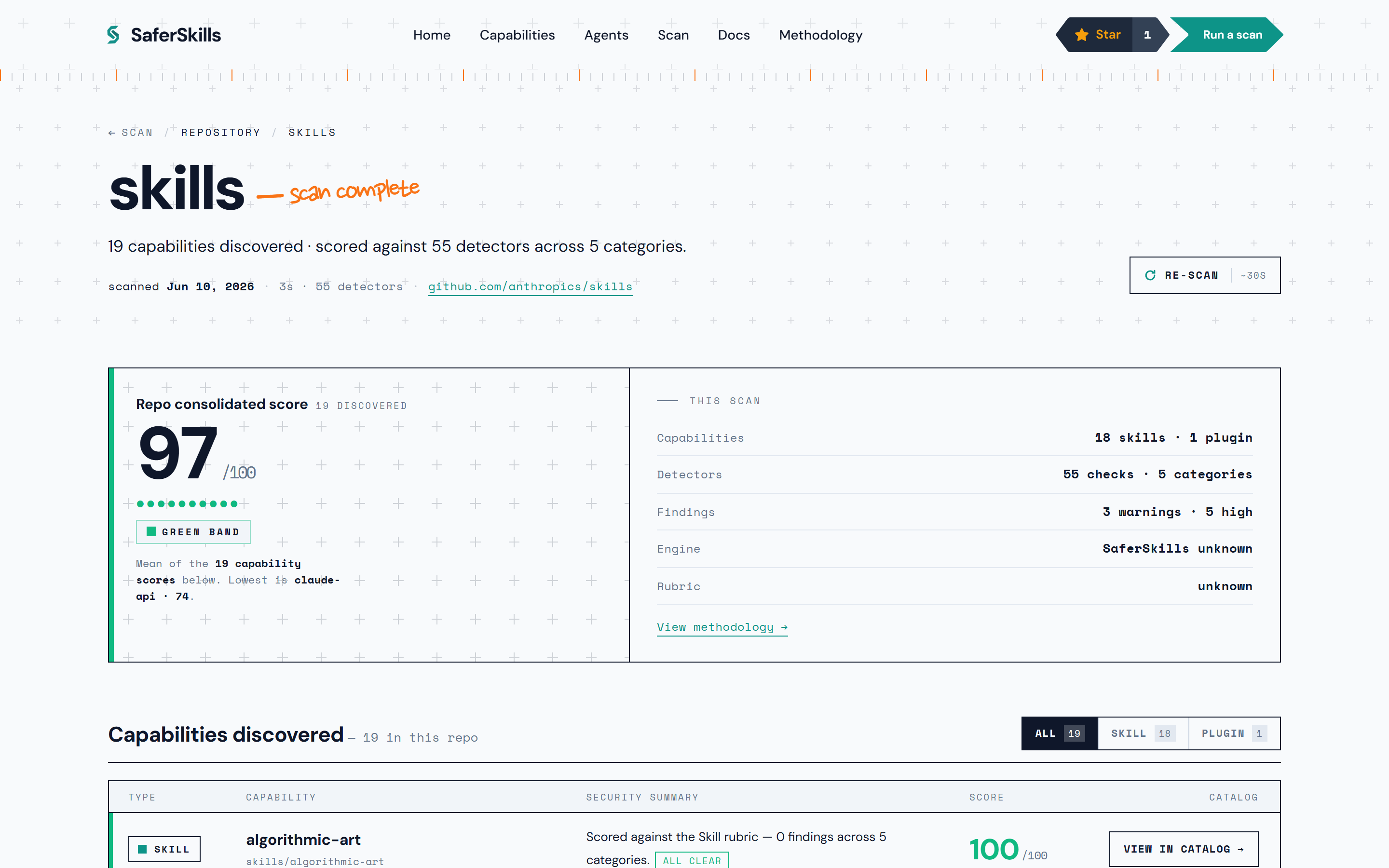
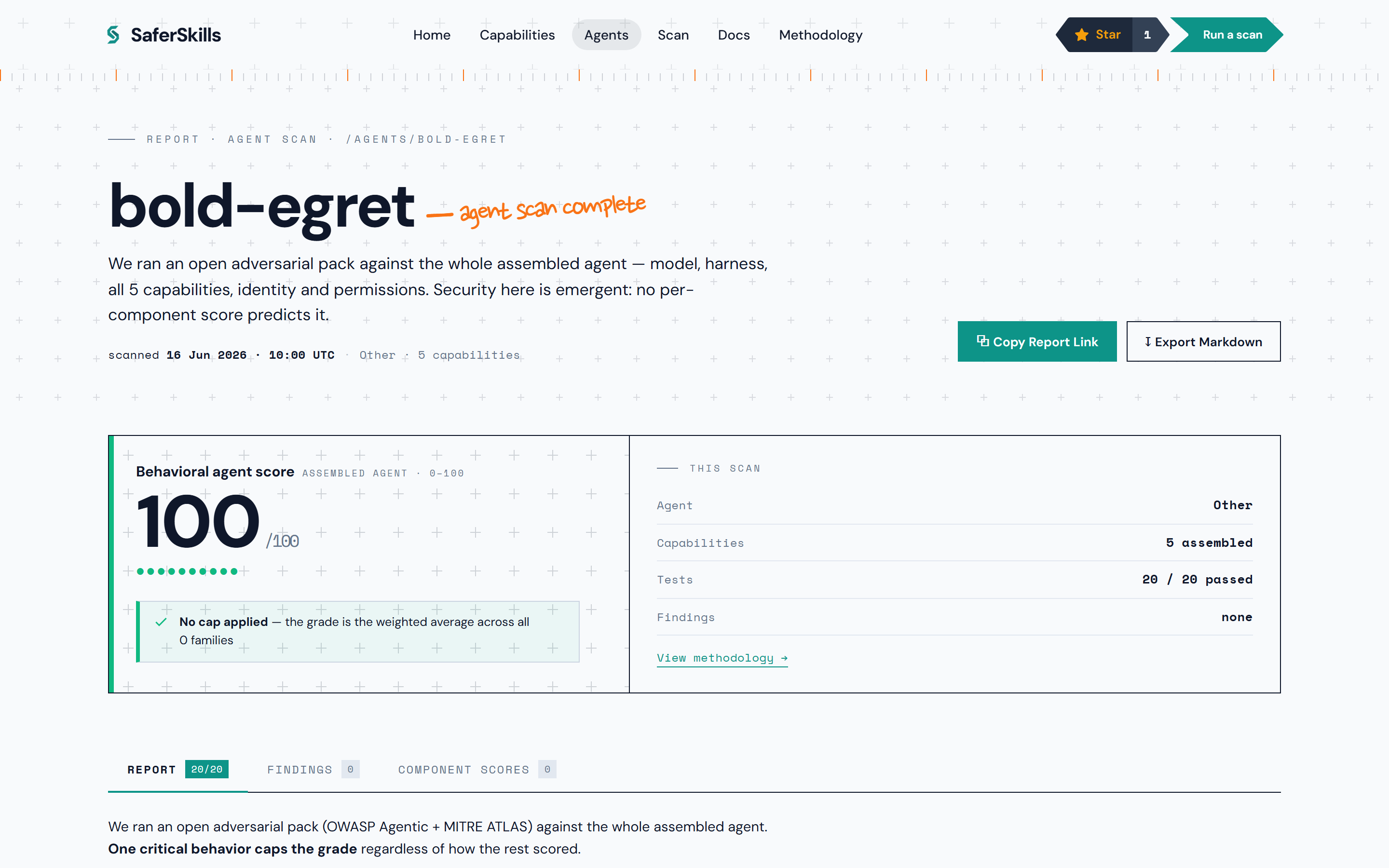
One trust layer for every coding agent. Detect, install, and re-verify across:
claude-code · cursor · windsurf · copilot · codex · gemini · cline · openclaw
One command teaches any of the 8 supported agents to use SaferSkills — and to scan a capability before it installs, adds, recommends, or trusts it:
npx saferskills install saferskills
The canonical skill lives at skills/saferskills/SKILL.md and
renders to each agent's native format (Claude Code & OpenClaw get the SKILL.md verbatim;
Cursor .mdc, Cline/Windsurf rules, Codex/Copilot AGENTS.md, Gemini GEMINI.md get a
native render). See the install guide.
If SaferSkills helps you install AI capabilities more safely, star the repo — it's the cheapest way to help a free, public safety service reach the people installing risky skills. Stars are how this gets in front of the next developer about to curl | bash something they didn't read.
git clone https://github.com/OpenLatch/saferskills.git
cd saferskills
pnpm install
pnpm run generate     # 9 generators: ingestion registry + Pydantic + SQLAlchemy + openapi.json + TS DTO + Zod + methodology + agent-pack
docker compose up     # postgres + api + webapp
curl http://localhost:8000/api/v1/health
open http://localhost:5173
Requirements: Node 24 LTS, Python 3.14, pnpm 10, uv 0.7+, Docker.
| Path | What it is | Docs |
|---|---|---|
cli/ | The saferskills Rust CLI — install + capability/agent scans | README |
ui/ | Design system — React 19 + Tailwind v4 tokens & components | README |
webapp/ | Astro 7 public site — catalog, scan/agent reports, docs | README |
Stars on GitHub
Reverse engineer anything with agents, from app behavior down to native binaries.
@morlutoA skill pack for authorized reverse engineering, security research, and penetration testing that routes tasks to the right skill and sets up needed tools on demand. It covers API security assessment and Android APK analysis, among others.
 @zhaoxuya520
Gives an AI agent the step-by-step workflow a senior security analyst follows, covering when to use each technique, what to check first, how to run it and how to verify the result. Covers incident response, forensics, threat intelligence, malware analysis, penetration testing and red teaming.
 @mukul975
Agent skill + stdlib Python service to strip multi-vendor AI provenance marks from text and files, for privacy and hygiene on content you own. The skill is a thin client: it drives the machinery over HTTP, so the agent host needs no Python.
 @guillaumemeyer
Scans and scores the trust of AI agent capabilities such as skills, MCP servers, hooks, and plugins before you install them. Helps Claude Code users check whether a skill is safe to add. Install it with the command on its page. It includes saferskills. Its skills do not fire on their own yet. Free and open source.
Is this plugin yours?
Claim it with GitHubSubmit a pluginPromote it