Finds, scores, and ranks the best library, SDK, or tool for your exact stack — no Reddit threads, no outdated blogs. 5-tier search, deterministic scoring, built-in security gate. Works with Claude Code, Claude.ai, Codex & Antigravity.
FAQ
skillmama is a Claude Code plugin with hand-picked skills for development work, indexed on Flowy. Install it with the command on its page. Its skills do not fire on their own yet. Request auto-invocation to have Flowy route them as you prompt. Free and open source.
Repo: Magithar/SKILLmama

📖 Build-in-public series on Dev.to:
Part 1 — scoring formula, 5-tier search, end-to-end example. Part 2 — security gate, SQP rules, companion skills. Part 3 — project scanner, Flow B, gap analysis. Part 4 — Phase 1.5, constraint confirmation in Flow A. Part 5 — tested my own install instructions, found they were wrong. Part 6 — eval harness, trigger-classification tests, bugs found by testing instead of assuming. Part 7 — paired skill-on/skill-off ablation, the deployment persistence check it exposed, and the live CVE it later caught. Part 8 — building the live OSV.dev and npm publisher-continuity checks, and the real CVE that proved them.
npx skills add Magithar/SKILLmama
When run interactively, it prompts you to pick your agent and installs correctly. This installs SKILLmama via the skills.sh ecosystem.
npx skills add Magithar/SKILLmama -a claude-code
The explicit -a claude-code flag is required for Claude Code. Without it, non-interactive installs (e.g. running the command via an agent's own shell tool) can silently skip the step that wires the skill into .claude/skills/, and /skillmama won't appear.
Alternatively, copy the skill file manually into your project's .claude/commands/ folder:
mkdir -p /your-project/.claude/commands
cp .claude/commands/skillmama.md /your-project/.claude/commands/skillmama.md
Then type /skillmama (or /SKILLmama, matching skill name casing) in any Claude Code session inside that project.
skillmama/ folder:
zip -r skillmama.zip skillmama/
skillmama.zip/skillmama in any Claude.ai conversationManual (recommended) — place codex/AGENTS.md in your repo root, then run naturally:
codex "find me the best job queue for this project"
npx skills add Magithar/SKILLmama -a codexinstalls successfully — theskillsCLI only discovers files literally namedSKILL.md, so it installsskillmama/SKILL.mdinto.agents/skills/skillmama/rather thancodex/AGENTS.mddirectly. Both files run the same pipeline, so this should be safe, though it hasn't been live-tested against a real Codex client (see AI Adapters below). One cosmetic quirk either way: the installed file's trigger list still mentions the/skillmamaslash command, which doesn't exist in Codex — harmless, just ignore that line.
Recommended — install as a native global skill (confirmed working via live testing). No need to clone this repo first:
mkdir -p ~/.gemini/config/skills/skillmama
curl -sL https://raw.githubusercontent.com/Magithar/SKILLmama/main/skillmama/SKILL.md -o ~/.gemini/config/skills/skillmama/SKILL.md
Already have this repo cloned? Use the local copy instead so you always get your working tree's version, not main:
mkdir -p ~/.gemini/config/skills/skillmama
cp skillmama/SKILL.md ~/.gemini/config/skills/skillmama/SKILL.md
Fully restart Antigravity (this path is read at startup), then ask "Which skills are installed?" to confirm — SKILLmama should appear under Global & Built-in Skills and in the / command picker.
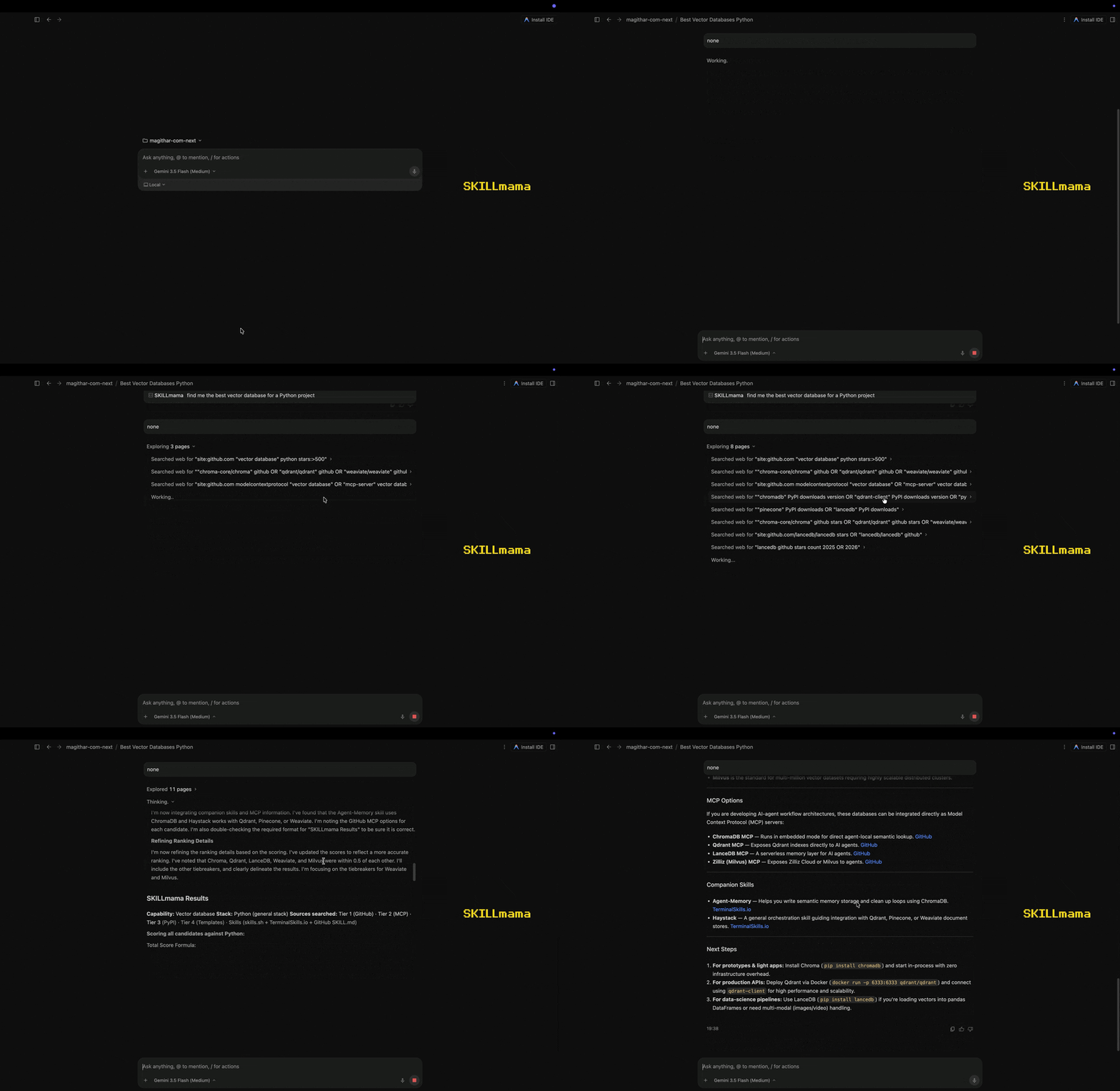
Usage — invoke explicitly, confirmed working via live testing: type / and select SKILLmama from the picker (or type SKILLmama before your request), then your capability question:
SKILLmama find me the best vector database for a Python project
This triggered the real pipeline in testing — a Phase 1.5 constraint question ("do you have any specific constraints or preferences? ... Reply 'none' to search with no filters"), not a generic answer. Plain natural-language prompts with no explicit SKILLmama invocation were not confirmed to auto-trigger the skill — invoke it explicitly for reliable results.
Per Antigravity's official Agent Skills docs, the agent is also supposed to auto-trigger relevant skills from context alone, without explicit invocation — driven by the skill's
description:frontmatter. We haven't verified that mode here (only explicit invocation was tested), so treat auto-trigger as unconfirmed and invoke explicitly for now.
⚠️
npx skills add Magithar/SKILLmama -a antigravityinstalls successfully but to the wrong path (~/.agents/skills/), which Antigravity never reads — confirmed by live testing (installed, restarted, asked a capability question, got a generic answer with no SKILLmama pipeline behavior).~/.gemini/config/skills/is Antigravity's real global skills directory, confirmed against the official docs and by re-testing after moving the file there. Use the manual copy above until the CLI is updated to target the correct path.
Fallback — load antigravity/PROMPT.md as the system prompt, then ask naturally:
find me a vector database for this project
/skillmama ← scans your project and asks what to find
/skillmama find me a vector database for my FastAPI project
/skillmama what auth library should I use for my Next.js app?
/skillmama find a .dwg parser for Node.js
| AI System | File | npx skills add | How to use |
|---|---|---|---|
| Claude Code | .claude/commands/skillmama.md | ✅ Works — installs to .claude/skills/ | /skillmama slash command — CLI wires it automatically |
| Claude.ai | skillmama/SKILL.md | N/A (not CLI-installable) | Upload zip via Customize → Skills |
| OpenAI Codex | codex/AGENTS.md | ⚠️ Installs, but unverified — not live-tested against a real Codex client | Place file in repo root manually (recommended until verified) |
| Antigravity | antigravity/PROMPT.md | ❌ Wrong path — use ~/.gemini/config/skills/ instead (manual copy, confirmed working) | Manual copy to ~/.gemini/config/skills/skillmama/, then invoke explicitly: SKILLmama <request> (confirmed working) |
All four adapters run the same pipeline and produce identical output. A few notes on the npx skills add path:
skills CLI only recognizes files named SKILL.md, so -a codex and -a antigravity both install skillmama/SKILL.md into .agents/skills/skillmama/ rather than codex/AGENTS.md or antigravity/PROMPT.md. Harmless in principle, since every file shares the same pipeline logic.~/.gemini/config/skills/, not .agents/skills/. Confirmed by testing — after a CLI install and restart, a capability question got a generic, non-pipeline answer.~/.gemini/config/skills/skillmama/ and restart. Confirmed working — the skill then appeared in Antigravity's own "Which skills are installed?" answer and its / command picker. See the Antigravity install steps above. ┌─────────────────────────────────────────────────────────┐
│ USER REQUEST │
└──────────────────────────┬──────────────────────────────┘
│
▼
◇ Capability
named?
/ \
YES NO
│ │
──────────────────────────┘ └──────────────────────────
│ │
▼ ▼
┌───────────────────────┐ ┌─────────────────────────┐
│ FLOW A │ │ FLOW B │
│ Capability Search │ │ Project Scanner │
└───────────┬───────────┘ └──────────┬──────────────┘
│ │
▼ ▼
┌───────────────────────┐ ┌─────────────────────────┐
│ PHASE 0 │ │ PHASE B1 │
│ Parse Request │ │ Deep Project Scan │
│ Extract: capability, │ │ Build Stack Profile: │
│ stack, constraints │ │ lang, framework, DB, │
└───────────┬───────────┘ │ auth, cache, AI/LLM, │
│ │ queue, search, email… │
▼ └──────────┬──────────────┘
◇ Capability │
vague? ▼
/ \ ┌─────────────────────────┐
YES NO │ PHASE B2 │
│ │ │ Gap Analysis │
▼ │ │ Missing categories → │
Ask 1 │ │ High / Medium / Low │
clarifying │ └──────────┬──────────────┘
question │ │
│ │ ▼
└────┬─────┘ ┌─────────────────────────┐
│ │ PHASE B3 │
▼ │ Ask 3 questions: │
┌───────────────────────┐ │ 1. Which gap(s)? │
│ PHASE 1 │ │ 2. Constraints? │
│ Architecture Scan │ │ 3. Anything missed? │
│ Read: package files, │ │ │
│ Dockerfile, README, │ │ ◀ STOP — await reply ▶ │
│ source files │ └──────────┬──────────────┘
│ Extract: lang, │ │
│ frameworks, DBs │ │ user picks capability
└───────────┬───────────┘ │
│ │
▼ │
┌───────────────────────┐ │
│ PHASE 1.5 │ │
│ Confirm Constraints │ │
│ (only if none │ │
│ stated): ask 1 │ │
│ informed question │ │
│ STOP — await reply │ │
└───────────┬───────────┘ │
│ │
└───────────────────────────┬───────────────────────────────────┘
│
▼
┌──────────────────────────────┐
│ PHASE 2 │
│ Derive Search Terms │
│ capability + stack → │
│ 3–5 search terms │
└──────────────┬───────────────┘
│
▼
┌──────────────────────────────┐
│ PHASE 3 — 5-Tier Search │
└──────────────┬───────────────┘
│
┌───────────────────┴─────────────────────────┐
│ Search loop (tiers in order) │
│ │
│ Tier 1 ── GitHub (stars, recency, contrib) │
│ ↓ │
│ Tier 2 ── MCP Ecosystem │
│ ↓ │
│ Tier 3 ── npm / PyPI registries │
│ ↓ │
│ Tier 4 ── Templates & Cookbooks │
└─────────────────┬───────────────────────────┘
│
◇ 8+ candidates
found?
/ \
YES NO
│ │
Skip remaining │
tiers │
│ │
└─────┬──────┘
│
▼
┌────────────────────────────────────────┐
│ PHASE 3.5 — Security Gate (Libraries)│
│ │
│ Live checks (per candidate): │
│ OSV.dev advisory lookup (npm/PyPI/ │
│ Go/crates.io, exact version) │
│ npm publisher-continuity check │
│ │
│ Hard Gate (per candidate): │
│ 🚫 BLOCKED → discard, never score │
│ ⚠️ WARN → show, user confirms │
│ │
│ Quality flags (SQP rules): │
│ SQP-1 Vague triggers │
│ SQP-2 Missing user warnings │
│ SQP-3 Policy violations │
└───────────────┬────────────────────────┘
│
▼
┌──────────────────────────────────────────┐
│ PHASE 3.6 — Companion Skills Search │
│ (REQUIRED — never skip) │
│ │
│ For each candidate: │
│ Search: site:skills.sh [name] │
│ Search: terminalskills.io/skills [name]│
│ Search: site:skillsmp.com [name] │
│ Search: github.com "SKILL.md" [name] │
└───────────────┬──────────────────────────┘
│
▼
┌────────────────────────────────────────┐
│ PHASE 3.7 — Security Gate (Skills) │
│ │
│ 🚫 BLOCKED → discard │
│ ⚠️ SQP-1/2/3 → flag, keep │
│ ⚠️ WARN → show with caution │
└───────────────┬────────────────────────┘
│
▼
┌────────────────────────────────────────┐
│ PHASE 4 — Score Each Candidate │
│ │
│ Score = (C × 0.40) + │
│ (P × 0.30) + │
│ (M × 0.15) + │
│ (S × 0.15) │
│ │
│ C — Compatibility (stack fit) │
│ P — Popularity (stars/downloads)│
│ M — Maintenance (last commit) │
│ S — Simplicity (install effort) │
│ │
│ Each factor: 1–10 │
└───────────────┬────────────────────────┘
│
▼
┌────────────────────────────────────────┐
│ PHASE 5 — Present Results │
│ │
│ #1, #2, #3 — full score breakdown │
│ Also Considered — table │
│ MCP callout (if found) │
│ Companion Skills (if found) │
│ Next Steps (3 actions) │
└────────────────────────────────────────┘
Before scoring, every candidate passes through the gate (Phase 3.5). The first two layers query live data rather than relying on the model's recall:
| Layer | What it checks | Action |
|---|---|---|
| Advisories | Live OSV.dev lookup for the exact version being recommended, across npm, PyPI, Go, and crates.io | 🚫 BLOCKED if CRITICAL/HIGH with no fix available (the advisory's trigger condition, if OSV states one — a specific mode, flag, or endpoint — is quoted verbatim so you can judge whether your own usage is exposed), ⚠️ WARN if a fix exists (the fixed version is named) or if MODERATE/LOW |
| Publisher continuity | Whether npm publish rights changed hands between releases, the event-stream failure mode that advisory scanning misses | ⚠️ WARN naming both publishers and the date, never an automatic discard. CI bots are not counted as a handoff |
| Hard Gate | Data exfiltration, no-disclosure destructive ops, jailbreak instructions | 🚫 BLOCKED (discarded) or ⚠️ WARN (user confirms) |
| SQP-1 | Vague trigger phrases with no exclusion conditions | Flag in result |
| SQP-2 | Destructive/sensitive ops with no user-visible warning | Flag in result |
| SQP-3 | Hardcoded language/locale without user opt-in | Flag in result |
Known limits. Stated plainly, because a gate that oversells what it checks is worse than no gate:
N/A (unsupported ecosystem) rather than implying the check ran.N/A (unverified), never a silent pass.SQP rules are inspired by NVIDIA/SkillSpector (Apache 2.0). For deeper static analysis with 64 vulnerability patterns, run SkillSpector directly: pip install skillspector && skillspector scan <repo-url>.
Every candidate that passes the gate is scored 1–10 on four dimensions:
| Factor | Weight | Signals |
|---|---|---|
| Compatibility | 40% | Language/framework fit, official SDK, integration effort |
| Popularity | 30% | GitHub stars, npm/PyPI/go weekly downloads |
| Maintenance | 15% | Days since last commit, release cadence |
| Simplicity | 15% | Setup effort, documentation quality |
Total = (Compat × 0.40) + (Pop × 0.30) + (Maint × 0.15) + (Simp × 0.15)
| Tier | Source | What it finds |
|---|---|---|
| 1 | GitHub | Open-source libraries, frameworks, SDKs |
| 2 | Smithery / MCP Ecosystem | AI-native tools installable as MCP servers |
| 3 | npm / PyPI / pkg.go.dev | Package registries with download signals |
| 4 | Curated Templates | LangGraph, OpenHands, cookbook examples |
| — | skills.sh / TerminalSkills.io / SkillsMP (Phase 3.6) | Companion agent skills for top candidates |
Results open with a scoring table prefixed by the detected stack, then a ranked card per pick:
**Scoring all candidates against [stack]:**
| Candidate | Compat | Pop | Maint | Simple | Score |
|-----------|--------|-----|-------|--------|-------|
| Name | X | X | X | X | X.X |
#1 — [Name] · Score: X.X/10
[One sentence on why it wins for this stack]
- Compatibility: X/10 — [reason]
- Popularity: X/10 — [stars/downloads]
- Maintenance: X/10 — [last commit / release cadence]
- Simplicity: X/10 — [setup effort]
- Security: [PASS | ⚠️ SQP-N — finding | 🚫 BLOCKED]
- Install: `[command]`
- Links: [npm] · [PyPI] · [pkg.go.dev] · [Smithery] · [GitHub]
Followed by:
Security findings from the internal gate surface inline on each candidate's Security: line — there is no separate gate section in the output.
User prompt:
find me a vector database for my FastAPI + Python project
Step 1 — Architecture Scan
✓ pyproject.toml → Python 3.11, FastAPI, SQLAlchemy → PostgreSQL
✓ Dockerfile → containerized, no GPU
✓ .env.example → OPENAI_API_KEY present → RAG use case confirmed
Detected stack: Python / FastAPI / PostgreSQL / Docker / OpenAI
Step 2 — Confirm Constraints (Phase 1.5 — no constraints were stated, so SKILLmama asks one informed question and stops)
SKILLmama: I see you're on Python / FastAPI / PostgreSQL / Docker / OpenAI.
Before I search — any constraints? (e.g. self-hosted, open-source only,
free tier, must integrate with PostgreSQL). Reply "none" to search with no filters.
User: containerizable, Python client, must stay open-source
Step 3 — Capability Detection
CAPABILITY : vector database for RAG / semantic search
STACK : Python / FastAPI / PostgreSQL / Docker / OpenAI
CONSTRAINTS: containerizable, Python client, open-source
Step 4 — 5-Tier Search
Tier 1 GitHub → qdrant/qdrant (17k★), chroma-core/chroma (14k★),
pgvector/pgvector (11k★), milvus-io/milvus (29k★)
Tier 2 MCP → qdrant-mcp-server, chroma-mcp
Tier 3 PyPI → qdrant-client (380k/wk), chromadb (620k/wk), pgvector (180k/wk)
Tier 4 Templates → LangChain + Qdrant RAG template, FastAPI + Chroma starter
Skills (3.6) → "qdrant-memory-skill", "chroma-rag-skill" on skills.sh + TerminalSkills.io + SkillsMP
Step 5 — Output
## SKILLmama Results
Capability: vector database for RAG
Stack: Python / FastAPI / PostgreSQL / Docker / OpenAI
Sources searched: Tier 1 (GitHub) · Tier 2 (MCP) · Tier 3 (PyPI) · Tier 4 (Templates) · Skills (skills.sh + TerminalSkills.io + SkillsMP + GitHub SKILL.md)
---
**Scoring all candidates against Python / FastAPI / PostgreSQL / Docker / OpenAI:**
| Candidate | Compat | Pop | Maint | Simple | Score |
|-----------|--------|-----|-------|--------|----------|
| Qdrant | 9 | 8 | 10 | 9 | **9.05** |
| pgvector | 10 | 7 | 9 | 7 | **8.65** |
| Chroma | 8 | 8 | 9 | 10 | **8.55** |
| Milvus | 6 | 9 | 10 | 4 | **7.05** |
---
#1 — Qdrant · Score: 9.05/10
Docker-native, official Python client, active MCP server for AI workflows.
- Compatibility: 9/10 — official qdrant-client SDK, FastAPI examples in docs
- Popularity: 8/10 — 17k GitHub stars, 380k PyPI downloads/week
- Maintenance: 10/10 — committed 2 days ago, weekly releases
- Simplicity: 9/10 — docker run + pip install, 5-min setup
- Security: PASS — no findings
- Install: docker run -p 6333:6333 qdrant/qdrant && pip install qdrant-client
- Links: [skills.sh](https://skills.sh/qdrant) · [PyPI](https://pypi.org/project/qdrant-client) · [Smithery](https://smithery.ai/server/qdrant-mcp-server) · [GitHub](https://github.com/qdrant/qdrant)
#2 — pgvector · Score: 8.65/10
Stay on PostgreSQL — no new infra, native SQL queries.
- Links: [PyPI](https://pypi.org/project/pgvector) · [GitHub](https://github.com/pgvector/pgvector)
#3 — Chroma · Score: 8.55/10
Easiest local dev setup; best for prototyping before scaling.
- Links: [PyPI](https://pypi.org/project/chromadb) · [Smithery](https://smithery.ai/server/chroma-mcp) · [GitHub](https://github.com/chroma-core/chroma)
---
Also Considered:
| Name | Score | Why not #1 | Links |
|--------|-------|-----------------------------------|-------|
| Milvus | 7.05 | Complex setup, over-engineered for solo/small team | [PyPI](https://pypi.org/project/pymilvus) · [gh](https://github.com/milvus-io/milvus) |
---
MCP Option: qdrant-mcp-server — install as MCP tool for direct AI memory integration.
[Smithery](https://smithery.ai/server/qdrant-mcp-server) · [GitHub](https://github.com/qdrant/mcp-server-qdrant)
---
Companion Skills:
> qdrant/mcp-server-qdrant ships its own skill:
> npx skills add qdrant/mcp-server-qdrant
> [skills.sh](https://skills.sh/qdrant/mcp-server-qdrant) · [GitHub](https://github.com/qdrant/mcp-server-qdrant)
> Security: PASS
Next Steps:
1. docker run qdrant/qdrant and pip install qdrant-client to validate locally
2. Use the LangChain + Qdrant RAG template as a starting point
3. If staying Postgres-only, evaluate pgvector — saves an infra hop
SKILLmama is a capability oracle: it tells you what to use and why, with evidence.
SKILLmama/
├── skillmama/
│ └── SKILL.md # Claude.ai skill (upload as zip)
├── .claude/
│ └── commands/
│ └── skillmama.md # Claude Code slash command
├── codex/
│ └── AGENTS.md # OpenAI Codex agent instructions
├── antigravity/
│ └── PROMPT.md # Antigravity system prompt
├── evals/
│ └── skillmama-ablation.md # Manual trigger/pipeline eval + result log
└── README.md
SKILLmama ships a manual eval harness at evals/skillmama-ablation.md: 5 prompts that should trigger the skill, 5 that shouldn't, run skill-on vs. skill-off. It's checked after any change to the Trigger rules or the core phases — the log has already caught and fixed three real bugs: a silent empty scan when the working directory didn't match the stated stack, Maintenance scores presented as verified when they were actually estimated, and a deployment-persistence blind spot (recommending an in-process store without checking whether the target hosting platform's disk actually survives a restart) — the last one found via a genuine paired skill-off/skill-on ablation run, not just inference.
See evals/skill-on-vs-skill-off-comparison.md for the full unedited transcript of that ablation run: the same question asked with and without SKILLmama, side by side.
Inspired by Philipp Schmid's (Google DeepMind) talk "Don't Ship Skills Without Evals," and the paired skill-on/skill-off ablation methodology from SkillsBench (Li et al.), also live at skillsbench.ai.
.claude/
commands/
skillmama.md
.gitignore
antigravity/
PROMPT.md
assets/
logo.png
skillmama-antigravity-demo.gif
CHANGELOG.md
codex/
AGENTS.md
evals/
skill-on-vs-skill-off-comparison.md
skillmama-ablation.md
LICENSE
README.md
skillmama/
SKILL.md© 2026 Flowy · Free and open source
Built for Claude Code · Not affiliated with Anthropic