
Agent Orchestration
Plugin
hermes-jev-skills
Give your agent a fast, cheap second brain for the small decisions. Your agent burns frontier-model tokens on things that are not thinking: which model should answer this turn, which of 377 skills to load, which retrieved passages matter, which turns survive

Plugin Signal77/100Solid
maintained100
capable58
documented75
adopted65
Install
$ npx -y skills add kerpopule/hermes-jev-skills --agent claude-code
Stats
1,119
Stars
111
Forks
Active
Maintenance
Python
Language
MIT
License
1d ago
Last commit
26d ago
Created
4h ago
Added
Repo: kerpopule/hermes-jev-skills
What's inside
Skill(11 skills)
/jev-browser-useUse when driving a web page in a browser — clicking, typing, navigating, logged-in or JS-rendered pages. Jev picks each step from the elements observed, under a host allowlist and a step budget./jev-compactionUse when a transcript has to be cut to a fixed size and you must choose which turns go. Jev marks each turn keep, summarize or drop. Measured: it does not make a handoff better./jev-computer-useUse when driving a desktop GUI through a computer-use driver — windows, menus, native apps, OS dialogs. You build a table of safe actions; Jev picks the next one in about 0.4 seconds.
Agent(4 agents)
jev-lane-escalateLane escalate (opus, high effort). Only when evidence warrants it: the lane below failed repeatedly, checks keep failing, security-sensitive code changed, or design uncertainty remains. Chosen by `jev lane classify`; see ~/.claude/CLAUDE.md.jev-lane-highLane high (opus, medium effort). Hard work: many files, a cause not yet found, subtle state, design choices inside the task, or an expensive mistake. Chosen by `jev lane classify`; see ~/.claude/CLAUDE.md.jev-lane-mediumLane medium (sonnet, medium effort). Ordinary work with a clear goal: a feature or fix in a few files, tests to write or update, a bug with a known cause. Chosen by `jev lane classify`; see ~/.claude/CLAUDE.md.jev-lane-smallLane small (haiku, low effort). Mechanical, fully specified work: a rename, a typo, a one-line fix, a format change, a lookup, one edit with an obvious check. Cheapest lane. Chosen by `jev lane classify`; see ~/.claude/CLAUDE.md.
README
Hermes Jev Skills
Give your agent a fast, cheap second brain for the small decisions.
Your agent burns frontier-model tokens on things that are not thinking: which model should answer this turn, which of 377 skills to load, which retrieved passages matter, which turns survive a summary, which button comes next. Those are decisions, not prose. Hand them to something that costs a fraction of a cent and answers in about 0.4 seconds, and let the expensive model do the writing.
That is what Jev is. It is TypeSafe's decision model. It never writes text. You give it a state and typed questions (pick one, score this, yes or no) and it answers with a calibrated confidence. This repo wires that into an agent's day.
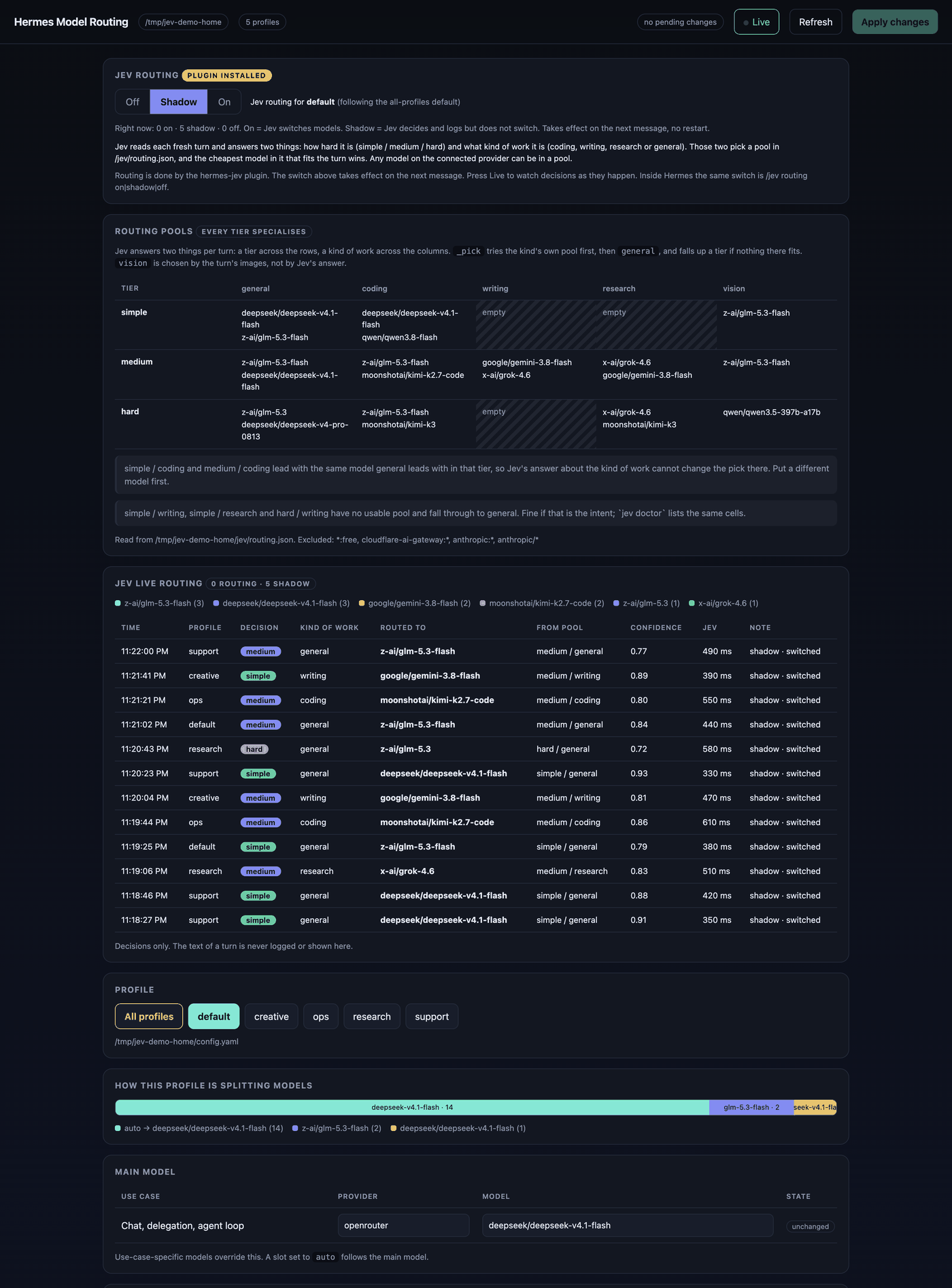
jev dashboard. The profiles, paths and decisions here are a demo home; the pools are a real working set. python3 scripts/demo_home.py builds a home where nothing is real, which is where the next one comes from. One switch for Jev routing, every pool as a tier-by-work-kind grid, and each decision as it happens (tier, work kind, model, which pool it came from, confidence, latency).
What Jev decides, and what it costs
| Skill | What Jev decides | Measured |
|---|---|---|
| Model routing | Which model is good enough for this turn, from every model you can call | ~0.4 s per turn |
| Search | Which of the results you fetched are worth opening, whether the evidence answers the question, and which of your candidate queries to run next. Jev never writes a query | ~1.9 s per round (median of five live runs, two requests: rank, then sufficiency and the pick) |
| Social research | Which discovered posts are worth opening and, after a local evidence-floor check, whether a bounded projection answers the question. Depth and source linkage are enforced locally, not by Jev | Reuses jev search; no social-specific benchmark yet |
| Memory | Which retrieved passages are worth reading, and which contain hidden instructions | 60 passages per request, up to 480 per call; an injection screen runs locally even when Jev is down |
| Web screening (Hermes) | Which parts of a web_search / web_extract result carry instructions aimed at the agent, withheld before the agent reads them | In-distribution planted attacks in 80 real web results: 70 of 79 caught, against 11 for Hermes's own pattern scan; 0 of 1,520 clean chunks withheld; ~0.2 s per result. Not portable recall (scorecard, public transfer evidence) |
| Handoffs | Nothing, by default. We measured it: a handoff written from Jev's keep / summarize / drop digest recalled less than one written from the plain transcript. What ships is the whole dialogue, 1,200 words and a way back to the old session | 58.7% recall alone, 75.0% with one search, against 37.5% and 68.3% before (scorecard) |
| Choosing turns | Which turns to keep when a transcript must be cut to a fixed size | 71 turns in 0.95 s; beat choosing by recency 11 questions to 4 |
| Skill selection | Which installed skill this turn needs, or none | 377 skills in ~2.8 s; acknowledgements answered locally for free |
| Triage | How urgent a message is, what kind it is, and whether a person must see it | ~0.4 s per message, $0.00006 |
| Mailbox sorting | Which lane an inbox message belongs in — needs reply, updates, promotional, sales, spam — and whether it is worth a person's attention | ~0.44 s p50 per message, $0.00002 each |
| Computer use | The next GUI action, from a table of actions you already judged safe. --plan splits a multi-step command once, up front | ~0.5 s per decision |
| Browser use | The next page action, same contract | ~0.4 s per step |
Eleven skills ship as plain SKILL.md files, so they are not Hermes-only. The same folder works in Claude Code, Codex, or anything that reads a skill file.
jev mail --file inbox.json             # sort a mailbox into lanes
jev mail --file inbox.json --summary   # counts per lane, what was unsure, what it cost
Runnable design-choice example
Closed preset selection with deterministic rendering: two compatible layout/type/palette presets, local contrast and copy checks, offline fallbacks, and an optional real-browser QA script. Offline by default; no new skill or routing hook. This demonstrates the contract, not measured design-quality gains.
Try it in two commands
git clone https://github.com/kerpopule/hermes-jev-skills ~/hermes-jev-skills && python3 ~/hermes-jev-skills/install.py
jev setup-key # paste your key into the one-time page it opens, then run: jev doctor
Python 3.9 or newer, no dependencies. Got it as a zip? Unzip it anywhere and run python3 install.py from that folder. Or point your agent at this repo and say "install Hermes Jev Skills": it will follow AGENTS.md.
The installer finds Hermes, Claude Code and Codex on the machine and installs for each one it finds. python3 install.py --check shows exactly what it would do without changing anything. --uninstall reverses it. For Claude Code it also adds four lane subagents (jev-lane-small … jev-lane-escalate, each with its own model and effort) and a short, delimited lanes block in ~/.claude/CLAUDE.md, backed up first (--no-claude-md leaves that file alone). See lanes.md.
Not sure yet? Run jev models suggest --write to draft routing pools from price bands, then /jev routing shadow for a day. Shadow mode decides and logs without switching anything, so a day of decisions costs almost nothing and risks nothing. Turn it on when the log looks right.
On Hermes
Built for Hermes. The dashboard has its own notes in router-dashboard/README.md.
Start in shadow mode. It is the honest way to see what Jev would do before it does anything.
/jev                         status
/jev routing shadow          decide and log, do not switch (start here)
/jev routing on              switch models per turn
/jev skills on               suggest the right skill per turn
/jev notice on               show "[Jev] hard · coding → kimi-k3 · confidence 0.92" on routed replies
/jev screen shadow           screen web_search / web_extract results for injected instructions, log only
/jev screen on               withhold the parts that carry them, with a notice in their place
/jev routing on all          make it the default for every profile (a profile's own setting still wins)
The agent gets five tools: jev_memory_filter, jev_compact_select, jev_choose_action, jev_supervise, jev_escalate.
The hermes-jev plugin uses only public plugin seams (pre_llm_call, transform_tool_result, the llm_request middleware, tools, a slash command), so hermes update does not break it and nothing in Hermes core is patched.
A plugin can swap the model, not the provider connection. On OpenRouter that still covers every vendor. If you run /model yourself, your choice wins.
Every model you have
jev models list              # everything this machine can call: price, context, vision, reasoning
jev models providers         # which providers you hold a key or login for
jev models suggest --write   # first-draft pools from price bands; then edit to taste
The catalog is models.dev, filtered to providers whose API-key name is set in your environment or Hermes .env, or that Hermes holds a login for. Only key names are read. Pools live in ~/.hermes/jev/routing.json (the default for every profile); ~/.hermes/profiles/<name>/jev/routing.json overrides it for one profile. Details in skills/jev-model-routing.
Your API key never touches the agent
jev setup-key opens a one-time page served only by your own computer. You paste your TypeSafe key there. It goes straight into the OS secret store (macOS Keychain, or secret-tool on Linux, or a 0600 file as a last resort) and, on a Hermes machine, into each profile's .env. The agent that ran the command sees one line: stored, verified, yes or no. Never the key, not even a prefix.
The page lives on an unguessable one-time URL, refuses requests with a foreign Host header (DNS rebinding), sends no referrer, logs nothing, and shuts down after one use or ten minutes. On a headless box, run jev setup-key --tty yourself for a hidden prompt.
Do not paste your key into a chat. If you already did, make a new one.
What leaves your machine
Jev is a cloud API, so this is spelled out rather than implied:
- Routing: the user's turn, redacted (emails, phones, tokens, long hex masked), capped at 2,500 characters (
ask_chars), read as the opening and, mostly, the end. Never history, tool results, files or memory. Turns that look like they hold a secret, and any profile you list inprivate_profiles, send only coarse features: length, whether code is present, whether risk words appear. - Memory: the query and up to 900 characters per passage, redacted. Your store's ids, paths and sources are replaced with
P0,P1… and never sent. A passage that looks like a credential is not sent at all. - Choosing turns (
jev compact-select, or handoffs withHANDOFF_JEV=1): the first and last 350 characters of each turn, redacted. Turns that look sensitive are skipped. A default handoff sends Jev nothing. - Skills: the turn, redacted, plus skill names and descriptions.
- Web screening (
/jev screen onorshadow, Hermes only): eachweb_searchresult's title and description, and each page fromweb_extractin chunks of up to 900 characters, redacted. URLs and the query are not sent. A chunk that looks like a credential is not sent, and on a profile listed inprivate_profilesnothing is sent at all: the local pattern screen decides alone. Browser pages are never screened by this, because a logged-in page is the person's own data. - Search (
jev search): the date, the question, the queries already tried, and up to 900 characters of each shortlisted result (title, URL, snippet), redacted. Result ids stay local: Jev seesP0,P1… A result that looks like a credential is not sent, and neither is one carrying hidden instructions. A question that looks sensitive is not sent at all. - Social research skill: no new request shape. Discovery ranking and final sufficiency use
jev search, so the question, tried queries and candidate queries leave the machine only after a mandatory local gate clears them. Each all-clear social result is projected to an opaque id, a platform/evidence-level title without the account handle, its canonical public URL only when that complete URL is not person-marked, and at most 900 characters of source-grounded paraphrase and coverage tags without direct comment text, engagement counts or timestamps. The full local evidence row, screenshots and raw page data are not sent. A public URL whose path, slug or query identifies an account or person is person-marked. If the question, queries or any candidate field are private, person-marked or sensitive, the whole call is skipped; the ledger stays local and intact while selection uses only the locally screened head of the original order. Jev unavailability takes that same fail-open path and never restores a locally rejected entry.
File tree
FAQ
hermes-jev-skills is a Claude Code plugin with 11 hand-picked skills for agent orchestration work, indexed on Flowy. Install it with the command on its page. It includes jev-browser-use, jev-compaction, jev-computer-use. Its skills do not fire on their own yet. Request auto-invocation to have Flowy route them as you prompt. Free and open source.
- What is hermes-jev-skills?
- Give your agent a fast, cheap second brain for the small decisions. Your agent burns frontier-model tokens on things that are not thinking: which model should answer this turn, which of 377 skills to load, which retrieved passages matter, which turns survive
- How do I install hermes-jev-skills?
- Run these in Claude Code: npx -y skills add kerpopule/hermes-jev-skills --agent claude-code. Then prompt normally.
- Does hermes-jev-skills auto-invoke its skills?
- Not yet. It is indexed on Flowy as a plain plugin. Request auto-invocation on its page and Flowy will route its skills for you as you prompt.
- Is hermes-jev-skills free?
- Yes. Flowy is free and open source, with nothing gated. You can read every skill in full before you install.
Is this plugin yours?
Claim it with GitHubSubmit a pluginPromote it