
Development
Plugin
session-orchestrator
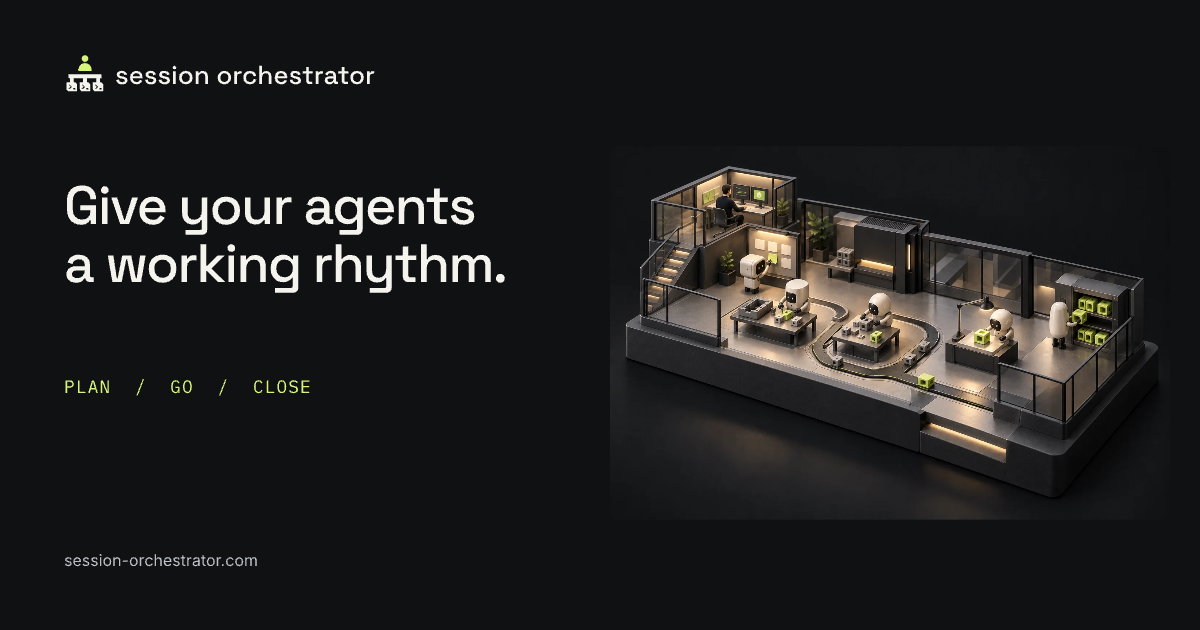
Give your agents a working rhythm. You type three commands: /session reads your repository, your open issues and the last session, proposes what to work on, and waits for your correction.

Plugin Signal88/100Strong
maintained100
capable91
documented100
adopted37
Install on Claude Code
> /plugin marketplace add Kanevry/session-orchestrator> /plugin install session-orchestrator@kanevry
Stats
52
Stars
7
Forks
Active
Maintenance
JavaScript
Language
MIT
License
1d ago
Last commit
5mo ago
Created
Repo: Kanevry/session-orchestrator
In this plugin
- skills
- architecture
- autopilot
- bootstrap
- brainstorm
- claude-md-drift-check
- close
- convergence-monitoring
- debug
- discovery
- dispatcher
- docs-orchestrator
- ecosystem-health
- eli5
- eval
- evolve
- frontmatter-guard
- gitlab-ops
- gitlab-portfolio
- go
- grill
- harness-audit
- hook-development
- mcp-builder
- memory-cleanup
- mode-selector
- npm-publish
- peekaboo-driver
- persona-panel
- plan
- playwright-driver
- portfolio
- quality-gates
- reconcile
- release
- remote-offload
- repo-audit
- session-end
- session-plan
- session-start
- spinout
- sunset-review
- test-runner
- test
- tmux-layout
- using-orchestrator
- ux-grill
- vault-mirror
- vault-sync
- wave-executor
- write-executable-plan
- agents
- commands
- MCP
What's inside
Skill(50 skills)
/architectureUse when the user asks to improve architecture, find refactoring opportunities, surface deepening opportunities, consolidate tightly-coupled modules, or make a codebase more testable and AI-navigable. Surfaces shallow modules and hypothetical seams using a precise vocabulary/autopilotUse this skill when running an autonomous session-orchestration loop. Chains session-start → session-plan → wave-executor → session-end for N iterations with all 10 kill-switches (SPIRAL, FAILED wave, carryover > 50%, max-hours, max-sessions, resource-overload, token-budget,/bootstrapUse this skill when scaffolding the minimum repository structure required by session-orchestrator. Invoked automatically by the Bootstrap Gate when CLAUDE.md, Session Config, or bootstrap.lock is missing. Also available as /bootstrap for manual invocation. Three intensity tiers:
- /brainstorm
- /claude-md-drift-check
- /close
- /convergence-monitoring
- /debug
- /discovery
- /dispatcher
- /docs-orchestrator
- /ecosystem-health
- /eli5
- /eval
- /evolve
- /frontmatter-guard
- /gitlab-ops
- /gitlab-portfolio
- /go
- /grill
- /harness-audit
- /hook-development
- /mcp-builder
- /memory-cleanup
- /mode-selector
- /npm-publish
- /peekaboo-driver
- /persona-panel
- /plan
- /playwright-driver
- /portfolio
- /quality-gates
- /reconcile
- /release
- /remote-offload
- /repo-audit
- /session-end
- /session-plan
- /session-start
- /spinout
- /sunset-review
- /test-runner
- /test
- /tmux-layout
- /using-orchestrator
- /ux-grill
- /vault-mirror
- /vault-sync
- /wave-executor
- /write-executable-plan
Agent(14 agents)
analystUse this agent for read-only PRD-quality review. Checks acceptance-criteria specificity, scope drift detection, and completeness of /plan output. <example>Context: /plan feature produced a PRD. user: "Review the PRD before /go." assistant: "I''ll dispatch analyst to checkarchitect-reviewerUse this agent for read-only architectural audits between waves. Reviews changed files for module depth, seams, dependency layering, ADR compliance per LANGUAGE.md vocabulary. <example>Context: After Impl-Core wave shipped 8 files. user: "Audit the W2 architecture beforecode-implementerUse this agent for feature implementation, API development, refactoring, and general code changes. Handles backend logic, API routes, service layers, and cross-cutting concerns. <example>Context: Wave plan assigns a new API endpoint implementation. user: "Implement CRUD API for
Command(2 commands)
Hook(10 hooks)
MCP(1 mcp)
Badges


README
Session Orchestrator
Give your agents a working rhythm.
You type three commands:
/sessionreads your repository, your open issues and the last session, proposes what to work on, and waits for your correction./goruns the agreed work in waves of parallel agents and runs your test, typecheck and lint commands between each wave. Work that fails a check goes back to be fixed before the next wave starts./closechecks every planned item against what actually happened, commits, and files the rest as issues for next time.
Session Orchestrator is a free, MIT-licensed workflow plugin for Claude Code, Codex CLI, Cursor IDE, or Pi. It runs on your machine and writes plain text into your repository. No account, no server, nothing to sign up for.
flowchart LR
    S["/session"] --> G["/go"]
    G --> Q{"quality gate"}
    Q -- "fails" --> G
    Q -- "passes" --> C["/close"]
Longer explanation, with examples and screenshots: session-orchestrator.com (auf Deutsch).
User guide · Install & upgrade · Changelog
Install
You need Node.js 24 or later, a git repository, and one of the four agents below. Full requirements, upgrade path and uninstall: docs/install.md.
| Platform | Install |
|---|---|
| Claude Code | /plugin marketplace add Kanevry/session-orchestrator then /plugin install session-orchestrator@kanevry, then install its Node dependencies once. |
| Codex CLI | git clone the repo, npm install, then node scripts/codex-install.mjs (guide). |
| Cursor IDE | git clone the repo, npm install, then node scripts/cursor-install.mjs /path/to/your/project (guide). |
| Pi | pi install npm:session-orchestrator (guide). |
Quick Start
1. Run /bootstrap once in your project. It creates the minimum structure and writes .orchestrator/bootstrap.lock. /session refuses to start until that file exists.
2. Add a Session Config to your project's instruction file — CLAUDE.md on Claude Code and Cursor, AGENTS.md on Codex CLI and Pi (which file each platform reads). These seven fields are enough:
## Session Config

test-command: npm test
typecheck-command: npm run typecheck
lint-command: npm run lint
agents-per-wave: 6
waves: 5
persistence: true
enforcement: warn
The first three are the commands /go runs between waves and /close runs at the end — use whatever your project actually uses. Everything else is opt-in: full template · every key, its type and default.
3. Run the loop.
/session feature    # read the repo, propose scope, wait for your correction
/go                 # execute in waves, check between each
/close              # verify, commit, file the rest as issues
On Codex the same three are $session-orchestrator:session feature, $session-orchestrator:go, $session-orchestrator:close (Codex usage). /plan and /evolve extend the loop; you can start with just these three.
In headless Claude Code (claude -p), /session and /plan are reserved terminal-only built-in names and the bare form is refused; use /session-orchestrator:session and /session-orchestrator:plan there. Every other command keeps its bare form.
How it works
When you type /session feature:
- It reads the project. Git state, open issues, recent commits, documentation, host resources and the records of previous sessions become a Session Overview with one recommendation.
- You correct the scope. Nothing is implemented until you agree to the plan.
- The work is split into waves. The session type decides how many: housekeeping 1, feature 3, deep 5, the ultradeep profile 7. Each wave gets a purpose, a list of file paths it may write to, and a result that can be checked.
/goruns it. Agents whose file scopes do not overlap run at the same time on Claude Code and Codex; Cursor and Pi run them one after another. After each wave the quality gate runs, and anything it reports goes back for correction before the next wave starts./closechecks and records. It compares the plan against what happened, runs the full quality gate, commits file by file, and opens issues for whatever was not finished.
What it writes into your repository, and nothing else — all of it plain text, all of it local:
.orchestrator/bootstrap.lock        # written by /bootstrap, the gate for every later run
.orchestrator/current-session.json  # which session owns this working copy right now
.orchestrator/session.lock          # heartbeat lock; stops two sessions colliding in one checkout
.orchestrator/host.json             # host-local identity for peer-session detection
.orchestrator/metrics/*.jsonl       # append-only session, learning, event and subagent records
.orchestrator/steering/             # stable product/tech/structure context injected each session
.claude/STATE.md                    # wave progress and deviations (harness-specific directory)
The plugin is 50 skills, 28 slash commands, 14 typed subagents and 27 hook files across 10 event types. A slash command is a skill whose frontmatter says user-invocable: true (26 of them) or one of the two remaining commands/*.md files (/session, /templates-ack) — one definition per name, so nothing is listed twice in the / picker. Skills, commands and agents are Markdown with YAML frontmatter; the code that dispatches, validates and records runs in scripts/lib/*.mjs and hooks/*.mjs. There is no build step and no compiled artifact — when a session does something you did not expect, you can open the file that decided it. Full inventory: docs/components.md.
Why it is built this way
- The wave order is deliberate. Discovery runs first so every implementer starts from the same picture of the code. Impl-Core runs before Impl-Polish so the structure exists before anything integrates against it. The Quality wave simplifies generated code before tests are written — write the tests first and they assert whatever the model produced, so changing it later means rewriting the tests too.
- Checks run between waves, not only at the end. A mistake caught after wave 2 costs one wave. The same mistake found at
/closehas already been copied into every wave after it. Findings below the configured confidence threshold are not shown to you. - A crash does not lose the session.
STATE.mdrecords which wave finished and what deviated from the plan. The next/sessionoffers to continue from the last completed wave. - Two sessions in one working copy is treated as a real risk. Two people, or two of your own sessions, in the same checkout share one git index, one filesystem and one
STATE.md, and neither can see the other's uncommitted work. A heartbeat session lock, per-agent file-scope manifests, and the PSA rules in.claude/rules/parallel-sessions.mdexist for exactly that case. - Guards run where the harness supports them, and the table below says where it does not. A destructive-command policy — 11 rules block, 4 warn — and file-scope enforcement run as real hooks on Claude Code, as bridges on Cursor and Pi, and as instructions only on Codex. Details:
docs/components.md. - What it learns is opt-in and readable. Every session appends a record. After 5 or more sessions,
/evolve analyzeproposes patterns with a confidence score; you read them and delete the ones you disagree with. Nothing is applied without you. - GitLab and GitHub, both fully. It detects which one your remote points at and drives issues and merge/pull requests for either.
How this compares to other orchestrators, with measured results kept separate from unmeasured claims: docs/components.md § Comparisons.
Platform support
| Feature | Claude Code | Codex CLI | Cursor IDE | Pi |
|---|---|---|---|---|
| All 28 commands | Native slash commands | Generated skills ($session-orchestrator:<name>) | Native .cursor/commands slash commands | Prompt templates |
| Parallel agents | Agent tool | Multi-agent roles | Sequential only | Sequential (parallel planned) |
| Session persistence | .claude/STATE.md | .codex/STATE.md | .cursor/STATE.md | .pi/STATE.md |
| Scope enforcement | Active PreToolUse hook; blocking in strict, reporting in warn | Instructions only; no compatible apply_patch handler | preToolUse + beforeShellExecution bridge; scope blocking requires strict; afterFileEdit is post-hoc | tool_call bridge; scope blocking requires strict |
| Destructive-command guard | Active PreToolUse hook applies policy severity | Instructions only; no handler wired | beforeShellExecution bridge for supported commands | tool_call bridge for supported commands |
| AskUserQuestion | Native tool | Numbered-list fallback | Numbered-list fallback | Numbered-list fallback |
| Quality gates | Full | Full | Full | Full |
All four platforms share the same skills, commands and scripts; only the hooks differ, because each harness fires different events. Codex leaves its PreToolUse handlers empty because these guards do not yet match its tool names and edit payloads (why). Cursor and Pi have known event-coverage limits — see docs/cursor-setup.md and docs/pi-setup.md.
Recent highlights (v5.2.0)
Highlights of the v5.2.0 line:
- One definition per slash command. 24
commands/*.mdtwins were folded into theirskills/<name>/SKILL.md; the/picker no longer lists duplicates,/discovery,/evolveand/planare live underclaude -pagain, and the Cursor, Pi and Codex wrappers are generated from oneuser-invocablereading (scripts/lib/user-invocable-skills.mjs) instead of four private ones. Operator-only commands (/close,/go,/release, …) keepdisable-model-invocationon every generated surface. - Expired generated rules can now be swept.
node scripts/sweep-expired-rules.mjs(dry-run by default,--applyto write) removes the prose of expired entries from the consolidated.claude/rules/files while keeping their provenance pairs, so/reconciledoes not re-propose the learning. It refuses symlinks and paths outside the rules directory, writes atomically, and reports the files it cannot map 1:1 instead of guessing. - Two guard holes closed. The issue-budget hook enumerates every shell loop, so an exempt first loop no longer lifts the bulk deny for a second one; the entry-guard validator now also censuses the bare
argv[1].endsWith('<file>.mjs')form.release.mjs --checkasks both CI platforms about the release commit's sha rather than GitHub's own HEAD.
Full changes and verification: CHANGELOG.md.
Documentation
- User guide — config reference, a walkthrough of one session, troubleshooting, FAQ
File tree
Showing a partial view of a very large repo.
FAQ
session-orchestrator is a Claude Code plugin with 50 hand-picked skills for development work, indexed on Flowy. Install it with the command on its page. It includes architecture, autopilot, bootstrap. Its skills do not fire on their own yet. Request auto-invocation to have Flowy route them as you prompt. Free and open source.
- What is session-orchestrator?
- Give your agents a working rhythm. You type three commands: /session reads your repository, your open issues and the last session, proposes what to work on, and waits for your correction.
- How do I install session-orchestrator?
- Run these in Claude Code: /plugin marketplace add Kanevry/session-orchestrator then /plugin install session-orchestrator@kanevry. Then prompt normally.
- Does session-orchestrator auto-invoke its skills?
- Not yet. It is indexed on Flowy as a plain plugin. Request auto-invocation on its page and Flowy will route its skills for you as you prompt.
- Is session-orchestrator free?
- Yes. Flowy is free and open source, with nothing gated. You can read every skill in full before you install.
Is this plugin yours?
Claim it with GitHubSubmit a pluginPromote it