
Agent Orchestration
Plugin
ccteam-creator
Multi-agent team orchestration skill for Claude Code. One skill, a full engineering team.

Plugin Signal43/100Fair
maintained22
capable23
documented100
adopted53
Install on Claude Code
> /plugin marketplace add jessepwj/CCteam-creator> /plugin install CCteam-creator@ccteam
What's inside
Skill(2 skills)
/CCteam-creator-cnSet up a complete agent team with file-based planning for complex multi-agent projects. Use when: (1) user asks to start a new complex project with a team/swarm, (2) user says "set up team", "create team", "build a team for X", "start project X", (3) user invokes/CCteam-creatorSet up a complete agent team with file-based planning for complex multi-agent projects. Use when: (1) user asks to start a new complex project with a team/swarm, (2) user says "set up team", "create team", "build a team for X", "start project X", (3) user invokes /CCteam-creator
README
CCteam-creator
Multi-agent team orchestration skill for Claude Code.
One skill, a full engineering team. CCteam-creator turns a single Claude Code session into a coordinated team of 2-6 AI agents — with built-in CI enforcement, code review, doc-code sync, and a taste feedback loop that encodes your preferences into automated checks. Human steers, agents execute.
Standing on the Shoulders of Giants
CCteam-creator is built upon outstanding open-source projects and engineering practices:
| Source | What We Learned |
|---|---|
| planning-with-files | Manus-style persistent markdown planning — the 3-file pattern (task_plan.md / findings.md / progress.md) that survives context compression. The "context window = RAM, file system = disk" philosophy. |
| everything-claude-code | Agent harness optimization by Anthropic hackathon winner. 13 expert agents, 40+ skills. Inspired our role-based agent design and skill structure. |
| mattpocock/skills | TDD vertical-slice philosophy, "design it twice" parallel sub-agent pattern, interface durability principles, and plan stress-testing methodology. |
| OpenAI Harness Engineering | The discipline of designing constraints, feedback loops, and documentation systems that make AI agents reliable at scale. Inspired our docs/ knowledge base, invariant-driven review, Doc-Code Sync, failure-to-guardrail loop, and anti-bloat principles. |
| Anthropic Harness Design | Anthropic Labs' research on multi-agent architectures for long-running autonomous coding. Three key lessons absorbed into CCteam-creator: (1) Evaluator calibration — out-of-the-box LLMs are poor QA agents that rationalize away issues; the fix is few-shot calibration anchors with concrete STRONG/WEAK examples, which shaped our Review Dimensions system. (2) Every harness component is an assumption — each mechanism encodes a belief about what the model can't do alone, and these assumptions go stale as models improve; this became our Assumption Audit checklist. (3) Generator-evaluator separation — separating the agent doing the work from the agent judging it is more tractable than making a generator self-critical, validating our existing dev/reviewer split and motivating the anti-leniency rule. |
What It Does
CCteam-creator sets up parallel AI agent teams in Claude Code. Instead of a single AI assistant, you orchestrate multiple specialized agents — developers, researchers, testers, reviewers — working together on your project.
When invoked, CCteam-creator:
- Consults with you — explains how agent teams work, understands your project, recommends a team
- Sets up everything — planning files, docs/ knowledge base, CLAUDE.md operations guide, agent onboarding
- Manages collaboration — agents communicate directly, persist state to files, follow built-in protocols
How It Works — Full Lifecycle
Here's a complete walkthrough of how CCteam-creator operates, from first invocation to project completion and session resume.
Phase 1: Setup (First Session)
You: "Set up a team for my e-commerce project"

┌─ Step 1: Consultation ──────────────────────────────────┐
│ team-lead (Claude) asks about:                          │
│ - Project goals and deliverables                        │
│ - Task type (software, research, etc.)                  │
│ - Current state (greenfield or existing code)           │
│ - Quality priorities → become Review Dimensions         │
│ team-lead recommends: backend-dev + frontend-dev +      │
│   researcher + reviewer (4 agents)                      │
└─────────────────────────────────────────────────────────┘
         ↓ user confirms
┌─ Step 2-3: File Creation ───────────────────────────────┐
│ Creates .plans/ecommerce/ with:                         │
│   task_plan.md, decisions.md, docs/, per-agent dirs     │
│ Generates CLAUDE.md (always in context, survives        │
│   compressions — the team's persistent memory)          │
└─────────────────────────────────────────────────────────┘
         ↓
┌─ Step 4: Spawn & Snapshot ──────────────────────────────┐
│ Spawns all agents in parallel with onboarding prompts   │
│ Saves team-snapshot.md (complete onboarding prompts     │
│   + skill file timestamps → enables fast resume)        │
└─────────────────────────────────────────────────────────┘
Phase 2: Collaboration (Working Session)
┌─ team-lead (you + Claude main session) ─────────────────┐
│                                                         │
│  Dispatches tasks via SendMessage:                      │
│  ┌──────────────┐  ┌──────────────┐                     │
│  │ researcher   │  │ backend-dev  │                     │
│  │ explores     │  │ waits for    │                     │
│  │ codebase     │  │ research     │                     │
│  └──────┬───────┘  └──────┬───────┘                     │
│         │ findings.md     │                             │
│         └────────────────→│ reads findings,             │
│                           │ confirms understanding,     │
│                           │ then builds feature         │
│                           └──────┬───────┐              │
│                                  │       ↓              │
│                           ┌──────┴──┐ ┌─────────┐       │
│                           │ request │ │ reviewer │       │
│                           │ review  │→│ scores   │       │
│                           │(direct) │ │ dims +   │       │
│                           └─────────┘ │ issues   │       │
│                                       └──┬──────┘       │
│  Key behaviors:                          │              │
│  • Dev confirms understanding before     │              │
│    starting large tasks                  │              │
│  • Dev escalates ambiguous/irreversible  │              │
│    decisions with options + recommendation│              │
│  • Reviewer scores project-specific      │              │
│    dimensions with anti-leniency rule    │              │
│  • All progress persists to .plans/ files│              │
└──────────────────────────────────────────┘
Phase 3: Resume (Next Session)
You: exit Claude Code, come back later
You: "Resume my e-commerce project"

┌─ Fast Resume Path ──────────────────────────────────────┐
│ 1. CLAUDE.md auto-loads → team-lead knows the roster    │
│ 2. Reads team-snapshot.md header → checks timestamps    │
│    ┌─ skill files unchanged? ──→ use cached prompts     │
│    └─ skill files updated?   ──→ ask: cache or re-read? │
│ 3. Spawns agents from snapshot (skips ~2500 lines)      │
│ 4. Each agent reads own .plans/ files → resumes work    │
└─────────────────────────────────────────────────────────┘

No work is lost. All state lives in .plans/ files.
Phase Boundaries: Harness Checks
At the end of each phase, team-lead runs two types of checks:
- Operational Health — are docs fresh? are progress files maintained? any new Known Pitfalls?
- Assumption Audit — is each harness component (task folders, 3-Strike, context recovery, reviewer pass) still adding value, or can it be simplified?
In Action
Screenshots from a real project session (ChatR — a full-stack chat application with event-driven observability).
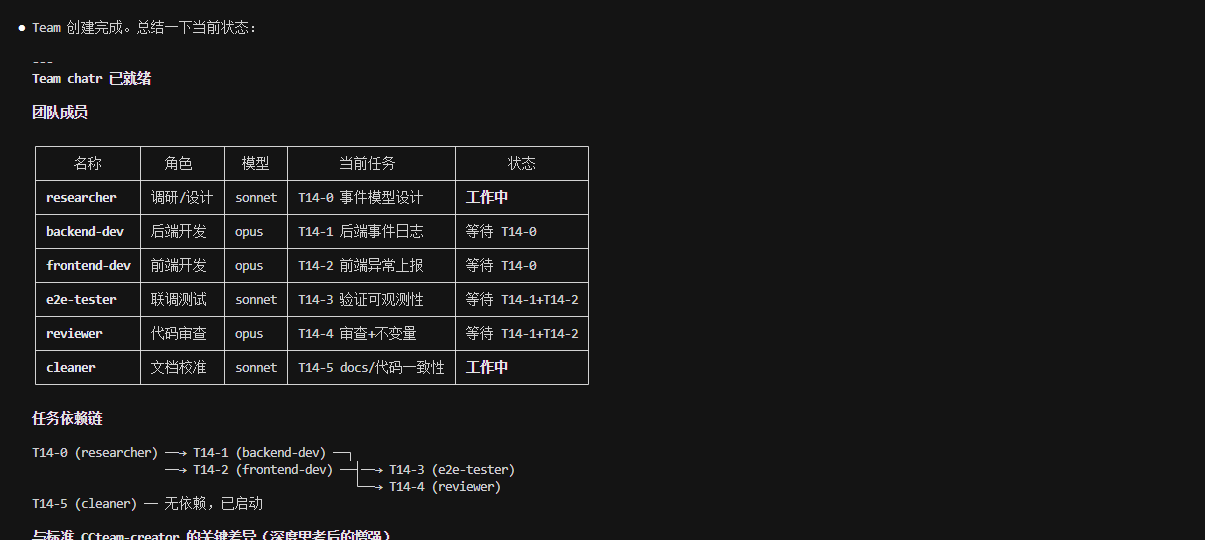
1. Team Roster & Dependency Chain
After setup, team-lead summarizes the team roster, task assignments, and dependency graph. All agents receive their onboarding and begin preparing.
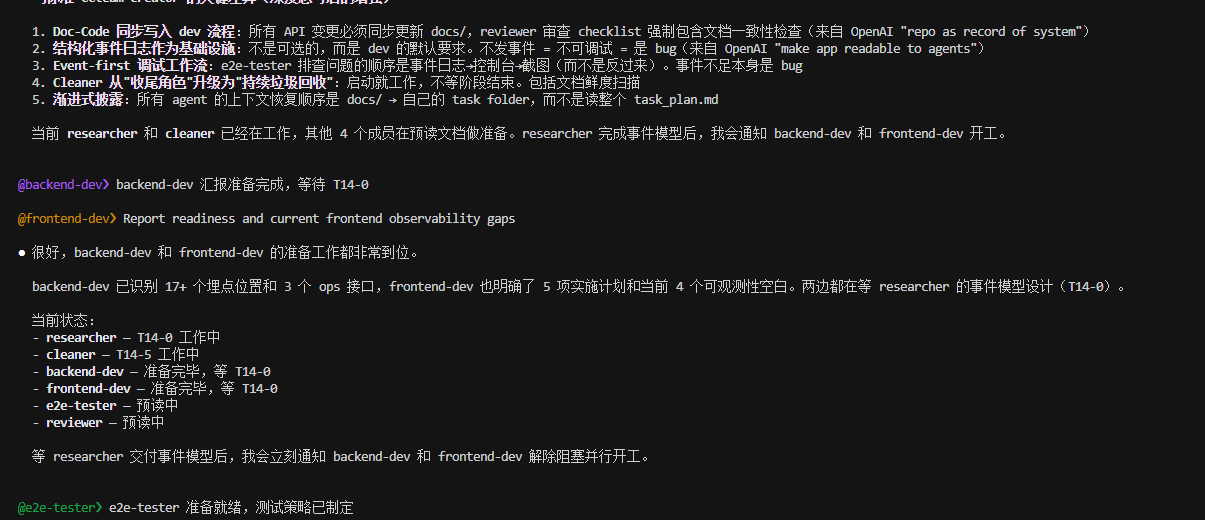
2. Parallel Task Dispatch
Team-lead orchestrates 6 agents simultaneously — researcher and custodian start immediately (no dependencies), while devs prepare and wait for research output. Each agent knows its dependencies.
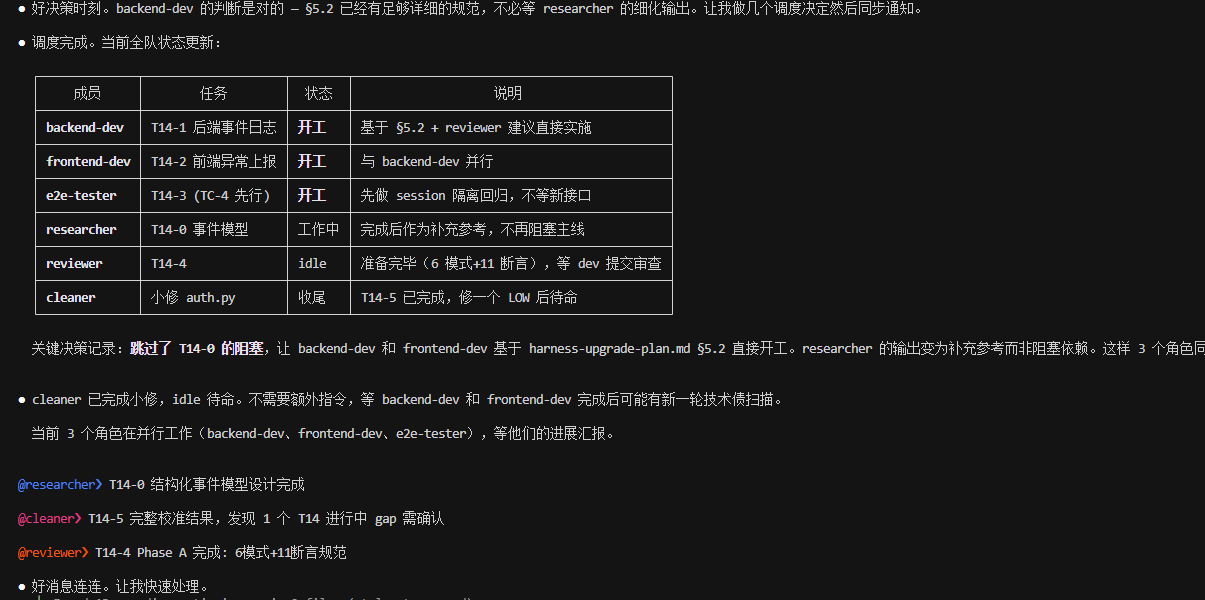
3. Development Phase — 3 Agents Working in Parallel
Backend-dev, frontend-dev, and e2e-tester all working concurrently. Team-lead tracks status, makes scheduling decisions (e.g., bypassing a dependency when enough info is available), and coordinates handoffs.
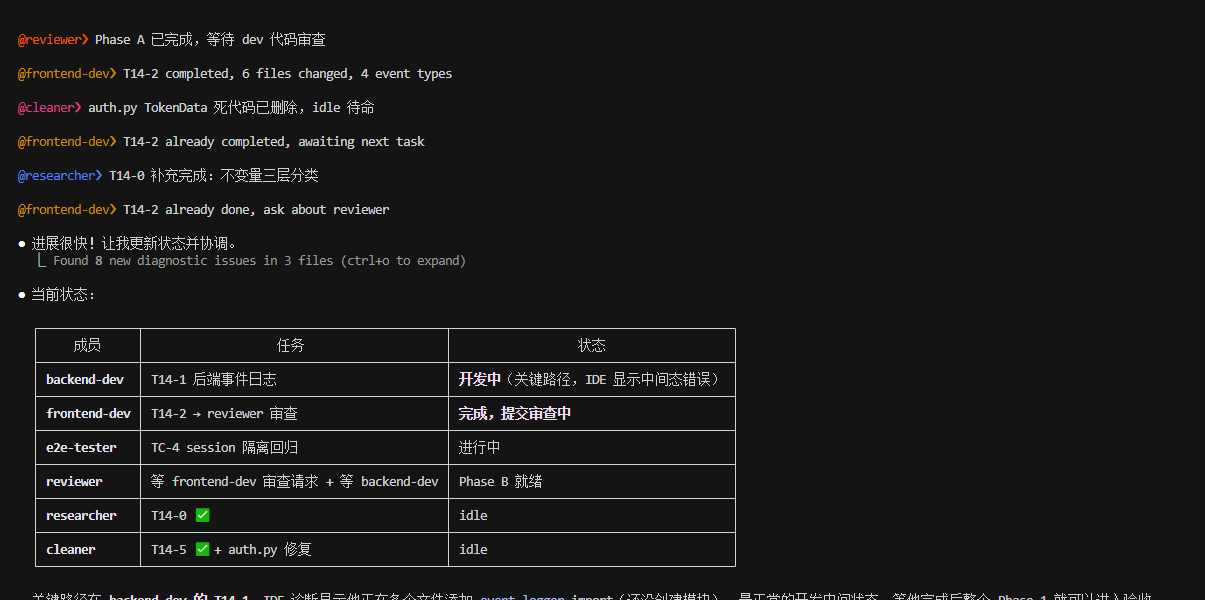
4. Code Review & Peer Coordination
Agents communicate directly — frontend-dev submits to reviewer, reviewer reports completion, team-lead tracks the status table with real-time progress from all 6 agents.
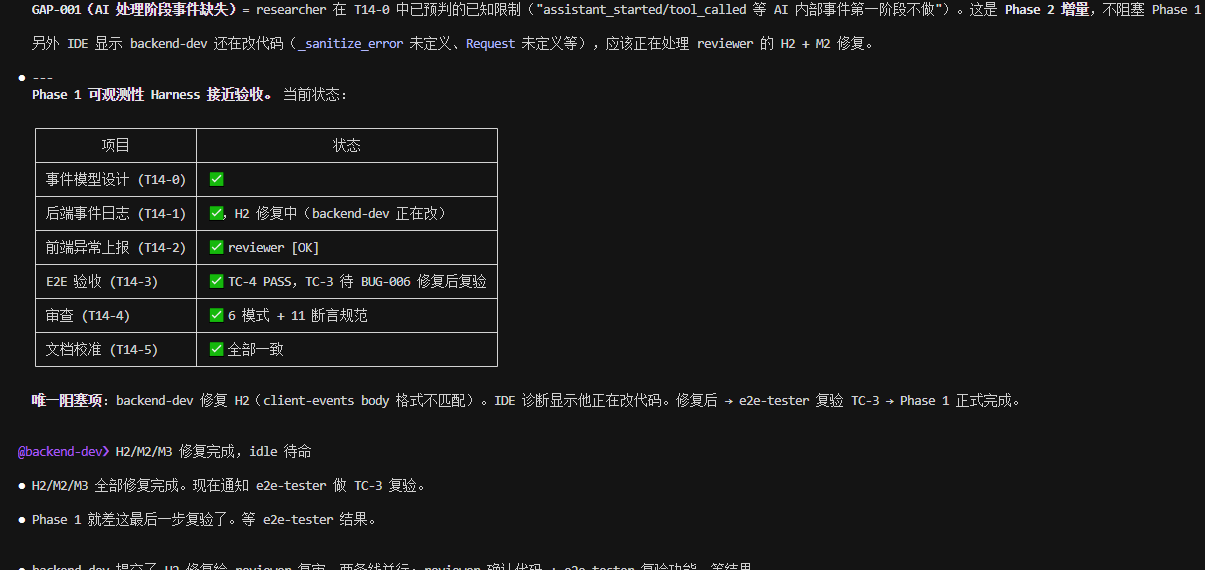
5. Phase Harness Validation
Team-lead runs a phase-level harness check — verifying each task's completion status, reviewer verdicts, e2e test results, and doc consistency before advancing to the next phase.
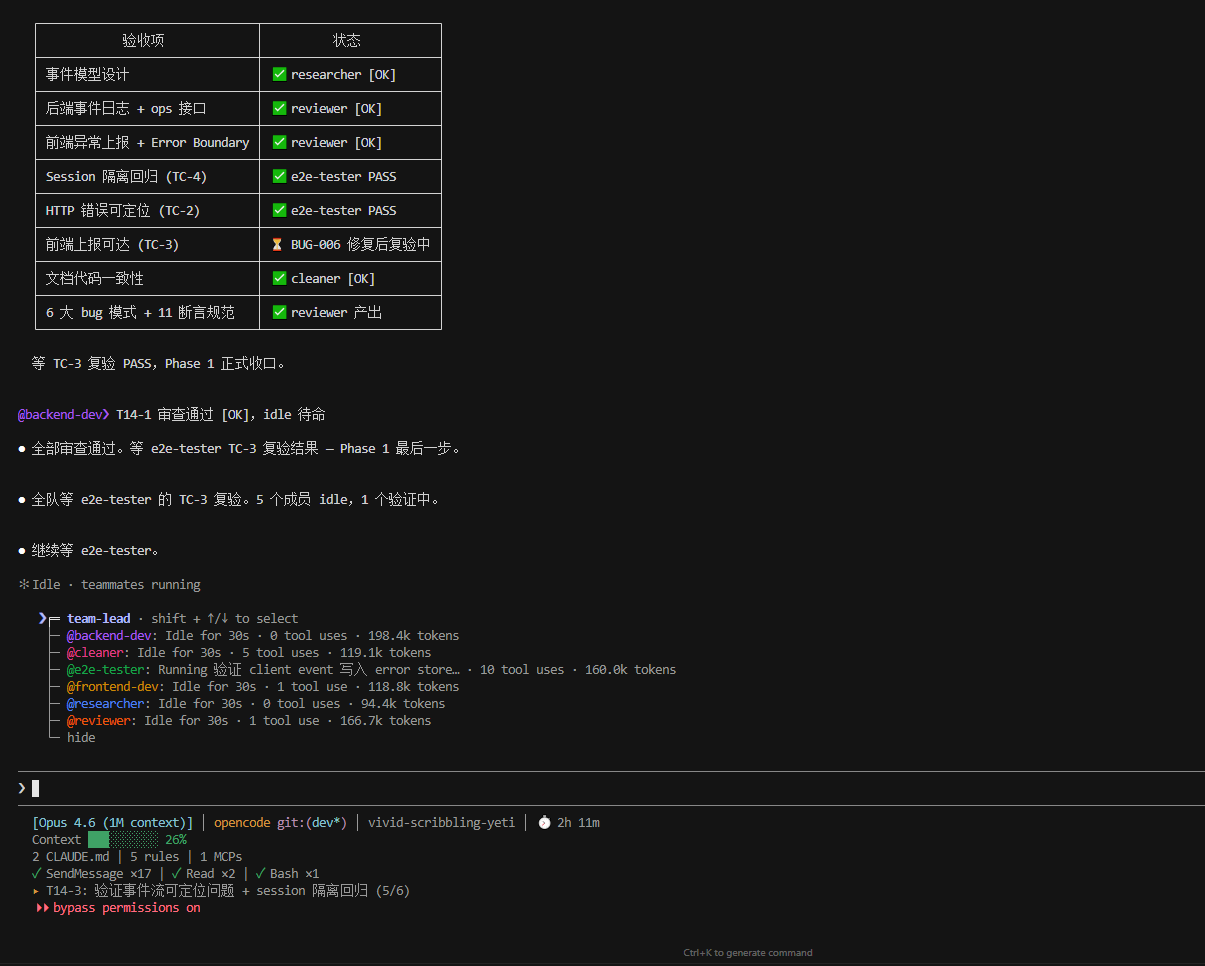
6. Final Dashboard — All Agents, One View
The complete validation checklist with reviewer [OK], e2e-tester PASS/FAIL status, and doc consistency verification. Bottom shows Claude Code's real-time agent HUD with all 6 teammates and their token usage.
Prerequisites
Agent teams are an experimental feature in Claude Code. Enable them first:
# Option A: Environment variable
export CLAUDE_CODE_EXPERIMENTAL_AGENT_TEAMS=1

# Option B: In ~/.claude/settings.json
{
  "env": {
    "CLAUDE_CODE_EXPERIMENTAL_AGENT_TEAMS": "1"
  }
}
Installation
Important: Install either the English OR Chinese version — not both.
Option 1: Marketplace (Recommended)
# Step 1: Add the marketplace (in Claude Code)
/plugin marketplace add jessepwj/CCteam-creator

# Step 2: Install — choose ONE language
/plugin install CCteam-creator@ccteam        # English
/plugin install CCteam-creator-cn@ccteam     # Chinese
Option 2: Manual Install (Direct Skill Copy)
If you prefer not to use the marketplace, just clone the repo and copy the skill folder directly into your local skills directory. After this, the skill appears directly in ~/.claude/skills/ and can be invoked with /CCteam-creator (or /CCteam-creator-cn) — no /reload-plugins needed.
git clone https://github.com/jessepwj/CCteam-creator.git

# English (recommended)
cp -r CCteam-creator/skills/CCteam-creator ~/.claude/skills/CCteam-creator

# Or Chinese
cp -r CCteam-creator/cn/skills/CCteam-creator-cn ~/.claude/skills/CCteam-creator-cn
Then restart Claude Code once (skills are discovered at session start). After restart:
- Slash command:
/CCteam-creatoror/CCteam-creator-cn - Natural language: "set up a team for my project" / "帮我搭建一个团队"
To update later: cd into the cloned repo, run git pull, and re-run the cp -r command above. The skill's built-in Step 0 Update Check will notify you inline when a new version is available on GitHub.
Option 3: Project-level Install
Share with your team via a project-local skills directory. Copy into the project's .claude/skills/:
# English
cp -r CCteam-creator/skills/CCteam-creator .claude/skills/CCteam-creator

# Or Chinese
cp -r CCteam-creator/cn/skills/CCteam-creator-cn .claude/skills/CCteam-creator-cn
Usage
> Set up a team for my e-commerce project
> /CCteam-creator
> Build a REST API with a team
The slash command is
/CCteam-creator(or/CCteam-creator-cnfor the Chinese variant). Natural language triggers also work — just ask to "set up a team" or similar. If you invoke via the Skill tool directly, use the full namespace:Skill(CCteam-creator:CCteam-creator).
Trigger keywords: team, swarm, start project, set up project, create team, build team, multi-agent project.
Available Roles
| Role | Name | Model | Key Capabilities |
File tree
FAQ
ccteam-creator is a Claude Code plugin with 2 hand-picked skills, indexed on Flowy in the Agent Orchestration category. Install it with the command on its page. It includes CCteam-creator-cn, CCteam-creator. Its skills do not fire on their own yet. Request auto-invocation to have Flowy route them as you prompt. Free and open source.
- What is ccteam-creator?
- Multi-agent team orchestration skill for Claude Code. One skill, a full engineering team.
- How do I install ccteam-creator?
- Run these in Claude Code: /plugin marketplace add jessepwj/CCteam-creator then /plugin install CCteam-creator@ccteam. Then prompt normally.
- Does ccteam-creator auto-invoke its skills?
- Not yet. It is indexed on Flowy as a plain plugin. Request auto-invocation on its page and Flowy will route its skills for you as you prompt.
- Is ccteam-creator free?
- Yes. Flowy is free and open source, with nothing gated. You can read every skill in full before you install.
Is this plugin yours?
Claim it with GitHubSubmit a pluginPromote it