
Research
Plugin
night-owl-research-agent
A fully automatic, domain-aware AI research agent for Geoscientists, Remote Sensing researchers, and GIScientists — powered entirely by Claude Code skills.

Plugin Signal54/100Fair
maintained28
capable76
documented75
adopted43
Install
$ npx -y skills add grind-lab-core/night_owl_research_agent --agent claude-code
Stats
107
Stars
25
Forks
Maintained
Maintenance
Python
Language
5mo ago
Last commit
6mo ago
Created
3h ago
Added
In this plugin
- skills
- auto-review-loop
- data-download
- deploy-experiment
- experiment-design-pipeline
- experiment-design
- full-pipeline
- generate-idea
- generate-report
- idea-discovery-pipeline
- idea-review
- lit-review
- novelty-check
- paper-covert
- paper-draft
- paper-figure-generate
- paper-plan
- paper-review-loop
- paper-writing-pipeline
- refine-research
- spatial-analysis
- submit-check
- training-check
- agents
- MCP
- commands
What's inside
Skill(22 skills)
/auto-review-loopAdversarial iterative review loop with generator-evaluator separation. Up to 4 rounds of independent review, improvement, and re-evaluation. Persists state to output/REVIEW_STATE.json for recovery. Stop: score ≥ 7.5/10 on all dimensions, or 4 rounds. Writes full history to/data-downloadDiscover, evaluate, and download publicly available datasets from the internet. Infers data needs from a research question or task, selects authoritative sources, downloads reproducibly, validates file integrity, and documents provenance. Pauses for user input when/deploy-experimentDeploy and run experiments for ML/DL training (local, remote, or Modal GPU) AND spatial data science / GIScience experiments (local, data-driven). Reads from output/refine-logs/EXPERIMENT_PLAN.md and output/refine-logs/FINAL_PROPOSAL.md, writes to output/experiment/. Use when
- /experiment-design-pipeline
- /experiment-design
- /full-pipeline
- /generate-idea
- /generate-report
- /idea-discovery-pipeline
- /idea-review
- /lit-review
- /novelty-check
- /paper-covert
- /paper-draft
- /paper-figure-generate
- /paper-plan
- /paper-review-loop
- /paper-writing-pipeline
- /refine-research
- /spatial-analysis
- /submit-check
- /training-check
Agent(9 agents)
citation-managerAPA 7th edition citation formatting and reference validation agent. Use this agent to: - Format all references in APA 7th edition - Validate in-text citations match reference list - Check DOI availability and format - Detect orphan citations and missing references - Produce agap-finderResearch gap identification agent for geo/RS/GIScience papers. Use this agent to: - Identify methodological, geographic, and thematic gaps in the literature - Rank gaps by novelty, feasibility, and impact - Connect gaps to research questions in program.md - Output a ranked gapgeo-specialistGeospatial domain expert agent that injects spatial analysis context into the research pipeline. Use this agent to: - Recommend appropriate spatial methods for the research question - Suggest open-source datasets with spatial coverage and resolution - Review spatial analysis
README
NORA (Night Owl Research Agent)
A fully automatic, domain-aware AI research agent for Geoscientists, Remote Sensing researchers, and GIScientists — powered entirely by Claude Code skills.
Quick Start
NORA runs inside Claude Code. There is no Python entry point, no server to spin up, and no build step — you just drop the skills into Claude Code's skill directory and invoke the launcher.
Step 1 — Install Claude Code
Install Claude Code first. Any of the official distributions works:
- CLI (recommended):
npm install -g @anthropic-ai/claude-code claude --version - Desktop app (macOS / Windows): download from https://claude.com/claude-code
- VS Code extension: install "Claude Code" from the Marketplace
- Web: https://claude.ai/code
Sign in once with your Anthropic account so Claude Code can reach the API.
Step 2 — Get NORA onto your machine
git clone https://github.com/GRIND-Lab-Core/night_owl_research_agent.git
cd night_owl_research_agent
Step 3 — Install the skills into Claude Code
Claude Code looks for skills under ~/.claude/skills/ (user-level, available in every project) or <project>/.claude/skills/ (project-local). Copy the entire skills/ folder from this repo into one of those locations.
macOS / Linux (user-level — recommended):
mkdir -p ~/.claude/skills
cp -R skills/* ~/.claude/skills/
Windows PowerShell (user-level):
New-Item -ItemType Directory -Force -Path "$env:USERPROFILE\.claude\skills" | Out-Null
Copy-Item -Recurse -Force .\skills\* "$env:USERPROFILE\.claude\skills\"
Windows bash / Git Bash:
mkdir -p "$USERPROFILE/.claude/skills"
cp -R skills/* "$USERPROFILE/.claude/skills/"
Project-local alternative (skills only visible when Claude Code is opened in this folder):
mkdir -p .claude/skills
cp -R skills/* .claude/skills/
Also copy the launcher slash command so /launcher is available:
# macOS / Linux
mkdir -p ~/.claude/commands
cp .claude/commands/launcher.md ~/.claude/commands/
# Windows PowerShell
New-Item -ItemType Directory -Force -Path "$env:USERPROFILE\.claude\commands" | Out-Null
Copy-Item -Force .\.claude\commands\launcher.md "$env:USERPROFILE\.claude\commands\"
Verify the install — open Claude Code and run:
/skills
You should see the NORA skills (full-pipeline, lit-review, idea-discovery-pipeline, deploy-experiment, paper-draft, …) listed.
Step 4 — Start a research session
Open the night_owl_research_agent folder in Claude Code (this gives NORA access to CLAUDE.md, RESEARCH_PLAN.md, output/, memory/, and tools/), then pick one of the two entry points:
Option A — interactive launcher (best for first-time users):
/launcher
The launcher walks you through a short questionnaire — research topic, stage to start from, control flags (AUTO_PROCEED, HUMAN_CHECKPOINT, COMPACT_MODE, REVIEWER_DIFFICULTY) — and routes to the correct skill.
Option B — end-to-end pipeline (best when you already know what you want to run):
Skill: full-pipeline
"Your research direction here, e.g. 'urban soundscape inequality via street-view + audio foundation models'"
or, if you prefer a slash-style invocation:
/full-pipeline "your research direction"
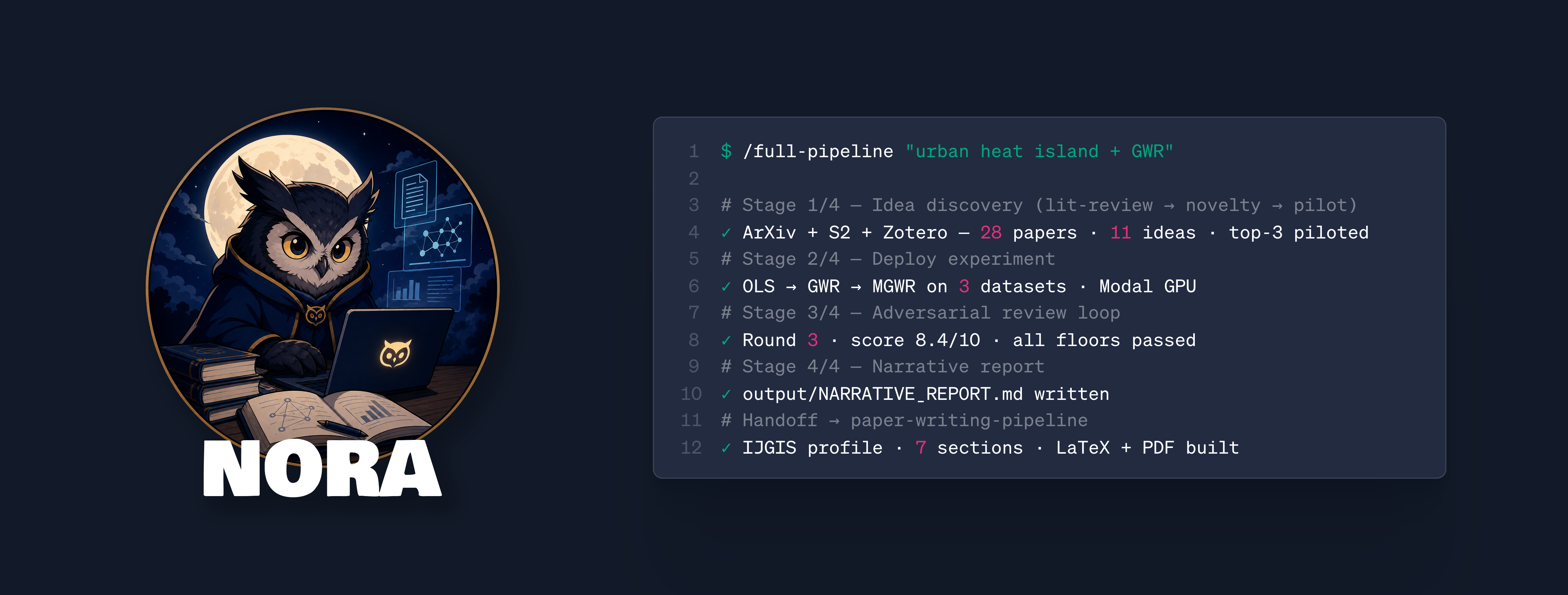
full-pipeline chains all four stages:
idea-discovery-pipeline → deploy-experiment → auto-review-loop → generate-report
and then hands off to paper-writing-pipeline for the manuscript.
Tip: for reproducibility, fill in RESEARCH_PLAN.md (or BRIEF.md) in the project root before launching. When either file is present, skills read it as the authoritative brief and ignore conflicting $ARGUMENTS.
Step 5 — (Optional) Enable extras
- MCP servers — edit
.mcp.jsonand register with Claude Code (/mcpinside the chat) to enablefilesystem,fetch,arxiv_mcp,geo_mcp,github, andbrave_search. Seemcp/README_MCP.md. - Hooks —
settings.jsonwiresharness/hooks/*.shinto Claude Code's lifecycle (writeshandoff.jsonon session end, validates tool use, sends desktop notifications). On Windows, run the hook scripts via Git Bash or WSL. - W&B — if your experiments use Weights & Biases, run
wandb loginonce on the host wheredeploy-experimentwill launch training. - API keys — set
ANTHROPIC_API_KEY(for Claude Code), plus any optional keys you want to use (SEMANTIC_SCHOLAR_API_KEY,GITHUB_TOKEN,BRAVE_API_KEY).
Prerequisites summary
| Requirement | Why |
|---|---|
| Claude Code (CLI / desktop / web / VS Code) | Runtime for skills |
| Anthropic account + API credit | Powers the agent |
Python 3.10+ with pip install arxiv requests | tools/arxiv_fetch.py, tools/semantic_scholar_fetch.py |
Conda env with geopandas, pysal, libpysal, esda, spreg, mgwr, rasterio, xarray | Track B (spatial) experiments |
| CUDA GPU (local / remote SSH / Modal) | Track A (deep-learning) experiments — optional |
What It Does
NORA automates the complete academic research lifecycle using Claude Code skills — Markdown-defined workflows that Claude reads and executes, selecting appropriate tools and methods based on context.
- Literature review — searches ArXiv, Semantic Scholar, local papers, Zotero, and Obsidian; synthesizes findings and identifies ranked research gaps.
- Idea discovery — generates 8–12 research ideas from literature gaps, validates novelty via multi-source search + external reviewer, and pilot-tests the top candidates. Pilots run a mandatory local-GPU presence check first (
nvidia-smi→ CUDA, then MPS, thennone); when a local GPU is detected, every pilot launches on it instead of silently falling back to CPU or remote. - Method refinement — iteratively refines vague research directions into problem-anchored, implementation-ready proposals via adversarial review (up to 5 rounds, score ≥ 9 target).
- Experiment design & execution — produces claim-driven experiment roadmaps and deploys to local, remote SSH, or Modal serverless GPU (Track A), or runs spatial/GIScience methods on CPU (Track B), or both for mixed GeoAI. The same mandatory local-GPU check runs at Step 0 of
deploy-experimentso any ML/DL workload (pilot or full) executes on the local GPU when present. - Data acquisition — discovers, evaluates, downloads, validates, and documents datasets from government portals, APIs, cloud archives, and open repositories with full provenance.
- Spatial analysis — guideline-driven: classifies the analytical objective, runs ESDA, and applies geospatial diagnostics conditionally on the research question. MAUP discussion, GWR/MGWR, residual Moran's I, alternative spatial weights, and spatial CV are triggered only when the claim depends on them; when in doubt the skill pauses for a human checkpoint instead of running heavyweight checks (or skipping reviewer-expected ones) by reflex.
- Adversarial review — up to 4 rounds of generator–evaluator-separated review with per-criterion hard floors;
medium/hard/nightmarereviewer modes via Codex MCP,codex exec, or a Claude subagent. Domain personas (giscience,remote-sensing,spatial-data-science) apply geo-specific must-checks only where the paper's claims actually depend on them instead of penalizing every paper for missing MAUP / GWR discussion. - Report + paper writing — consolidates every pipeline artifact into
output/NARRATIVE_REPORT.md, then runspaper-writing-pipelineto produce a journal-ready manuscript (Markdown → LaTeX → PDF/DOCX) with journal-specific profiles for IJGIS, IEEE TGRS, ISPRS JPRS, RSE, AAG, TGIS, and more.
Architecture
NORA is a skills-first system. All research logic lives in Markdown skill files that Claude reads and executes.
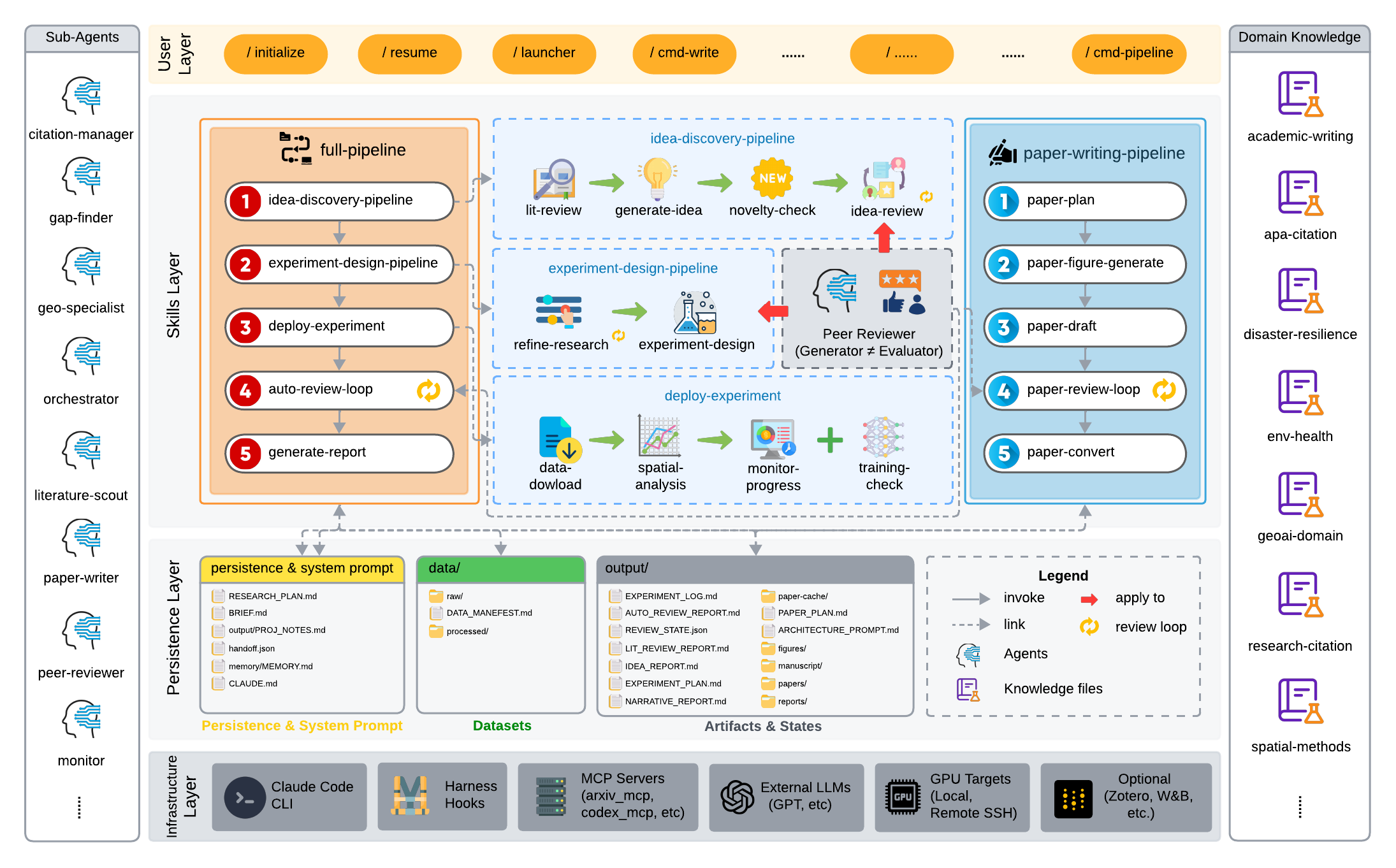
Skills describe workflow logic in Markdown. Claude reads a skill to understand the workflow, then decides the exact sequence of actions based on context — the skill provides guidelines and decision frameworks, not rigid procedures.
You (or /launcher)
    ↓ invokes
Skill SKILL.md  ←─── reads domain knowledge from skills/knowledge/
    ↓ Claude decides what to do
CLI tools (tools/arxiv_fetch.py, etc.) + inline Python + MCP servers as needed
    ↓ produce
Output files (reports, paper-cache, figures, manuscript)
    ↓ read by
Next skill in pipeline
The single installed slash command is /launcher. Every other skill is invoked by name (Claude Code's native Skill tool) or by being called internally from another skill.
Skills
23 workflow skills in skills/ plus domain knowledge in skills/knowledge/. Each skill is a self-contained Markdown workflow file.
Workflow Skills
| Skill | What it does |
|---|---|
full-pipeline | Master pipeline: idea discovery → experiment → review → report → paper |
lit-review | Search + synthesize + gap analysis (ArXiv, Semantic Scholar, local papers, Zotero, Obsidian) |
idea-discovery-pipeline | Full idea pipeline: lit-review → generate-idea → novelty-check → idea-review → experiment-design-pipeline |
generate-idea | Brainstorm 8–12 ideas, filter, pilot-test top 3, rank (called by idea-discovery-pipeline) |
novelty-check | Verify idea novelty via multi-source search + external reviewer |
idea-review | External critical review of research ideas (Codex MCP) |
refine-research | Iterative method refinement via external review (up to 5 rounds, score ≥ 9) |
experiment-design | Claim-driven experiment roadmap with run order, budget, decision gates |
experiment-design-pipeline | One-shot wrapper: refine-research → experiment-design |
deploy-experiment | Deploy experiments — mandatory local-GPU check at Step 0, then Track A (GPU ML) and/or Track B (CPU spatial) |
data-download | Discover, evaluate, download datasets with provenance tracking |
spatial-analysis | Research-question-driven spatial analysis: classification → ESDA → method → conditional diagnostics → interpretation, with a human checkpoint before adding or skipping heavyweight spatial checks |
auto-review-loop | Up to 4 adversarial review rounds with per-criterion floors |
generate-report | Consolidate lit-review + idea + experiment + review artifacts into output/NARRATIVE_REPORT.md |
paper-writing-pipeline | Orchestrates paper-plan → paper-figure-generate → paper-draft → paper-review-loop → paper-covert |
paper-plan | Build section outline + figure plan (output/PAPER_PLAN.md) |
paper-figure-generate | Generate publication-quality figures, maps, diagrams, and captions |
paper-draft | Turn output/PAPER_PLAN.md into a journal-quality Markdown manuscript |
paper-review-loop | Reviewer-editor review of the draft manuscript and iterative revision |
paper-covert | Convert final manuscript into venue submission package (modular LaTeX, PDF, DOCX) |
submit-check | Validate manuscript against target-journal requirements |
training-check | Monitor running experiments for stalls/failures |
Domain Knowledge
| File | Domain |
|---|---|
spatial-methods.md | Spatial statistics, regression, autocorrelation |
geoai-domain.md | GeoAI, spatial deep learning, foundation models |
academic-writing.md | Academic writing conventions |
apa-citations.md | APA 7th edition citation formatting |
disaster-resilience.md | Disaster management, community resilience |
environmental-health.md | Environmental epidemiology, exposure assessment |
literature-mining.md | Literature search and synthesis strategies |
research-iteration.md | Iterative research refinement patterns |
Control Flags
Edit CLAUDE.md before starting a long run:
File tree
FAQ
night-owl-research-agent is a Claude Code plugin with 22 hand-picked skills, indexed on Flowy in the Research category. Install it with the command on its page. It includes auto-review-loop, data-download, deploy-experiment. Its skills do not fire on their own yet. Request auto-invocation to have Flowy route them as you prompt. Free and open source.
- What is night-owl-research-agent?
- A fully automatic, domain-aware AI research agent for Geoscientists, Remote Sensing researchers, and GIScientists — powered entirely by Claude Code skills.
- How do I install night-owl-research-agent?
- Run these in Claude Code: npx -y skills add grind-lab-core/night_owl_research_agent --agent claude-code. Then prompt normally.
- Does night-owl-research-agent auto-invoke its skills?
- Not yet. It is indexed on Flowy as a plain plugin. Request auto-invocation on its page and Flowy will route its skills for you as you prompt.
- Is night-owl-research-agent free?
- Yes. Flowy is free and open source, with nothing gated. You can read every skill in full before you install.
Is this plugin yours?
Claim it with GitHubSubmit a pluginPromote it