Claude plans. Cursor writes. Claude reviews. A Claude Code plugin that delegates coding execution to Cursor's Composer — without ever leaving the Claude Code TUI.
FAQ
cursor-plugin-cc is a Claude Code plugin with 1 hand-picked skill for development work, indexed on Flowy. Install it with the command on its page. It includes composer-prompting. Its skills do not fire on their own yet. Request auto-invocation to have Flowy route them as you prompt. Free and open source.
> /plugin marketplace add freema/cursor-plugin-cc> /plugin install cursor@tomas-cursor
Repo: freema/cursor-plugin-cc
Claude plans. Cursor writes. Claude reviews. A Claude Code plugin that delegates coding execution to Cursor's Composer — without ever leaving the Claude Code TUI.

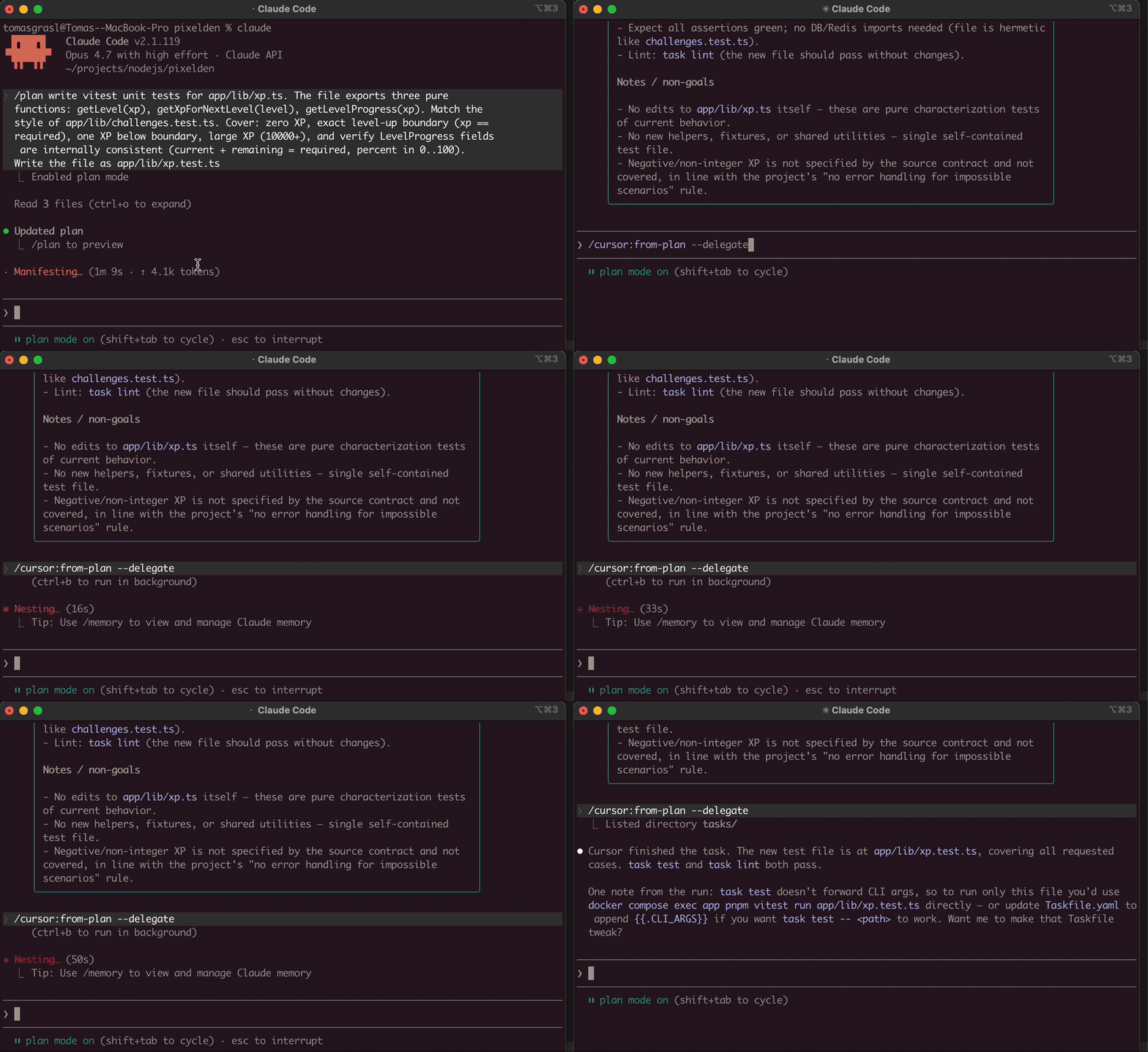
you ▸ /plan add a /health endpoint to our Express app that returns { status, version, uptime }
claude ▸ Plan written to ~/.claude/plans/health-endpoint.md
(4 acceptance criteria, 3 files to touch, verify with `npm test`)
you ▸ /cursor:from-plan --delegate
plugin ▸ wrote tasks/20260427-1830-health-endpoint.md
▸ handing off to cursor-agent (composer-2.5-fast, --force)…
cursor ▸ ✓ src/routes/health.ts (new, 24 lines)
▸ ✓ src/app.ts (mounted route)
▸ ✓ tests/health.test.ts (new, 3 passing)
▸ done in 11s · chat_id=V1StGXR8_Z
you ▸ review the diff
claude ▸ LGTM. Nit: hard-coded "1.0.0" — pull from package.json instead.
you ▸ /cursor:resume "read version from package.json"
cursor ▸ ✓ src/routes/health.ts (1 line changed)
▸ ✓ tests/health.test.ts (assertion updated, still passing)
▸ done in 4s
That's the whole loop. Claude does the thinking (plan, review). Cursor does the typing (file edits, tests). You stay in one TUI.
Why this is fast: composer-2.5-fast is Cursor's tuned-for-CLI variant — it ships small, well-scoped changes in seconds. Claude Code spends its tokens on planning and reviewing, where thinking actually matters. Two tools, each doing what they're best at.
Preferred — from GitHub:
/plugin marketplace add freema/cursor-plugin-cc
/plugin install cursor@tomas-cursor
/reload-plugins
/cursor:setup
Local, for hacking on the plugin from a checkout:
/plugin marketplace add /Users/you/path/to/cursor-plugin-cc
/plugin install cursor@tomas-cursor
/reload-plugins
/cursor:setup
⚠️ Do not skip
/reload-plugins. Right after/plugin installthe/cursor:*commands are NOT yet available — Claude Code only picks them up after a plugin reload. If you seeUnknown command: /cursor:setup, you forgot this step — run/reload-pluginsand try again.
The plugin ships as plain ESM JavaScript with zero runtime dependencies — just the Node stdlib. /plugin install is literally all you need; no npm install, no build step, no dist/ folder. Each slash command runs node "${CLAUDE_PLUGIN_ROOT}/scripts/<cmd>.mjs" directly from the committed source.
The first /cursor:setup run tells you if cursor-agent is missing or unauthenticated. For hacking on the plugin itself (tests, lint, formatting), see Contributing below.
--model auto or other entitled modelscursor-agent on your PATH — install via curl https://cursor.com/install -fsS | bashcursor-agent login completed at least onceThis is the entire happy path. Three commands inside Claude Code:
┌──────────────────────────────────────────────────────────────────┐
│ 1. /plan <what you want> │
│ → Claude drafts a plan into ~/.claude/plans/<slug>.md │
│ (the approval dialog appears — you can ignore it, │
│ the plan file is already on disk) │
├──────────────────────────────────────────────────────────────────┤
│ 2. /cursor:from-plan --delegate │
│ → plugin reads the newest plan from ~/.claude/plans/ │
│ → rewrites it as tasks/<YYYYMMDD-HHmm>-<slug>.md │
│ (Cursor-shaped: Goal / Context / Acceptance / Files / │
│ How to verify / Guardrails) │
│ → invokes `cursor-agent -p --force` with prompt: │
│ "Implement the task in @tasks/…. Follow every section." │
│ → Cursor reads the @path, writes the code, reports back │
├──────────────────────────────────────────────────────────────────┤
│ 3. <your verify command> e.g. `npm test`, `task test`, │
│ `pnpm test <name>` │
│ → confirm the change is green │
└──────────────────────────────────────────────────────────────────┘
What lives where after a run:
| Path | Written by | Purpose |
|---|---|---|
~/.claude/plans/<slug>.md | Claude (plan mode) | Source of truth for the plan |
tasks/<YYYYMMDD-HHmm>-<slug>.md | This plugin | Cursor-shaped contract — commit this |
<your source files> | Cursor | The actual code change |
Iterate: if Claude's review of the diff finds something, just run /cursor:resume "fix X" — same Cursor chat, no replanning. For a fresh slice, run /cursor:from-plan --delegate again with a new plan, or /cursor:delegate "<task>" directly without plan mode.
Skip plan mode for quick one-shots: /cursor:delegate "<task description>" skips steps 1–2 and goes straight to Cursor with whatever string you give it. Good for small, obvious work where a plan would be overkill.
Eleven slash commands under the cursor: namespace:
/cursor:delegate — hand a coding task to Cursor, foreground or background./cursor:from-plan — turn a Claude Code plan (from plan mode) into a tasks/<file>.md and hand it off to Cursor./cursor:review — read-only code review of your git diff by a Cursor model. Reports findings; never edits files./cursor:adversarial-review — steerable review that challenges the design and approach (assumptions, tradeoffs, failure modes), not just implementation defects. Read-only./cursor:browser — verify a URL / flow in a real browser via Cursor's chrome-devtools MCP./cursor:status — list recent jobs or inspect a specific one./cursor:result — print the final output of a finished job./cursor:cancel — terminate a running job (SIGTERM, then SIGKILL after 5 s)./cursor:resume — continue the previous Cursor chat with a follow-up./cursor:sessions — list Cursor's own chat sessions for this repo./cursor:setup — health-check the CLI, list models + configured MCPs, or guide installation.Plus a cursor-runner subagent you can invoke from inside Claude to delegate well-scoped tasks automatically, and a composer-prompting skill it uses to shape well-specified tasks into tight Cursor prompts.
Short answer: Composer is genuinely good at most day-to-day coding work — and I don't want a pile of terminal windows to drive it. I want Claude Code to be the orchestrator for everything. The flow that keeps working for me is simple: Claude makes the plan, Composer executes it, Claude reviews the diff. Two tools, each doing what it is best at.
"Why not do the whole thing inside Cursor, then?" Claude Code has a certain magic, particularly around planning. It is not purely about the underlying model — it is the whole rig (long-context sessions, subagents, the TUI, the way tools compose) that, in my experience, only really clicks inside Claude Code.
Cursor CLI has its own plan mode and it is fine, but execution is where Cursor really shines: file edits, applying diffs, crunching through a well-scoped task list in force mode. Cursor 2 and the Composer models are heavily tuned for exactly that CLI use-case. (The same is true of Codex and GPT on OpenAI's side, which is why openai/codex-plugin-cc exists — and which is what I borrowed from heavily when building this plugin. Credit where due.)
So: Claude plans, Cursor writes, Claude reviews, repeat. Glued together by seven slash commands and one subagent.
/cursor:reviewThe core loop stays Claude plans, Cursor writes, Claude reviews — that is where Claude Code earns its keep. But sometimes you want a second reviewer on the same diff: a different model with a fresh perspective, or a deeper pass from gpt/opus/gemini while Claude keeps its context for orchestration. That is what /cursor:review is for.
It is modelled on openai/codex-plugin-cc's /codex:review, adapted to the Cursor CLI: the plugin collects the git diff itself (working tree or branch vs a base), hands it to a Cursor model with a strict review-only prompt, and returns the findings verbatim. It never edits your files — a post-flight check fails the job if the run touches the working tree, so a review can't quietly turn into an edit. See /cursor:review under Usage for flags and examples.
/cursor:delegate <task...>Hand a coding task to cursor-agent -p ….
| Flag | Default | Effect |
|---|---|---|
--model <id> | auto (or $CURSOR_PLUGIN_CC_DEFAULT_MODEL) | Aliases → real Cursor ids: composer/fast → composer-2.5-fast, composer-full → composer-2.5, sonnet → claude-4.6-sonnet-medium, opus → claude-opus-4-7-high, gpt/codex → gpt-5.3-codex, grok → grok-4.3, gemini → gemini-3.1-pro, auto → auto. Unknown or retired ids (e.g. composer-2, composer-2-fast) are forwarded as-is. auto lets Cursor pick whatever model your account is entitled to — safe if you don't have a Composer seat. Run /cursor:setup --print-models for the live list. |
--background | off | Detach; the command returns a job id immediately. |
--wait | on (if not --background) | Block until finished. |
--fresh | off | Start a brand-new Cursor session (no resume). |
--resume[=<chat-id>] | off | Resume a prior chat. With no id, resume the latest for this repo. |
--no-force | --force is ON | Disable auto-approve (paranoid mode). |
--cloud | off | Pass -c to cursor-agent. |
--timeout <sec> | 1800 | Kill the job if it exceeds this. |
--no-git-check | off | Allow running outside a git repo. |
Examples:
/cursor:delegate add a dark-mode toggle to the settings page
/cursor:delegate --model composer "write jest tests for utils/date.ts"
/cursor:delegate --background --model auto "migrate user repository to Doctrine 3"
/cursor:delegate --resume "continue with the failing edge case"
/cursor:from-plan [plan-name] [--delegate] [--model <id>] [--background] [--list]Takes a Claude Code plan file (anything written under ~/.claude/plans/ by Claude's plan mode) and rewrites it as a Cursor-shaped task file under tasks/<YYYYMMDD-HHmm>-<slug>.md. The task file has the standard five sections (Goal, Repo context, Acceptance criteria, Files to touch, How to verify) plus a guardrail block — exactly the shape the cursor-runner subagent enforces — and a link back to the source plan.
Two modes:
/cursor:delegate @tasks/… command to run next. Lets you review the task before any Cursor tokens get spent.--delegate / --yes): writes the task file AND invokes /cursor:delegate in one go. Use when you already trust the plan.Examples:
# Plan mode first — Claude drops the plan under ~/.claude/plans/<slug>.md
# when you exit plan mode. Then:
/cursor:from-plan # newest plan → tasks/ → print delegate command
/cursor:from-plan dark-mode # match on a plan name fragment
/cursor:from-plan --delegate # newest plan → tasks/ → delegate immediately
/cursor:from-plan --out-dir PRPs # write the task file next to your specs instead
/cursor:from-plan --in-place PRPs/x.md # no task file at all — delegate the spec as written
/cursor:from-plan --delegate --model opus --background "some-slug"
/cursor:from-plan --list # show the 15 most recent plans
Not limited to Claude's plan mode. The [plan-name] argument also accepts an absolute or repo-relative path to any Markdown plan/spec file — one written by another spec/plan plugin (Superpowers, GSD, …) or by hand:
/cursor:from-plan ./specs/checkout-flow/plan.md
/cursor:from-plan --delegate docs/rfc-042.md
Sections named like Overview, Requirements, Design, Tasks, or Testing are mapped onto the task shape. Sections that map to nothing are never dropped — they are carried through under ## Additional specification context, so a format richer than Claude's plan-mode shape (a PRP's All Needed Context and its CRITICAL: gotchas, Spec Kit's Clarifications, OpenSpec's Deltas) reaches Cursor intact. A document whose structure isn't recognised at all is embedded verbatim instead of being reduced to placeholders. Only reviewer-facing commentary (Effort / risks, Open questions, Alternatives considered) is deliberately left behind.
Where the task file goes — derived, not configured. Point the command at a spec and the task file is written next to it. PRPs/018-wizard.md produces PRPs/<stamp>-018-wizard.md, beside its siblings. A spec already says where it belongs, so there is nothing to set up:
/cursor:from-plan PRPs/018-wizard.md # → PRPs/<stamp>-018-wizard.md
/cursor:from-plan specs/checkout.md # → specs/<stamp>-checkout.md
tasks/ is the fallback for Claude's own plan-mode files, which have no project location to inherit. Override with --out-dir <dir>, CURSOR_PLUGIN_CC_TASKS_DIR, or a per-repo default via /cursor:setup --tasks-dir <dir> (reset with --no-tasks-dir). Full precedence: --out-dir → the spec's own directory → env var → repo config → tasks/.
Multi-repo works out of the box. Nothing here assumes the spec and the code share a repository. Keep your PRPs centralised in one monorepo and run the command from whichever service repo you're changing:
cd ~/work/breviabook-api
/cursor:from-plan --delegate ~/work/breviabook/PRPs/018-wizard.md
The task file joins 001–017 in the monorepo — the API repo gets no stray PRPs/ or tasks/ folder — and Cursor receives an absolute path to it, since @path cannot reach outside the repo it runs in. Code changes still land in the repo you invoked from.
Or skip the task file entirely. When your spec already is the task, --in-place delegates the source document as written and creates nothing:
/cursor:from-plan --in-place --delegate PRPs/dark-mode.md
Same effect as /cursor:delegate "Implement @PRPs/dark-mode.md", but it still resolves the plan by name fragment and prints the title first. Works across repos too.
This is the closest thing to "plan in Claude, execute in Cursor" in one session: Claude does the thinking, Cursor does the typing, and the task file is a durable contract between the two.
/cursor:review [flags] [focus...]Read-only code review of your git diff by a Cursor model. The plugin collects the diff itself, embeds it in a strict review-only prompt, runs cursor-agent over it, and prints the findings verbatim — grouped Blocking / Should-fix / Nits with a one-line verdict. It does not edit files; if the run touches the working tree anyway, a post-flight check marks the job failed and flags it. Tracked as a normal job, so /cursor:status, /cursor:result and /cursor:cancel all work on it.
By default it picks the target automatically: a dirty working tree is reviewed as-is; a clean tree falls back to a branch diff against the detected default branch. Any trailing text is passed as a reviewer focus.
Wait or background? If you don't pass --wait or --background, the command first estimates the diff size (git status / git diff --shortstat) and asks once whether to wait for the result or run it in the background — recommending background for anything beyond a tiny 1–2 file change, since a multi-file review can take a while. Pass --wait or --background explicitly to skip the question.
| Flag | Default | Effect |
|---|---|---|
--base <ref> | auto | Review the branch diff <ref>...HEAD (merge-base) instead of the working tree. |
--scope auto|working-tree|branch | auto | Force the target. working-tree = uncommitted changes; branch = vs the detected default branch. |
--adversarial | off | Challenge the design and assumptions, not just implementation defects. Prefer the dedicated /cursor:adversarial-review command; this flag is kept for backward compatibility. |
--model <id> | auto | Same aliases as /cursor:delegate. Use gpt/opus/gemini for a deeper review. |
--background | off | Detach; returns a job id immediately. Read it later with /cursor:result. |
--wait | on | Block until the review finishes (default unless --background). |
--timeout <sec> | 1800 | Kill the review if it exceeds this. |
--no-git-check | off | Allow running outside a git repo (rarely useful — there is no diff to review). |
Examples:
/cursor:review # review the current working-tree diff
/cursor:review --base main # review this branch vs main
/cursor:review --scope branch --model gpt # branch diff, deeper model
/cursor:review --adversarial "is the retry/backoff design sound under load?"
/cursor:review --background --model opus # detach; /cursor:result when ready
This is a second opinion, not a replacement for Claude reviewing the diff in-session. Reach for it when you want a different model's eyes on the change, or to offload a large review while Claude keeps orchestrating.
/cursor:adversarial-review [flags] [focus...]A steerable sibling of /cursor:review that questions the chosen implementation and design rather than only hunting implementation defects. Use it to pressure-test assumptions, tradeoffs, failure modes, and whether a different approach would have been simpler or safer — for example before shipping a change you are not fully sure about.
It uses the same review-target selection as /cursor:review (working tree by default, --base <ref> for a branch diff, --scope, --model, --wait/--background) and, like /cursor:review, estimates the diff and asks wait-vs-background when you don't pass an explicit mode. Any trailing text is the reviewer focus — use it to point the challenge at a specific risk area. It is read-only and never edits files; the same post-flight check applies.
/cursor:adversarial-review # challenge the working-tree diff
/cursor:adversarial-review --base main # challenge this branch vs main
/cursor:adversarial-review "is the retry/backoff design sound under load?"
/cursor:adversarial-review --background --model opus look for race conditions and question the approach
Under the hood it is /cursor:review --adversarial, so it shows up as a normal job in /cursor:status, /cursor:result, and /cursor:cancel.
/cursor:browser <url> <what to verify...>Verify a page or a flow in a real browser via Cursor's chrome-devtools MCP. This is read-only by design — Cursor navigates, interacts, checks console/network and reports back; it will not modify your source files.
/cursor:browser http://localhost:3000 "login flow works for valid and invalid credentials"
/cursor:browser http://localhost:5173 "dark-mode toggle persists across reloads"
/cursor:browser localhost:8080 "no console errors on the home page; no 4xx/5xx requests"
Under the hood: the command pre-checks that chrome-devtools is configured in cursor-agent mcp list, then invokes cursor-agent -p --approve-mcps … with a prompt that scripts the standard flow (list_pages → navigate → take_snapshot → interact → wait_for → console/network checks → screenshot). No flags to remember.
Setup for this command (one-time): add the MCP server to your Cursor MCP config, usually ~/.cursor/mcp.json:
{
"mcpServers": {
"chrome-devtools": {
"command": "npx",
"args": ["-y", "chrome-devtools-mcp@latest", "--isolated"]
}
}
}
Restart Cursor so cursor-agent picks up the new MCP. --isolated makes each run use a fresh Chrome profile, which sidesteps the common "profile already in use" lockout.
Verify with /cursor:setup --doctor — it now lists every MCP cursor-agent can see and whether each is loaded.
/cursor:status [job-id] [--all] [--json]Without args, shows the jobs for this repository as a table — scoped to the current Claude Code session (plus jobs that predate session tracking), capped at 10 rows. With an id, shows the full job record including the Cursor chat id (so you can resume manually with cursor-agent --resume=<id>). Pass --all to lift both the session scope and the row cap. Pass --json to get the raw job record(s) for scripting.
/cursor:status
/cursor:status V1StGXR8_Z
/cursor:status --all
/cursor:result [job-id] [--json]Prints the final summary of a finished job. Defaults to the most recent one for this repo. --json prints the raw job record (status, summary, filesTouched, exit code, chat id) instead of Markdown.
/cursor:result
/cursor:result V1StGXR8_Z
/cursor:cancel [job-id]Cancels a running job. With no id, cancels the single running job (errors if there are several).
/cursor:cancel
/cursor:cancel V1StGXR8_Z
/cursor:resume [task...]Shortcut for /cursor:delegate --resume <task...>. Without a task, sends an empty follow-up ("continue").
/cursor:resume "now wire it into the App shell"
/cursor:resume --resume=chat_abc123 "fix the failing test"
/cursor:sessionsShells out to cursor-agent ls and lists Cursor's own chat sessions for this repo. If that call times out or returns empty, the plugin falls back to its local job registry.
/cursor:setup [--doctor] [--print-models] [--install] [--json] [--enable-review-gate|--disable-review-gate]Runs a quick health-check. --doctor produces extended diagnostics (Node version, PATH, CURSOR_API_KEY presence masked, jobs dir writability, cursor-agent version). --print-models shells out to cursor-agent --list-models. --install prints the install command but does not run it — you must copy-paste it yourself. --json emits the full doctor report as JSON (checks[].ok, allOk) for scripting. --enable-review-gate / --disable-review-gate toggle the per-repo stop review gate.
/cursor:setup --enable-review-gate # per repo; --disable-review-gate turns it off
When enabled, a Stop hook has a Cursor model review each turn's edits before Claude Code is allowed to end the turn. The reviewer answers ALLOW: … or BLOCK: …; a block feeds the reason back to Claude, which keeps working until the issue is fixed. Turns without code changes are allowed through immediately, a missing or logged-out Cursor CLI degrades to a note instead of blocking, and the gate never fires twice in a row for the same stop (no loops). Off by default.
Review runs also emit a machine-readable verdict: the review prompt asks for a trailing JSON block (schemas/review-output.schema.json — verdict, findings with severity/file/line, next steps). When present, it is stored on the job record and available via /cursor:result --json; the human-facing summary stays pure Markdown.
The plugin registers Claude Code hooks (hooks/hooks.json):
/cursor:status uses the stamp to scope its default view to your jobs — parallel Claude sessions in the same repo stop seeing each other's runs (use --all for everything).cursor-agent running unattended. Jobs from other sessions — or jobs with no session stamp — are left alone.If you want a run to outlive the session, start it outside the hook's reach (e.g. node scripts/delegate.mjs from a plain terminal) — jobs without a session stamp are never auto-cancelled.
This plugin is built around one pattern: Claude plans and reviews, Cursor writes code. Treat them as two separate roles, not one pipeline:
/cursor:delegate (or the cursor-runner subagent) hands that spec to Cursor. Cursor writes files under --force, fast./cursor:resume "fix X" for the same thread, or /cursor:delegate --fresh for a new slice.The plugin intentionally does not try to collapse these phases into one. Cursor is fast but context-starved; Claude has the whole session context but is slower per edit. Keeping them in separate phases is the whole point.
A good /cursor:delegate prompt has five sections:
AGENTS.md, .cursor/rules, CLAUDE.md).npm test, task typecheck, …) that prove the task is done.The cursor-runner subagent applies this template automatically. When you write /cursor:delegate by hand, aim for the same structure in the task string — it is the single biggest lever on Cursor's output quality.
cursor-agent --force will YOLO through whatever you give it. Keep slices small: ≤ 5 steps, ≤ 10 files, ≤ 2 architectural layers per /cursor:delegate call. If the plan is bigger, split it — one slice per call — and let Claude review between slices.
The plugin codebase is English, but it does not impose a language policy on your repo. When the cursor-runner subagent prepares a prompt, it reads the target repo's AGENTS.md / .cursor/rules / existing code and tells Cursor to match that style — whether that means Czech commits, German UI strings, or anything else. Do not put "write everything in English" in your own prompts unless that is actually your repo's convention.
Fast parallel task. You're in Claude Code. You want Cursor to handle something small while you keep working.
/cursor:delegate --background "write jest tests for src/utils/date.ts"
# keep talking to Claude
/cursor:result
Tight loop. Delegate in the foreground, let Claude review, then iterate.
/cursor:delegate "extract the retry logic from apiClient.ts into a hook"
# Claude reads the diff, suggests a fix
/cursor:resume "also add a unit test for the 429 path"
Escalation. Start small, upgrade if Cursor stalls.
/cursor:delegate --model composer "<task>"
# composer gave up — retry with opus from scratch
/cursor:delegate --model opus --fresh "<same task>"
Resume vs fresh. Use --resume (default) when the new task is the same thread of work. Use --fresh when the topic changed, or when the previous run went off the rails and resuming would just carry the confusion forward.
The two-phase loop above is the concept; here is the concrete workflow that falls out of it in practice, and the one I keep reaching for:
cursor-runner subagent enforces). Save it under tasks/<slug>.md in the repo./cursor:delegate @tasks/<slug>.md implement this. The @path shorthand inlines the file contents into the prompt, so Cursor gets the full spec without Claude having to re-type it. Composer executes — it is genuinely fast, and a precisely defined task is usually a one-shot job./cursor:resume "fix X" on the same thread, or escalate with /cursor:delegate --model opus --fresh <same task file> if Composer stalled.tasks/ becomes a little log of what the repo's delegated changes looked like. Handy when you want to re-delegate a similar slice — just copy an old file, tweak the bullets.Why this works: Claude's tokens go into planning and reviewing, where thinking matters; Cursor's Composer handles the actual typing, where it is cheaper and faster. The task file is the contract between the two phases — if it is sloppy, no model will save you. Writing a good one is itself a skill, and it is the only skill this workflow asks of you.
If you want Claude to do the whole thing automatically — draft the task file AND hand it off — that is what the cursor-runner subagent is for. Ask it to either "draft a task file for X" (it stops there) or "implement X via Cursor" (it drafts, hands off, and reports the diff).
/cursor:from-plan → delegateIf you already used Claude Code's plan mode for a task (the /plan … flow that drops a plan file under ~/.claude/plans/<slug>.md after you approve it), you do not need to re-type anything. Run /cursor:from-plan and the plugin will:
~/.claude/plans/ (or the one matching a name fragment you pass).tasks/<YYYYMMDD-HHmm>-<slug>.md in the current repo and print the exact /cursor:delegate @tasks/… command for you to run.So the full loop is:
/plan add a dark-mode toggle to the settings page
# Claude proposes a plan; you approve inside plan mode.
/cursor:from-plan --delegate --model opus
# Plan gets turned into a task file and handed off to Cursor in one step.
# Back in Claude Code: review the diff, /cursor:resume "fix X" if needed.
The task file stays in tasks/ as a durable record — the contract between plan and execution. Re-running a similar slice later is a two-line diff of that file away.
| Env var | Purpose |
|---|---|
CURSOR_API_KEY | Forwarded to cursor-agent. Optional — cursor-agent login is usually enough. |
CURSOR_AGENT_BIN | Override binary path (used by the test suite). |
CURSOR_PLUGIN_CC_HOME | Override the jobs-registry root. Default: an existing ~/.cursor-plugin-cc if present, else Claude Code's plugin data dir (CLAUDE_PLUGIN_DATA/state), else ~/.cursor-plugin-cc. |
CURSOR_PLUGIN_CC_DEFAULT_MODEL | Default --model when none is passed. Accepts the same aliases as --model (e.g. composer, opus). Falls back to auto. |
A repo-local .cursor-plugin-cc.json is on the roadmap for overriding the default model per repo; until then, set --model per invocation or pin CURSOR_PLUGIN_CC_DEFAULT_MODEL in your shell.
Every finished job stores the Cursor chat_id. Read it from /cursor:status <job-id> or /cursor:result. Then, in any terminal:
cursor-agent --resume=<chat_id>
This re-opens the same Cursor session without going through Claude Code — handy when you want to finish something in Cursor's interactive UI.
Does it need a special Node version? Yes — ≥ 18.18. The CI matrix tests 18.18, 20, and 22 on Linux and macOS.
Does it use my existing Cursor auth? Yes. The plugin shells out to your already-installed cursor-agent, which uses whatever session cursor-agent login set up (or CURSOR_API_KEY if you prefer).
Does it upload my code anywhere? No — the plugin itself runs locally. cursor-agent of course sends your prompts to Cursor's backend; that is Cursor's normal behaviour, not something this plugin changes.
What does --force do? It is Cursor's auto-approve (aka --yolo). With it on, Cursor writes files without asking each time. This is necessary for non-interactive use but means Cursor can touch your working tree freely. Use --no-force if you want to test against an interactive flow — but note that most headless invocations will hang waiting for approval, so --no-force is really only useful for debugging.
The model list doesn't match what I see in Cursor. Run /cursor:setup --print-models — that shells out to cursor-agent --list-models and shows exactly what your account supports. The alias table in the plugin is a convenience; Cursor's actual model IDs drift over time.
cursor-agent hangs after finishing a task. Known quirk of the print-mode CLI. The plugin has a 5-second watchdog that SIGTERMs the process after a result event if it hasn't self-exited, then SIGKILLs 5 seconds later.
Things that bit users (and us) during development, with the exact fix each time.
Unknown command: /cursor:setupYou skipped /reload-plugins. Claude Code only picks up newly-installed plugin commands after a reload — /plugin install alone is not enough. Run /reload-plugins and the commands appear.
Shell command failed for pattern ... no matches found: review?Zsh globbing on ? or * in your prompt. This should not happen in v0.2.0+ because every command wrapper quotes "$ARGUMENTS". If you see it, your plugin is outdated — reinstall: /plugin marketplace remove tomas-cursor && /plugin marketplace add freema/cursor-plugin-cc && /plugin install cursor@tomas-cursor && /reload-plugins.
Error: Cannot find module '.../dist/<cmd>.js' or '.../scripts/<cmd>.mjs'Stale plugin cache from an older version. Same fix as above: remove marketplace, re-add, re-install, reload.
Shell command permission check failed for pattern "!node ..."First-time Bash permission prompt. Approve node for this session (Claude Code asks once per session; the approval covers all plugin commands since all of them invoke node). If you denied it accidentally, /permissions lets you review/change.
/cursor:browser says "The run never called the chrome-devtools MCP"The MCP server is not loaded in the current cursor-agent process. Three common causes:
cursor-agent mcp enable chrome-devtools (or use --approve-mcps which /cursor:browser already passes).~/.cursor/mcp.json. Add the entry the error message suggests, including --isolated in the args to avoid Chrome profile lockouts.mcp.json. Cursor caches MCP config at startup; a restart is required.Verify with /cursor:setup --doctor → the "Configured Cursor MCPs" section should list chrome-devtools with status loaded (or at least approved).
/cursor:from-plan says "no plan files found"Claude Code only writes plan files when you explicitly enter plan mode and then exit it with approval. If you never did that, there is nothing to convert. Enter plan mode (/plan ...) first; run /cursor:from-plan --list afterwards to confirm the file is there.
cursor-agent hangs mid-runUsually Cursor's backend, not us. The plugin has a default 30-minute timeout (--timeout 1800). For long tasks, bump it with --timeout 3600. For stuck jobs, /cursor:cancel <id> — SIGTERM with a 5 s grace window, then SIGKILL.
/cursor:delegate prints Error: current directory is not a git repositorySafety check: by default the plugin refuses to run outside a git repo so Cursor cannot modify an unversioned tree. Pass --no-git-check if you know what you are doing.
Every job writes its full cursor-agent NDJSON stream to ~/.cursor-plugin-cc/jobs/<repo-hash>/logs/<job-id>.ndjson. When reporting bugs, include the first ~50 lines of the relevant log (after scrubbing anything sensitive).
Plugin users can skip this section — there is nothing to build.
Contributors, read CONTRIBUTING.md for the dev setup, branch naming, the "how to add a new slash command" recipe, and the release flow. The hard rules (zero runtime deps, no build step, etc.) live in AGENTS.md — the same file cursor-runner tells Cursor to read before touching any repo. Reporting a vulnerability? See SECURITY.md.
CI runs npm test and npm run lint on every PR across Node 18.18 / 20 / 22 on Ubuntu + macOS. No direct pushes to main — branch protection enforces PR review.
Things that are not in 0.1.0 but on the list:
/cursor:browser hard-codes chrome-devtools as the MCP name. Planned: a --mcp <name> flag plus autodiscovery so any DevTools-style MCP works. First follow-up target: Mozilla's firefox-devtools-mcp..cursor-plugin-cc.json at repo root to override default model, timeout and MCP preference without re-typing flags./plugin install cursor@tomas-cursor without a cd plugins/cursor && npm install step.Contributions and ideas welcome.
.claude-plugin/
marketplace.json
.editorconfig
.github/
ISSUE_TEMPLATE/
bug_report.yml
config.yml
feature_request.yml
PULL_REQUEST_TEMPLATE.md
workflows/
ci.yml
.gitignore
AGENTS.md
CHANGELOG.md
CONTRIBUTING.md
docs/
demo.gif
LICENSE
NOTICE
plugins/
cursor/
.prettierignore
.prettierrc
agents/
cursor-runner.md
commands/
adversarial-review.md
browser.md
cancel.md
delegate.md
from-plan.md
result.md
resume.md
review.md
sessions.md
setup.md
status.md
eslint.config.js
hooks/
hooks.json
package-lock.json
package.json
plugin.json
prompts/
review.md
stop-review-gate.md
schemas/
review-output.schema.json
scripts/
browser.mjs
cancel.mjs
delegate.mjs
from-plan.mjs
lib/
args.mjs
config.mjs
cursor.mjs
git.mjs
hints.mjs
id.mjs
invoked.mjs
jobs.mjs
kill.mjs
md.mjs
parse.mjs
paths.mjs
plan.mjs
prompts.mjs
review-output.mjs
run.mjs
result.mjs
resume.mjs
review.mjs
session-hook.mjs
sessions.mjs
setup.mjs
status.mjs
stop-review-gate-hook.mjs
skills/
composer-prompting/
references/
composer-antipatterns.md
model-selection.md
prompt-anatomy.md
SKILL.md
tests/
args.test.mjs
browser.test.mjs
config.test.mjs
cursor.test.mjs
delegate.fg.test.mjs
fixtures/
cursor-agent-stub.mjs
cursor-events/
browser-fallback.ndjson
browser-happy-nested.ndjson
browser-happy.ndjson
failure.ndjson
gate-allow.ndjson
gate-block.ndjson
happy-path.ndjson
review-happy.ndjson
review-violation.ndjson
from-plan-outdir.test.mjs
gate.test.mjs
hardening.test.mjs
helpers.mjs
hints.test.mjs
jobs.test.mjs
kill.test.mjs
parse.test.mjs
paths.test.mjs
plan.test.mjs
prompts.test.mjs
review-output.test.mjs
review.test.mjs
session.test.mjs
tsconfig.check.json
vitest.config.mjs
README.md
SECURITY.md© 2026 Flowy · Free and open source
Built for Claude Code · Not affiliated with Anthropic