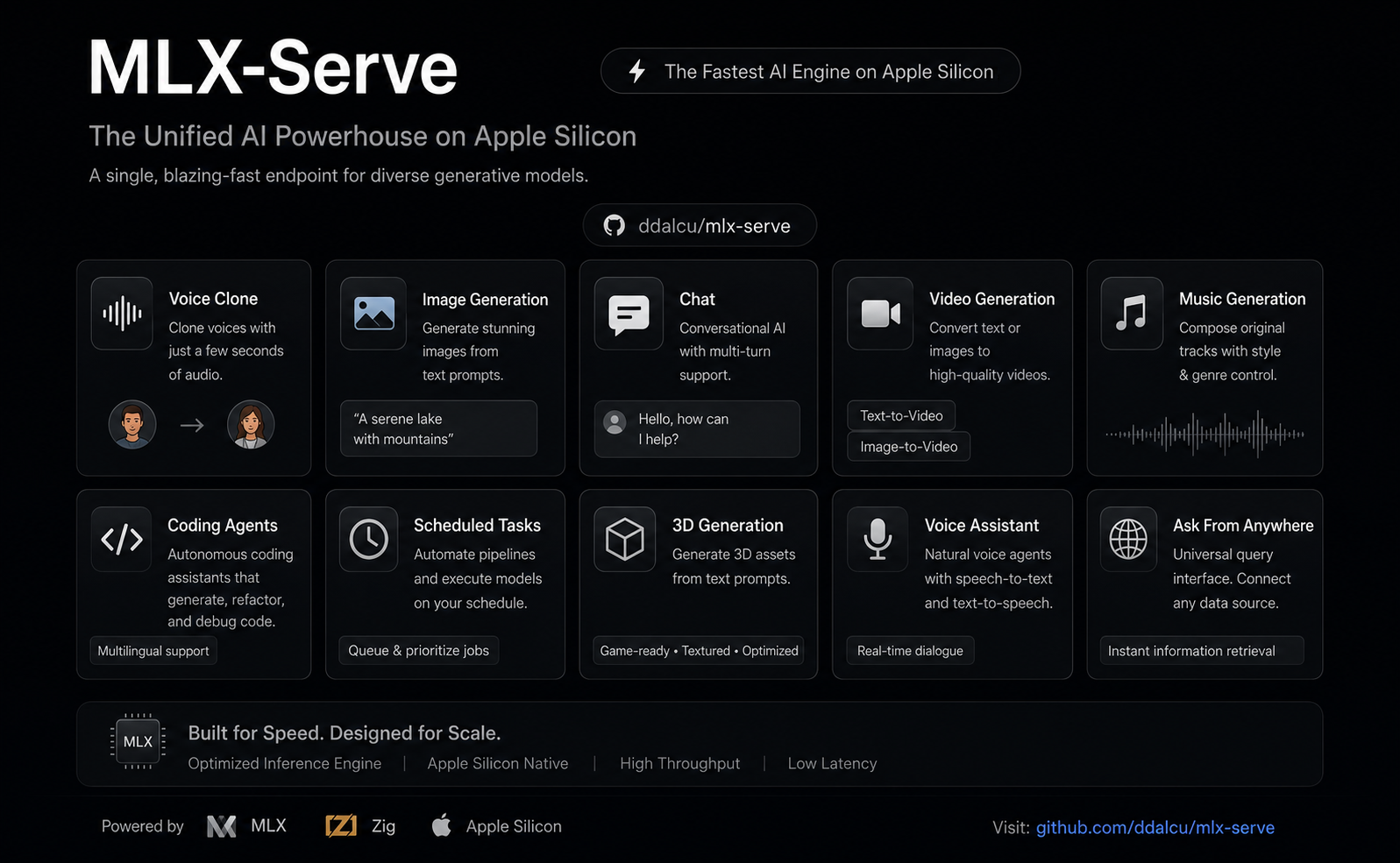
OpenAI- and Anthropic-compatible local inference for Apple Silicon — MLX and GGUF — faster than LM Studio on identical MLX weights. No Python. No cloud. No Electron.

$ npx -y skills add ddalcu/mlx-serve --agent claude-code
Run the curl in your terminal, the rest in Claude Code.
Repo: ddalcu/mlx-serve
What's inside

OpenAI- and Anthropic-compatible local inference for Apple Silicon — MLX and GGUF — faster than LM Studio on identical MLX weights. No Python. No cloud. No Electron.

mlxserve.com · Download MLX Core.app · Changelog
mlx-serve is a native Zig server that runs any LLM on Apple Silicon — MLX-format models and every GGUF on HuggingFace (Qwen, Llama, Mistral, Gemma, DeepSeek V4 Flash, thousands more). It exposes OpenAI-compatible and Anthropic-compatible HTTP APIs out of the box, so the same http://localhost:11234 works with Claude Code, the OpenAI SDK, Continue, Cursor, Open WebUI, and anything else that speaks one of those wires. Beyond text, the same server generates images, video, music, speech (with voice cloning), and 3D models — all natively on MLX. Ships with MLX Core, a macOS menu-bar app with chat, agent mode, MCP tool calling, and model management.
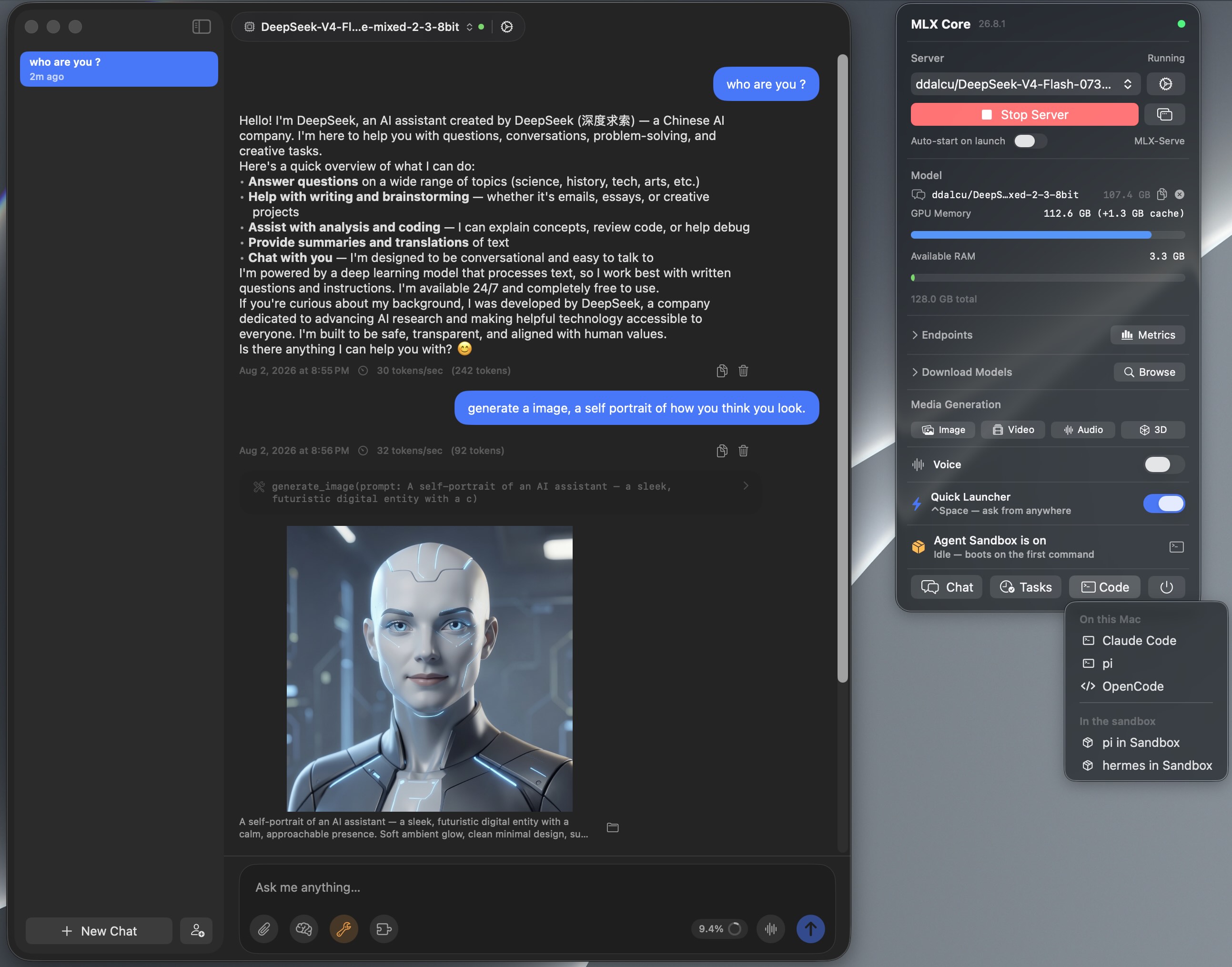
MLX Core is a signed, notarized macOS menu-bar app that bundles the server. Browse and download models with a progress UI, chat, run agent mode with MCP tools, generate images / video / music / speech / 3D, and tune every server flag from a Settings window. No terminal, nothing to configure. The server underneath is the same binary the CLI runs, on the same http://localhost:11234, so Claude Code and any OpenAI or Anthropic client can point at it while the app is running.
Download MLX Core.app — latest release for macOS (Apple Silicon)
brew tap ddalcu/mlx-serve https://github.com/ddalcu/mlx-serve
brew install --cask mlx-core # the app (recommended)
brew install mlx-serve # CLI + server only, no GUI
Ollama-style, if that's your habit:
mlx-serve run gemma4 # downloads Gemma 4 E4B (4-bit), serves it, chats right in your terminal
mlx-serve pull qwen3.6:27b # just download (resumable, straight from Hugging Face)
mlx-serve list # what's on disk
mlx-serve serve # serve everything you've pulled — models load on demand by name
Short names, org/repo HuggingFace ids, and name:tag all work.
Or drive the server directly with flags, which is what you want for scripts, launchd, or a headless Mac:
# one model, pinned for the life of the process
mlx-serve --model ~/.mlx-serve/models/mlx-community/gemma-4-e4b-it-4bit --serve --port 11234
# a whole folder, every model loaded on demand by name
# (this is exactly what `mlx-serve serve` and the app do)
mlx-serve --serve --model-dir ~/.mlx-serve/models
# GGUF takes the same flags; the server detects it and routes to the embedded llama.cpp
mlx-serve --model ~/models/Qwen3.5-4B-Q4_K_M.gguf --serve
mlx-serve --help lists every flag. Defaults are --host 0.0.0.0 --port 11234.
And because mlx-serve speaks the Ollama API (/api/chat, /api/generate, /api/tags, /api/embed, /api/pull, …) alongside OpenAI and Anthropic, your existing Ollama-connected tools — Raycast, Obsidian, Enchanted, Open WebUI, ollama-python/js — work unchanged: point them at http://localhost:11234 and keep your workflow, on a faster engine.

If you're already on LM Studio, Ollama, or mlx-lm and wondering whether to switch — here's the short version, head-to-head:
| mlx-serve | LM Studio | Ollama | mlx-lm | |
|---|---|---|---|---|
| MLX models (native Apple) | ✅ | ✅ | ❌ | ✅ |
| GGUF models (llama.cpp) | ✅ embedded | ✅ | ✅ | ❌ |
| OpenAI-compatible API | ✅ | ✅ | partial | ❌ |
| Anthropic Messages API | ✅ | 🟡 partial² | ❌ | ❌ |
| Ollama API (drop-in for Ollama clients) | ✅ | ❌ | ✅ native | ❌ |
run <model> CLI with auto-download + REPL | ✅ | ❌ | ✅ | ❌ |
| OpenAI Responses API + WebSockets | ✅ | 🟡 partial² | ❌ | ❌ |
| DeepSeek V4 Flash (284B) | ✅ via ds4 | ❌ | ❌ | ❌ |
| Speculative decoding (PLD + drafter + native MTP) | ✅ | ❌ | partial | drafter only |
| Decode speed (geomean vs LM Studio, identical weights) | +26% (MLX, shipping defaults) | baseline | ~−15% (GGUF, est.¹) | +11% (MLX) |
| KV-cache quantization (4/8-bit + TurboQuant) | ✅ | ❌ | partial | ✅ |
| Continuous batching | ✅ | ❌ | ✅ | ❌ |
| Built-in agent loop + MCP client | ✅ 10 tools | ❌ | ❌ | ❌ |
| Sandboxed agent shell (isolated Linux VM) | ✅ | ❌ | ❌ | ❌ |
| LAN model sharing (use another Mac's models) | ✅ | ❌ | ❌ | ❌ |
| One-click launchers (Claude Code, OpenCode, Pi) | ✅ | ❌ | ❌ | ❌ |
| Python required at runtime | ❌ | ❌ | ❌ | ✅ |
| Native menu-bar app (no Electron) | ✅ | ❌ Electron | ❌ | ❌ |
| Image generation + photo editing | ✅ | ❌ | ❌ | ❌ |
| Video generation (text / image / audio → video) | ✅ | ❌ | ❌ | ❌ |
| Speech + voice cloning | ✅ | ❌ | ❌ | ❌ |
| Music generation | ✅ | ❌ | ❌ | ❌ |
| 3D generation (image → textured 3D model) | ✅ | ❌ | ❌ | ❌ |
| License | MIT | proprietary | MIT | MIT |
¹ Ollama can't run MLX, so the comparison is GGUF-vs-GGUF.
² Recent LM Studio builds ship Anthropic /v1/messages and OpenAI /v1/responses compatibility endpoints, with partial coverage of each surface — mlx-serve additionally implements e.g. the Responses WebSocket transport and /v1/responses/compact.
Numbers and charts in Performance.
/v1/chat/completions, /v1/completions, /v1/embeddings, /v1/models, streaming SSE, tools, JSON-schema constrained decoding, logprobs./v1/responses with previous_response_id chains, per-event sequence_number, the /v1/responses/compact opaque history blob, and a WebSocket transport on the same endpoint./v1/messages works with Claude Code (ANTHROPIC_BASE_URL=http://localhost:11234) and the Anthropic SDK./api/chat, /api/generate, /api/tags, /api/show, /api/ps, /api/embed, /api/pull speak the Ollama wire (NDJSON streaming, tool calls with object arguments, thinking, format JSON schemas, name:latest model names), so the whole Ollama client ecosystem works against mlx-serve unchanged.mlx-serve run gemma4 downloads (resumable), serves, and drops you into a streaming chat REPL; pull / list / serve manage a shared ~/.mlx-serve/models store the GUI app uses too.--max-concurrent N batches decode requests through one forward pass for ~1.6× throughput at 4-way parallel.--lan-share all lets other Macs on your network run inference on this Mac's models; --lan-discover mirrors peers' models into /v1/models as model@peer and proxies requests transparently, so Claude Code on a MacBook chats with the Studio's 27B through plain localhost. Off by default, zero configuration (Bonjour), share list enforced server-side, and only inference is ever exposed.image_url content blocks.logprobs / top_logprobs on chat, and the legacy integer shape on /v1/completions, streaming and not. Pre-temperature, ids travel with values, and the entry belongs to the token that was actually returned.reasoning_content.pip, no venv. The MLX Core app ships everything signed and notarized.Menu-bar app that wraps the server with a full UI:
~/.lmstudio/settings.json) so you don't re-download what's on disk, GGUF rows show a min–max RAM-estimate range.~/.mlx-serve/mcp.json.localhost live (an Express app on guest port 8080 is http://localhost:8080 on your Mac), and a green shield in the toolbar shows when commands run isolated. Let the agent go wild — your Mac stays untouched.~/.mlx-serve/system-prompt.md and ~/.mlx-serve/memory.md..md files into ~/.mlx-serve/skills/ with YAML frontmatter to teach the agent custom capabilities triggered by keywords.One server, five modalities — the tray has ImageGen, VideoGen, AudioGen (speech + music) and 3D panels that run FLUX.2 / Krea-2 / Microsoft Mage-Flow, LTX-Video 2.3 / MiniMax-H3, ACE-Step 1.5, Qwen3-TTS / Kokoro-82M, and Hunyuan3D-2.1 natively on MLX. Click a panel, hit Download, generate. Each panel remembers your last-used model, quality, resolution, steps and seed between sessions.
You can also generate media straight from chat: ask for an image, a spoken line, a music track or a short clip and it renders inline in the conversation with a progress bar, using your saved settings for that modality. Attach a photo and say "make it winter" and the edit comes back in the same thread. Double-click any chat image to open it full-size in Preview.
And it goes well beyond text-to-X:
client.images.edit(image=…, prompt=…) against POST /v1/images/edits.overall_soundscape:. The REF2VA build builds the clip around pictures, clips or audio you attach (<Picture 1>, <Video 1>, <Audio 1> in the prompt); the FL2VA build takes first/last keyframes and chains windows into longer clips. Turbo renders in 4 steps instead of 30. It is slow either way: 1344×768 at 124 frames is about 50 minutes on an M4 Max..safetensors adapters to restyle FLUX, Krea, Mage-Flow, LTX or MiniMax-H3 generations at runtime. Up to 8 at once, summed rather than merged, so nothing is re-quantized and there is zero quality loss on the base weights. Each adapter runs at the strength its own file declares.Models:
| Feature | Default | Other options | Approx. RAM |
|---|---|---|---|
| Image | FLUX.2-klein 4B 4-bit (mflux, ~5 GB pre-quantized) | FLUX.2-klein 9B (10 GB), Krea-2-Turbo, Mage-Flow Turbo / Edit 8-bit (8.5 / 9.1 GB) | 8 / 12 / 16 GB |
| Video | LTX-Video 2.3 Q4 | MiniMax-H3 (Hailuo 3.0) 4-bit / 8-bit, video and matching soundtrack in one pass | LTX 24 GB RAM (~50 GB download); H3 26 GB (40 GB) or 44 GB (69 GB) |
| Speech | Qwen3-TTS 1.7b (voice cloning) | Qwen3-TTS 0.6b, Kokoro-82M (54 voices, ~345 MB) | 8 GB RAM, ~3.5 GB first-run download |
| Music | ACE-Step 1.5 XL Turbo 8-bit | — | 8 GB RAM, ~6.2 GB first-run download |
| 3D | Hunyuan3D-2.1 8-bit (shape + PBR texture) | — | 16 GB RAM |
The 41 GB LTX snapshot ships both transformer variants (1-stage distilled + 2-stage dev, ~11 GB each) plus a 7.6 GB distillation LoRA, so you can switch between Fast/Good/Quality/Super offline without re-downloading.
Outputs go to ~/.mlx-serve/generations/ under per-modality, per-date folders.
The app won't let you start a generation if there isn't enough free RAM. If the mlx-serve server is running and competing for memory, you'll be prompted to stop it first.
| Architecture | model_type | Examples | Chat Format | Vision |
|---|---|---|---|---|
| Gemma 4 | gemma4, gemma4_unified | gemma-4-e2b-it-4bit, gemma-4-e4b-it-8bit, gemma-4-26b-a4b-it-4bit, gemma-4-12b-unified | Gemma turns | SigLIP (unified adds audio) |
| Gemma 3 | gemma3 | gemma-3-12b-it-qat-4bit | Gemma turns | -- |
| DiffusionGemma | diffusion_gemma | diffusiongemma-26B-A4B-it-4bit | Gemma turns (block diffusion) | -- |
| Qwen 2 / 3 / 3.5 / 3.6 | qwen2, qwen3, qwen3_moe, qwen3_5, qwen3_5_moe, qwen3_next | Qwen3-4B, Qwen3.5-4B, Qwen3.6-27B, Qwen3.6-35B-A3B | ChatML | Qwen3-VL |
| DeepSeek V4 Flash | deepseek_v4 | DeepSeek-V4-Flash-0731 (284B-A13B, 1M ctx) — native MLX for safetensors builds, embedded ds4 for .gguf | DSV4 + DSML tools | -- |
| Inkling Small | inkling_mm_model | Thinking Machines Inkling Small (276B-A12B MoE, 2-bit) | role-less channel messages | -- |
| Hunyuan 3 | hy_v3 | Hy3-295B-Instruct (295B-A21B MoE, 2-bit) | Hunyuan tags | -- |
| Laguna | laguna | poolside Laguna S 2.1 / XS (117.6B-A8.5B MoE coder, nvfp4) | GLM tags, pre-opened think | -- |
| Nemotron-H | nemotron_h | Nemotron-3-Nano-4B | ChatML | -- |
| LFM2 / LFM2.5 | lfm2 | LFM2.5-2.6B (8-bit, bf16, nvfp4, mxfp4) | ChatML, Pythonic tool calls | -- |
| Llama | llama | Llama 3, Llama 3.1, Llama 3.2 | Llama-3 | -- |
| Mistral | mistral | Mistral 7B Instruct v0.3 | Mistral turns | -- |
| Embeddings | bert, gemma3_text, qwen3 | bge, mxbai, EmbeddingGemma, Qwen3-Embedding (pooling read from the checkpoint) | n/a | -- |
| Anything else as GGUF | via embedded llama.cpp | any .gguf on HuggingFace | per-template | -- |
Media models live in the same registry and are classified the same way: FLUX.2, Krea-2 and Mage-Flow (image), Qwen3-TTS, Kokoro and ACE-Step (speech + music), LTX-Video and MiniMax-H3 (video), Hunyuan3D-2.1 (3D). A chat request naming one of them gets a 400 that names the endpoint to use instead.
Any quantized MLX model using one of the above architectures works natively. Anything else can be served as GGUF through the embedded llama.cpp engine — just pick the .gguf file in the Model Browser and the server auto-routes by format. Models with unsupported architectures are flagged in the Model Browser but can still be downloaded.
./scripts/fetch-zig.sh into .zig-toolchain/)brew install webpscripts/build-mlx.sh, not brew packages, so the NAX kernels the brew bottle silently omits are included)You only need this if you're hacking on mlx-serve. To just use it, grab the app or brew install above.
One script builds everything, app and server:
git clone --recurse-submodules https://github.com/ddalcu/mlx-serve && cd mlx-serve
APPLE_DEVELOPER_ID=- APPLE_TEAM_ID=- SKIP_NOTARIZE=1 ./app/build.sh
open "app/MLX Core.app"
app/build.sh snaps the pinned submodules back to their commits, stages llama.cpp and the Zig nightly, builds mlx + mlx-c with NAX kernels asserted, compiles the Swift app and the Zig server, then bundles and signs. APPLE_DEVELOPER_ID=- picks ad-hoc signing, so no Apple developer account is needed. A notarized release build wants a real identity plus APPLE_ID and APPLE_ID_PASSWORD.
Server only, skipping the app:
./scripts/fetch-llama.sh && ./scripts/build-mlx.sh # once, and again on a pin bump
zig build -Doptimize=ReleaseFast # always ReleaseFast; Debug is 2-4x slower
Serving is covered in Get started. One-shot, without a server:
mlx-serve --model /path/to/model --prompt "What is 2+2?"
| Flag | Default | Description |
|---|---|---|
--model PATH | required | Path to the model directory or a .gguf file |
--serve | off | Start the HTTP server |
--host ADDR | 0.0.0.0 | Bind address (all interfaces — set 127.0.0.1 for strictly local) |
--port N | 11234 | Port for the HTTP server |
--prompt TEXT | "Hello" | Prompt for interactive mode |
--max-tokens N | 100 | Maximum tokens to generate |
--temp F | 0.0 | Sampling temperature (0 = greedy) |
--ctx-size N | auto | Context window size (auto = computed from GPU memory) |
--embedding-max-length N | auto | Per-input token ceiling for /v1/embeddings (auto = the model's declared window; over-limit inputs get a 400, never silent truncation) |
--timeout N | 300 | Stall timeout — seconds without a new token (a request that keeps producing never times out) |
--reasoning-budget N | -1 | Thinking token budget (-1 = unlimited, 0 = no thinking) |
--no-vision | off | Disable vision encoder even if model supports it |
--pld / --no-pld | on | Prompt Lookup Decoding (model-agnostic spec-decode) |
--pld-draft-len N | 5 | Max draft tokens per PLD step |
--pld-key-len N | 3 | N-gram match key length for PLD |
--drafter DIR | none | Gemma 4 assistant drafter checkpoint (e.g. gemma-4-E4B-it-assistant-bf16) |
--draft-block-size N | 4 | Drafts per round for the Gemma 4 drafter |
--no-mtp / --mtp | on when sidecar present | Disable / force the native MTP head (MoE trunks default off) |
--mtp-depth N | 3 | Max tokens drafted per MTP round (adaptive controller tunes within [1, N]) |
--dspark | off | DeepSeek V4's own block-parallel draft stages (~11 GB on top of the model) |
--no-decode-attn-quant | on | Disable the decode-only requant of dense bf16 attention weights (the "Fast decode for bf16-attention models" toggle) |
--kv-quant {off,4,8,turbo2,turbo4} | off | KV-cache quantization scheme (MLX path) |
--kv-attn-mode {auto,dense,fused} | auto | Decode read path for quantized KV: fused reads the packed cache in place, auto engages it from 8K prompt tokens (only at --kv-quant 4/8; per-request kv_attn_mode overrides) |
--llama-kv-quant {off,q8,q4} | off | KV-cache quantization for GGUF (llama.cpp path) |
--llama-cache-entries N | 4 | Multi-session LRU for llama.cpp (warm multi-doc agents) |
--tokenize-cache-entries N | 4 | Chat-template + tokenize cache size |
--max-concurrent N | 1 | Continuous-batch decode parallelism |
--prefix-cache-entries N | auto | Shared-prefix KV cache entry cap |
--prefix-cache-mem N{KB,MB,GB} | 2 GB | Shared-prefix KV cache memory cap |
--prefix-cache-disk N{MB,GB} | off | SSD tier: prefixes survive restarts (11K-token restart TTFT 5.9 s → 0.7 s) |
--metrics | off | Prometheus /metrics + live dashboard panel on / |
--api-key KEY | none | Require a key for non-localhost requests (localhost stays open) |
--lan-share <all|id,...> | off | Share the listed models (or all) with your local network over Bonjour — only inference is exposed, model management stays host-local |
--lan-discover | off | Discover models other Macs share: they appear in /v1/models as model@peer and requests proxy to that Mac |
--lan-name NAME | hostname | The Bonjour name other Macs see |
--model-dir PATH | none | Discover and serve every model in a folder (LRU resident set). Repeatable — folders merge first-wins |
--max-resident-mem N{MB,GB} | auto | Summed memory cap across loaded models; decides whether a model may load at all (auto = 80% of the MLX wired limit, 0 disables) |
--max-resident-models N | 3 | How many models stay loaded at once (LRU-evicted) |
--skip-mem-preflight | off | Skip the free-RAM pre-flight on load (the cap above is checked first, and still applies) |
--no-tool-autocorrect | off | Turn off schema-driven repair of model-emitted tool arguments |
--log-level | info | Log level (error, warn, info, debug) |
--log-file PATH | ~/.mlx-serve/logs/ | Where the server log goes |
curl http://localhost:11234/v1/chat/completions \
-H "Content-Type: application/json" \
-d '{
"messages": [{"role": "user", "content": "Write a haiku about programming."}],
"max_tokens": 256,
"stream": true
}'
Supports messages, max_tokens, temperature, top_p, top_k, stream, stream_options, tools, response_format, repetition_penalty, presence_penalty, logprobs / top_logprobs, reasoning_effort / enable_thinking / reasoning_budget_tokens, plus per-request kv_quant and kv_attn_mode overrides. Messages can include image_url content blocks (base64 or URL) for vision-capable models. Usage always carries prompt_tokens_details.cached_tokens, and a reply cut short because the model went in circles reports finish_details: {"type": "repetition_loop"} beside finish_reason.
curl http://localhost:11234/v1/messages \
-H "Content-Type: application/json" \
-H "anthropic-version: 2023-06-01" \
-d '{
"model": "mlx-serve",
"max_tokens": 256,
"messages": [{"role": "user", "content": "Write a haiku about programming."}]
}'
Compatible with Claude Code (ANTHROPIC_BASE_URL=http://localhost:11234 claude) and Anthropic SDKs. Supports streaming, tool calling, and extended thinking.
curl http://localhost:11234/v1/responses \
-H "Content-Type: application/json" \
-d '{
"model": "mlx-serve",
"input": "Write a haiku about programming.",
"stream": true
}'
Stateful chains via previous_response_id, full streaming SSE with per-event sequence_number, schema-conformant envelope with tools / tool_choice / text / reasoning / usage echo. POST /v1/responses/compact returns an opaque base64 history blob that round-trips back as a compaction input item without any LLM call. Same endpoint also accepts an Upgrade: websocket handshake — each text frame is a response.create JSON message, and each SSE event becomes one outbound text frame.
GET / — built-in web console: chat playground, Monitor, image and audio tools, API referenceGET /health — health checkGET /v1/models — list loaded models with capabilities + engine infoPOST /v1/completions — text completionsPOST /v1/embeddings — text embeddings (BERT, EmbeddingGemma, and last-token pooling models like Qwen3-Embedding; pooling follows the checkpoint's sentence-transformers metadata, dimensions truncates and renormalizes)POST /v1/images/generations, POST /v1/images/edits — image generation and instruction edits; the edits endpoint speaks the OpenAI SDK's multipart shape (client.images.edit), including repeated image[] for multi-referencePOST /v1/audio/speech — Qwen3-TTS (ref_audio clones a voice) or Kokoro (voice picks or blends one of 54), WAV outPOST /v1/audio/music-generations — ACE-Step text-to-music, 48 kHz stereo WAVPOST /v1/video/generations — LTX-Video or MiniMax-H3; base64 rgb8 frames plus pcm_s16le audio, mux on your sidePOST /v1/3d/generations — Hunyuan3D-2.1, base64 GLBPOST /v1/load-model, POST /v1/unload-model — load a discovered model (or one by absolute path), free one nowPOST /tokenize, POST /detokenize, GET /props — tokenizer round-trip and llama.cpp-style server propsGET /metrics, GET /metrics.json — Prometheus + JSON (needs --metrics)GET /v1/responses/{id}, DELETE /v1/responses/{id} — fetch / delete stored responsesEvery media endpoint takes "stream": true for SSE progress ending in a base64 complete payload. Media LoRAs use one grammar everywhere: lora_paths + lora_scales, up to 8, stacked.
Apple M4 Max, identical weights per engine. Both charts are regenerated per release by tests/bench.sh, which boots each engine in turn and lets llmprobe take the numbers: warmup discarded, median of three, same protocol for everyone. CSVs live in docs/perf-csvs/, and benchmarks.md tracks decode speed release by release. Every engine's version is recorded in the CSV and printed in the chart legend, so a number here always says which build it beat.

Code completion decode tok/s, v26.8.3, against LM Studio 0.4.19+2, oMLX 0.5.2 and MTPLX 2.5.3. Every bar is that engine on its shipping defaults — llmprobe measures the server that is running, so there is no best-config collapse and no per-model tuning. All four engines load the identical MLX weight files. MTPLX shows 0 where it can't run (it needs its own MTP artifacts), and LM Studio is absent on two rows it has no copy of. Geomean decode: +26% over LM Studio across the four shared models and +25% over oMLX across all six, with prefill +36% and +10%. The two head-to-heads that matter are on the competitors' own checkpoints: +23% decode over oMLX on its oQ4e (prefill level), and +10% decode / +17% prefill over MTPLX on its own MTPLX-Optimized build. The bench is ./tests/bench.sh --family all --lmstudio --omlx --mtplx.

Same-checkpoint head-to-head, coding-agent prompts, fresh boots, cold prompts. Against oMLX 0.5.2 running its native Lightning MTP on its own oQ4e checkpoint, mlx-serve decodes 25–36% faster at every rung from 0.5K to 16K, with prefill ahead at all four (+2% to +8%). Both engines speculate with the checkpoint's own MTP head, so this is engine against engine on identical weights. The ladder reaches 64K under --full; this release shipped the default depth.
Three flavors, all greedy-equivalent (byte-identical at temp=0 within the first 30 tokens; mathematically exact at temp > 0 via the Leviathan probability-ratio sampler):
prompt + generated_tokens. Default-on, no per-model setup. Wins on agent loops, RAG and code editing, anywhere the answer echoes the prompt.--drafter <dir>. Cross-attends into the target's KV cache, so no weights are duplicated.All three share an adaptive prompt-time gate: a 3-gram repetition score auto-disables speculation on novel content, so creative writing and one-shot Q&A run at parity instead of paying verify overhead. A runtime acceptance gate disables speculation mid-decode if per-draft acceptance falls below break-even, sticky for the rest of the request. Both apply across all four API surfaces, streaming and non-streaming, including requests with tools. Agentic tool loops are speculative decoding's best workload.
The defaults are already the fast path. If you have plenty of RAM, the fastest configuration is the one you get out of the box. Every speed-relevant knob is a memory-for-speed trade in one direction or the other.
| Knob (CLI flag / Settings) | Default | What it does to speed | Flip it when… |
|---|---|---|---|
KV cache quantization (--kv-quant) | off | ≈ −10% decode at 2–4K context; at long context the fused packed reads (auto from 8K) cut the penalty to ≈ −18% at 42K (was −47%). Saves 2× (8-bit) / 4× (4-bit) KV RAM. | …memory is the constraint: long contexts or big models on a 16 GB Mac. |
PLD (--pld) | on | Large wins on agent loops, code editing and RAG. Auto-gates itself off on novel prose. | Leave on. --no-pld only for apples-to-apples benchmarks. |
Sampling (temperature / top_p / top_k) | model defaults | Full sampling costs ~6% decode vs greedy. | Temp 0 for benchmarks; keep sampling for chat quality. |
Continuous batching (--max-concurrent) | 1 | ~1.6× total throughput at 4-way on dense models, at some per-request latency cost. | …several clients share the server. |
Prefix cache (--prefix-cache-entries/-mem) | on | Repeated system prompts and multi-turn chats skip re-prefill. | Leave on. Cap entries on RAM-tight Macs (the app does this automatically). |
| Native MTP (auto when the checkpoint ships a sidecar) | on | Large gains on code and coding-agent loops. | Leave on. --no-mtp for benchmarks; per-request enable_mtp opts MoE trunks in. |
Drafter (--drafter) | auto in the app | Big gains on Gemma 4 dense code-edit loops (+52% on E4B code, 117 → 178 tok/s). The app downloads and pairs the drafter with dense Gemma 4 models by itself; on the CLI it stays opt-in. | Leave on. The Settings toggle turns auto-pairing off. |
Fast decode for bf16-attention models (--no-decode-attn-quant to disable) | on | Serves dense bf16 attention weights through a decode-only quantized copy: −23% per-token time on models that ship bf16 attention (poolside Laguna). Prefill keeps the dense weights. Can vary output wording slightly on those models; quantized checkpoints are unaffected. | …you want output on such a model to match the fully dense path byte for byte. |
Building from source? Always zig build -Doptimize=ReleaseFast. A bare zig build produces a Debug binary that's 2–4× slower and looks like a regression.
Yes, though it depends what you run. On the v26.8.3 matrix (M4 Max, LM Studio 0.4.19+2, identical MLX weight files, both engines on shipping defaults), mlx-serve decodes +26% geomean and prefills +36% geomean across the four models LM Studio also has.
The shape matters more than the average. On dense Gemma, raw single-stream decode is now a wash (−0.5% on E4B, −0.8% on 31B) — LM Studio has caught up there. The separation is prefill, which is +117% on E4B and +35% on the 26B-A4B MoE, and speculative decoding: on Qwen 3.6 27B mlx-serve loads the checkpoint's MTP head and LM Studio does not, which is +145% decode on the same file. Earlier releases quoted a larger geomean by picking the best speculative configuration per model; this one is defaults against defaults, which is the number you actually get.
For most use cases, yes. mlx-serve runs the same MLX and GGUF models, exposes an OpenAI-compatible API on the same kind of port, and ships a native menu-bar app instead of an Electron one. It goes deeper on the API surface than LM Studio's newer compatibility endpoints — fuller Anthropic Messages and OpenAI Responses coverage, plus a WebSocket transport and response compaction — and adds things LM Studio doesn't have: MCP tool calling, agent mode with 10 built-in tools, KV-cache quantization, continuous batching, and the antirez/ds4 engine for DeepSeek V4 Flash.
On Apple Silicon, yes — mlx-serve speaks the Ollama API natively (/api/chat, /api/generate, /api/tags, /api/embed, /api/pull, …), so Raycast, Obsidian, Enchanted, Open WebUI, and ollama-python/js work unchanged: drop in http://localhost:11234 wherever you had http://localhost:11434. The CLI workflow matches too (mlx-serve run gemma4, pull, list, serve). Underneath, you get llama.cpp and native MLX with the Mac-specific optimizations Ollama doesn't ship (Metal kernels through mlx-c, speculative decoding, shared-prefix KV cache, the Gemma 4 cross-attention drafter).
Yes. mlx-serve embeds llama.cpp's inference library (libllama) inside the same signed, notarized binary. Point --model at any .gguf and the server auto-detects the format and routes to the right engine — no pip, no venv, no llama-server to install separately. DeepSeek V4 Flash GGUFs go through the dedicated antirez/ds4 engine instead, also embedded.
Yes — natively. mlx-serve implements Anthropic's /v1/messages endpoint including streaming, tool calling, and extended thinking. Point Claude Code at it with ANTHROPIC_BASE_URL=http://localhost:11234. The MLX Core app ships a one-click "Launch Claude Code" button that wires up the env vars for you.
Yes — LAN Sharing, off by default. Turn on sharing where the models live (Settings ▸ LAN Sharing, or mlx-serve --serve --lan-share all) and discovery on the Mac that wants to use them (--lan-discover). They find each other over Bonjour — no IPs, no config — and shared models appear in every model picker as "model · peer" and in /v1/models as model@peer, so even Claude Code pointed at localhost can run on the other Mac's model. Works for chat and image/speech/music/video/3D generation; models cold-load on demand on the host; only inference is exposed (model management, metrics, and the status page stay private to each Mac).
All work — anything that talks the OpenAI chat-completions or Anthropic Messages wire protocol does. mlx-serve also implements the newer OpenAI Responses API (/v1/responses) for clients that want stateful chains via previous_response_id, plus a WebSocket transport on the same endpoint.
Yes, on 128 GB+ Apple Silicon Macs. Open the MLX Core Model Browser, pick DeepSeek-V4-Flash, hit Download. Since v26.7.12 the safetensors build runs on our own MLX engine rather than through GGUF: 284B with 13B active, 1M context, chat, thinking, tool calls and streaming, about 30 tok/s serial decode on an M4 Max and roughly twice that with DSpark (--dspark, the checkpoint's own draft stages). .gguf builds still route to the embedded ds4 engine. Agent mode and MCP tools work on DSV4 too. It needs the 0731 release of the checkpoint; the earlier preview is turned away at load.
Native MLX dispatch for Gemma 3/4, DiffusionGemma, Qwen 3 / 3.5 / 3.6 / 3-Next, Tencent Hunyuan 3 (295B), Thinking Machines Inkling Small (276B), poolside Laguna S 2.1, Llama 3.x, Mistral, Nemotron-H, LFM2.5, and DeepSeek V4 Flash. Anything else as GGUF via embedded llama.cpp — Qwen, Llama, Mistral, Gemma, DeepSeek, Phi, Yi, and thousands more available on HuggingFace.
Yes — the largest open model mlx-serve runs. The 2-bit mixed-precision build (mlx-serve run hy3, ~105 GB on disk) decodes at ~26 tok/s with ~235 tok/s prefill on an M4 Max, with thinking, tool calling, and all four API surfaces working. It's recommended for Macs with more than 128 GB of unified memory; on a 128 GB Mac it loads and answers correctly, but only a minimal context window (~3K tokens) fits beside the weights — fine for short chats, tight for agent work. The checkpoint's native multi-token-prediction head is supported too (enable_mtp: true per request, best with --mtp-depth 1).
MTPLX is a focused Python runtime built around Qwen's native multi-token-prediction heads, and it set the bar here. mlx-serve loads the same MTP sidecar artifacts (including MTPLX-published ones) with zero setup and, in a same-machine head-to-head on the identical checkpoint, prompts, and sampling (v26.8.3 vs MTPLX 2.5.3, both on shipping defaults), decodes +10% faster with +17% prefill and a third of the time to first token (494 ms vs 1528 ms). You also get the rest of the stack — OpenAI/Anthropic/Ollama APIs, GGUF, the agent app — in one binary with no Python.
Yes, on both API surfaces. The server detects tool-call patterns across architectures (Hermes XML, Gemma 4 <|tool_call>, raw JSON, ChatML), repairs common Qwen 3.5/3.6 escape quirks, and emits OpenAI-style tool_calls deltas in the SSE stream. The MLX Core app ships 10 built-in tools (shell, file I/O, search, browse, web search, memory) and connects to MCP servers from a curated marketplace.
Zig with direct mlx-c FFI — no Python runtime, no Electron, no IPC bridge. The release binary is ~7 MB. Eager warmup at boot page-faults weights and pre-compiles decode kernels (first request 3.5× faster). Multi-turn agent loops reuse KV across turns and skip re-prefilling system prompts via a shared-prefix cache. Tokenize caching turns the second hit on a long conversation into a memcpy.
For greedy decoding (temp=0), mlx-serve is byte-identical to the reference for the first ~30-80 generated tokens, with the long-tail divergence inherent to INT4 float-reduction order (documented in CLAUDE.md). For temp > 0, the Leviathan probability-ratio sampler keeps speculative decoding mathematically exact in distribution. Equivalence is pinned by tests/test_pld_equivalence.sh, test_drafter_equivalence.sh, and test_kv_quant_equivalence.sh.
Nowhere off your machines. Everything runs locally — no analytics, no telemetry, no cloud calls. The HTTP server listens on your local network interface by default (--host 0.0.0.0) so your own devices can reach it; set --host 127.0.0.1 to make it strictly local, or --api-key to gate every non-localhost request. With LAN Sharing on, prompts sent to a shared model travel only across your local network to the Mac hosting that model. Open source under MIT.
The MLX Core app self-updates by checking the GitHub releases feed. CLI: brew upgrade --cask mlx-core or brew upgrade mlx-serve.
mlx-serve stands on a lot of open-source shoulders. Huge thanks to all of these projects.
Inference + math — MLX · mlx-c · mlx-lm · llama.cpp · nlohmann/json · antirez/ds4 · jinja.cpp
Metal kernels we ported — some of the fastest paths in the engine started as someone else's work, and the source says so at every one of them:
Model architectures + tokenizers — Google Gemma · Qwen · Meta Llama · Mistral AI · NVIDIA Nemotron-H · Liquid LFM2.5 · DeepSeek · Tencent Hunyuan · poolside · HuggingFace tokenizers
Image + video — stb_image · libwebp · FLUX.2 · LTX-Video 2.3
MLX Core (Swift app) — Anthropic swift-sdk · Model Context Protocol Swift SDK · Apple frameworks (PDFKit, WKWebView, AVFoundation, AppKit, SwiftUI)
Full licenses and the required attributions are in NOTICE.
If we missed you, please open a PR — happy to add anyone who landed code, fixtures, or a fix here.
mlx-serve is built on a 16 GB M4 Mac mini and a 128 GB M4 Max, and lately the machines are the bottleneck rather than the code:
So there's a fund for a Mac Studio Ultra. If mlx-serve replaced an API bill for you and you feel like chipping in, the button is here (or Buy Me a Coffee). Nothing gets paywalled either way: MIT now, MIT after.
Progress: ▱▱▱▱▱▱▱▱▱▱ 0%
Nobody yet. Everyone who chips in gets a line here, with a link if they want one, or stays anonymous. Thank you in advance.
Builds, benchmarks and teardowns of what's under the hood:
Subscribing, following, and starring the repo cost nothing and genuinely help the project reach people. It's the cheapest way to support it.
MIT, see LICENSE.
mlx-serve bundles third-party code that stays under its own license, including some Apache-2.0 Metal kernels and the Jinja engine that renders chat templates. NOTICE lists all of it with the required attributions, and LICENSE-APACHE-2.0 is the Apache License text.
★ Found this useful? Star the repo, subscribe on YouTube, follow on X. It really does help others discover it.
.claude/
skills/
bench/
SKILL.md
release/
SKILL.md
.github/
FUNDING.yml
workflows/
ci.yml
pages.yml
release.yml
.gitignore
.gitmodules
app/
appicon.png
appiconb.png
build.sh
CLAUDE.md
Info-MAS.plist
Info.plist
mlx-serve-MAS.entitlements
MLXCore-MAS.entitlements
MLXCore.entitlements
Package.resolved
Package.swift
PrivacyInfo.xcprivacy
project.yml
Sources/
MLXServe/
AppState.swift
MLXServeApp.swift
Models/
Agent.swift
AgentAdvancedSummary.swift
AgentModels.swift
ChatErrorNotice.swift
ChatModels.swift
CommunityLinks.swift
ContextSizeDisplay.swift
ContextWindowStats.swift
DrafterPairing.swift
FirstRunFlow.swift
GgufQuants.swift
HFModels.swift
MCPConfig.swift
MediaGenSettings.swift
MlxVariants.swift
ModelBrowserSection.swift
ModelRoots.swift
RecommendedModels.swift
ServerOptions.swift
SettingsCategory.swift
SettingsReset.swift
SettingsSearch.swift
TaskModels.swift
Resources/
.gitkeep
appiconb.png
tray.png
Services/
ActivationPolicyManager.swift
ActiveAgentVoice.swift
AgentBudget.swift
AgentComposer.swift
AgentEngine.swift
AgentMediaInline.swift
AgentMemory.swift
AgentModelSwitch.swift
AgentPrompt.swift
AgentResolution.swift
AgentSandbox.swift
AgentStore.swift
AgentWorkspaceSwitch.swift
AgentWriter.swift
APIClient.swift
AppActivation.swift
ApprovalPolicy.swift
AppStateAgents.swift
AudioClipPlayer.swift
AudioGenService.swift
AudioPreprocessor.swift
AudioRecorder.swift
AudioReference.swift
BrowserManager.swift
ChatImagePreview.swift
ChatModelSelection.swift
ChatScroll.swift
ChatTurnEngine.swift
ChunkedDownload.swift
CLIInstaller.swift
CLILauncher.swift
CLISetupInstructions.swift
ClonedVoiceSynthesizer.swift
ComposerIntent.swift
CronSchedule.swift
Dictation.swift
DockReopen.swift
DocumentIndex.swift
DownloadManager.swift
EngineVersions.swift
FileSearcher.swift
FollowUpTimer.swift
GuestChannel.swift
GuestProtocol.swift
H3Planning.swift
HFSearchService.swift
ImageEditExamples.swift
ImageGenService.swift
ImagePreprocessor.swift
KokoroVoiceCatalog.swift
LoadingCue.swift
MarkdownSegmenter.swift
MCPCatalog.swift
MCPManager.swift
MCPSpawner.swift
MediaBundle.swift
MediaGen.swift
MediaGenProgress.swift
MediaRecents.swift
MediaStorage.swift
MediaToolArgs.swift
Model3DGenService.swift
MultimodalContent.swift
MusicGenService.swift
MusicPromptLibrary.swift
OCIClient.swift
OnDeviceSpeech.swift
ProcessRegistry.swift
QuickLauncher.swift
SandboxAgentRegistry.swift
SandboxPortForwarder.swift
SandboxProvisioner.swift
SandboxSmoke.swift
SandboxSSH.swift
ScheduleParser.swift
SentenceChunker.swift
SentenceStreamer.swift
ServerManager.swift
SpeechRecognizing.swift
SpeechSanitizer.swift
SpeechSynthesizing.swift
StreamCoalescer.swift
SubjectCutout.swift
SyntaxHighlighter.swift
SystemGrounding.swift
SystemMetrics.swift
TarReader.swift
TaskNotifier.swift
TaskScheduler.swift
TelegramAPI.swift
TelegramBridge.swift
TestServer.swift
ToolExecutor.swift
TruncationNotice.swift
UpdateChecker.swift
VideoGenService.swift
VoiceActivity.swift
VoiceCatalog.swift
VoiceClipLibrary.swift
VoiceCloneMenuModel.swift
VoiceModeController.swift
VoicePreflight.swift
VoicePreprocessor.swift
VoicePreviewer.swift
VoicePrompt.swift
VoicePulse.swift
VoiceTranscriber.swift
VoiceTrayDot.swift
VoiceTurnMachine.swift
VzGuest.swift
WakeChime.swift
WakeWord.swift
WebSourceExtractor.swift
Support/
BuildFeatures.swift
SecurityScopedBookmark.swift
Views/
AgentsWindow.swift
AgentViews.swift
AudioGenView.swift
BrowserView.swift
BundleDownloadBar.swift
ChatEmptyState.swift
ChatErrorCard.swift
ChatMediaAttachmentView.swift
ChatMetrics.swift
ChatModelGate.swift
ChatModelPill.swift
ChatView.swift
CodeBlockView.swift
ComposerTip.swift
ContextPill.swift
EmbeddedTerminalView.swift
H3PromptExamples.swift
ImageGenView.swift
LanModelPicker.swift
MCPMarketplaceView.swift
Model3DGenView.swift
ModelBrowserMetrics.swift
ModelBrowserView.swift
ModelDownloadView.swift
MusicGenView.swift
NewTaskSheet.swift
QuickLauncherView.swift
RecommendedStarterCard.swift
SandboxSessionTabs.swift
SandboxTerminalView.swift
SeedText.swift
SettingsView.swift
StatusMenuView.swift
TasksView.swift
VideoGenView.swift
VoiceModeView.swift
VoiceTrayPanel.swift
WebSourcesChip.swift
WelcomeView.swift
Tests/
MLXCoreTests/
ActivationPolicyTests.swift
AgentAdvancedSummaryTests.swift
AgentBrevityTests.swift
AgentBudgetTests.swift
AgentCapabilityGateTests.swift
AgentHarnessTests.swift
AgentIntegrationTests.swift
AgentMediaInlineTests.swift
AgentModelListTests.swift
AgentModelSwitchTests.swift
AgentPromptTests.swift
AgentRepetitionTests.swift
AgentResolutionTests.swift
AgentRetryBudgetTests.swift
AgentSandboxTests.swift
AgentSessionThreadTests.swift
AgentStoreTests.swift
AgentsWindowFocusTests.swift
AgentToolResolutionTests.swift
AgentTurnConfigTests.swift
AgentVoiceOverrideTests.swift
AgentWorkspaceDefaultTests.swift
AgentWorkspaceSwitchTests.swift
AgentWriteFileRecoveryTests.swift
AgentWriterTests.swift
APIClientLoadModelTests.swift
AppActivationTests.swift
ApprovalPolicyTests.swift
AppStateUseModelTests.swift
AudioGenTests.swift
AudioPreprocessorTests.swift
AudioRecorderTests.swift
AudioSettingsSidecarTests.swift
ChatEmptyStateTests.swift
ChatErrorNoticeTests.swift
ChatImagePreviewTests.swift
ChatMetricsTests.swift
ChatModelSelectionTests.swift
ChatModeTogglesTests.swift
ChatPasteTests.swift
ChatRowBuilderTests.swift
ChatScrollTests.swift
ChatTurnEngineTruncationTests.swift
ChunkedDownloadTests.swift
CLIInstallerTests.swift
CLISetupInstructionsTests.swift
ClonedVoiceSynthesizerTests.swift
CodeBlockTextTests.swift
CommunityLinksTests.swift
ComposerInputTests.swift
ComposerModeControlTests.swift
ComposerTipTests.swift
ContextMonitorTests.swift
ContextSizeDisplayTests.swift
ContextWindowStatsTests.swift
CronScheduleTests.swift
DictationTests.swift
DockReopenTests.swift
DocumentIndexRealDataTests.swift
DocumentIndexTests.swift
DownloadManagerLayoutTests.swift
DownloadManagerTransferTests.swift
DrafterAutoDownloadTests.swift
DrafterPairingTests.swift
EditFileRecoveryTests.swift
EmbeddedTerminalLayoutTests.swift
EndpointsSectionTests.swift
EngineVersionsTests.swift
FileSearcherTests.swift
FileToolSandboxGateTests.swift
FirstRunFlowTests.swift
Fixtures/
hy3d_sphere.glb
hy3d_textured_quad.glb
GenExperimentTests.swift
GgufQuantTests.swift
GLBMeshLoaderTests.swift
GuestChannelTests.swift
GuestProtocolTests.swift
H3PlanningTests.swift
HFSearchTests.swift
HostEscapeAuditTests.swift
InfoPlistTests.swift
KokoroVoiceCatalogTests.swift
LanModelCapabilityTests.swift
LanSharingTests.swift
LocalModelPickerTests.swift
MarkdownLinkTests.swift
MarkdownSegmenterTests.swift
MCPFailFastTests.swift
MCPSpawnerTests.swift
MCPTests.swift
MediaBundleTests.swift
MediaGenProgressTests.swift
MediaGenServiceTests.swift
MediaGenSettingsTests.swift
MediaGenTests.swift
MediaRecentsTests.swift
MediaToolArgsTests.swift
MemoryInfoTests.swift
MlxVariantTests.swift
Model3DGenServiceTests.swift
ModelBrowserMetricsTests.swift
ModelBrowserSectionTests.swift
ModelCatalogTests.swift
ModelEngineLabelTests.swift
ModelFormatTests.swift
ModelRootsTests.swift
ModelSelectionReconcileTests.swift
MTPSettingsTests.swift
MultimodalContentTests.swift
MultiTurnEngineTests.swift
MusicGenTests.swift
OCIClientTests.swift
OnDeviceSpeechTests.swift
OrphanedTurnTests.swift
OwnedRootDiscoveryTests.swift
PackagingTests.swift
PerSessionUIStateTests.swift
ProcessCardControlsTests.swift
ProcessOutputBufferTests.swift
ProcessRegistryTests.swift
ProcessToolDispatchTests.swift
ProcessToolSchemaTests.swift
QuickLauncherTests.swift
ReasoningHistoryRoundTripTests.swift
RecommendedModelsTests.swift
RestartBannerGateTests.swift
SandboxAgentRegistryTests.swift
SandboxPortForwarderTests.swift
SandboxProvisionerTests.swift
SandboxSessionTabsTests.swift
SandboxSSHTests.swift
SandboxTransportTests.swift
ScheduleParserTests.swift
SecurityScopedBookmarkTests.swift
SeedTextTests.swift
SentenceChunkerTests.swift
SentenceStreamerTests.swift
ServerControlButtonPresentationTests.swift
ServerEnsureChatModelTests.swift
ServerLogBufferTests.swift
ServerOptionsTests.swift
ServerQuitTeardownTests.swift
SessionToolDisableTests.swift
SettingsCategoryTests.swift
SettingsResetTests.swift
SettingsSearchTests.swift
SettingsSectionResetTests.swift
ShellHandlerTests.swift
ShellSentinelTests.swift
SpeechSanitizerTests.swift
StatusMenuTrayTests.swift
StreamCoalescerTests.swift
SubjectCutoutTests.swift
SyntaxHighlighterTests.swift
SystemGroundingTests.swift
SystemMetricsTests.swift
TarReaderTests.swift
TaskCreateToolTests.swift
TaskModelsTests.swift
TaskSchedulerHelpersTests.swift
TaskSchedulingTests.swift
TelegramTests.swift
ToolKeyOrderTests.swift
TruncationNoticeTests.swift
UpdateCheckerTests.swift
VideoGenA2VWiringTests.swift
VideoGenDialogueExampleTests.swift
VoiceActivityTests.swift
VoiceAgentWakePhraseTests.swift
VoiceCatalogTests.swift
VoiceClipLibraryTests.swift
VoiceCloneMenuTests.swift
VoiceCloneModelResolutionTests.swift
VoiceModeControllerTests.swift
VoiceOrbInlineTests.swift
VoicePreflightTests.swift
VoicePreprocessorTests.swift
VoicePreviewerTests.swift
VoicePromptTests.swift
... 522 moreFAQ
mlx-serve is a Claude Code plugin with 2 hand-picked skills for deployment work, indexed on Flowy. Install it with the command on its page. It includes bench, release. Its skills do not fire on their own yet. Request auto-invocation to have Flowy route them as you prompt. Free and open source.