


rea
Reverse engineer anything with agents, from app behavior down to native binaries.
460k
 @morluto
Helps AI agents such as Claude Code remove personal data from data broker sites and request account deletion and opt-outs. Intended for users who want to reduce their online personal data footprint.
Claude Code
$ npx -y skills add danieljustus/symaira-eraseme --agent claude-code
Codex
$ npx skills add danieljustus/symaira-eraseme -a codex
Cursor
$ npx skills add danieljustus/symaira-eraseme -a cursor
Gemini CLI
$ npx skills add danieljustus/symaira-eraseme -a gemini-cli
GitHub Copilot
$ npx skills add danieljustus/symaira-eraseme -a github-copilot
OpenCode
$ npx skills add danieljustus/symaira-eraseme -a opencode
Windsurf
$ npx skills add danieljustus/symaira-eraseme -a windsurf
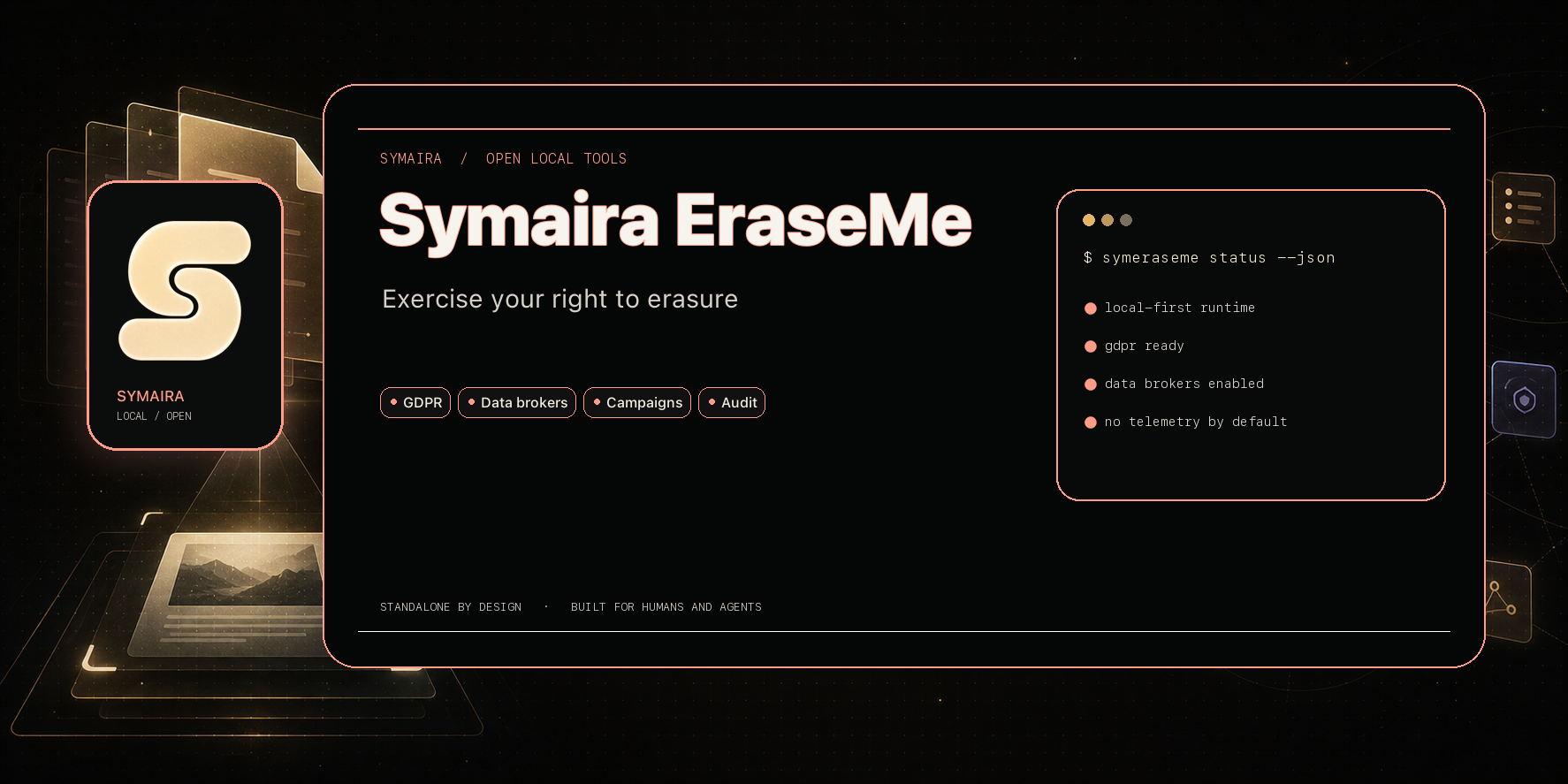
Accepted product direction — implementation pending: EraseMe remains an independent privacy product. Browse/Operate becoming optional Brain modules and credential UI moving to Brain must not introduce a mandatory Brain dependency into privacy workflows. See PB-2026-09-09.




Symaira EraseMe helps you exercise your GDPR/CCPA right to erasure against data brokers. It is a local-first Rust CLI with a native SwiftUI macOS app and an authenticated MCP JSON-RPC interface.
Current source tree: Rust-only CLI and native SwiftUI macOS app, version 0.17.0.
The 0.15 line is the first without Go sources and supports macOS on Apple Silicon
and Linux (amd64/arm64) only; 0.15.1 patched the bundled SQLite
(RUSTSEC-2026-0459), 0.16.0 added plan delete and a compact
get_dashboard_data default, and 0.17.0 improves read-only CLI output, command
help and secret-provider timeout cleanup. The Rust-only package layout
was introduced in the
v0.14.0 canary prerelease.
The historical v0.13.0 prerelease remains dual-backend, and v0.12.1 is the
last Go-only stable release. Check GitHub releases
for published versions and channels. The maintainer waived the seven-day
post-stable observation period and authorized Go-source retirement on 2026-10-12.
The Go implementation and module files are removed from this source tree;
frozen Go observations and their immutable source history remain for conformance.
CUT-004/CUT-005 technical acceptance and release gates are not waived.
Status: Beta. Core planning, event tracking, deadline handling, registry validation, inbox triage, reports, and the MCP/CLI contracts are implemented. Some broker-specific web flows still require manual review.
Product scope is Apple (macOS on Apple Silicon, iOS) plus Web. The current implementation ships the macOS app and CLI; this scope does not claim an existing iOS app or Web client. Linux remains supported for CLI/server use and CI.
| Platform | Current support |
|---|---|
| macOS arm64 (Apple Silicon) | Native app, CLI, PR parity and release gates |
| Linux amd64 / arm64 | CLI/server, native CI and release archives |
| iOS / Web | In product scope; no installable client shipped here |
| Windows, including ARM64 | Unsupported; no native CI or new release artifacts |
| macOS Intel | Unsupported; no native CI or new release artifacts |
Historical release assets and frozen platform observations stay immutable.
Windows-only source, native test harnesses and PowerShell helpers have been
removed (#1276);
frozen Windows captures under tests/fixtures/go-frozen/ stay as read-only
historical evidence. See #1274.
brew tap danieljustus/tap
brew install symeraseme
symeraseme version
Download the macOS arm64 or Linux amd64/arm64 archive for your chosen version from
GitHub releases.
Rust-only archives contain only the Rust CLI; no Go rollback binary
or legacy backend selector is distributed. The historical v0.13.0 prerelease
is dual-backend and its assets must remain unchanged; v0.12.1 is the last
Go-only stable release. Canary builds reach Homebrew only after stable promotion and the
release gates pass.
For a published Rust-only version, download its versioned macOS DMG from
GitHub releases.
It bundles only the Rust CLI/MCP server. The release workflow requires Developer
ID signing, notarization, stapling and attestation before publication. Local builds may be ad-hoc signed
and are not equivalent to that published artifact. Historical v0.13.0 assets
remain unchanged. No GUI Homebrew cask is configured.
The last pre-cutover implementation is preserved at the annotated Git tag
python-final. Existing installations should migrate their local data before
removing the old runtime:
symeraseme migrate \
  --source /path/to/old-state \
  --destination /path/to/rust-state \
  --dry-run
The migration is explicit, creates a backup before writing, never deletes the
source, and can resume from .migration-state.json. See
TROUBLESHOOTING.md for the full rollback procedure.
# Create an encrypted local identity profile
symeraseme init-profile

# Inspect the embedded broker registry
symeraseme registry validate
symeraseme brokers list --law GDPR

# Plan, review, and dry-run a campaign
symeraseme plan create --campaign initial --max 5
symeraseme plan show --campaign initial
symeraseme plan execute --campaign initial --dry-run

# Created a campaign by mistake? Delete it while nothing was sent
symeraseme plan delete --campaign initial --dry-run

# Track deadlines and view reports
symeraseme tick --dry-run
symeraseme generate-report
Destructive execution requires explicit consent. Review the plan first and use
symeraseme grant execute --ttl 3600 for a short-lived automation token.
Start the local authenticated HTTP server:
symeraseme mcp
# Default: http://127.0.0.1:8000
Use --host and --port to change the loopback endpoint. Non-loopback binds
require --allow-remote. Use --stdio when an MCP client needs
newline-delimited JSON-RPC over standard streams.
The token is generated on startup and written with restrictive permissions to
the configured data directory (mcp_token). Send it on every HTTP request as:
Authorization: Bearer <token>
Never put the token in source control, issue reports, shell history, or logs. The complete transport and tool contract lives in docs/mcp-contract.md.
The event store defaults to ~/.local/share/symeraseme/symeraseme.db; it never
falls back to a temporary directory in production. Configuration precedence is
built-in defaults, ~/.config/symeraseme/config.toml (or
$XDG_CONFIG_HOME/symeraseme/config.toml), the project .symeraseme.toml,
then environment variables. SYMERASEME_DATA_DIR selects
the base data directory, SYMERASEME_DB_DIR overrides only the database
directory, and SYMERASEME_ENCRYPT_DB accepts 1|true|yes|on or
0|false|no|off. Invalid values fail closed. When encryption is enabled, the
SQLite file is written as a standard Fernet envelope and decrypted only into a
private temporary directory during use; switching modes is atomic.
Credentials should be referenced through the canonical symvault:// form or a
platform secure store; resolved values are never logged. Provider-specific
configuration is consumed by the shared Rust LLM provider layer.
Requirements: Rust 1.98.0 (pinned in rust-toolchain.toml). The Rust build,
test suite and frozen-observation checks do not require Go. A full Xcode
installation is required for the macOS GUI.
# Prepare immutable producer history once, before the first test run
python3 scripts/prepare-frozen-history.py --fetch

# Rust CLI and frozen-observation conformance suite
make build-rust
make rust-gate
make parity

# Additional Rust acceptance gates (require cargo-llvm-cov and pinned Miri)
make coverage
make miri

# macOS app
make app-test
./app/SymairaEraseMe/build.sh

# Local development packaging example only; not a release-version claim
VERSION=0.17.0 ./scripts/package-dmg.sh
Use a full-history clone. Even then, squash merges and deleted feature branches
can leave pinned producer commits outside ordinary branch/tag history. The
explicit preparation above fetches only missing immutable producer objects;
it does not change the checkout, fixtures or recorded source identities.
Subsequent replay is offline with respect to that history. Without --fetch,
the preparation command only checks availability and fails if an object is missing.
make parity replays recorded Go observations through Rust without a Go
executable. Keep the frozen observations and their source-provenance checks
intact. make build, make test, make lint, make vet and make fmt-check
now run Rust tooling. make coverage enforces 80% project line coverage and
90% aggregate critical-code line coverage. make miri runs the pinned Rust
interpreter contract; it is not a substitute for native concurrency tests.
The old live-oracle Make targets are retired. Native platform, security and
release-artifact gates remain separate from the local make rust-gate.
Add a verified YAML broker entry under registry/brokers/, then run:
make build-rust
./build/rust/debug/symeraseme-rust registry validate
Do not fabricate endpoints or include personal data. The registry is embedded in the Rust CLI and is not rewritten by normal CLI operation.
crates/                 Rust CLI, core, and engine
rust-tests/parity/      Conformance suite and frozen Go observations
registry/               Broker/law/schema source data
skills/                 Agent skill bundle and workflow documentation
app/SymairaEraseMe/      SwiftUI macOS client
scripts/                 Build, packaging, and verification tools
Tags matching v* trigger .github/workflows/release.yml:
checksums.txt and the per-archive CycloneDX SBOMs.Stars on GitHub
Reverse engineer anything with agents, from app behavior down to native binaries.
@morlutoA skill pack for authorized reverse engineering, security research, and penetration testing that routes tasks to the right skill and sets up needed tools on demand. It covers API security assessment and Android APK analysis, among others.
 @zhaoxuya520
Gives an AI agent the step-by-step workflow a senior security analyst follows, covering when to use each technique, what to check first, how to run it and how to verify the result. Covers incident response, forensics, threat intelligence, malware analysis, penetration testing and red teaming.
 @mukul975
Agent skill + stdlib Python service to strip multi-vendor AI provenance marks from text and files, for privacy and hygiene on content you own. The skill is a thin client: it drives the machinery over HTTP, so the agent host needs no Python.
 @guillaumemeyer
Helps AI agents such as Claude Code remove personal data from data broker sites and request account deletion and opt-outs. Intended for users who want to reduce their online personal data footprint. Install it with the command on its page. It includes contribute-broker. Its skills do not fire on their own yet. Free and open source.
Is this plugin yours?
Claim it with GitHubSubmit a pluginPromote it