
AI & Agents
Plugin
builderio-builder-skills
Small, composable skills for your favorite agent.

Plugin Signal82/100Strong
maintained99
capable69
documented75
adopted78
Install on Claude Code
> /plugin marketplace add BuilderIO/skills> /plugin install builder-skills@builder-skills
Stats
4,528
Stars
227
Forks
Active
Maintenance
JavaScript
Language
MIT
License
4m ago
Last commit
3mo ago
Created
12h ago
Added
Repo: BuilderIO/skills
In this plugin
- skills
- agent-watchdog
- an
- efficient-fable
- efficient-frontier
- factory-babysit-pr
- factory-collect
- factory-human-digest
- factory-lookback
- factory-recover
- factory-review-prs
- factory-ship
- factory-watchdog
- factory
- plan-arbiter
- plow-ahead
- quick-recap
- read-the-damn-docs
- rewind
- stay-within-limits
- turn-into-app
- visual-edit
- visual-plan
- visual-recap
- webmcp
- commands
- MCP
What's inside
Skill(24 skills)
/agent-watchdogUse when asked to watch, babysit, audit, review, compare, or fix another agent's work from a Codex session ID, Claude Code session/transcript, chat/thread link, PR, branch, log, or pasted run summary. Monitor until the other agent is done or blocked, reconstruct what the user/anOpen and operate Agent-Native workspace apps through Dispatch MCP, with inline app surfaces, browser-session authentication, and current screen state./efficient-fableUse when running Claude Fable on codebase-heavy or token-heavy work and the user wants Fable to orchestrate research, coding, and testing while cheaper subagents do bounded heavy lifting.
- /efficient-frontier
- /factory-babysit-pr
- /factory-collect
- /factory-human-digest
- /factory-lookback
- /factory-recover
- /factory-review-prs
- /factory-ship
- /factory-watchdog
- /factory
- /plan-arbiter
- /plow-ahead
- /quick-recap
- /read-the-damn-docs
- /rewind
- /stay-within-limits
- /turn-into-app
- /visual-edit
- /visual-plan
- /visual-recap
- /webmcp
Command(1 command)
MCP(1 mcp)
README
Skills for agents
Small, composable skills for your favorite agent.
Quick install recommended skills
npx @agent-native/skills@latest add
See the full CLI docs below.
Skills At A Glance
/factory(experimental) - Configure connected sources, prompts, schedules, and delivery policies./factory-collect- Collect feedback, product telemetry, errors, and issues./factory-babysit-pr- Follow one authorized PR through checks and review./factory-review-prs- Review a PR queue with separate reply, approval, and merge criteria./factory-ship- Publish delivery work under configured verification and merge policies./factory-lookback- Find recurring signals and systemic fixes across a chosen time window./factory-human-digest(experimental) - Summarize work that still needs human judgment across configured sources./factory-watchdog- Find stalled delivery work and notify when a concrete next step is due./factory-recover- Resume interrupted work when its authorization and worktree are still valid.
/an- Open and operate Agent-Native apps beside the conversation./webmcp- Open web apps in the built-in browser and use MCP tools first./visual-plan- Turn text plans into rich visual plans./visual-recap- Turn diffs into interactive visual recaps./visual-edit- Open a running local app for visual editing./rewind- Recover recent local screen context through Clips Desktop./agent-watchdog- Audit another agent's work./plan-arbiter- Compare competing plans and choose a direction./plow-ahead- Keep working through ordinary ambiguity./efficient-fable- Orchestrate Fable with cheaper helper agents./efficient-frontier- Preserve high-cost models for judgment./stay-within-limits- Track usage limits before long-running work./quick-recap- End work with a clear status signal./read-the-damn-docs- Check authoritative docs before guessing./turn-into-app- Turn the current thread or a skill into a runnable Agent-Native app.
Skill Details
/factory
Experimental. Start with the Factory guide, then open the full Factory skill for agent instructions.
Factory is an experimental set of agent skills for turning feedback, product telemetry, errors, and delivery signals into policy-gated software changes. The modules can collect current reports, look back for recurring failures, and review or ship changes. Configure schedules and separate rules for fixing, replying, reviewing, approving, merging, deploying, and closing.
flowchart LR
    sources["Feedback and telemetry"] --> collect["/factory-collect"]
    sources --> lookback["/factory-lookback<br/>recurring patterns"]
    collect --> agent["Factory workflow"]
    lookback --> agent
    agent -->|"policy allows"| fix["Isolated fix<br/>checks and verification"]
    agent -->|"unclear or out of scope"| human["Human decision"]
    fix --> pr["Pull request"]
    pr -->|"approval and merge rules"| ship["Ship"]
    pr -->|"needs judgment"| human
    ship -->|"if allowed"| source["Reply or close source item"]
Configuration at a glance
This abbreviated example uses placeholder scopes and connected tools. Factory does not install these integrations or create the schedule for you.
version: 1
timezone: UTC

sources:
  - id: support
    provider: slack
    scope: channel-id
  - id: errors
    provider: sentry
    scope: organization/project

repositories:
  - id: app
    provider: github
    remote: example/project

workflows:
  collect:
    enabled: true
    sources: [support, errors]
    reply:
      mode: criteria
      require: [one missing detail blocks triage or verification]
      tone: warm and direct
      guidance: Ask one targeted question, then re-triage when an answer arrives.
  lookback:
    enabled: true
    schedule: monthly
    window: last 30 days
    sources: [support, errors]
    implement:
      mode: manual
  human-digest:
    enabled: true
    schedule: weekly
    window: last 7 days
    repositories: [app]
    sources: [support, errors]
    include: [pull-requests, issues, feedback, errors]
    granularity: balanced

skill_prompts:
  factory-ship: |
    Keep release summaries concise and link the verified change.
  factory-human-digest: |
    Group repeated UX concerns, but include a link to every source item.
Each Factory skill reads its own optional prompt entry as additional project guidance. Prompt text cannot authorize an action that its separate policy blocks.
The configuration reference explains the available YAML fields, source patterns, policies, and host limitations.
/factory-collect
Start with the Factory guide, then read the full collect skill.
/factory-babysit-pr
Start with the Factory guide, then read the full PR babysitting skill.
/factory-review-prs
Start with the Factory guide, then read the full PR review skill.
/factory-ship
Start with the Factory guide, then read the full shipping skill.
/factory-lookback
Start with the Factory guide, then read the full lookback skill.
/factory-human-digest
Experimental. Start with the Factory guide, then read the full human digest skill. It defaults to all configured human-pending work from the last 7 days at balanced detail; ask for a narrower source type, another date range, or brief or detailed output.
/factory-watchdog
Start with the Factory guide, then read the full watchdog skill.
/factory-recover
Start with the Factory guide, then read the full recovery skill.
/an
Open a granted Agent-Native app in the host's inline MCP App or built-in browser
surface, then keep the agent connected to the app's live UI and screen state.
For example, run /an slides to open Slides, sign in in that browser
surface, and then ask the agent to create or update the deck. Focused requests
such as make this bigger use the Slides selection state and a bounded
readback-verified edit.
The plugin registers Dispatch MCP automatically for Claude and Codex at
https://dispatch.agent-native.com/mcp. In ChatGPT, add that same URL as
an OAuth custom connector. The host may need a reload or connector rescan after
installation.
/webmcp
Open a requested URL in the host's built-in browser and use the page's MCP or
WebMCP tools before browser UI automation for app communication or edits. For
example, run /webmcp slides.agent-native.com make me a new deck about onboarding
to open Slides and complete the request in that tab. The skill waits for the
user to sign in when needed, then calls the page's window.__agentNativeWebMcp
helper from the host's JavaScript evaluator (or a host WebMCP bridge when one
is exposed): one screen read, one smallest mutation, one readback. If neither
is available, it stops before a state-changing click or type fallback and
reports the limitation.
/visual-edit
Open a running local app in Design as URL-backed iframe screens for visual inspection, route-state exploration, and source-backed editing.
Unlike a static mockup, the canvas stays connected to the app's real routes and
the local bridge. Use /visual-edit when a UI needs to be reviewed or changed
in context, including responsive states and multi-screen flows.
Install the skill and Design connector from your app repository:
npx @agent-native/core@latest skills add visual-edit
Try it on one screen, several routes, a complete flow, or responsive sizes:
/visual-edit the dashboard at desktop size/visual-edit compare the dashboard, settings, and reports pages side by side/visual-edit the onboarding flow from welcome through account created/visual-edit show the dashboard at desktop, tablet, and mobile widths
Read the public Visual Edit README for a hands-on example, and the Agent-Native guide for the full workflow.
/rewind
Use local Clips Rewind screen memory to recover a recent moment: what was said, what appeared on screen, or what happened just before the current task. It searches bounded local chapters, transcripts, OCR, and frames first; it is not a hosted recording archive and does not upload raw local media by default.
Rewind requires macOS, the signed
Clips Desktop app, and a compatible
agent with the local clips-screen-memory MCP connection. If you invoke Rewind
before installing Clips, the skill asks permission to open the official install
flow instead of silently installing capture software. Follow the Rewind setup
and first-test guide.
/visual-plan
Turn ordinary text plans into rich interactive visual plans with diagrams, file maps, annotated code, open questions, and UI/prototype review when useful.
Solves for plans that are too important to bury in chat. The output is scannable, commentable, and intuitive enough for a human to approve before code changes start.
Visual plans are MDX, customizable with your own components, and are viewed with the Agent-Native plans app. In local-files mode, /visual-plan writes and serves MDX locally through a localhost bridge instead of uploading plan content to the hosted database. Source here
/visual-recap
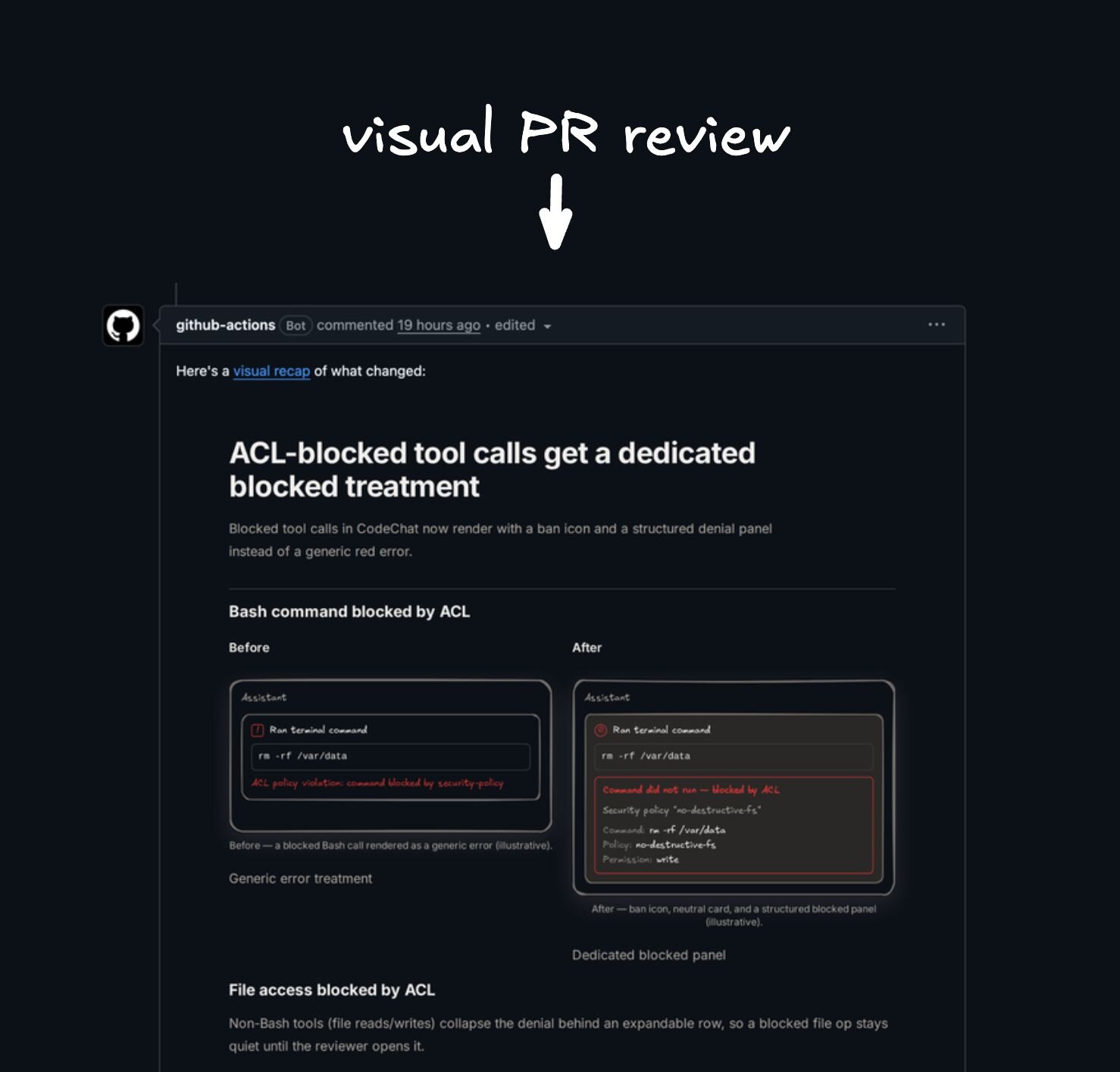
Turn a branch, commit, or PR diff into an interactive visual recap with annotated diffs, diagrams, API/schema summaries, file maps, UI state summaries, and focused review notes.
Solves for diffs that hide the shape of the change. Reviewers can understand contracts, architecture moves, schema changes, and UI impact before diving into raw line-by-line review.
Visual recaps are MDX, customizable with your own components, and are viewed with the Agent-Native plans app. Source here
You can also install a GitHub action for these to be automatically generated for every PR with
npx @agent-native/skills@latest add
/agent-watchdog
Audit another agent's work from a Codex session, Claude Code transcript, PR, branch, or run summary.
File tree
FAQ
builderio-builder-skills is a Claude Code plugin with 24 hand-picked skills for ai & agents work, indexed on Flowy. Install it with the command on its page. It includes agent-watchdog, an, efficient-fable. Its skills do not fire on their own yet. Request auto-invocation to have Flowy route them as you prompt. Free and open source.
- What is builderio-builder-skills?
- Small, composable skills for your favorite agent.
- How do I install builderio-builder-skills?
- Run these in Claude Code: /plugin marketplace add BuilderIO/skills then /plugin install builder-skills@builder-skills. Then prompt normally.
- Does builderio-builder-skills auto-invoke its skills?
- Not yet. It is indexed on Flowy as a plain plugin. Request auto-invocation on its page and Flowy will route its skills for you as you prompt.
- Is builderio-builder-skills free?
- Yes. Flowy is free and open source, with nothing gated. You can read every skill in full before you install.
Is this plugin yours?
Claim it with GitHubSubmit a pluginPromote it