
Agent Orchestration
Plugin
pi-herdsman
The orchestration layer between Pi and herdr.

Plugin Signal62/100Solid
maintained100
capable14
documented75
adopted49
Install
$ npx -y skills add boadij/pi-herdsman --agent claude-code
Stats
197
Stars
18
Forks
Active
Maintenance
TypeScript
Language
Apache-2.0
License
40m ago
Last commit
1mo ago
Created
2h ago
Added
What's inside
Badges




README
Pi Herdsman 🐏
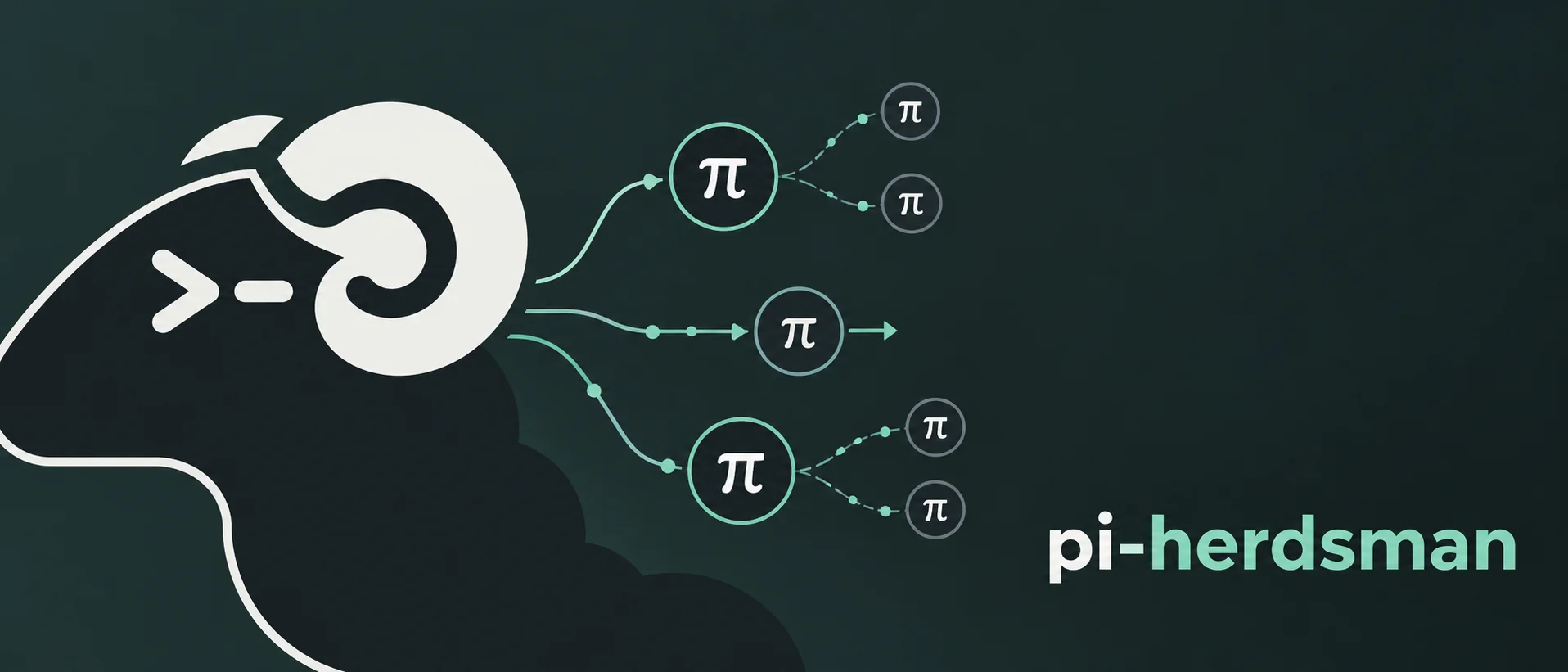
The orchestration layer between Pi and herdr.
Pi Herdsman turns independent Pi sessions into a coordinated agent system, from one background Agent to parallel branch-based project work. Pi owns each coding-agent conversation; herdr owns processes, panes, workspaces, and worktree placement; Herdsman connects them through delegation, ownership, supervision, and project orchestration.
Demo
Realtime live demo of a manager > lead > agent workflow.
What Pi Herdsman gives you
- Background Agents. Delegate bounded work without blocking the Lead conversation.
- Parallel and nested delegation. Run independent work concurrently and let explicitly enabled Agents delegate their own bounded subtasks.
- Project orchestration. A Manager coordinates durable branch-based work across independent Leads and their Agent trees.
- Direct supervision. Chief, Manager, Lead, and Agent responsibilities stay explicit instead of collapsing into one global controller.
- Owned usage visibility. Inspect Pi-native token usage and cost for the current session and its transitively owned managed Agents. An active Manager also sees the Leads in its current durable project assignments and their owned Agent trees.
- Your workflow stays yours. Bring your own Agent definitions, models, tools, skills, extensions, and development process.
Quick start
On Linux or macOS, install the released Pi, herdr, and Pi Herdsman stack:
curl -fsSL https://raw.githubusercontent.com/boadij/pi-herdsman/main/install.sh | sh
See Getting started for the tested runtime baselines and how the bootstrap handles newer Pi and herdr versions.
If you already manage Pi and herdr yourself:
pi install npm:pi-herdsman
herdr integration install pi
Start herdr in your project, then start Pi inside its pane:
herdr
pi
Delegate naturally:
Use scout to inspect the authentication flow.
The Agent runs asynchronously while the Lead conversation stays available. Open the human Agent-management surface at any time with:
/agents
It also exposes Session stats for the current Pi session and its owned Agent sessions; in active Manager mode, it includes current assigned project Leads and their owned Agent trees.
See Getting started for prerequisites, configuration, observability, and the complete first-use path.
From one Agent to a project
A normal Pi session is a Lead. It owns the Agents it delegates:
You ↔ Lead
      ├─ Agent
      │  └─ Agent
      └─ Agent
For independent project work, an eligible Lead can enter Manager mode. Managers coordinate Leads instead of implementing through Agents themselves:
You ↔ Manager
      ├─ Lead → Agents
      └─ Lead → Agents
A Chief is an optional runtime-wide supervisor above Managers. Without an active Manager for a project, Chief can directly supervise its ordinary Leads.
The important boundaries are:
supervision: Chief → Manager → Lead
ownership: Lead → Agent → Agent
Project work is durable by Git branch. It does not belong to the Manager session that happened to start it, so assignments can be paused, resumed, or retired across Manager turnover.
Manager-created project Leads are dedicated Managed Lead sessions: identity stays
with the exact Pi session, while only a current project assignment authorizes
execution. Unavailable or retired assignments never enable ordinary Lead tools.
Use native Pi /fork or /clone for independent ordinary continuation with copied
history, not a separate checkout or fresh process configuration. See
Project orchestration.
See Coordination for the mental model and Project orchestration for the Manager workflow.
Choose your next step
| Goal | Start here |
|---|---|
| Install and delegate your first task | Getting started |
| Run independent branch-based project work | Project orchestration |
| Understand roles, ownership, and authority | Coordination |
| Customize Agents | Agent definitions |
| Build against the model-facing tools | Coordination API |
| Deploy an SSH-ready environment | Container deployment |
| Contribute to Pi Herdsman | Contributing |
Community
Questions, workflows, examples, and ideas are welcome in GitHub Discussions.
For reproducible bugs and concrete actionable work, use GitHub Issues.
License
File tree
FAQ
pi-herdsman is a Claude Code plugin with 1 hand-picked skill, indexed on Flowy in the Agent Orchestration category. Install it with the command on its page. It includes agent-definitions. Its skills do not fire on their own yet. Request auto-invocation to have Flowy route them as you prompt. Free and open source.
- What is pi-herdsman?
- The orchestration layer between Pi and herdr. Pi Herdsman turns independent Pi sessions into a coordinated agent system, from one background Agent to parallel branch-based project work.
- How do I install pi-herdsman?
- Run these in Claude Code: npx -y skills add boadij/pi-herdsman --agent claude-code. Then prompt normally.
- Does pi-herdsman auto-invoke its skills?
- Not yet. It is indexed on Flowy as a plain plugin. Request auto-invocation on its page and Flowy will route its skills for you as you prompt.
- Is pi-herdsman free?
- Yes. Flowy is free and open source, with nothing gated. You can read every skill in full before you install.
Is this plugin yours?
Claim it with GitHubSubmit a pluginPromote it